

Tahajjud is one of the most special voluntary prayers a Muslim can perform. It is a beautiful sign of sincere faith, a quiet moment when a believer leaves their bed to stand before Allah (SWT) and speak to Him through du‘a. In these peaceful hours of the night, Allah’s mercy is near, and prayers are answered. In this guide, we’ll explain what Tahajjud prayer is, the best time to pray it, how to perform tahajjud prayer step by step, how many rakat in tahajjud, and how to end it properly with Witr, based on the Qur’an and Sunnah.
What Is Tahajjud Prayer?
Tahajjud is a voluntary (Nafil) night prayer performed after a period of sleep — the sleep is what distinguishes it from Qiyam al-Layl, the broader term many scholars use for any night prayer, slept or not. The name comes from the Arabic root hajada (هجد), meaning “to sleep at night”; the verb form tahajjud means to deliberately give up that sleep for the sake of worship. This distinction matters practically: someone who stays awake praying straight through from Isha without sleeping first is technically performing Qiyam al-Layl, while Tahajjud specifically describes waking from sleep to pray. In everyday usage the two terms are often used interchangeably, but the linguistic root points to the deeper meaning — a prayer that costs the worshipper something (rest) as an act of devotion.
When to Pray Tahajjud Prayer?
The Tahajjud window opens after Isha prayer and closes at Fajr, but not every hour in that window carries equal weight. Scholars consistently point to the final third of the night as the most rewarded time, based on Allah’s instruction in Surah Al-Isra to rise in part of the night for additional prayer as a means of reaching a praised status (Quran 17:79), and the description in Surah Al-Muzzammil of night worship as spiritually weightier and better suited to focused recitation (Quran 73:1–6).
وَمِنَ ٱلَّيْلِ فَتَهَجَّدْ بِهِۦ نَافِلَةًۭ لَّكَ عَسَىٰٓ أَن يَبْعَثَكَ رَبُّكَ مَقَامًۭا مَّحْمُودًۭا
Translation: And rise at ˹the last˺ part of the night, offering additional prayers, so your Lord may raise you to a station of praise (Surah Israa-17-79)
And Prophet Muhamed(PBUH) says:
“If anyone is afraid that he may not get up in the latter part of the night, he should observe a witr in the first part of it; and if anyone is eager to get up in the last part of it he should observe a witr at the end of the night, for prayer at the end of the night is attended by the angels, and that is most excellent.”
| Segment | Approximate Window | Description |
|---|---|---|
| First third | Just after Isha | Suitable for those who fear they won’t wake later |
| Middle third | Mid-night | A balanced option for most schedules |
| Last third | Ending at Fajr | The most rewarded time, described in Hadith as when Allah’s mercy is nearest |
What time can Tahajjud be prayed?
To make a long story short, Tahajjud is prayed any time after Isha and befor Fajir, better to be late at night after you sleep.
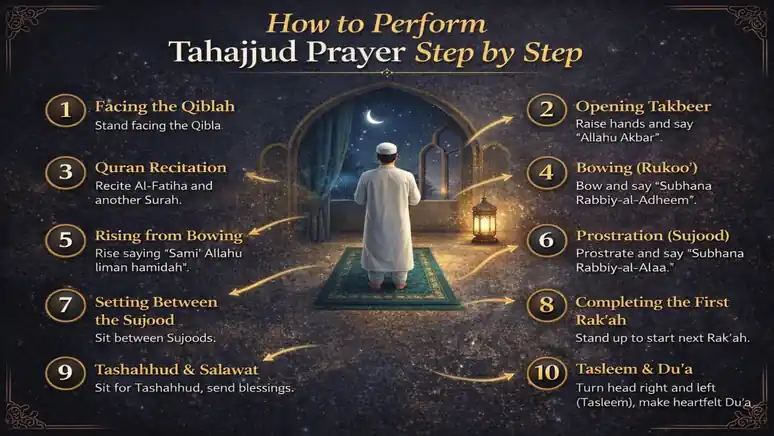
How to Pray Tahajjud? Step-by-Step Guide
Tahajjud is prayed in sets of two rak’ahs at a time, performed between Isha and Fajr after waking from sleep. To begin, stand facing the Qiblah with a sincere intention (niyyah) and full focus of heart (Khushu’). Each set opens with Takbeer, followed by recitation of Al-Fatiha, Rukoo’, standing, and two Sujood — then Tasleem to close the set. Repeat for as many sets as you wish, then seal the night with one rak’ah of Witr.
The Prophet Muhammad ﷺ said:
Deeds are to be judged only by intentions, and a man will have only what he intended
Step 1: Facing the Qiblah
Stand facing the Qibla with your feet shoulder-width apart.
Step 2: The opening Takbeer
Raise your hands and say “Allahu Akbar” (Allah is the greatest) to begin the prayer. Place your right hand over your left above your chest.
Step 3: Quran recitation
Recite Surah Al-Fatiha (the opening chapter of the Quran), followed by whatever you can recite from the Quran.
Step 4: Bowing
Bow (Rukoo’) by saying “Allahu Akbar” and place your hands on your knees. Say “Subhana Rabbiy-al-Adheem” (Glory be to my Lord Almighty) at least three times while bowing.
Step 5: Rising from bowing
Rise from the bowing position and stand upright while saying, “Sami’ Allahu liman hamidah” (Allah hears those who praise Him), followed by “Rabbana lakal hamd” (O our Lord, to You is the praise).
Step 6: Prostration
Prostrate (Sujood) by saying “Allahu Akbar” and place your forehead, nose, palms, knees, and toes on the ground. Say “Subhaana Rabbiy-al-A‘laa” (Glory is to my Lord, the Most High) at least three times.
And this is the closest anyone can get to Allah, so we were encouraged to do duaa:
Allah’s Messenger (ﷺ) said:
The closest that the slave comes to his Lord is when he is prostrating, so invoke Allah much (in prostration)
Take your time here to make du‘a from your heart.
Step 7: Setting between the two prostrations
Sit up briefly while saying “Allahu Akbar.” Then return to Sujood, repeating “Subhaana Rabbiy-al-A‘laa” at least three times.
Step 8: Completing the First Rak‘ah
Rise from the prostration and stand up, saying “Allahu Akbar.” Now you finished the first Rakaa.
Step 9: Start the next Rakaa!
Begin the second Rakaa and repeat steps 3–7. (recitation, rukoo‘, standing, and sujood)
Step 10: Tashahhud
After completing two Rakaas, sit and recite the Tashahhud (At-tahiyyatu lillah, was-salawaatu wat-tayyibaat. As-salaamu ’alayka ayyuhan-Nabiyyu wa rahmat-Ullahi wa barakaatu. As-salaamu ’alayna, wa ’alaa ‘ibaadi-llahis saaliheen. Ashhadu alla ilaha illallah wa ashhadu anna muhammadan ‘abduhu wa rasuluhu.
Step 11: Send Salawat Upon the Prophet ﷺ
Recite the Salat Ibrahimiyyah, sending peace and blessings upon Prophet Muhammad ﷺ by reciting: “Allahumma Salli ‘ala Muhammadin wa ‘ala aali Muhammadin, kama sallaita ‘ala Ibrahima wa ‘ala aali Ibrahima innaka Hamidum-Majeed. Allahumma barik ‘ala Muhammadin wa ‘ala aali Muhammadin kama barakta ‘ala Ibrahima wa ‘ala aali Ibrahima innaka Hameedum-Majeed”.
Step 12: Make Supplications
It is highly recommended to recite some Sunnah du’as (supplications) at this point.
Step 13: Tasleem
Conclude the prayer by turning your head to the right and then to the left, saying “Assalamu alaikum wa rahmatullah” each time.
Step 14: After Tahajjud: Make Du‘a
After completing your prayer, make heartfelt supplications to Allah. This is a powerful time for Du’a, as the Prophet Muhammad (PBUH) said:
The closest that the Lord comes to the slave is in the last portion of the night. So, if you can be among those who remember Allah in this hour, then be among them
Now, after clearing how to perform tahajjud prayer, it’s time to answer the question: how many rakats for tahajjud?
Read Also: Dua For Last 10 Days of Ramadan

How Many Rakat in Tahajjud Prayer?
There is no fixed number of rak‘ahs for Tahajjud prayer for those asking how many rakat in Tahajjud. However, following the Sunnah of the Prophet Muhammad ﷺ, it is commonly recommended to pray 11 or 13 rak‘ahs, including Witr.
1. How to Pray 4 Rakat Tahajjud?
Following the step-by-step instructions given before, just repeat the set another time after finishing the first two rakaat.
It is advisable to have a brief set between each 2 set of rakaat.
2. How to Pray 8 or 12 Rakat Tahajjud?
Simply follow the same method:
- Pray two rak‘ahs at a time
- End each set with Tasleem
- Repeat until you reach 8 or 12 rak‘ahs
Every two sets of rakaat should be separated by a short set.
General Rule for Tahajjud Prayer
When praying Tahajjud, it is prayed in an even number of Rakaat, in sets of 2.
Ibn ‘Umar رضي الله عنه narrated that the Prophet ﷺ said:
The Salat during the night and the day is two and two
3. How to Pray 13 Rakat Tahajjud?
Now it’s clear, just do one more witr rakaa after Tahajjud.
simply:
- Pray 12 rak‘ahs of Tahajjud (in sets of two)
- Then finish with one rak‘ah of Witr
📖 Deepen Your Islamic Knowledge
Learn Islamic Fiqh, Prayer rules, and Quran with certified scholars online.
Join 1,000+ students from the US · First class free
How to Pray Witr After Tahajjud?
After explaining what Tahajjud is, how to perform tahajjud and how many rakats, let’s explain how to pray Witr in Tahajjud.
Witr is an odd-numbered Sunnah prayer, usually performed after Tahajjud, and it’s often short but holds great reward.
How to Pray Witr Prayer
Witr can be prayed as one rak‘ah (most common) or more, but one rak‘ah is sufficient.
In that rak‘ah:
- Recite Surah Al-Fātiḥah
- Follow it with Surah Al-Ikhlāṣ (or any other short surah)
- Complete the rak‘ah with Rukū‘ (bowing) and Sujūd (prostration)
- Sit for Tashahhud
- End the prayer with Tasleem
You may also make du‘a during or after the prayer, especially in the quiet hours of the night.
Is Witr Necessary After Tahajjud?
Both Witr and Tahajjud are Sunnah, so they are not an obligatory prayer, but praying them is a sign of Sincerity, and following Sunnah, Witr should be after Tahajjud.
Learn Tahajjud the Right Way Through Islamic Studies:
Mubarek Academy is a reliable source for Islamic education when you get to the end of your hunt for genuine information, particularly answers to queries like how many rakat in Tahajjud. Mubarek Academy is an Islamic school devoted to fostering character, religion, and knowledge of the Quran and Sunnah. The academy assists students of all ages in strengthening their relationship with Allah via the use of trained scholars, organized courses, and a student-centered methodology. Mubarek Academy empowers Muslims all around the world to follow Islam with assurance, clarity, and sincerity in their everyday lives by fusing traditional research with contemporary teaching techniques, from fundamental Islamic studies to helpful advice on worship.
Learn Tahajjud the Right Way with Mubarek Academy
Conclusion:
In conclusion, the Tahajjud prayer stands as a profound spiritual anchor, offering a unique opportunity for intimacy with Allah (SWT) during the serene final third of the night. Whether you perform the minimum two rakats or follow the prophetic Sunnah of eleven to thirteen, the essence lies in sincerity and Khushu. By closing your night with the Witr prayer, you fulfill the Sunnah and solidify your devotion. Ultimately, Tahajjud is not just a ritual; it is a transformative practice that brings peace, clarity, and answered supplications to every believer.
Frequently Asked Questions
How to get up for Tahajjud?
Set an alarm for the last third of the night, make Wudu before sleeping so you’re ritually ready upon waking, and make a sincere intention before bed. Sleeping early gives your body enough rest to rise without excessive difficulty. Above all, ask Allah directly for the strength and sincerity to wake, since waking itself is a gift from Him.
Can Tahajjud be prayed before sleeping?
Yes, prayer performed before sleeping is valid, but scholars classify it as Qiyam al-Layl rather than Tahajjud in the strict linguistic sense, since Tahajjud specifically means rising after sleep. The reward for night prayer applies either way, but Tahajjud carries added virtue precisely because it requires overcoming the difficulty of leaving a warm bed.
Can Tahajjud be prayed every night?
Yes, Tahajjud can and ideally should be prayed every night. It was a consistent practice of the Prophet Muhammad ﷺ, and scholars describe regular night prayer, however brief, as more beloved to Allah than an inconsistent one performed at length occasionally. Even two rak’ahs nightly builds a lasting habit of closeness to Allah.
What if I wake up late for Tahajjud?
Pray whatever time remains before Fajr enters, even if only a few minutes are left. Two brief rak’ahs prayed sincerely still carry the full reward associated with Tahajjud. There’s no minimum waiting period required; what matters is intention and sincerity, not the exact hour within the Isha-to-Fajr window.
How to get up for Tahajjud consistently?
Consistency comes from habit, not willpower alone. Keep a fixed, early sleep schedule, avoid heavy meals or screens close to bedtime, and maintain regular Dhikr throughout the day so waking for prayer feels natural rather than forced. Starting with just two rak’ahs nightly builds the habit gradually before increasing.
Can Tahajjud be prayed in 2 Rakat only?
Yes, two rak’ahs is the accepted minimum for Tahajjud; there is no fixed maximum, and the Prophet ﷺ himself prayed varying numbers on different nights. It’s recommended to close the night with at least one rak’ah of Witr afterward, which seals the night’s voluntary prayers.
الأستاذ أحمد محمود عبد العزيز معلم متخصص في تدريس القرآن الكريم واللغة العربية للناطقين بها وبغيرها. كاتب وباحث مدونات مجاز في رواية حفص عن عاصم ومتني الجزرية وتحفة الأطفال. تتركز كتاباته على تقديم محتوى لغوي وقرآني مؤصل وموثق من قِبل العلماء، مستنداً إلى خبرته العملية الواسعة لمساعدة الطلاب حول العالم على فهم أحكام التجويد وأسرار اللغة العربية بطريقة صحيحة ومبسطة.



Kalim Ahmed
18 Feb, 2026It is very much useful for all especially for the beginners.. A great effort, Alhamdulillah!