
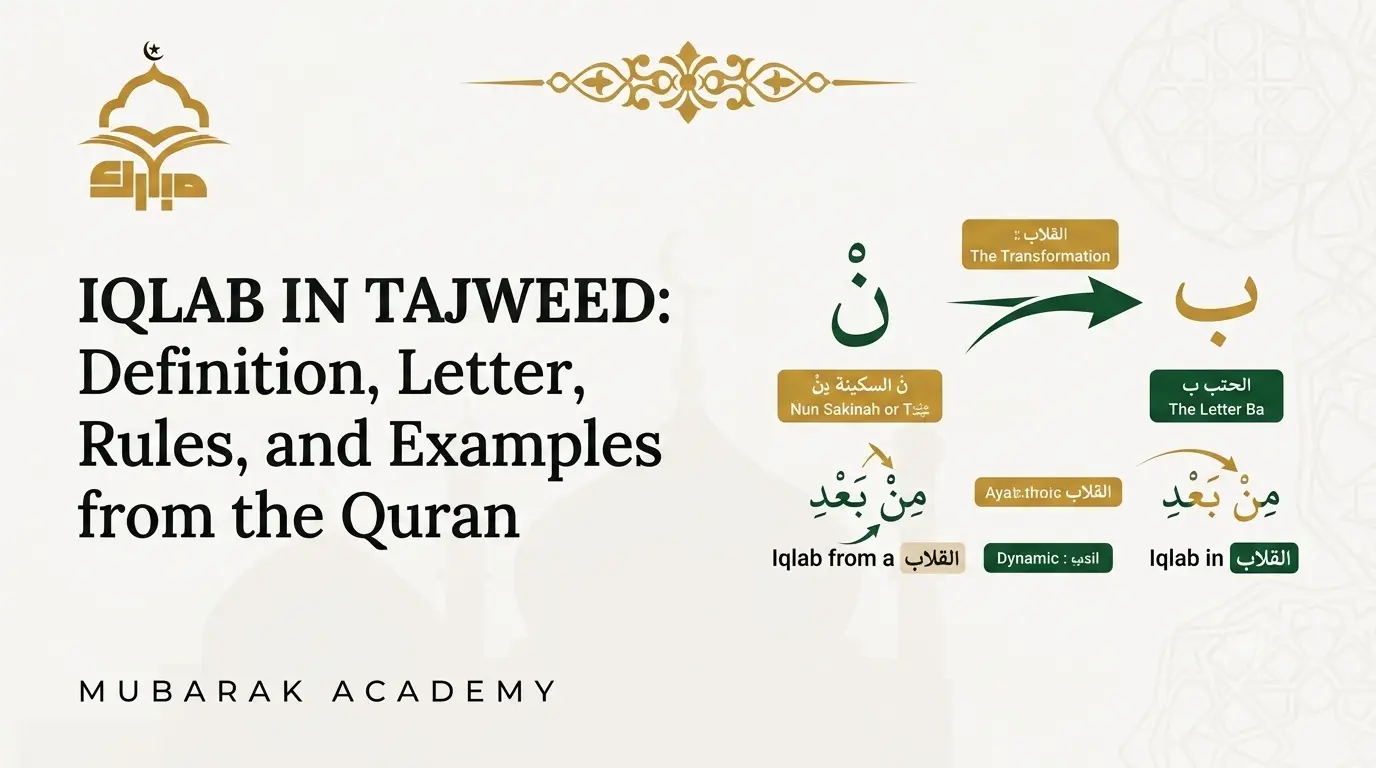
Iqlab (الإقلاب) is one of the four rules of Noon Sakinah and Tanween. It applies when a Noon Sakinah (نْ) or Tanween (ـًـٍـٌ) is followed by the letter Ba (ب), converting the Noon into a Meem-like sound with a full Ghunnah of two counts. Unlike the other three rules, the Noon is not hidden or merged. It is converted entirely.Among all the rules that govern Quranic recitation, Iqlab stands out for exactly this reason: it is the only rule where a letter is fully converted into a different sound. This guide covers its Arabic and English meaning, how to pronounce it correctly, its positions in the Quran, real Quranic examples, and how it differs from Ikhfa and Idgham.
What Is Iqlab in Tajweed?
Iqlab in Tajweed is the conversion of a Noon Sakinah (نْ) or Tanween (ـًـٍـٌ) into a Meem sound held inside the mouth with a full Ghunnah of two counts, when followed by the letter Ba (ب). The Noon is not hidden as in Ikhfa, nor merged as in Idgham. It is converted into an entirely different sound.
The word Iqlab (إقلاب) comes from the Arabic root qalaba (قَلَبَ), meaning to flip or to convert — a name that precisely describes the rule. The Noon is not hidden, as in Ikhfa, nor merged as in Idgham. It is converted into an entirely different sound.
This rule was codified and transmitted by the scholars of Tajweed science, most comprehensively by Imam Ibn al-Jazari (رحمه الله) — the foremost authority on Quranic recitation — in his celebrated text Al-Muqaddimah al-Jazariyyah. His classification of the four rules of Noon Sakinah remains the standard taught in every Tajweed curriculum worldwide.
Iqlab Meaning in Arabic
Iqlab (إقلاب) comes from the Arabic root qalaba (قَلَبَ), meaning to flip, turn over, or convert something from one state into another. Classical Arabic lexicons use this root to describe any act of transformation where the original form is replaced entirely by a new one. In Tajweed, the name is precise: the Noon is not modified or concealed, it is flipped into a different letter sound altogether.
Iqlab Meaning in English
In English, Iqlab is most accurately translated as conversion or substitution. Neither “hiding” nor “merging” captures it, because Iqlab is the only rule among the four where the original sound is replaced entirely. Some translations use “turning” or “flipping,” which reflect the Arabic root faithfully. What all translations agree on is the core idea: one sound goes in, a different sound comes out.
The Letter of Iqlab in Tajweed: Ba (ب) Only
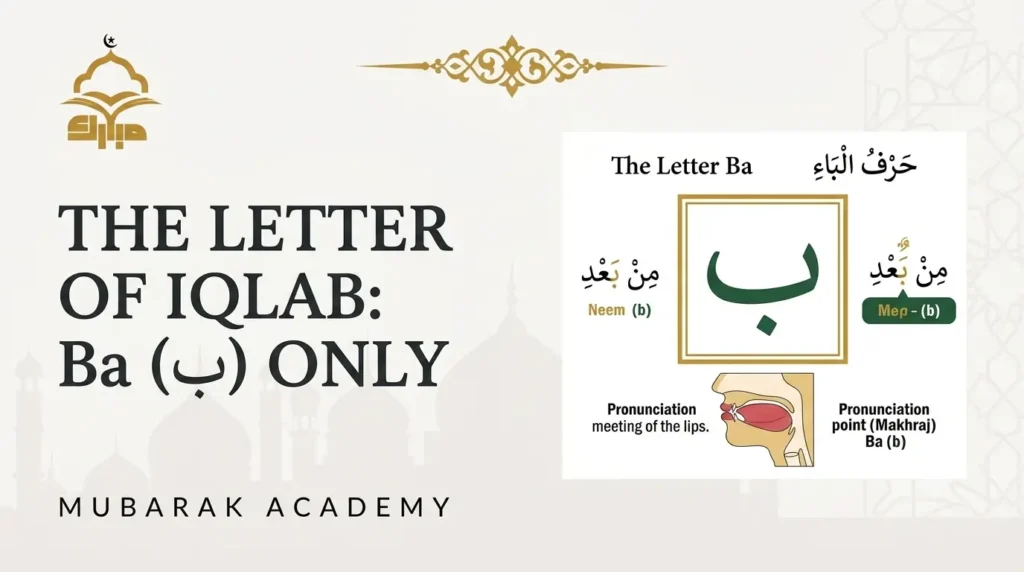
Unlike Ikhfa, which has fifteen triggering letters, or Idgham, which has six, Iqlab has exactly one letter: Ba (ب). This makes Iqlab the most straightforward of the four Noon Sakinah rules to identify in the Quran.
Whenever a Noon Sakinah or any form of Tanween appears directly before a Ba — whether within one word or between two consecutive words — Iqlab applies without exception.
In most printed Mushafs, this position is marked by a small Meem (م) written above the Noon Sakinah or near the Tanween. This notation alerts the reciter before they reach the word, and is used consistently across standard Quran editions including the Hafs an Asim recitation.
How to Pronounce Iqlab Correctly?
Correct pronunciation of Iqlab requires three precise and sequential actions:
- Close the lips lightly — positioning them as if preparing to pronounce Meem (م), without completing the sound.
- Suppress the Noon entirely — the Noon Sakinah or Tanween must not appear in the output at all.
- Apply a full Ghunnah of two counts — the nasal resonance from the nasal passage (al-Khayshoom, الخيشوم) must be held for two full beats before transitioning to the Ba.
The most common beginner mistake is partially pronouncing the Noon before initiating the Ghunnah. This produces a hybrid sound that constitutes a Tajweed error. The Noon must be fully replaced from the first moment — not reduced, not faded — replaced.
This Meem positioning is not arbitrary — it is the same articulation used in [the rules of Meem Sakinah], which students should study alongside Iqlab.
The Three Positions of Iqlab in the Quran:
1. Iqlab Within a Single Word
This occurs when the Noon Sakinah and Ba appear together inside the same word. It is the least frequent position.
- أَنبِيَاء (Anbiya — prophets) — Noon Sakinah followed by Ba within one word. Found in Surah Al-Baqarah (2:61) and throughout the Quran.
- يَنبُوعًا (Yanbu’an — a spring) — Noun Sakinah and Ba within a single word. Surah Al-Isra (17:90).
2. Iqlab Between Two Separate Words
The most common occurrence. The Noon Sakinah appears at the end of one word, and the Ba begins the next.
- مِن بَعْدِ (min ba’di — after) — The Noon Sakinah on min (مِنْ) is followed by Ba at the start of ba’di. This exact combination appears dozens of times across the Quran.
- مَن بَخِلَ (man bakhila — whoever is miserly) — Surah Al-Hadid (57:24).
3. Iqlab Between Tanween and Ba:
When a word ends with Tanween (double damma ـٌ, double kasra ـٍ, or double fatha ـً) and the following word begins with Ba, Iqlab applies to all three Tanween forms.
- سَمِيعٌ بَصِيرٌ (Sami’un Baseer — All-Hearing, All-Seeing) — Tanween on Sami’un followed by Ba on Baseer. Found in Surah Al-Hajj (22:75) and Surah An-Nisa (4:58).
- خَبِيرٌ بَصِيرٌ (Khabirun Baseer — All-Aware, All-Seeing) — Surah Fatir (35:31).
- صُمٌّ بُكْمٌ (summun bukmun — deaf, mute) — Surah Al-Baqarah (2:18), a classic training verse.
Note that the Ba itself is a heavy letter in certain contexts — understanding [Tafkheem and Tarqeeq] will help you recite the Ba after Iqlab with its correct weight.
Ghunnah in Iqlab: Why It Is Mandatory?
Ghunnah in Tajweed (الغُنَّة) — the nasal resonance produced from the nasal passage — is not optional in Iqlab. A recitation of Iqlab without Ghunnah is classified as Lahn Khafi (لحن خفي) — a hidden mistake that does not invalidate the prayer but falls below the standard of correct Tajweed recitation.
The duration of the Ghunnah in Iqlab is two counts (harakatan) — the same as Idgham with Ghunnah and Ikhfa. During this Ghunnah, the lips are in the Meem position — lightly closed, not pressed — while all airflow passes through the nasal cavity. No sound escapes through the mouth during this phase.
This consistency of Ghunnah duration across three of the four rules is intentional in classical Tajweed pedagogy. It allows students to learn the nasal quality once and apply the same breath control across Idgham, Iqlab, and Ikhfa.
Iqlab vs. Ikhfa vs. Idgham: Key Differences
Students frequently confuse these three rules because all three involve a suppressed or altered Noon. The table below clarifies the distinctions:
| Feature | Iqlab | Ikhfa | Idgham |
|---|---|---|---|
| Triggering letters | Ba (ب) — 1 letter | 15 letters | 6 letters: ي ر م ل و ن |
| Effect on Noon | Converted to Meem sound | Hidden (not converted) | Merged into next letter |
| Lips during Ghunnah | Closed (Meem position) | Open | Depends on letter |
| Ghunnah duration | 2 counts | 2 counts | 2 counts (with Ghunnah letters); absent otherwise |
| Occurs within one word? | Yes | Yes | No — between two words only |
| Mushaf marker | Small Meem (م) | Sometimes a small symbol | No special marker |
The critical distinction between Iqlab and Ikhfa: in Iqlab, a genuine phonetic conversion takes place — the Noon becomes a Meem. In Ikhfa, the Noon is merely hidden while retaining its own articulation point (Makhraj), producing a partial nasal quality without changing identity.
Common Mistakes in Iqlab Recitation:
- Partially pronouncing the Noon: The most widespread error. The reciter produces a faint Noon sound before the Ghunnah. The Noon must be suppressed entirely from the first moment — not faded, not reduced.
- Absent or shortened Ghunnah: Some reciters apply the correct Meem position but hold it for less than two counts. The Ghunnah must be clear, nasal, and exactly two beats.
- Pressing the lips too firmly: The lips should be lightly closed in the Meem position. Pressing them with force changes the tonal quality of the Ghunnah and may produce an audible Meem release, which is incorrect.
- Applying Iqlab to the wrong Noon type: Iqlab applies only to Noon Sakinah (نْ) and Tanween — not to a regular Noon that carries a vowel (Noon Mutaharrikah, نَ / نِ / نُ). If the Noon has any vowel mark, Iqlab does not apply.
Recommended Practice Verses for Iqlab:
These verses are used by Tajweed teachers across all learning levels to practice Iqlab in different structural positions:
- Surah Al-Baqarah (2:18): صُمٌّ بُكْمٌ عُمْيٌ — Three consecutive Tanween endings creating multiple Iqlab positions in rapid succession.
- Surah An-Nisa (4:58): …إِنَّ اللَّهَ كَانَ سَمِيعًا بَصِيرًا — Tanween before Ba in a well-known verse.
- Surah Al-Hajj (22:75): إِنَّ اللَّهَ سَمِيعٌ بَصِيرٌ — The standard Iqlab teaching example across most curricula.
- Surah Fatir (35:31): خَبِيرٌ بَصِيرٌ — Clean Tanween-to-Ba transition.
A reliable practice method: isolate the Iqlab position, recite it slowly and hold the Ghunnah consciously for a full two counts, then recite the complete verse at normal speed. Repeat until the Ghunnah is consistent without conscious effort.
Iqlab Within the Four Rules of Noon Sakinah:
Understanding Iqlab fully requires seeing it as part of the complete system of Noon Sakinah and Tanween rules:
| Rule | Arabic | Triggering Letters | Effect on Noon |
|---|---|---|---|
| Izhar | إظهار | ء ه ع ح غ خ (6 throat letters) | Noon pronounced clearly |
| Idgham | إدغام | ي ر م ل و ن (6 letters) | Noon merges into next letter |
| Iqlab | إقلاب | ب (1 letter only) | Noon converts to Meem + Ghunnah |
| Ikhfa | إخفاء | 15 remaining letters | Noon hidden with nasal tone |
Iqlab holds a structurally unique position in this system: it is the only rule that involves a genuine phonetic transformation. The Noon does not simply disappear, merge, or hide — it becomes a different sound entirely.
We cover all four rules in depth in our dedicated guide to the [rules of Noon Sakinah and Tanween].
Key Entities and Concepts in This Topic:
| Entity | Type | Relevance to Iqlab |
|---|---|---|
| Noon Sakinah (نْ) | Phonological rule trigger | The primary sound that undergoes conversion in Iqlab |
| Tanween (ـً ـٍ ـٌ) | Phonological rule trigger | The three Tanween forms also trigger Iqlab before Ba |
| Ba (ب) | Triggering letter | The single letter that activates Iqlab |
| Ghunnah (غُنَّة) | Phonological property | Mandatory nasal resonance (2 counts) in Iqlab |
| Makhraj (مَخْرَج) | Articulation point | The Meem articulation position used in Iqlab output |
| Imam Ibn al-Jazari | Scholar (d. 833 AH) | Foundational authority on Tajweed classification |
| Al-Muqaddimah al-Jazariyyah | Classical text | Source text for the four Noon Sakinah rules |
| Lahn Khafi (لحن خفي) | Tajweed error category | Classification of Iqlab without Ghunnah |
| Hafs an Asim | Quranic recitation | Most widely used transmission; applies Iqlab as described |
| Mushafs | Quran copies | Printed editions that mark Iqlab with a small Meem (م) |
Conclusion
Iqlab is, in one sense, the simplest of the four Noon Sakinah rules — it has only one triggering letter, Ba (ب), and its output is consistent every single time. But simplicity of identification does not mean simplicity of execution. The Ghunnah must be exactly two counts, the Noon must be fully suppressed, and the lips must hold the Meem position without pressing. Getting all three right simultaneously is what separates reading the Quran from reciting it.
Mastering Iqlab is also a gateway. Once a student understands how a Noon can be converted, hidden, merged, or pronounced clearly depending on what follows it, the entire system of Noon Sakinah rules begins to make sense as a unified framework — not four disconnected rules but one coherent approach to managing the Noon sound in Arabic phonology.
Practice on the verses of Surah Al-Baqarah and Surah Al-Hajj, where Iqlab appears repeatedly. Slow your recitation. Hold the Ghunnah. Then return to normal speed. That cycle — slow, conscious, then natural — is how Tajweed moves from knowledge to habit.
Frequently Asked Questions
How many letters trigger Iqlab?
Only one letter triggers Iqlab: Ba (ب). This makes Iqlab the rule with the fewest triggering letters among the four rules of Noon Sakinah and Tanween.Does Iqlab occur inside single words?
Yes. Iqlab can occur within a single word — as in أَنبِيَاء — or between two consecutive words. In both cases, the rule and its pronunciation are identical.What is the Ghunnah duration in Iqlab?
The Ghunnah in Iqlab lasts two counts (harakatan). This is a fixed, mandatory duration. A shorter Ghunnah constitutes a Lahn Khafi (hidden recitation error).How is Iqlab marked in the Mushaf?
Most standard Quran editions mark Iqlab positions by placing a small Meem (م) above the Noon Sakinah or near the Tanween, alerting the reciter to apply the conversion at that point.What is the difference between Iqlab and Ikhfa?
In Iqlab, the Noon is converted to a Meem-like sound and the lips close. In Ikhfa, the Noon is hidden but not converted — the lips remain open and the Noon retains its own articulation point. Both require a Ghunnah of two counts.Apply Iqlab Correctly: Under the Guidance of a Certified Teacher
Iqlab is one of the most precise transitions in Tajweed: a Noon that converts to a hidden Meem, lips closing, Ghunna held for two full counts, then releasing into Ba — all within a fraction of a second of recitation. Understanding the rule on paper is straightforward. Executing it cleanly at normal recitation speed, consistently, across every position in the Quran, is where students need real guidance.
Mubarak Academy offers structured, live one-on-one Tajweed courses with teachers who hold Ijazah through a verified Sanad connected to the Prophet ﷺ — meaning the recitation they teach has been checked and passed down through an unbroken chain of qualified scholars. Iqlab, Ghunna, Ikhfa, and every other rule are taught in context, not in isolation, so your recitation becomes cohesive rather than rule-by-rule mechanical.
Claim your free trial class at Mubarak Academy and recite Iqlab positions to a teacher who will tell you exactly what to correct.
الأستاذ أحمد محمود عبد العزيز معلم متخصص في تدريس القرآن الكريم واللغة العربية للناطقين بها وبغيرها. كاتب وباحث مدونات مجاز في رواية حفص عن عاصم ومتني الجزرية وتحفة الأطفال. تتركز كتاباته على تقديم محتوى لغوي وقرآني مؤصل وموثق من قِبل العلماء، مستنداً إلى خبرته العملية الواسعة لمساعدة الطلاب حول العالم على فهم أحكام التجويد وأسرار اللغة العربية بطريقة صحيحة ومبسطة.