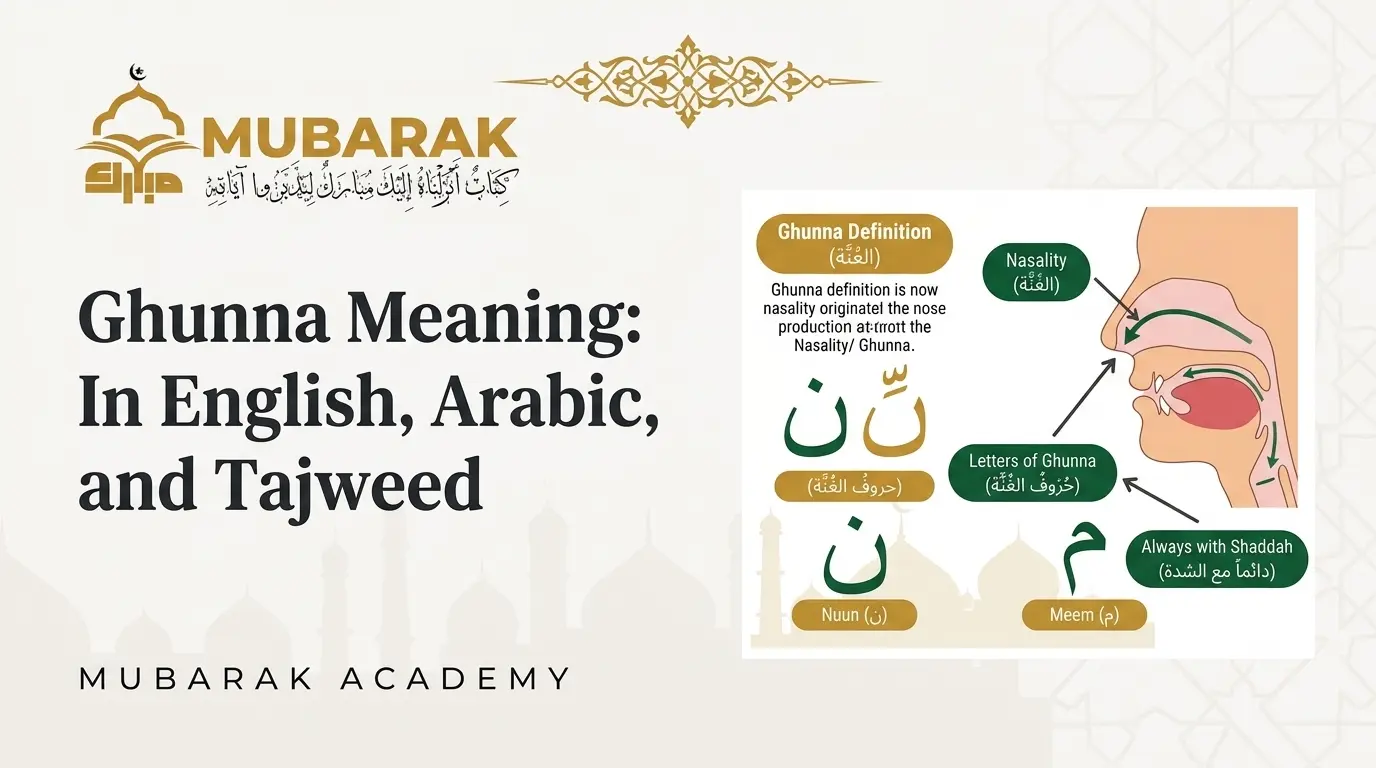
Ghunna in Tajweed(غُنَّة) is the nasal resonance, a soft humming sound, produced from the nasal passage (al-Khayshoom) when reciting Noon (ن) or Meem (م) in specific Tajweed positions. It belongs exclusively to these two letters and is produced independently of the tongue, lips, and throat, which is what makes it structurally unique among the properties (Sifaat) of Arabic letters. Ghunna appears in four of the most common recitation rules, namely Idgham, Iqlab, Ikhfa, and Shaddah, and is held for two counts at its full level. It is not a stylistic choice but a phonological obligation, and without it the recitation of Noon and Meem is considered deficient, The Quran was not only revealed in meaning, it was revealed in sound. Every letter, every vowel, every pause carries a precision that the scholars of Tajweed have preserved across fourteen centuries of oral transmission. Among the most distinctive sounds in that tradition is the Ghunna, a nasal resonance that gives the recitation of Noon and Meem their unmistakable warmth and depth. Whether you are studying Tajweed for the first time or reviewing rules you were taught years ago, understanding Ghunna precisely is essential.
Ghunna Meaning: In English, Arabic, and Tajweed
Ghunna (غُنَّة) is the nasal resonance produced from the nasal passage (al-Khayshoom) when reciting Noon (ن) or Meem (م) in specific Tajweed positions. In English it means nasalization or nasal tone. In Arabic the word refers to any sound that exits through the nose rather than the mouth. In Tajweed it is a defined, mandatory phonological property — not a stylistic choice.
Ghunna Meaning in Arabic
Ghunna in Arabic (غُنَّة) comes from the root gh-n-n (غ-ن-ن) — a root that classical Arabic lexicons define as any sound that passes through the nasal cavity rather than the mouth. The word carries no ambiguity in Arabic. It describes a distinct phonological phenomenon that Arabic grammarians and Tajweed scholars recognized, named, and codified precisely — separate from any general concept of vocal tone or quality.
Ghunna Meaning in English
Ghunna in English has no single equivalent word. The closest translations are nasalization, nasal resonance, or nasal tone — all describing a sound shaped or produced through the nasal cavity. What these translations miss is the obligatory nature of Ghunna in recitation. In English, nasalization is often a stylistic or dialectal feature. In Tajweed it is a rule with a defined duration, a defined source, and defined consequences when omitted.
Ghunna in Tajweed
Ghunna in Tajweed is a sound produced from al-Khayshoom, the nasal passage, with no part played by the tongue, lips, or throat. This is what makes Ghunna distinctive among the sounds of Arabic recitation, because every other articulation point shapes a full letter, while al-Khayshoom produces only this nasal resonance. To see where it fits, it helps to understand what Makhraj means in Tajweed, the articulation points that define where each Arabic sound originates. Al-Khayshoom is the 17th and final of the 17 makharij, the only one dedicated to Ghunna rather than to a letter, which is why Noon and Meem carry their nasal quality wherever this point is engaged.
Which Letters Carry Ghunna?
Ghunna is a permanent property of two Arabic letters:
| Letter | Name | When Ghunna Applies |
|---|---|---|
| ن | Noon (نون) | When it carries a Shaddah, when it is Sakinah (with sukoon), or when it appears as Tanween |
| م | Meem (ميم) | When it carries a Shaddah, when it is Sakinah (with sukoon) |
Both letters produce Ghunna from the same source — al-Khayshoom — but the strength and duration of that Ghunna depends on the vowel state of the letter and which Tajweed rule is triggered. A Noon with Shaddah produces a stronger, longer Ghunna than a Noon Sakinah in Ikhfa, for example.
For the specific rules governing Meem Sakinah, which includes its own Ghunna-bearing rule (Ikhfa Shafawi), see our detailed guide to the rules of Meem Sakinah.
Where Is Ghunna Produced? The Nasal Passage (al-Khayshoom)
 Al-Khayshoom (الخيشوم) is the Arabic term for the entire nasal passage — the cavity that runs from behind the nose to the back of the throat. In Tajweed science, it is classified as a standalone Makhraj, meaning it is a recognized and independent point of articulation, not a secondary feature of another letter’s production. To feel the Ghunna, place a finger lightly on the side of your nose while reciting a Noon with Shaddah (e.g., إِنَّ). You should feel vibration in the nasal bone. If there is no vibration, the Ghunna is not being produced correctly — the sound is coming from the mouth or throat, which is incorrect. During Ghunna, the back of the throat (the velum) closes slightly to redirect airflow into the nasal passage. The mouth may be open or closed depending on the rule, but the defining characteristic is always the same: the nasal resonance must be audible and unambiguous.
The Three Levels of Ghunna in Tajweed:
Not all Ghunna is equal. Classical Tajweed scholars classify Ghunna into three levels of strength, from strongest to weakest:
Level 1: The Strongest Ghunna: Noon and Meem with Shaddah (المشدد)
When Noon (ن) or Meem (م) carries a Shaddah (ّ), the Ghunna is at its maximum strength and longest duration. The Shaddah doubles the letter, and the result is a full two-count Ghunna that must be held clearly before moving to the next sound. Examples from the Quran: إِنَّ (inna — indeed), ثُمَّ (thumma — then), رَبَّنَا (Rabbana — Our Lord). Each of these contains a Noon or Meem with Shaddah, and each requires the fullest expression of Ghunna. For the rules governing the Shaddah itself, see our guide to what is Shadda in Tajweed.
Level 2: Complete Ghunna (Two Counts): Noon and Meem in Tajweed Rules
This level covers Noon Sakinah and Meem Sakinah when they appear within specific Tajweed rules: Idgham with Ghunna, Ikhfa, Ikhfa Shafawi, and Iqlab. The Ghunna here lasts exactly two counts (harakatan) — the same duration as Level 1, but slightly less intense in resonance. For example, in the rule of Iqlab in Tajweed, when a Noon Sakinah or Tanween is followed by Ba (ب), the Noon converts to a Meem-like sound with a full two-count Ghunna. The Ghunna in this case is complete and mandatory — omitting it constitutes a recitation error (Lahn Khafi).
Level 3: Incomplete Ghunna (One Count or Less): Noon and Meem with Vowels
When Noon or Meem carries a vowel (fatha, kasra, or damma), a minimal residual Ghunna remains as part of the letter’s natural phonological character. This is the weakest level — it is present but not deliberately held. It cannot be described as a rule application; it is simply the inherent nasal quality of these two letters. Tajweed teachers generally do not drill this level separately. It is present naturally when the letters are pronounced correctly, and attempting to exaggerate it actually distorts the recitation.
Ghunna in the Four Rules of Noon Sakinah and Tanween:
Ghunna appears as a mandatory component in three of the four rules of Noon Sakinah and Tanween. The fourth rule — Izhar — explicitly requires the absence of Ghunna. For the complete framework of all four rules together, see our guide to the rules of Noon Sakinah and Tanween.
| Rule | Ghunna? | Duration | Lip Position |
|---|---|---|---|
| Izhar (إظهار) | ❌ No Ghunna | None — Noon pronounced clearly | Open |
| Idgham with Ghunna (إدغام بغنة) | ✅ Full Ghunna | 2 counts | Depends on merged letter |
| Idgham without Ghunna (إدغام بلا غنة) | ❌ No Ghunna | None — Noon fully merges | Open |
| Iqlab (إقلاب) | ✅ Full Ghunna | 2 counts | Closed (Meem position) |
| Ikhfa (إخفاء) | ✅ Ghunna present | 2 counts | Open |
Idgham with Ghunna
When a Noon Sakinah or Tanween is followed by one of the four letters Yaa (ي), Waw (و), Meem (م), or Noon (ن), the Noon merges into the following letter and a Ghunna of two counts is produced. The Noon disappears into the following letter while the nasal resonance continues independently from al-Khayshoom. Example: مِن نِعْمَةٍ (min ni’matin — from a blessing). The Noon Sakinah on مِنْ is followed by Noon, triggering Idgham with Ghunna. The two Noons merge, and a two-count Ghunna is held before completing the word.
Ikhfa with Ghunna
Ikhfa is the concealment of the Noon Sakinah or Tanween before any of fifteen triggering letters. During Ikhfa, the Noon is hidden — not fully pronounced, not fully merged — and a Ghunna of two counts is produced while the articulation point prepares for the next letter. Example: مِن قَبْلِ (min qabli — before). The Noon Sakinah is concealed before Qaf (ق), and a two-count Ghunna bridges the gap between the Noon position and the Qaf’s articulation. This is the most frequently encountered Ghunna in everyday Quranic recitation because Ikhfa has fifteen triggering letters.
Iqlab with Ghunna
As covered in our guide to Iqlab in Tajweed, when a Noon Sakinah or Tanween is followed by Ba (ب), the Noon converts into a hidden Meem sound with a two-count Ghunna. The lips close into the Meem position and the Ghunna resonates fully through al-Khayshoom before the Ba is pronounced. Example: سَمِيعٌ بَصِيرٌ (Sami’un Baseerun — All-Hearing, All-Seeing). Surah Al-Hajj (22:75). The Tanween on Sami’un followed by Ba triggers Iqlab, with a mandatory two-count Ghunna at the transition point.
Meem Sakinah with Shaddah
When a Meem carries a Shaddah, it produces the same strongest-level Ghunna as Noon with Shaddah. The Meem is doubled, and a full two-count Ghunna resonates through the nasal passage while the lips remain closed. Example: ثُمَّ (thumma — then). One of the most common Quranic words, appearing hundreds of times. Every occurrence requires the full Ghunna before the final voweled Meem.
Ghunna Examples from the Quran:
The following verses demonstrate Ghunna in its different positions and rule contexts. All references are verified against the Hafs an Asim recitation — the most widely read transmission of the Quran worldwide:
| Verse | Surah & Ayah | Position | Rule |
|---|---|---|---|
| إِنَّ اللَّهَ… | Al-Baqarah (2:20) | Noon with Shaddah | Level 1 — Strongest Ghunna |
| مِن نِعْمَةٍ | Al-Nahl (16:53) | Noon Sakinah + Noon | Idgham with Ghunna |
| سَمِيعٌ بَصِيرٌ | Al-Hajj (22:75) | Tanween + Ba | Iqlab with Ghunna |
| مِن قَبْلِ | Al-Baqarah (2:25) | Noon Sakinah + Qaf | Ikhfa with Ghunna |
| صُمٌّ بُكْمٌ | Al-Baqarah (2:18) | Tanween + Ba (×2) | Iqlab — multiple Ghunna |
| ثُمَّ | Throughout Quran | Meem with Shaddah | Level 1 — Strongest Ghunna |
Recitation tip: Use Quran.com to listen to any verse above recited by Sheikh Mishary Al-Afasy or Sheikh Abdul Basit. Focus specifically on the nasal resonance at each Ghunna position. Training your ear before training your mouth is the fastest way to correct Ghunna production.
Noon Ghunna Words in Arabic: How to Identify Them:
To identify noon ghunna words in Arabic, look for any of the following in the Quran:
- A Noon (ن) with a Shaddah — written as نّ. Every occurrence requires Ghunna.
- A Noon with a sukoon (نْ) — Noon Sakinah. Check the following letter to determine which rule applies and whether Ghunna is required.
- A Tanween ending (ـًـٍـٌ) on any noun. The following letter determines the rule and whether Ghunna is present.
- A Meem (م) with Shaddah — written as مّ. Every occurrence requires Ghunna.
- A Meem with sukoon (مْ) — Meem Sakinah. The following letter determines whether Ghunna applies (Ikhfa Shafawi or Idgham Shafawi with Ghunna).
In most printed Mushafs, a small circle or the letter م (Meem) is written above certain Noon positions to alert the reader that a rule — including a Ghunna-bearing one — applies at that point. Learning to scan for these markers before reciting a new passage significantly reduces errors.
Common Mistakes in Ghunna Recitation:

- Producing Ghunna from the throat, not the nose: The most widespread error. Students often produce a nasal-like hum from the back of the throat (similar to a humming or buzzing sound) rather than from al-Khayshoom. The test is simple: pinch your nose during the Ghunna. If the sound stops entirely, it was coming from the nose correctly. If it continues unchanged, it was throat-produced and incorrect.
- Short Ghunna in Ikhfa and Iqlab: Some reciters rush through Ikhfa and Iqlab positions, producing a Ghunna of less than two counts. This is a Lahn Khafi (لحن خفي) — a hidden recitation error. Count two beats consciously during practice until the duration becomes automatic.
- Adding Ghunna in Izhar positions: Izhar (clear pronunciation before throat letters: ء ه ع ح غ خ) explicitly requires the absence of Ghunna. Students who have drilled Ghunna heavily sometimes carry it into Izhar positions by habit. The Noon before a throat letter must be clean and completely clear of nasal resonance.
- Inconsistent Ghunna strength across levels: Treating all Ghunna the same regardless of whether it appears in a Shaddah (Level 1) or Ikhfa (Level 2) is a common intermediate-level error. The Shaddah Ghunna should be noticeably stronger and more sustained than the Ghunna in Ikhfa positions.
- Nasalizing voweled Noon and Meem excessively: When Noon or Meem carries a vowel (e.g., نَ, مِ), the minimal Level 3 Ghunna should be present naturally — not exaggerated. Overemphasizing it distorts the letter and creates an artificial, non-Arabic sound.
Practice Exercises for Ghunna:
Work through these exercises in order, spending at least five minutes on each before advancing:
- Isolate إِنَّ from Surah Al-Fatiha. Hold the Ghunna for two full counts. Place your finger on your nose and confirm the vibration.
- Recite مِن نِعْمَةٍ slowly, focusing on the Idgham with Ghunna. The two Noons merge — you should hear one sustained nasal sound, not two separate Noons.
- Recite صُمٌّ بُكْمٌ عُمْيٌ from Al-Baqarah (2:18). Three Tanween-Ba positions in rapid succession — each requires Iqlab with Ghunna. Hold each Ghunna before releasing into the Ba.
- Recite the opening three ayat of Surah Al-Baqarah at slow speed. Identify and hold every Ghunna position before reciting again at normal speed.
Ghunna Within the Broader Tajweed System:
Ghunna does not exist in isolation. It is part of a larger system of phonological properties (Sifaat) that define how Arabic letters are produced and distinguished from one another. Understanding Sifaat in Tajweed — the complete set of letter properties — gives Ghunna its proper place in the broader framework of correct recitation. Students who are serious about mastering Tajweed should also study Tafkheem and Tarqeeq alongside Ghunna. Heavy letters (Tafkheem) and light letters (Tarqeeq) often appear near Ghunna positions, and the interaction between nasal resonance and letter weight is one of the more nuanced aspects of advanced recitation. For students wondering how long the full journey takes, our article on how long it takes to learn Tajweed provides a realistic breakdown by level and daily study time.
Frequently Asked Questions
What does Ghunna mean in English?
Ghunna means nasalization or nasal resonance in English. It refers to a sound produced through the nasal passage (al-Khayshoom) rather than the mouth or throat — the same type of nasal quality found in the English letters ‘m’ and ‘n’ when held, but more precisely defined in Arabic Tajweed.What does Ghunna mean in Arabic?
In Arabic, Ghunna (غُنَّة) is derived from the root gh-n-n (غ-ن-ن) and refers specifically to a nasal tone or resonance. Classical Arabic lexicons define it as a sound that comes through the nose rather than through the primary vocal tract. In Tajweed, it is a defined phonological property of Noon and Meem.What does Ghunna mean in Tajweed?
In Tajweed, Ghunna is the mandatory nasal resonance produced from al-Khayshoom (the nasal passage) when reciting Noon (ن) or Meem (م) in specific positions — including when either letter carries a Shaddah, during Idgham with Ghunna, Ikhfa, and Iqlab. Its duration is two counts (harakatan) at the full level.How many counts is the Ghunna?
At its full level (Levels 1 and 2), Ghunna lasts exactly two counts (harakatan). This applies to Noon and Meem with Shaddah, Idgham with Ghunna, Ikhfa, and Iqlab. A Ghunna shorter than two counts is a Lahn Khafi — a hidden recitation error.Does Ghunna apply in Izhar?
No. Izhar — the clear pronunciation of Noon Sakinah or Tanween before one of the six throat letters (ء ه ع ح غ خ) — explicitly requires that the Noon be pronounced clearly with no Ghunna. Adding nasal resonance in Izhar positions is an error.Is Ghunna the same in all recitations (Qira’at)?
Ghunna is present across all major recitations (Qira’at) of the Quran, including both Hafs an Asim and Warsh an Nafi. The principle is universal in Tajweed science. Minor differences between transmissions may affect other rules but do not eliminate the fundamental requirement of Ghunna for Noon and Meem.Conclusion
Ghunna is one of the most frequently occurring sounds in Quranic recitation — present in every Noon and Meem with Shaddah, in every Idgham with Ghunna position, in every Ikhfa, and in every Iqlab. A student who masters Ghunna correctly does not just learn one rule; they correct a phonological quality that touches thousands of positions across the Quran. The path to consistent Ghunna is physical before it is intellectual. Read the rules, understand the levels, study the examples — then close your eyes, place your finger on your nose, and recite until the vibration is automatic. That moment when you no longer need to think about it is when the Ghunna has moved from knowledge to recitation. If you are building your Tajweed foundation systematically, the next step is to study the complete rules of Noon Sakinah and Tanween — the framework that Ghunna operates within — and then explore all major Tajweed rules with examples to see how Ghunna connects to the broader system of Quranic recitation.
External References
- Quran.com — Surah Al-Hajj (22:75) — Verify the Iqlab + Ghunna example سَمِيعٌ بَصِيرٌ directly in the Quran text.
- Quran.com — Surah Al-Baqarah (2:18) — Practice verse صُمٌّ بُكْمٌ عُمْيٌ with three consecutive Iqlab + Ghunna positions.
- Tanzil.net — Quran Text Database — Scholarly Quran text resource used to cross-check all verse references in this article.
- Islamweb.net — Tajweed Fatawa Library — Scholarly classifications of Lahn Khafi errors in recitation, including deficient Ghunna.
Master Ghunna the Right Way — With a Teacher Who Can Hear You
Reading about Ghunna is one thing. Producing it correctly is another. The nasal resonance of Noon and Meem cannot be self-taught from a description — it requires ears that can catch the difference between a throat-produced hum and a true Khayshoom vibration. Without live feedback, most students carry their Ghunna errors for years without realizing it.
Mubarak Academy offers live one-on-one Tajweed classes with certified teachers who hold Ijazah with an authenticated Sanad reaching back to the Prophet ﷺ — meaning every rule they teach, including Ghunna, has been transmitted and verified through an unbroken chain of qualified reciters. Whether you are a beginner just learning to distinguish Ikhfa from Izhar or an intermediate student refining your Ghunna duration and source, lessons are structured to your exact level.
Book a free trial class at Mubarak Academy and have your Ghunna corrected by a qualified teacher in your very first session.

Ustadh Ahmed Mahmoud Abdulaziz is an experienced teacher of Arabic and the Holy Quran for native and non-native speakers. He holds a verified Ijazah in Hafs ‘an Asim and is certified in the foundational Tajweed texts Al-Jazariyyah and Tuhfat Al-Atfal. Drawing on his extensive background in traditional Quranic recitation and international pedagogy, he writes scholar-verified, accessible articles to help students worldwide master Tajweed rules and Arabic linguistics safely and accurately.