
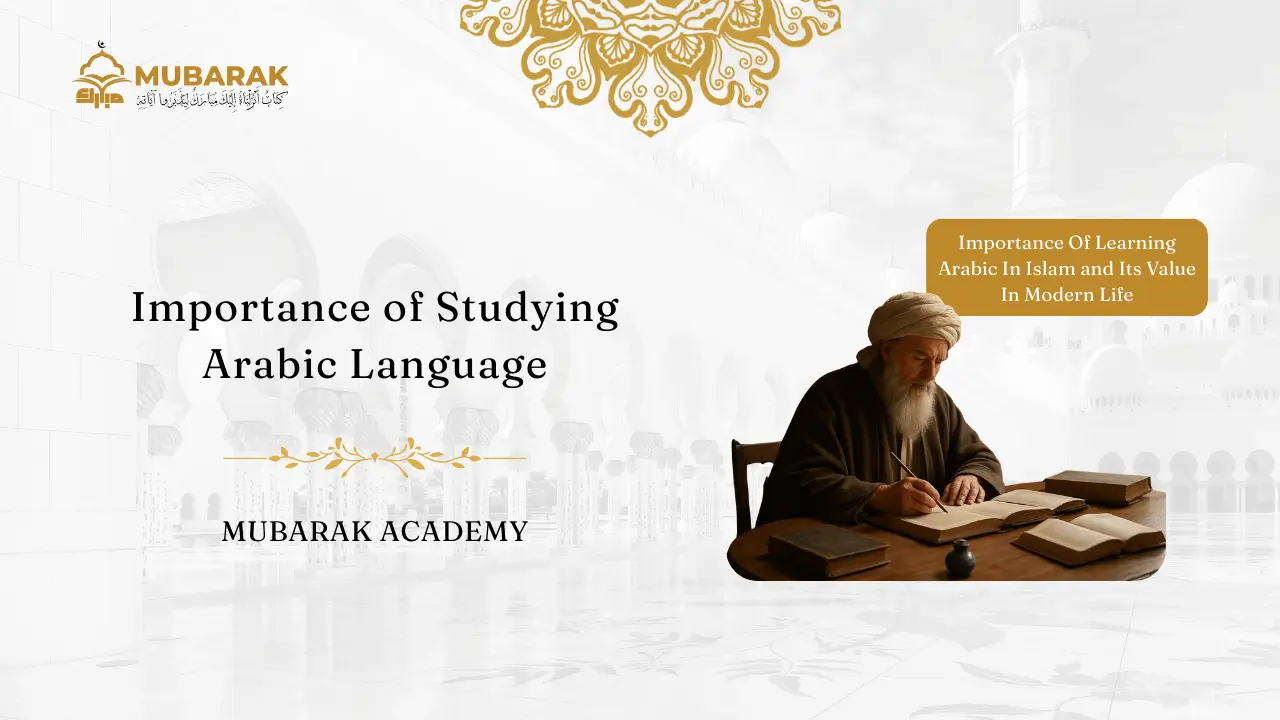
The importance of studying Arabic language is more than just a means of communication; it’s a gateway to culture, history, faith, and opportunity. Spoken by over 400 million people worldwide, Arabic holds a unique place as the language of the Quran, classical literature, and a rapidly growing global market. Whether you’re learning Arabic for religious understanding, career growth, or personal enrichment, studying Arabic can open doors you never expected.
10 Importance of Studying the Arabic Language
Below are key points that highlight the importance of learning Arabic in Islam and its value in modern life:
1. Understanding the Quran and Islamic Texts
When you study Arabic, you begin to understand the Quran as it was revealed, not just how it is interpreted in another language. You can see how:
- A single Arabic word may carry multiple layers of meaning
- Word order adds emphasis and guidance
- Grammar and verb forms reveal time, certainty, command, or mercy
- Subtle changes in wording completely shift the meaning and reflection
The same applies to Hadith and classical Islamic texts. Many rulings, explanations, and scholarly discussions depend on:
- Exact word choices
- Grammatical structures
- Contextual meanings that are often lost in translation
By understanding Arabic, you are no longer dependent on a translator’s interpretation, which demonstrates the importance of Arabic in Islamic studies, as it allows direct access to the meanings intended by Allah ﷻ and explained by the Prophet ﷺ and the great scholars of Islam.
2. Access to Rich Classical Literature
The importance of studying Arabic language also includes access to a vast body of classical knowledge built over more than a thousand years. Arabic was the language of poetry, science, philosophy, and history across many civilizations.
By learning Arabic, you can:
- Read famous poetry in its original, powerful form
- Understand important works in philosophy and science
- Explore historical texts that shaped cultures and ideas
Many of these works are not fully translated, and translations often miss the true meaning, so studying Arabic lets you understand these texts more clearly and appreciate their original depth and beauty.
3. Stronger Connection to Arab Culture
Language and culture go hand in hand. By learning Arabic, you gain a deeper understanding of Arab traditions, values, and perspectives, highlighting one of the key 5 importance of Arabic language aspects in today’s world.
4. Career and Job Opportunities
Learning Arabic opens doors to a wide range of professional opportunities because it is a language in high demand globally. Proficiency in Arabic is highly valued in fields like:
- Diplomacy and International Relations
- International Business and Trade
- Translation and Interpretation
- Education
- Media and Journalism
- Humanitarian and NGO Work
In short, knowing Arabic not only enhances your resume but also makes you a valuable asset in industries engaging with the Arab world, giving you a competitive edge in the global job market, which shows the importance of Arabic language in modern world.
5. Academic and Research Advantages
Many historical and scientific manuscripts exist only in Arabic. Learning the language gives researchers and students access to original sources, further emphasizing the benefits of learning Arabic Islam, and other scholarly pursuits.
6. Improved Memory and Cognitive Skills
Learning a new language, especially one with a unique structure like Arabic, keeps your mind active and sharp, as it helps improve focus, strengthens memory, and enhances problem-solving skills over time.
7. Easier Communication While Traveling
Arabic is spoken across more than 20 countries. Knowing the language enhances travel experiences and builds meaningful connections with locals.
8. Preserving Identity and Heritage
For Arabs and Muslims, studying Arabic helps preserve cultural and religious identity across generations.
9. Better Pronunciation and Tajweed
Learning Arabic grammar and phonetics improves Quran recitation and the correct pronunciation of Arabic letters.
10. Spiritual and Personal Growth
Understanding Arabic brings clarity, reflection, and a deeper emotional connection to prayers, supplications, and religious texts.
Best Arabic Course to Get Started
Choosing the right Arabic language course is the first step toward building a strong and confident foundation in the language. At Mubarak Academy, our Arabic programs are carefully designed to help beginners and advanced learners progress smoothly through a clear, structured learning path.
Our Arabic courses focus on grammar, vocabulary, reading, and practical usage, with special attention to Classical and Quranic Arabic, making learning both meaningful and applicable to real-life and religious contexts.
With Mubarak Academy’s online Arabic courses, students from anywhere in the world can learn Arabic at their own pace while receiving personalized support and continuous guidance. Whether your goal is to understand the Quran, improve communication skills, or build a solid linguistic foundation, Mubarak Academy provides the right environment to start and succeed.
Begin Learning Arabic Language Now!
Conclusion
The importance of studying Arabic language is undeniable; it benefits your mind, soul, and future. Whether your goal is religious understanding, academic excellence, or professional growth, Arabic provides lifelong value. With the right course and a consistent learning plan, mastering Arabic becomes an achievable and rewarding journey.
Frequently Asked Questions
1. Is Arabic difficult to learn for beginners?
Arabic may seem challenging at first, but with a well-structured course and regular practice, beginners can progress steadily and gain confidence over time.
2. How long does it take to learn Arabic?
Basic reading and understanding can be achieved within a few months, while full fluency depends on consistency, practice, and your personal learning goals.
3. Should I learn Classical Arabic or Modern Standard Arabic?
If your goal is understanding the Qur’an and classical texts, Classical Arabic is the best choice. For media, news, and general communication, Modern Standard Arabic is more suitable.
4. Do I need prior knowledge to start learning Arabic?
No prior knowledge is required. Most beginner Arabic courses start from the basics, covering letters, pronunciation, and simple grammar step by step.

Ustadh Ahmed Mahmoud Abdulaziz is an experienced teacher of Arabic and the Holy Quran for native and non-native speakers. He holds a verified Ijazah in Hafs ‘an Asim and is certified in the foundational Tajweed texts Al-Jazariyyah and Tuhfat Al-Atfal. Drawing on his extensive background in traditional Quranic recitation and international pedagogy, he writes scholar-verified, accessible articles to help students worldwide master Tajweed rules and Arabic linguistics safely and accurately.



Abdulmujeeb Sadullahi
3 May, 2026Masha Allah.