
Life is full of moments when we feel worried, confused, or in need of guidance. During these times, turning to Allah brings peace and reassurance to the heart. Salat ul Hajat is a beautiful voluntary prayer that Muslims perform when they have a specific need or request. In this guide, we will explain how to perform salat ul hajat, its purpose, the number of rakats, the recommended dua, and the best time to pray it.
What is Salat ul Hajat?
Salat ul Hajat is a voluntary prayer that Muslims perform when they have a specific need or are asking Allah for help. The word “Hajat” simply means a need, request, or something a person hopes for. Through this prayer, a believer turns to Allah and asks for guidance, support, and ease in their situation.
Many scholars say that learning how to perform Salat ul Hajat reminds Muslims to rely on Allah, especially during difficult moments, uncertainty, or when making important life decisions.
Some people also pray this prayer for personal matters such as work, health, family concerns, or even salatul hajat for marriage, asking Allah to guide them to what is best.
Purpose of Salat ul Hajat in Islam:
The main purpose of Salat ul Hajat is to turn to Allah and ask for His help, mercy, and guidance. In Islam, believers are encouraged to rely on Allah in every situation, whether the matter is small or very important.
When Muslims learn how to perform Salat ul hajat, they practice patience, humility, and sincere trust in Allah’s wisdom. This prayer reminds us that no matter what we are facing, Allah is always near, listening to our prayers and capable of fulfilling our needs in the best way.
When Should You Perform Salat ul Hajat?
There isn’t a specific time set for performing Salat ul hajat. A Muslim can pray it whenever they feel the need to ask Allah for help, except during the known times when prayer is discouraged.
Recommended times include:
- After making wudu (ablution)
- During quiet moments when the heart feels peaceful and focused
- When facing an important decision or going through a difficulty
- After obligatory prayers
- During the last third of the night
Learning how to perform Salat ul Hajat reminds believers that they can always turn to Allah for support, guidance, and relief whenever they need it.
How Many Rakats Are in Salat ul Hajat?
Most scholars explain that Salat ul hajat is usually performed as two rakats of voluntary prayer. After completing the prayer, the person makes a sincere dua, asking Allah to fulfill their need or ease their situation.
The most important thing is not the length of the prayer, but the sincerity of the heart. Praying with humility, focus, and trust in Allah is what truly gives this prayer its meaning.
How to Perform Salat ul Hajat Step by Step?
If you want to learn how to perform Salat ul Hajat, the process is simple and similar to other voluntary prayers. You can follow these easy steps:
1. Make wudu (ablution) to purify yourself before starting the prayer.
2. Make the intention in your heart to perform Salat ul Hajat for the sake of Allah
3. Pray two rakats of voluntary prayer.
4. In each rakat, recite Surah Al-Fatiha, followed by another surah from the Quran.
5. Complete the prayer the same way you finish any regular salah.
6. After finishing, praise Allah and send blessings upon the Prophet ﷺ.
7. Recite the strongest dua for Hajat.
8. Finally, ask Allah for the need or help you are seeking.
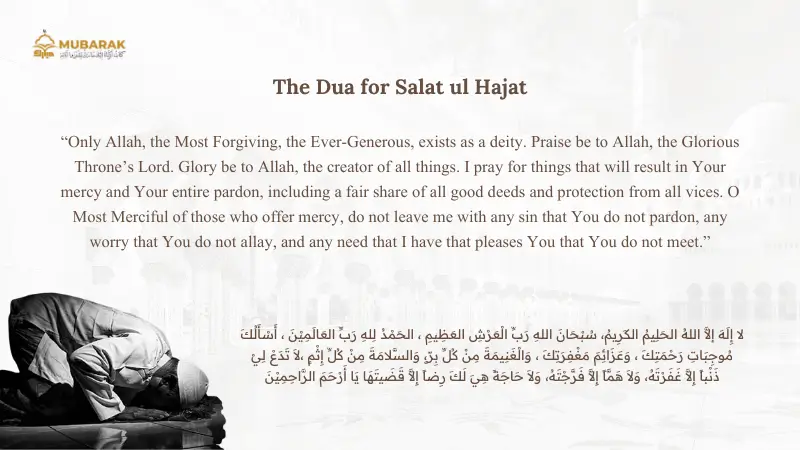
The Dua for Salat ul Hajat:
لا إِلَهَ إلاَّ اللهُ الحَلِيمُ الكَرِيمُ، سُبْحَانَ اللهِ رَبِّ الْعَرْشِ العَظِيمِ ، الحَمْدُ لِلهِ رَبِّ العَالَمِيْنَ ، أَسْأَلُكَ مُوجِبَاتِ رَحْمَتِكَ ، وَعَزَائِمَ مَغْفِرَتِكَ ، وَالْغَنِيمَةَ مِنْ كُلِّ بِرّ،ٍ وَالسَّلامَةَ مِنْ كُلِّ إِثْمٍ ،لاَ تَدَعْ لِيْ ذَنْباً إِلاَّ غَفَرْتَهُ، وَلاَ هَمَّاً إِلاَّ فَرَّجْتَهُ، وَلاَ حَاجَةً هِيَ لَكَ رِضاً إِلاَّ قَضَيتَهَا يَا أَرْحَمَ الرَّاحِمِيْنَ
Salat ul Hajat Dua in English:
“Only Allah, the Most Forgiving, the Ever-Generous, exists as a deity. Praise be to Allah, the Glorious Throne’s Lord. Glory be to Allah, the creator of all things. I pray for things that will result in Your mercy and Your entire pardon, including a fair share of all good deeds and protection from all vices. O Most Merciful of those who offer mercy, do not leave me with any sin that You do not pardon, any worry that You do not allay, and any need that I have that pleases You that You do not meet.” (Tirmidhi)
Quranic Verses Related to Salatul Hajat Prayer:
Many Quranic verses encourage believers to turn to Allah through prayer and supplication whenever they need help. These verses reflect the spirit and purpose behind this voluntary prayer.
1. Seeking Help Through Patience and Prayer:
Allah says in Surah al-baqarah:
﴿وَاسْتَعِينُوا بِالصَّبْرِ وَالصَّلَاةِ ۚ وَإِنَّهَا لَكَبِيرَةٌ إِلَّا عَلَى الْخَاشِعِينَ﴾
Meaning:
“And seek help through patience and prayer. Indeed, it is difficult except for the humble.”
This verse teaches believers to turn to prayer when they need Allah’s support and guidance.
2. Allah Is Near and Answers Supplication:
Allah says in Surah al-baqarah:
﴿وَإِذَا سَأَلَكَ عِبَادِي عَنِّي فَإِنِّي قَرِيبٌ ۖ أُجِيبُ دَعْوَةَ الدَّاعِ إِذَا دَعَانِ﴾
Meaning:
“And when My servants ask you about Me, indeed I am near. I respond to the call of the supplicant when he calls upon Me.”
This verse reminds Muslims that Allah hears every sincere dua.
3. Call Upon Allah and He Will Respond:
Allah says in Surah Ghafir:
﴿وَقَالَ رَبُّكُمُ ادْعُونِي أَسْتَجِبْ لَكُمْ﴾
Meaning:
“And your Lord says, ‘Call upon Me; I will respond to you.’”
This verse encourages believers to ask Allah for their needs, which reflects the purpose behind performing Salatul Hajat.
Together, these verses show that turning to Allah through prayer, dua, and trust is an essential part of a Muslim’s life, especially when seeking help, guidance, or relief from difficulties.

Salatul Hajat for Marriage:
If you are hoping to find a righteous spouse, performing Salat ul Hajat can be a beautiful way to ask Allah for guidance and blessings. Marriage is an important step in life, and this prayer allows believers to turn to Allah with sincerity and trust when seeking what is best for their future.
A Simple Du‘a for Marriage:
After completing the prayer, you can make a heartfelt du‘a such as:
“O Allah, if marriage is good for my faith, my life, and my future, then bless me with a righteous spouse who will bring goodness, love, and peace into my life.”
The most important thing is to ask Allah with sincerity and patience, trusting that He will guide you toward what is truly best for you.
What are The Benefits of Praying Salat ul Hajat?
Salat ul Hajat brings many spiritual benefits that help strengthen a believer’s connection with Allah, including:
- Strengthening faith and trust in Allah, especially when facing challenges.
- Encouraging patience during difficult situations and moments of uncertainty.
- Increasing humility, reminding believers to rely on Allah alone for their needs.
- Bringing peace and comfort to the heart through sincere supplication and prayer.
- Developing a habit of turning to Allah whenever a person seeks guidance or help.
When believers learn how to perform Salat ul Hajat, they also learn the importance of relying on Allah in every aspect of life.
Continue Your Islamic Learning Journey:
Learning about prayers like Salat ul Hajat is a meaningful step toward strengthening your faith and building a closer relationship with Allah. But it’s only the beginning of a beautiful journey of learning and understanding Islam more deeply.
At Mubarak Academy, we offer online Quran and Islamic studies courses designed to help students learn their religion in a clear, supportive, and engaging way. With experienced teachers and well-structured lessons, students can improve their Quran recitation, learn important duas, and grow spiritually step by step.
Conclusion
Salat ul Hajat is one of the simplest things a Muslim can do when life feels heavy or a decision is too big to sit with alone. Two rakats, a sincere dua, and an honest conversation with Allah. That’s it.
There’s no elaborate ritual here. The prayer works because the relationship it assumes is real — Allah hears, and He responds. Turning to Him through salah when you genuinely need something is one of those habits that quietly changes how you move through difficulty.
If you want to understand your religion more deeply — whether that’s learning how to pray correctly, improving your Quran recitation, or studying the duas that matter — Mubarak Academy runs live online courses taught by qualified teachers. It’s structured, it’s accessible, and you can start at whatever level you’re at. Contact mubarakacademy to find the right course for you.
FAQs
Is Salatul Hajat authentic?
Scholars have different opinions regarding specific narrations about Salat ul Hajat, but many agree that performing voluntary prayer and making dua for one’s needs is encouraged in Islam.
Can I pray Salatul Hajat everyday?
Yes, a Muslim may pray voluntary prayers and make dua regularly whenever they feel the need to seek Allah’s help.
What should I recite in Salat ul Hajat?
You can recite Surah Al-Fatiha followed by any other surah in each rakat.
Can I make my own dua after Salat ul Hajat?
Yes, you may ask Allah for any permissible need in your own words.
Can You Pray Salat ul Hajat for Any Need?
Yes, Muslims can pray Salat ul Hajat for any permissible need, whether it relates to personal, family, financial, or spiritual matters.

Ustadh Ahmed Mahmoud Abdulaziz is an experienced teacher of Arabic and the Holy Quran for native and non-native speakers. He holds a verified Ijazah in Hafs ‘an Asim and is certified in the foundational Tajweed texts Al-Jazariyyah and Tuhfat Al-Atfal. Drawing on his extensive background in traditional Quranic recitation and international pedagogy, he writes scholar-verified, accessible articles to help students worldwide master Tajweed rules and Arabic linguistics safely and accurately.