
The Prophet ﷺ said:
“Whoever recites a letter from the Book of Allah will receive a good deed, and a good deed is multiplied by ten. I do not say that Alif Lam Mim is one letter — Alif is a letter, Lam is a letter, and Mim is a letter.” [Sunan al-Tirmidhi, No. 2910; graded Sahih]
That reward structure — ten good deeds per letter, multiplied across 323,000 letters — makes daily Quran recitation one of the most consequential acts a Muslim can perform. This guide covers 15 proven benefits of reciting Quran daily, grounded in Quranic verses, authenticated hadith, and modern research on the mind and body.
What Are the Benefits of Reciting Quran Daily?
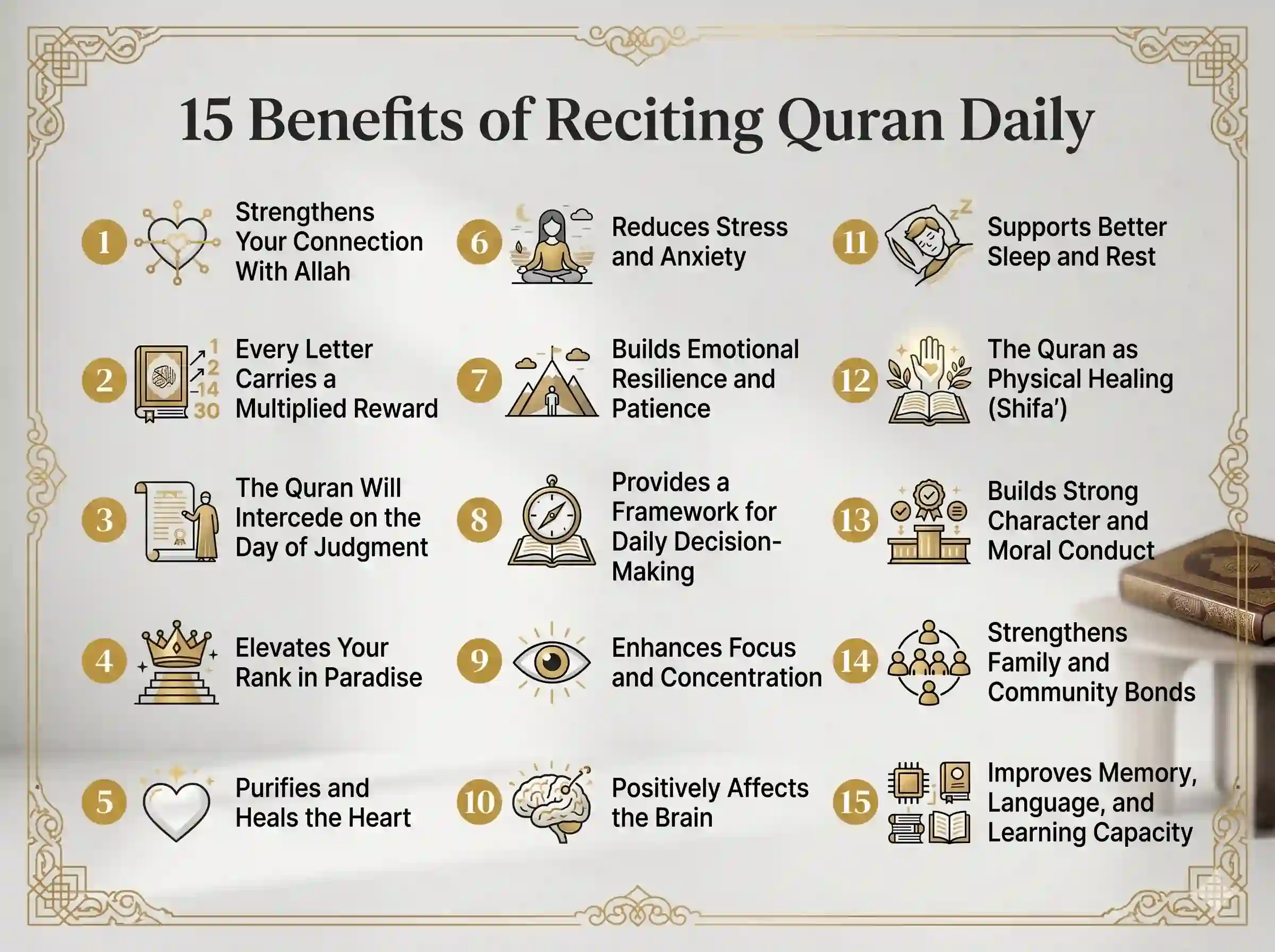
The benefits of reciting Quran daily include spiritual elevation, intercession on the Day of Judgment, a multiplied reward for every letter, mental clarity, emotional resilience, reduced stress and anxiety, improved memory and focus, strengthened character, and an elevated rank in Paradise. These benefits are not separate from one another — they form an interconnected system in which daily recitation simultaneously strengthens the believer’s relationship with Allah, their mental state, their physical wellbeing, and their conduct in the world.
15 Benefits of Reciting Quran Daily
1. Strengthens Your Connection With Allah
Allah (SWT) says:
إِنَّ هَٰذَا الْقُرْآنَ يَهْدِي لِلَّتِي هِيَ أَقْوَمُ
“Indeed, this Quran guides to that which is most upright.” [Surah Al-Isra 17:9]
Every session of daily recitation is a direct engagement with the words of Allah (SWT). Islamic scholars describe this as a two-way conversation — when a Muslim prays, they speak to Allah; when they recite the Quran, Allah speaks to them. A Muslim who recites daily maintains this conversation without interruption, keeping the heart spiritually alive and the connection with Allah constant.
2. Every Letter Carries a Multiplied Reward
The Prophet ﷺ said:
“Whoever recites a letter from the Book of Allah will receive a good deed, and the good deed is multiplied by ten. I do not say that Alif Lam Mim is one letter — Alif is a letter, Lam is a letter, and Mim is a letter.” [Sunan al-Tirmidhi, No. 2910; graded Sahih]
The Quran contains approximately 323,000 letters. At ten good deeds per letter, a single complete recitation produces over three million good deeds — available every day to anyone who recites consistently.
3. The Quran Will Intercede on the Day of Judgment
The Prophet ﷺ said:
“Read the Quran, for it will come on the Day of Resurrection as an intercessor for its companions.” [Sahih Muslim, No. 804; narrated by Abu Umamah Al-Bahili (رضي الله عنه)]
And specifically about Surah Al-Baqarah and Surah Al-Imran:
“Recite the two bright ones — for they will come on the Day of Resurrection like two clouds, interceding for their companions.” [Sahih Muslim, No. 804]
The Quran recited daily in this life becomes an advocate in the Next — on the day when no intercession avails except what Allah permits.
4. Elevates Your Rank in Paradise
The Prophet ﷺ said:
“It will be said to the companion of the Quran: Recite and ascend — for your rank will be at the last verse you recite.” [Sunan Abu Dawud, No. 1464; graded Hasan]
Every verse recited and memorised is a permanent elevation of rank in the Hereafter. The student who recites daily is simultaneously building their station in Paradise — one verse at a time.
5. Purifies and Heals the Heart
Allah (SWT) says:
يَا أَيُّهَا النَّاسُ قَدْ جَاءَتْكُم مَّوْعِظَةٌ مِّن رَّبِّكُمْ وَشِفَاءٌ لِّمَا فِي الصُّدُورِ
“O mankind, there has come to you instruction from your Lord and healing (shifa’) for what is in the breasts.” [Surah Yunus 10:57]
The Arabic word shifa’ (شِفَاء) means healing and cure — not merely comfort. The Quran actively addresses what ails the heart. Regular daily recitation maintains the spiritual alertness — khushu’ — that every act of worship requires to carry its full weight.
6. Reduces Stress and Anxiety
Allah (SWT) says:
أَلَا بِذِكْرِ اللَّهِ تَطْمَئِنُّ الْقُلُوبُ
“Verily, in the remembrance of Allah do hearts find rest.” [Surah Al-Ra’d 13:28]
Slow, measured recitation — tarteel, as commanded in Surah Al-Muzzammil (73:4) — functions similarly to controlled breathing and mindfulness practices. It combines the physiological with the spiritual simultaneously, calming anxious thoughts and restoring emotional balance.
7. Builds Emotional Resilience and Patience
The Quran teaches through its narratives — the trials of Prophet Ayyub (عليه السلام), the patience of Prophet Yusuf (عليه السلام), the steadfastness of Prophet Ibrahim (عليه السلام). A Muslim who recites these accounts daily absorbs a practical emotional framework: every difficulty has a purpose, every trial has a limit, and every patient believer has a guaranteed reward.
8. Provides a Framework for Daily Decision-Making
Allah (SWT) describes the Quran as:
“A guidance for mankind and clear evidence of guidance and criterion (furqan).” [Surah Al-Baqarah 2:185]
The word furqan (فُرْقَان) means the ability to distinguish between right and wrong. A Muslim who recites the Quran daily internalises this criterion gradually — making decisions with increasing clarity about what aligns with divine guidance and what does not.
9. Enhances Focus and Concentration
Reciting the Quran requires simultaneous engagement of multiple cognitive functions: correct pronunciation from the Makharij (articulation points), application of Tajweed rules, memorisation, and comprehension. This multi-layered mental engagement strengthens attention, working memory, and overall cognitive function — benefits that extend into daily tasks and study.
10. Positively Affects the Brain
Research on rhythmic, focused vocalisation consistently shows activation of the parasympathetic nervous system, which reduces cortisol levels and promotes deep relaxation. Studies published in the Journal of Religion and Health document the positive neurological effects of religious recitation on stress biomarkers. The calm and mental clarity most reciters experience after recitation has measurable physiological basis.
11. Supports Better Sleep and Rest
The Prophet ﷺ regularly recited Surah Al-Ikhlas, Surah Al-Falaq, and Surah An-Nas before sleep, blowing into his hands and wiping over his body [Sahih al-Bukhari, No. 5017; narrated by Aisha (رضي الله عنها)]. This Sunnah combines the spiritual protection of these surahs with the practical benefit of a calming pre-sleep ritual — reducing racing thoughts and preparing the mind and body for rest.
12. The Quran as Physical Healing (Shifa’)
Allah (SWT) describes the Quran as shifa’ in two separate verses — Surah Yunus (10:57) and Surah Al-Isra (17:82). Ibn al-Qayyim al-Jawziyyah (rahimahullah) dedicated significant attention to Quranic healing in Zad al-Ma’ad, describing the Quran as the most complete medicine for the heart — which in turn affects the body. The regular discipline of wudu, fixed daily routine, reduced stress hormones, and improved sleep all contribute to measurable physical wellbeing.
13. Builds Strong Character and Moral Conduct
Daily recitation continuously reinforces the values the Quran instils — honesty, patience, justice, gratitude, and self-control. These values do not develop through reading once — they develop through repeated daily engagement that gradually makes them the default orientation of the believer’s character and conduct.
14. Strengthens Family and Community Bonds
The Prophet ﷺ said: “The best of you are those who learn the Quran and teach it.” [Sahih al-Bukhari, No. 5027]. Families who recite the Quran together build a shared spiritual framework that strengthens relationships across every dimension. A community where daily Quran recitation is the norm is a community with shared moral language, shared values, and shared purpose.
15. Improves Memory, Language, and Learning Capacity
Research on structured Quranic memorisation in children consistently shows improvements in:
- Verbal memory — the ability to retain and recall spoken information
- Listening accuracy — distinguishing similar sounds precisely
- Pronunciation — articulation control that transfers to language learning
- Disciplined study habits — the consistency required for hifz develops learning habits that apply across all academic subjects
Children who grow up with daily Quran recitation consistently demonstrate stronger focus and academic performance. For families wanting to begin this journey, the Quran Memorization Course at Mubarak Academy offers structured programmes for all ages and levels.
Importance of Reading Quran with Understanding
Allah (SWT) says:
أَفَلَا يَتَدَبَّرُونَ الْقُرْآنَ أَمْ عَلَىٰ قُلُوبٍ أَقْفَالُهَا
“Do they not then ponder on the Quran, or are there locks upon their hearts?” [Surah Muhammad 47:24]
Recitation is the foundation. Understanding is the destination. A Muslim who recites the Quran daily while gradually building comprehension of its meaning moves from reading words to receiving guidance. Even a one-sentence understanding of each verse creates a semantic anchor in memory that pure phonetic recitation cannot produce.
The Quran Memorization Word by Word method builds this comprehension systematically — learning each word’s meaning and grammatical role alongside its pronunciation, producing recitation that is both correct and understood.
How to Make Quran Recitation a Daily Habit
Building a consistent daily recitation habit requires structure, not motivation. Motivation fluctuates — structure does not.
- Fix a time — after Fajr is optimal. The Prophet ﷺ supplicated for barakah in the early hours [Sunan al-Tirmidhi, No. 1212]. The combination of spiritual elevation after Fajr, mental clarity, and minimal distraction makes this the most productive recitation window of the day.
- Start with a non-negotiable minimum. The Prophet ﷺ said: “The most beloved deeds to Allah are those done consistently, even if they are small.” [Sahih al-Bukhari, No. 6464]. Begin with 10 minutes — one page or five verses. Consistency at a small amount produces more durable habit formation than ambitious targets that are frequently missed.
- Maintain wudu before recitation. Allah (SWT) says: “None touch it except the purified.” [Surah Al-Waqiah 56:79]. The act of wudu also signals to the mind that what follows is sacred — a practical psychological cue that improves focus during recitation.
- Use the same Mushaf every session. Visual memory plays a significant role in Quranic retention. A consistent Mushaf allows the brain to photograph the location of each verse — a memory tool that makes future recitation more accurate.
- Listen to a qualified reciter daily. Sheikh Mahmoud Khalil Al-Husary and Sheikh Muhammad Siddiq Al-Minshawy are the most widely recommended for their measured, Tajweed-accurate recitation. Even 10 minutes of listening embeds correct pronunciation before formal recitation begins.
- Connect recitation to existing daily anchors. Attach Quran recitation to an existing habit — after Fajr prayer, before breakfast, or immediately after Asr. Habit science consistently shows that new habits form most reliably when attached to established ones.
For students who want to move from daily recitation into structured memorisation, the guide on How to Memorize Quran Easily covers the complete step-by-step method from first verse to completion.
And for those who want to understand the full significance of what they are reciting before building the daily habit, the guide on the Importance of Learning the Quran provides the Quranic and hadith basis for why this practice is among the most consequential a Muslim can establish.
Frequently Asked Questions about Benefits of Reciting Quran Daily
- What are the main benefits of reciting Quran daily?
The main benefits of reciting Quran daily are: a multiplied reward of ten good deeds per letter recited [Sunan al-Tirmidhi, No. 2910], intercession on the Day of Judgment [Sahih Muslim, No. 804], healing and purification of the heart [Surah Yunus 10:57], reduced stress and anxiety through the remembrance of Allah [Surah Al-Ra’d 13:28], improved memory and cognitive function, strengthened moral character, and an elevated rank in Paradise [Sunan Abu Dawud, No. 1464]. - Is there a spiritual reward for reciting the Quran daily?
Yes — and it is precisely quantified. The Prophet ﷺ established ten good deeds per letter recited [Sunan al-Tirmidhi, No. 2910], and the Quran will intercede for its daily companion on the Day of Judgment [Sahih Muslim, No. 804]. The rank in Paradise of the person who recites the Quran consistently is measured by the last verse they recite [Sunan Abu Dawud, No. 1464] — making every session of daily recitation a permanent investment in the Hereafter. - How much Quran should I recite daily?
The Prophet ﷺ said: “The most beloved deeds to Allah are those done consistently, even if they are small.” [Sahih al-Bukhari, No. 6464]. Begin with a minimum you can maintain without exception — one page or five verses daily. The scholars recommended completing the Quran once per month (one juz’ per day) for those with sufficient time, and once every two months for those with limited time. Consistency at any amount is more valuable than volume without regularity. - What is the best time to recite the Quran daily?
After Salah Al-Fajr. The Prophet ﷺ supplicated for barakah specifically in the early hours of the day [Sunan al-Tirmidhi, No. 1212]. The mental clarity, spiritual elevation following Fajr prayer, and absence of daily distractions make this the most productive recitation window — a fact that experienced reciters and cognitive research on morning alertness both confirm. - Does reciting the Quran daily have scientific benefits?
Yes. Slow, rhythmic recitation activates the parasympathetic nervous system — reducing cortisol levels and promoting deep relaxation. Structured memorisation improves verbal memory, listening accuracy, and cognitive function, particularly in children. Research published in the Journal of Religion and Health documents positive neurological effects of religious recitation on stress biomarkers. These scientific findings are consistent with what the Quran itself describes — shifa’ (healing) for what is in the hearts [Surah Yunus 10:57]. - How can I make Quran recitation a daily habit?
Fix a time (after Fajr is optimal), set a non-negotiable minimum of 10 minutes or one page, maintain wudu before recitation, use the same Mushaf every session, and attach the habit to an existing daily anchor such as the Fajr prayer itself. The Prophet ﷺ established that the most beloved deeds are consistent ones [Sahih al-Bukhari, No. 6464] — structure and consistency produce the habit; motivation sustains it once it is established. - Can children benefit from reciting the Quran daily?
Yes — significantly. Daily Quran recitation in children improves verbal memory, listening accuracy, pronunciation control, and disciplined study habits that transfer to all academic subjects. Children who grow up with the Quran as a daily habit consistently demonstrate stronger focus and learning capacity. Beginning with short surahs from Juz’ Amma under qualified guidance is the recommended starting point for young learners.
Conclusion
The benefits of reciting Quran daily are established in Quran and Sunnah with precision, confirmed by modern research, and experienced by every Muslim who makes this practice a genuine daily commitment. Ten good deeds per letter. Intercession on the Day of Judgment. Healing for the heart. An elevated rank in Paradise. These are not aspirations — they are promises from Allah (SWT) and His Prophet ﷺ.
Allah (SWT) says:
وَلَقَدْ يَسَّرْنَا الْقُرْآنَ لِلذِّكْرِ فَهَلْ مِن مُّدَّكِرٍ
“And We have certainly made the Quran easy for remembrance, so is there any who will remember?” [Surah Al-Qamar 54:17]
Begin with one page. After Fajr. Tomorrow.

Ustadh Ahmed Mahmoud Abdulaziz is an experienced teacher of Arabic and the Holy Quran for native and non-native speakers. He holds a verified Ijazah in Hafs ‘an Asim and is certified in the foundational Tajweed texts Al-Jazariyyah and Tuhfat Al-Atfal. Drawing on his extensive background in traditional Quranic recitation and international pedagogy, he writes scholar-verified, accessible articles to help students worldwide master Tajweed rules and Arabic linguistics safely and accurately.