

When you begin learning the grammar of the Quran, something beautiful starts to happen. Words that once felt unfamiliar begin to make sense, meanings become clearer, and the verses feel more alive and personal. Instead of depending only on translations, you slowly start understanding the Quran in its original language, just as it was revealed.
In this guide, you’ll discover what Quranic Arabic grammar is, why it’s so important, and how you can learn Quranic Arabic grammar step by step, simply and practically.
What Is Quranic Arabic Grammar?
If you’ve ever read a verse of the Quran and wondered why certain words change form or why endings shift slightly, that’s exactly why many students decide to learn Quranic Arabic grammar for understanding quran.
Quranic Arabic grammar is simply the set of classical Arabic rules used in the Quran. It is built on two main foundations:
- Sarf (Morphology): which focuses on how words are formed and how they change.
- Nahw (Syntax): which focuses on how words come together to form meaningful sentences.
Together, these two sciences help you understand:
- How words change depending on tense, gender, and number
- Why are certain word endings different
- The role each word plays in a sentence
- The deeper meaning behind specific word choices
Quranic Arabic is slightly different from modern spoken Arabic. It follows classical rules that preserve the beauty, precision, and eloquence of the Quran.
You Can Learn More About: Classical Arabic vs Modern Standard Arabic
Importance of Learning Arabic Grammar for Understanding the Quran
Choosing to learn Quranic Arabic grammar is not just about studying rules; it completely changes how you experience the Quran. Instead of simply reciting the words, you begin to understand what Allah is saying, word by word. Here’s how grammar makes a powerful difference:
1. Understand the Exact Meaning
Arabic words often carry deep and layered meanings, and grammar helps you identify the precise meaning intended in each verse.
For example, in Surah Al-Fatiha:
ٱهۡدِنَا ٱلصِّرَٰطَ ٱلۡمُسۡتَقِيمَ
“Guide us to the straight path.”
The word ٱهْدِنَا (ihdina) means guide us. Through grammar, you learn that this is a direct request and continuous supplication to Allah, not just a one-time action.
This makes you realize you are constantly asking for guidance every time you recite it.
2. Reduce Dependence on Translation
Translations are helpful, but they can never fully capture the depth of the original Arabic.
For example, the word رَحْمَة (rahmah) is often translated as mercy, but in Arabic it also includes meanings of compassion, care, love, and protection. Grammar helps you understand these deeper layers directly, without relying entirely on translation.
3. Appreciate the Beauty and Precision of the Quran
The Quran’s eloquence is closely tied to its structure and word patterns. Grammar helps you see why certain words are used and why they appear in a specific form.
For example, Allah says:
وخُلِق الإنسان ضعيفاً
“And mankind was created weak.” (Surah An-Nisa 4:28)
The passive form خُلِقَ (was created) shifts your focus to the human condition itself, highlighting weakness as part of our nature. Grammar helps you notice and appreciate these subtle but powerful meanings.
4. Increase Your Focus and Connection in Prayer (Khushu)
When you understand what you are reciting, your prayer becomes more meaningful and personal.
How to Learn Quranic Arabic Grammar Word by Word
Learning the Quran grammar word by word becomes easier when you take it step by step. You don’t need to learn everything at once. Small, consistent effort makes a big difference.
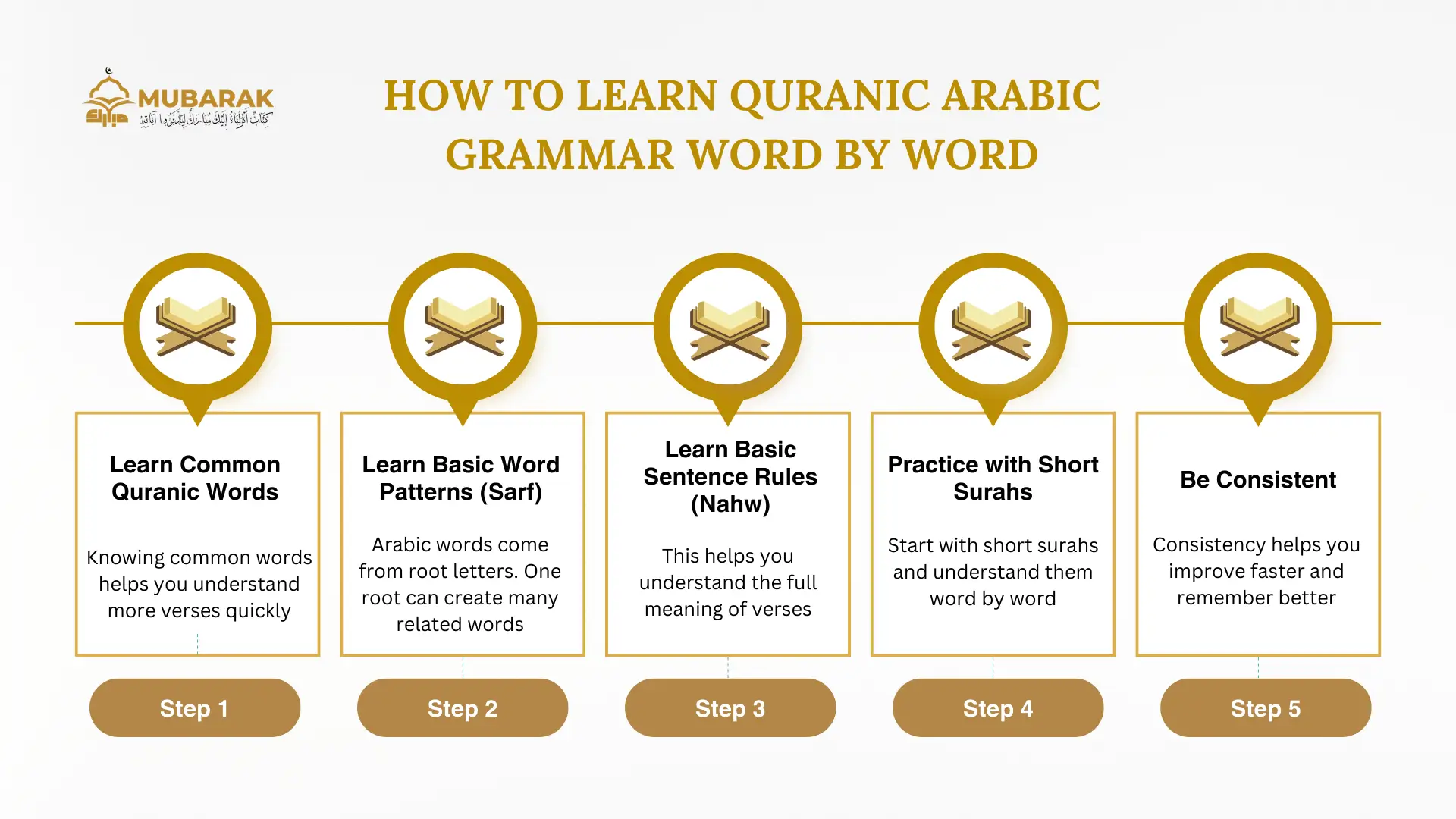
Step 1: Learn Common Quranic Words
Many words repeat throughout the Quran. Start with these words so you can recognize them easily.
Examples:
- رب – Lord
- قال – He said
- آمنوا – They believed
Knowing common words helps you understand more verses quickly.
Step 2: Learn Basic Word Patterns (Sarf)
Arabic words come from root letters. One root can create many related words.
Example from ك-ت-ب:
- كتب – he wrote
- كتاب – book
- كاتب – writer
This makes learning vocabulary easier.
Step 3: Learn Basic Sentence Rules (Nahw)
Learn how sentences work by identifying:
- The action (verb)
- Who did the action (subject)
- What received the action (object)
This helps you understand the full meaning of verses.
Step 4: Practice with Short Surahs
Start with short surahs and understand them word by word. This helps you apply what you learn and builds confidence.
Step 5: Be Consistent
Study a little every day, even 20-30 minutes. Consistency helps you improve faster and remember better.
Discover the Best Place to Learn Arabic Online
Key Grammar Rules Used Most in the Quran
While Arabic grammar is vast, some rules appear repeatedly in the Quran:
1. Nominal and Verbal Sentences
In Arabic, sentences usually fall into two main types:
Nominal sentences (الجملة الاسمية) start with a noun and often describe a state or fact.
- Example: ٱللَّهُ غَفُورٌ رَّحِيمٌ (Allah is Forgiving and Merciful).
- This type of sentence emphasizes stability and permanence.
Verbal sentences (الجملة الفعلية) start with a verb and describe an action.
- Example: خَلَقَ ٱللَّهُ ٱلسَّمَٰوَٰتِ وَٱلْأَرْضَ (Allah created the heavens and the earth).
- This focuses on the action itself.
Understanding the difference helps you see whether a verse is describing a constant truth or a specific action.
2. Past and Present Verb Forms
Verb tense in Arabic tells you whether an action has already happened, is happening now, or will happen.
- Example (past tense): خَلَقَ ٱلْإِنسَٰنَ ( He created mankind).
- Example (present tense): يَعْلَمُ مَا فِي ٱلسَّمَٰوَٰتِ (He knows what is in the heavens).
The present tense in the Quran often shows continuous and ongoing actions, especially when describing Allah’s knowledge, mercy, or power.
3. Subject (Fa’il) and Object (Maf’ool)
Grammar helps you clearly identify who is doing the action and who is receiving it.
Example: Allah created mankind
خَلَقَ ٱللَّهُ ٱلْإِنسَٰنَ
Here:
- ٱللَّهُ is the subject (the one who created)
- ٱلْإِنسَٰنَ is the object (the one who was created)
This clarity prevents confusion and helps you understand the verse correctly.
4. Case Endings (الإعراب – I‘rab)
In Arabic, the ending of a word changes depending on its role in the sentence. These small changes carry important meaning.
5. Attached Pronouns
The Quran often uses pronouns attached directly to words. These pronouns show possession or indicate who is being addressed.
Example: رَبِّكَ (Your Lord)
- The attached كَ means your.
Another example: خَلَقْنَاكُمْ (We created you)
- The attached كُمْ means you (plural).
Recognizing these pronouns helps you immediately understand who the verse is referring to.
Learn Quranic Arabic Grammar with Expert Guidance
Self-study is possible, but structured learning with expert teachers accelerates progress. A qualified instructor can:
- Simplify complex grammar concepts
- Explain difficult verses clearly
- Provide structured lessons step by step
- Correct mistakes early
- Keep you consistent and motivated
A guided Arabic language course ensures you build a strong foundation rather than learning random rules without context.
Whether you are a beginner or already studying Islamic sciences, learning advanced and basic Quranic Arabic grammar with expert support can dramatically improve your understanding.
Conclusion
When you choose to learn Quranic Arabic grammar, you’re choosing to connect with the Qur’an in a deeper and more personal way. It’s no longer just recitation; it becomes understanding.
It might feel a little overwhelming at the beginning, and that’s completely normal. But with steady effort and patience, it gets easier and more meaningful.
Take it one step at a time. Stay consistent. And remember, every small step you take to learn Quranic Arabic grammar brings you closer to truly understanding Allah’s words.
FAQs About Learning Quranic Arabic Grammar
1. Is Quranic Arabic different from modern Arabic?
Yes. Quranic Arabic follows classical grammar rules and vocabulary, which can differ from modern spoken dialects used in daily conversation.
2. How long does it take to learn Quranic Arabic grammar?
It depends on your consistency and study routine, but with regular learning and practice, many students build a solid foundation within 6–12 months.
3. Can beginners learn Quranic Arabic grammar?
Absolutely. Beginners can start with basic vocabulary and simple grammar concepts, then gradually advance step by step.
4. Do I need to learn Sarf and Nahw?
Yes. Sarf (word patterns) and Nahw (sentence structure) are both essential for understanding how Quranic Arabic works and for gaining deeper comprehension of the verses.
5. Can I learn Quranic Arabic online?
Yes. Many structured online programs provide clear lessons, qualified teachers, and flexible schedules to help students learn effectively from anywhere.