

Every serious student of hifz eventually faces the same challenge — memorizing new ayat while keeping older ones secure. The Quran contains 6,236 ayat across 114 surahs, and no single memorization method works for every learner. Scholars and teachers of tajweed and hifz have developed and refined dozens of techniques over centuries, drawing on principles of repetition, understanding, and consistent revision (muraja’ah). What distinguishes a Hafiz who completes the Quran from one who stalls mid-journey is rarely raw ability — it is almost always method and consistency.
This guide covers 15 proven Best Quran memorization techniques, organized by purpose: core methods for building new memorization, advanced methods for stronger retention, and daily practice methods that turn hifz into a lifelong habit.
What Are the Best Quran Memorization Techniques?
The best Quran memorization techniques are structured methods that combine controlled repetition, consistent revision, and gradual progression through the Mushaf. Successful Huffaz typically select 3 to 5 techniques that match their learning style and apply them within a fixed daily routine that balances new memorization with muraja’ah (ongoing revision of previously memorized portions).
No technique works in isolation. The methods below are most effective when embedded in a daily schedule that protects both new and old memorization.
5 Core Quran Memorization Techniques:
These five methods form the foundation of most successful hifz programs. They are widely taught by Quran teachers and are effective for learners at any stage.
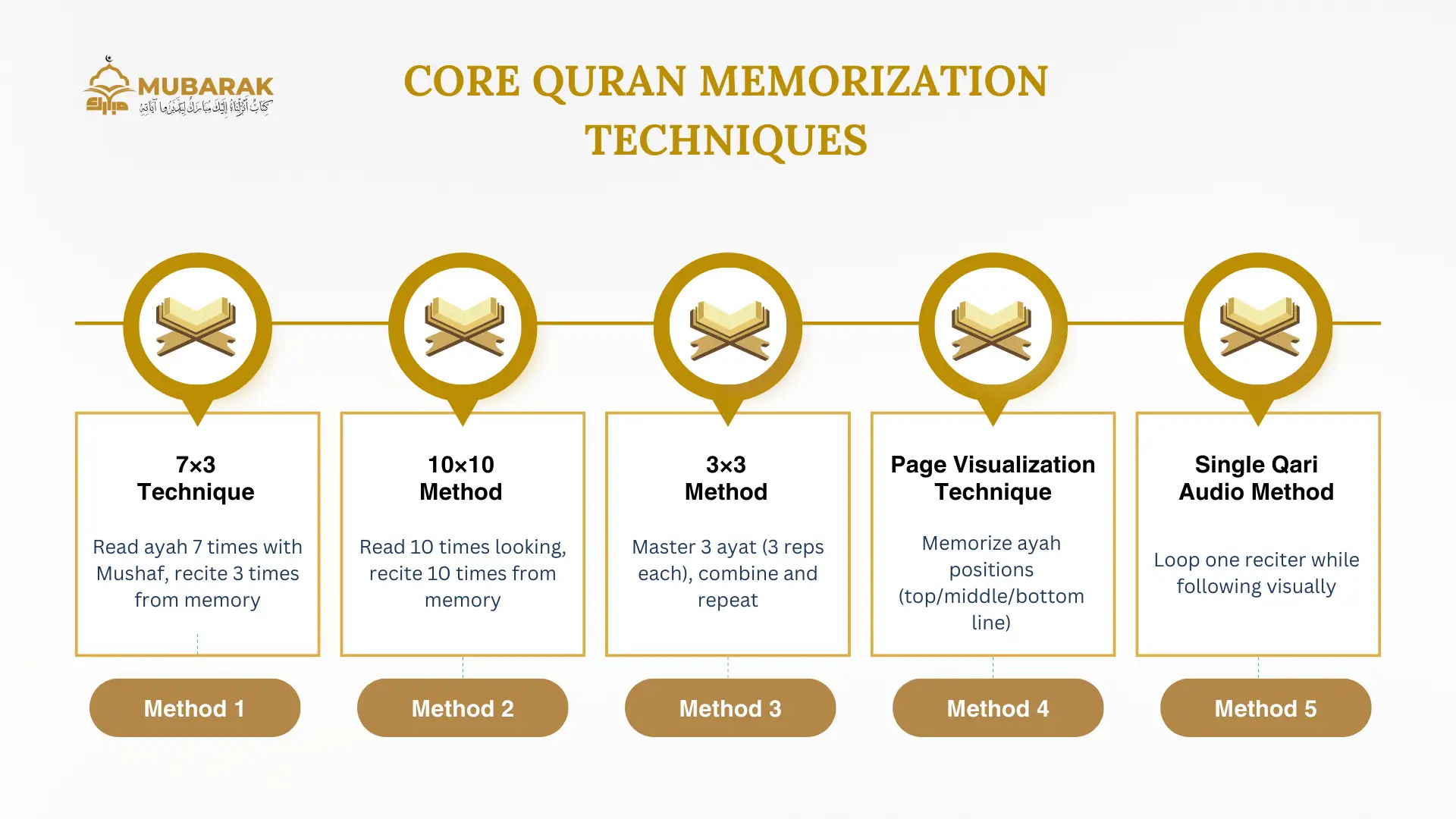
1. The 7×3 Technique
The 7×3 technique is one of the most widely recommended methods for beginners and for daily new memorization. The process is straightforward:
- Read the ayah from the Mushaf 7 times, following along carefully with both eyes and lips.
- Close or lower the Mushaf and recite the same ayah from memory 3 times.
The first seven repetitions build visual and oral familiarity with the ayah. The three memory recitations immediately test and reinforce retention. Because the ratio favors looking-then-recalling rather than pure repetition, learners move from recognition to recall in a single session — a critical distinction in hifz.
This method is particularly suited to learners who are new to structured memorization or who are working through ayat of moderate length. Those who want to deepen precision can pair it with quran memorization word by word to build accuracy at the word level before moving to full-verse repetition.
2. The 10×10 Method
For longer or more complex ayat — particularly those with similar phrasing to other verses — the 10×10 method applies deeper repetition:
- Read the ayah from the Mushaf 10 times with full attention to every word.
- Recite the same ayah from memory 10 times without looking.
The higher repetition count strengthens recall for passages that are easily confused with similar verses elsewhere in the Quran, such as repeated phrases across different surahs. This method demands more time per ayah but produces firmer long-term retention.
3. The 3×3 Method
Where the 7×3 and 10×10 methods focus on individual ayat, the 3×3 method for memorizing quran builds connections between consecutive verses:
- Memorize 3 ayat individually.
- Recite each ayah 3 times while looking at the Mushaf.
- Recite all 3 ayat together from memory 3 times.
- Repeat the full group until the passage flows without hesitation.
This approach trains the mind to associate the ending of one ayah with the opening of the next — a skill that is essential during prayer and during longer recitation sessions. Many Huffaz report that the 3×3 method significantly reduces the experience of “losing the thread” mid-surah.
4. The Page Visualization Technique
The Mushaf has a fixed layout. In most standard editions — particularly the Madinah Mushaf used in hifz schools — each page contains a consistent number of lines, and each ayah occupies a recognizable position on the page. The page visualization technique uses this physical structure as a memory anchor:
- While reading each ayah, note its position on the page — whether it begins at the top, in the middle, or near the bottom, and whether it flows onto the next line.
- During recitation from memory, mentally reconstruct the page layout and use it to locate the ayah in your visual memory.
Over time, the Hafiz develops a spatial memory of the Mushaf. This is why many experienced Huffaz, when they hesitate during recitation, describe “seeing” the page rather than simply trying to remember words. This technique is most effective when a single edition of the Mushaf is used consistently throughout the memorization journey.
5. The Single Qari Audio Method
Listening is one of the most natural pathways to Quran memorization, given the oral tradition through which the Quran has been transmitted across generations. The single qari method disciplines this listening:
- Select one reciter whose pronunciation, tajweed, and recitation style you will follow exclusively during your memorization period.
- Listen to the ayat you are memorizing repeatedly while following along in the Mushaf.
- Recite aloud in imitation of the qari’s rhythm and tone.
Using a single qari prevents the mental confusion that arises when a learner switches between multiple reciters with different tempos or stylistic variations. Commonly used reciters in hifz programs include Sheikh Mahmoud Khalil Al-Husary (known for his clear, measured pace suited to memorization), Sheikh Mishary Rashid Al-Afasy, and Sheikh Abdur-Rahman As-Sudais. The choice of reciter should be consistent and intentional from the start.
5 Advanced Quran Memorization Techniques:
These methods are most beneficial for students who have established a memorization routine and are working to strengthen retention, reduce errors, or accelerate progress.
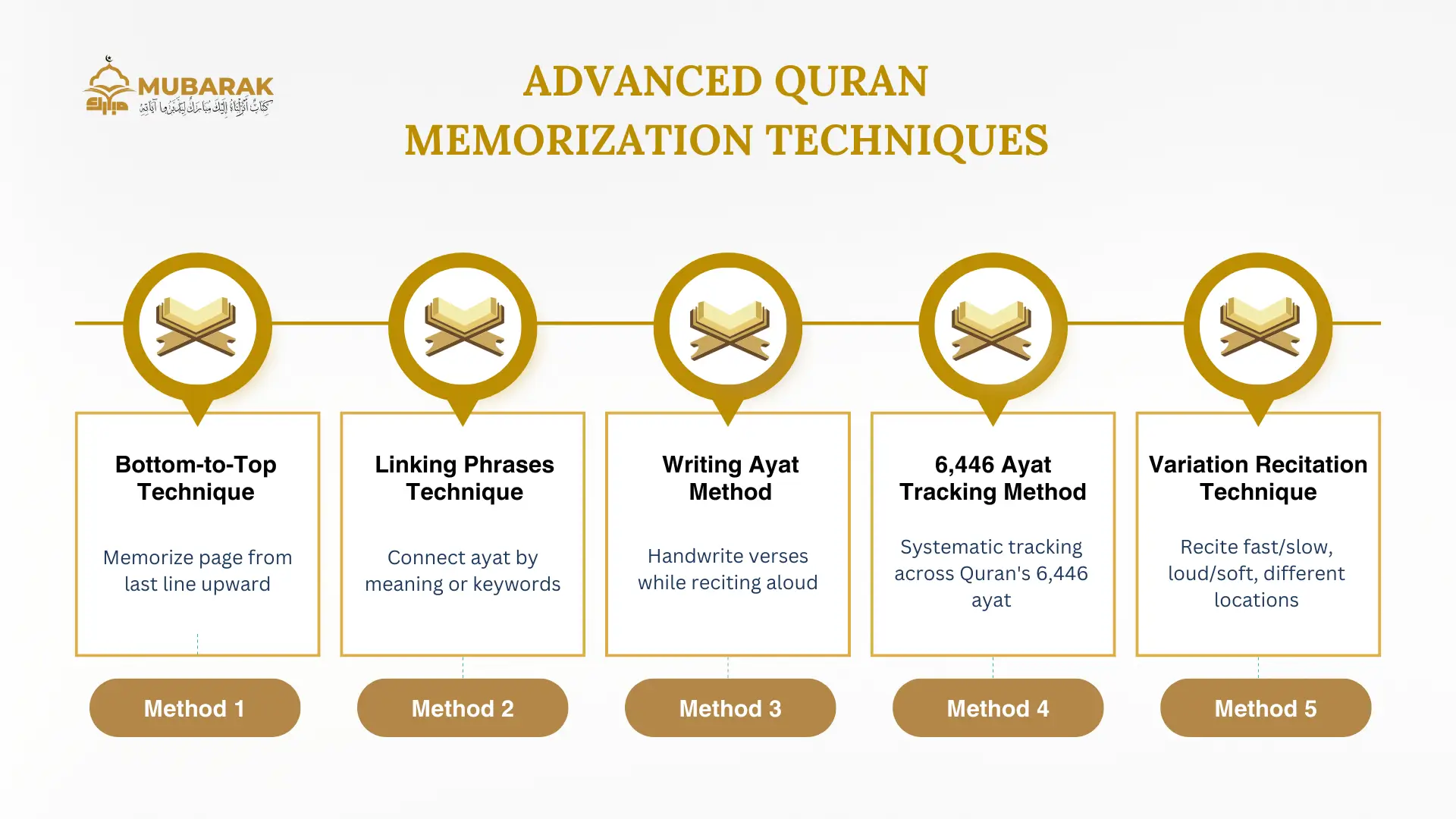
1. The Bottom-to-Top Technique
Standard memorization moves from the first ayah of a page to the last. The bottom-to-top technique reverses this sequence:
- Begin with the last ayah on the page.
- Memorize upward, ayah by ayah, until you reach the top of the page.
- Then recite the page from top to bottom in its correct order.
This method is particularly effective for revision (muraja’ah) because it prevents learners from relying on momentum — the habit of reciting the first portion of a page fluently while forgetting what comes after the midpoint. It also helps with pages that contain ayat similar to those on adjacent pages.
2. The Meaning-Based Linking Technique
Arabic is a language of precise semantic relationships, and the Quran’s structure often places thematically connected ayat in deliberate sequence. The linking technique leverages this:
- Before memorizing a group of ayat, read a reliable tafsir (Quranic commentary) to understand the meaning and context of the passage.
- Identify the connecting theme or logical flow between consecutive ayat.
- Use that thematic connection as a memory bridge — when you recall the meaning of one ayah, it points toward the content of the next.
This technique does not replace repetition — it complements it. Understanding the relationship between ayat makes memorization feel like following a coherent argument rather than storing disconnected phrases. Scholars such as Ibn Kathir (rahimahullah) emphasized understanding context as foundational to meaningful recitation.
3. The Writing Method
Writing by hand engages a distinct set of cognitive and motor processes that reinforce memorization through a different channel than speaking or listening:
- Write the ayah by hand, reciting it aloud as you write.
- Set the writing aside and recite the ayah from memory.
- Compare your recitation to the Mushaf and correct any errors.
This method is especially effective for fixing ayat that a learner keeps misquoting or confusing. The physical act of writing, combined with simultaneous oral recitation, creates multiple reinforcing memory traces. It is also a useful diagnostic tool — errors that appear in a learner’s writing often reveal the precise word or phrase that has not been fully secured.
4. The Structured Progress Tracking Method
The Quran contains 6,236 ayat, 114 surahs, and 30 juz. Without a clear tracking system, a learner can lose perspective on where they stand and what requires attention. The structured tracking method treats hifz as a managed project:
- Maintain a written or digital log divided into three categories: newly memorized, recently consolidated, and long-term memorized.
- Review the log regularly and schedule revision sessions based on which portions are most at risk of fading.
- Set weekly and monthly milestones.
This approach is not merely organizational — it is motivational. Seeing measurable progress across a structured record reinforces commitment during periods when daily sessions feel difficult.
5. The Varied Recitation Technique
Memorization that only ever occurs in one setting, at one speed, and at one volume becomes dependent on those conditions. The varied recitation technique builds flexible, context-independent recall:
- Recite sometimes at a slow, deliberate pace (tarteel) and sometimes at a moderate pace.
- Alternate between reciting aloud, at a low volume, and silently.
- Recite in different locations — at home, in the masjid, outdoors, during a commute.
This variation prevents the mind from anchoring memorization to a single environmental or sensory condition. A Hafiz trained through varied recitation will be equally secure during prayer, during tarawih, and during a formal recitation before a teacher.
5 Daily Practice Techniques for Long-Term Retention:
Consistent daily practice is what separates memorization that lasts from memorization that fades. These techniques are designed to be integrated into an existing daily routine without requiring large additional time commitments.
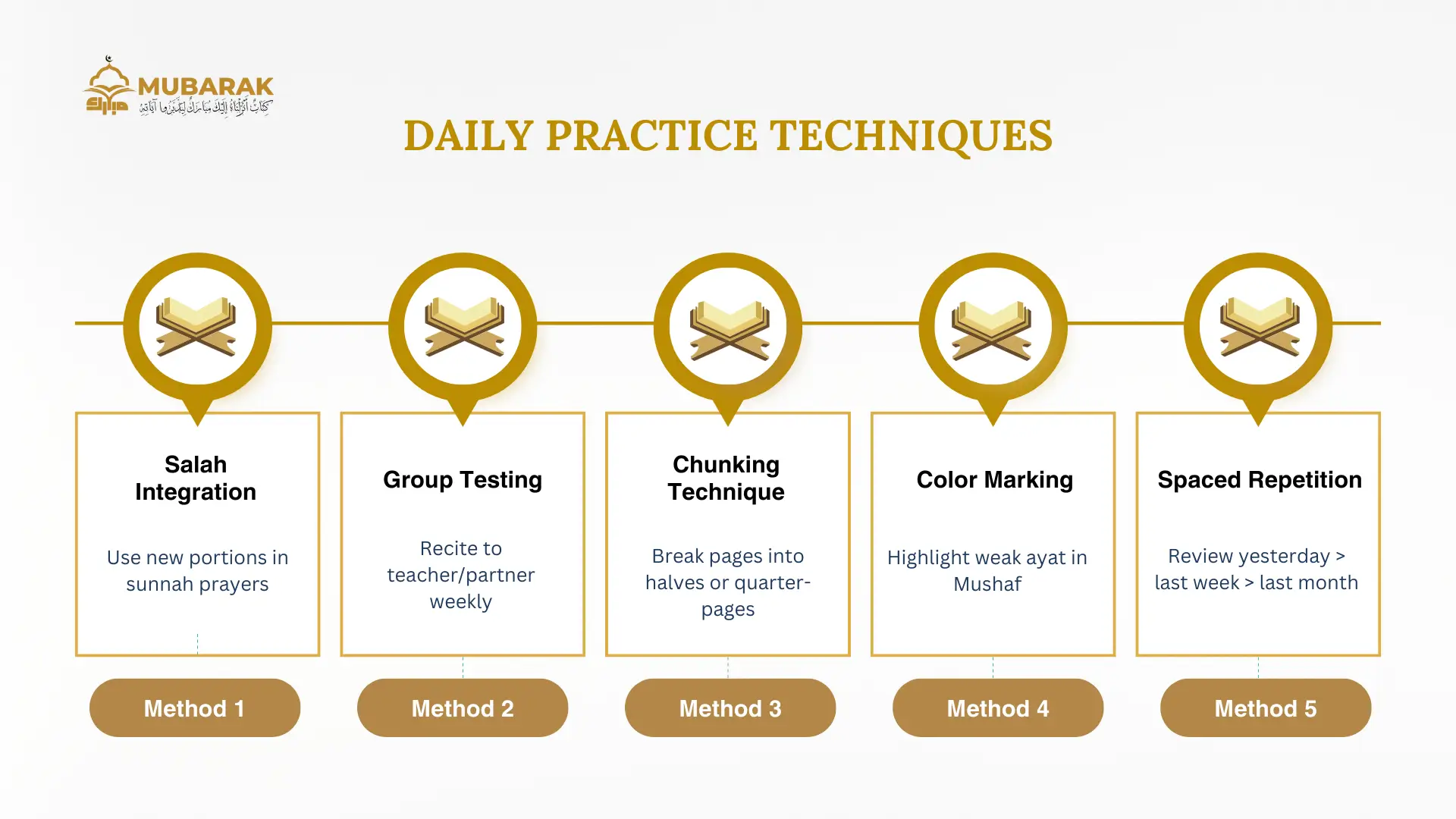
1. Salah Integration
The five daily prayers are the most natural and spiritually grounded context for applying new memorization. Rather than reserving newly memorized ayat only for dedicated practice sessions:
- Recite newly memorized ayat in the sunnah or nafl (voluntary) prayers that accompany the obligatory prayers.
- Rotate through recently memorized passages across different prayers throughout the week.
This approach moves memorization from a study exercise into active, repeated use — the same mechanism that allowed the Companions of the Prophet Muhammad ﷺ to maintain their Quran recitation through the structure of daily worship.
2. Accountable Group Recitation
Reciting before another person — whether a teacher, a family member, or a memorization partner — provides a level of attention and accountability that solitary practice cannot replicate:
- Establish a weekly session in which you recite a set portion before your teacher or partner.
- Allow them to correct errors, note hesitations, and confirm which passages are secure.
The early Muslim community placed high value on reciting the Quran to a qualified teacher, and the chain of transmission (sanad) in Quran recitation has been maintained through this practice for over fourteen centuries. Even informal group accountability significantly improves retention and catches errors before they become habitual.
For learners without access to a local teacher, a structured Quran Memorization Course provides the same accountability — weekly recitation sessions, error correction, and a consistent revision schedule.
3. The Chunking Method
A full page of the Mushaf can contain between 10 and 20 ayat depending on surah and verse length. Approaching a full page as a single memorization unit can create cognitive overload. The chunking method addresses this:
- Divide each page into two or three manageable portions — typically a half-page or quarter-page each.
- Memorize and consolidate each portion completely before moving to the next.
- At the end of the session, recite the full page as one connected unit.
Smaller targets allow the learner to reach a clear point of completion within a single session, which maintains motivation and reduces errors caused by fatigue.
4. Color Marking for Targeted Revision
Not every ayah requires the same amount of revision. Some passages are memorized firmly after the initial session; others require weeks of additional reinforcement. Color marking creates a visual map of the learner’s strengths and weaknesses:
- Using a light pencil or highlighter, mark ayat that feel uncertain or error-prone after each session.
- During revision, prioritize these marked passages before reviewing stronger portions.
- Remove marks only when the ayah has been recited correctly and without hesitation across multiple sessions.
This method makes revision more precise and prevents the common habit of over-revising already-strong portions while neglecting weaker ones.
5. Spaced Repetition
The forgetting curve — documented in educational research and consistent with the experience of hifz teachers — shows that memorized material fades fastest in the days immediately following initial learning, and more slowly thereafter. Spaced repetition counters this by scheduling revision at increasing intervals:
- Revise the previous day’s memorization at the start of every session.
- Revise portions from the past week at least twice during the week.
- Revise portions memorized within the past month at least once per week.
- Revisit older memorization monthly to prevent long-term fading.
This structure ensures that every portion of what has been memorized receives reinforcement at the point when it is most at risk of being forgotten. For a complete system on how to memorize Quran without forgetting, this revision schedule is the foundation every method builds on.
How to Choose the Right Combination of Techniques?
No learner should attempt to implement all 15 techniques simultaneously. A sustainable hifz system is built from a small number of methods chosen with intention:
- Beginners benefit most from combining the 7×3 technique, salah integration, and spaced repetition as a foundation.
- Intermediate learners who have completed several juz should add the meaning-based linking technique and structured progress tracking to strengthen retention.
- Advanced students working on completing or reviewing the full Quran should incorporate varied recitation and bottom-to-top revision to address weak passages and prevent over-reliance on familiar patterns.
The selection should be reviewed periodically with a qualified Quran teacher who can assess which passages are weakening and recommend adjustments.
How Many Techniques for Memorizing Quran?
There is no fixed number of Quran memorization techniques, as huffaz and scholars have developed dozens over centuries, but experts commonly list 10-25 effective ones.
What matters most is choosing methods that match your learning style and sticking to them consistently.
Successful memorization usually includes:
- A clear daily routine
- Balanced new memorization and revision
- Repetition with understanding
- Regular review (muraja’ah)
When these elements work together, memorization becomes stronger and easier to maintain.
Why So Many Quran Memorization Techniques Exist?
There are so many Quran memorization techniques simply because everyone learns differently. Some people remember best by repeating out loud, others by listening carefully, and some by reviewing again and again. What feels easy for one person may feel difficult for another.
Memorization also isn’t just one step. You first learn new ayat, then you work on strengthening them, and later you focus on keeping older memorization strong. Each stage needs a slightly different approach.
Life plays a role too. A child, a student, or a busy adult won’t all follow the same routine. That’s why having different techniques helps people stay consistent without feeling overwhelmed.
Learn Quran Memorization With Mubarak Academy
Mubarak Academy provides structured online hifz programs for students of all ages and levels. Each student is paired with an experienced Quran teacher who designs a personalized memorization plan, balancing new ayat with regular muraja’ah and tajweed correction.
Programs offered by Mubarak Academy include the Quran Memorization Course, the Online Tajweed Course, and the Quran Ijazah Course — for students who seek a formal certification of their recitation through an authenticated chain of transmission.
Our Recommended Courses
Conclusion
Memorizing the Quran is not about speed; it’s about consistency, structure, and sincerity. By using the best Quran memorization techniques and committing to regular revision, anyone can successfully memorize and retain the Quran. With proper guidance and a supportive learning environment, the journey becomes both easier and more rewarding.
If you’re ready to take the next step, learning Quran memorization with the right system can make all the difference.
FAQs About Quran Memorization Techniques
What is the best Quran memorization technique for a complete beginner?
The 7×3 technique applied to 3 to 5 verses daily is ideal for beginners. It prioritizes accuracy over volume, ensuring a small portion is memorized correctly and retained rather than a large portion learned loosely. Establishing a fixed, protected daily time is critical to building this foundational habit smoothly.
How many times should I repeat an ayah to memorize it properly?
Generally, you should repeat the verse 10 to 20 times while looking directly at the Mushaf to secure visual memory, followed by 5 to 10 times from memory. Continue this deliberate process until you can recite the entire verse smoothly, fluidly, and without any hesitation.
Which memorization technique is best if I have a weak memory?
For a weaker memory, lean heavily on high repetition, consistent audio listening to a single reciter, and structured daily revision. Methods like the 10×10 technique, the 3×3 system, and systematic spaced repetition are highly effective at moving verses securely from short-term to long-term memory retention.
Are there techniques to avoid mixing similar ayat and surahs?
Yes, utilizing page visualization techniques, analyzing the subtle contextual differences, and deeply understanding the linguistic meaning of the verses help reduce confusion. Focusing on the exact placement of identical phrases (Mutashabihat) prevents your mind from mixing similar verses or jumping incorrectly between different chapters.
Do children and adults need different techniques?
While core memorization mechanisms remain identical, implementation differs. Children thrive on shorter, highly interactive sessions packed with intense auditory repetition and gamified milestones. Conversely, adults benefit more from highly structured plans, deep conceptual understanding of the text, and self-disciplined, systematic daily revision cycles to maintain their hifz.

Ustadh Ahmed Mahmoud Abdulaziz is an experienced teacher of Arabic and the Holy Quran for native and non-native speakers. He holds a verified Ijazah in Hafs ‘an Asim and is certified in the foundational Tajweed texts Al-Jazariyyah and Tuhfat Al-Atfal. Drawing on his extensive background in traditional Quranic recitation and international pedagogy, he writes scholar-verified, accessible articles to help students worldwide master Tajweed rules and Arabic linguistics safely and accurately.