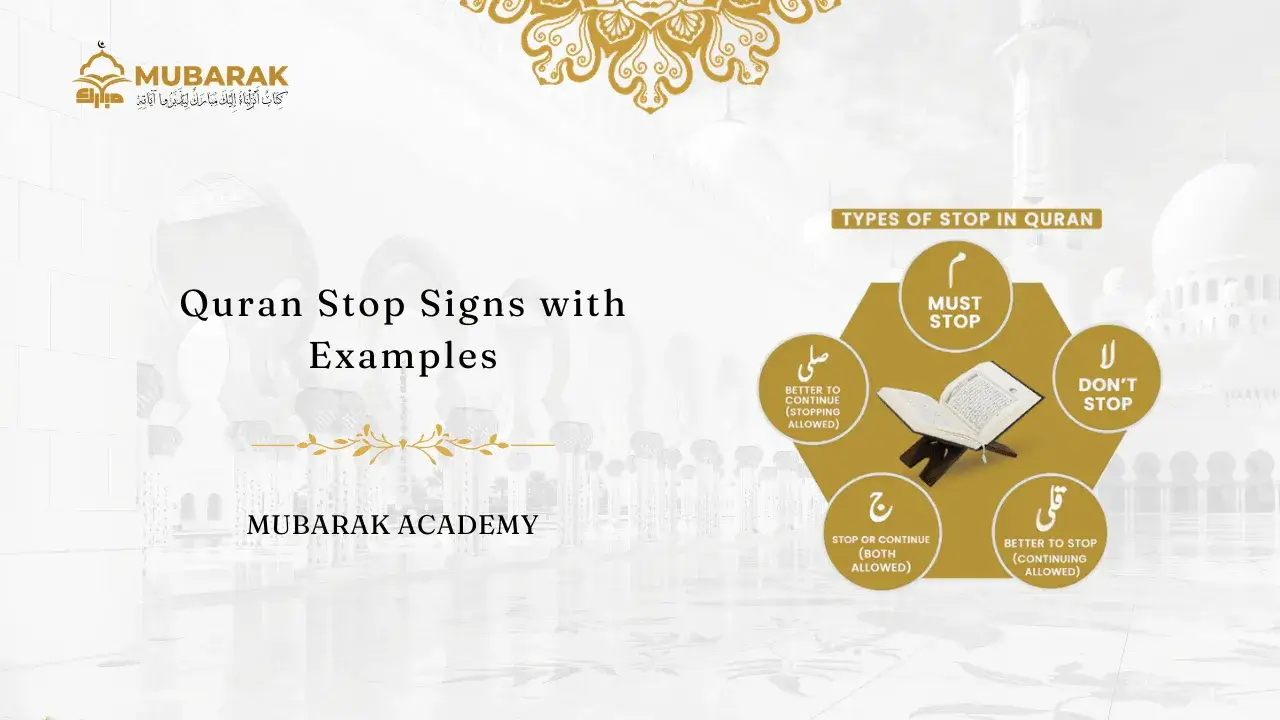
If you are learning Tajweed, you have probably seen small Arabic letters like م, ط, or لا in the Mushaf. These are not random markings; they are important stopping signs in Tajweed, which teaches you when to pause and when to continue so that the meaning stays correct.
In this guide, you’ll learn the major quran stop signs with examples, understand what each symbol means, and when to stop or continue so you can recite with confidence and accuracy.
What Is Stop Sign in Quran (Waqf)?
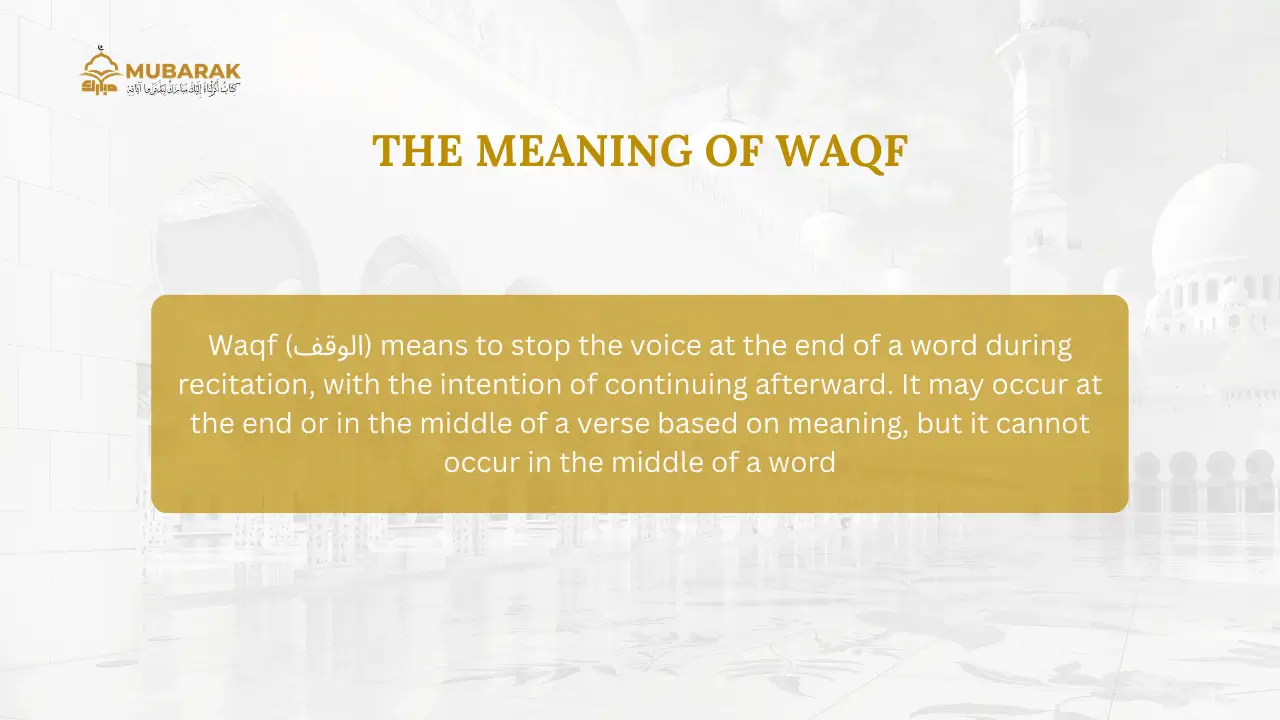
Waqf (الوقف) means stopping or pausing during recitation in a way that preserves the meaning of the verse.
If you are trying to learn Tajweed Quran online, understanding Waqf is one of the most important foundations of correct recitation.
The Arabic stop sign in quran was added by scholars of recitation to help readers avoid:
- Stopping at places that distort meaning
- Continuing when a pause is required
- Misunderstanding grammatical structures
Understanding the symbols in the quran and their meaning ensures that your recitation is accurate and meaningful.
In fact, many classical scholars considered mastering Waqf essential for advanced recitation. That’s why students studying Tajweed rules with examples always learn stopping rules alongside pronunciation.
Quran Stop Signs with Examples and Their Meaning
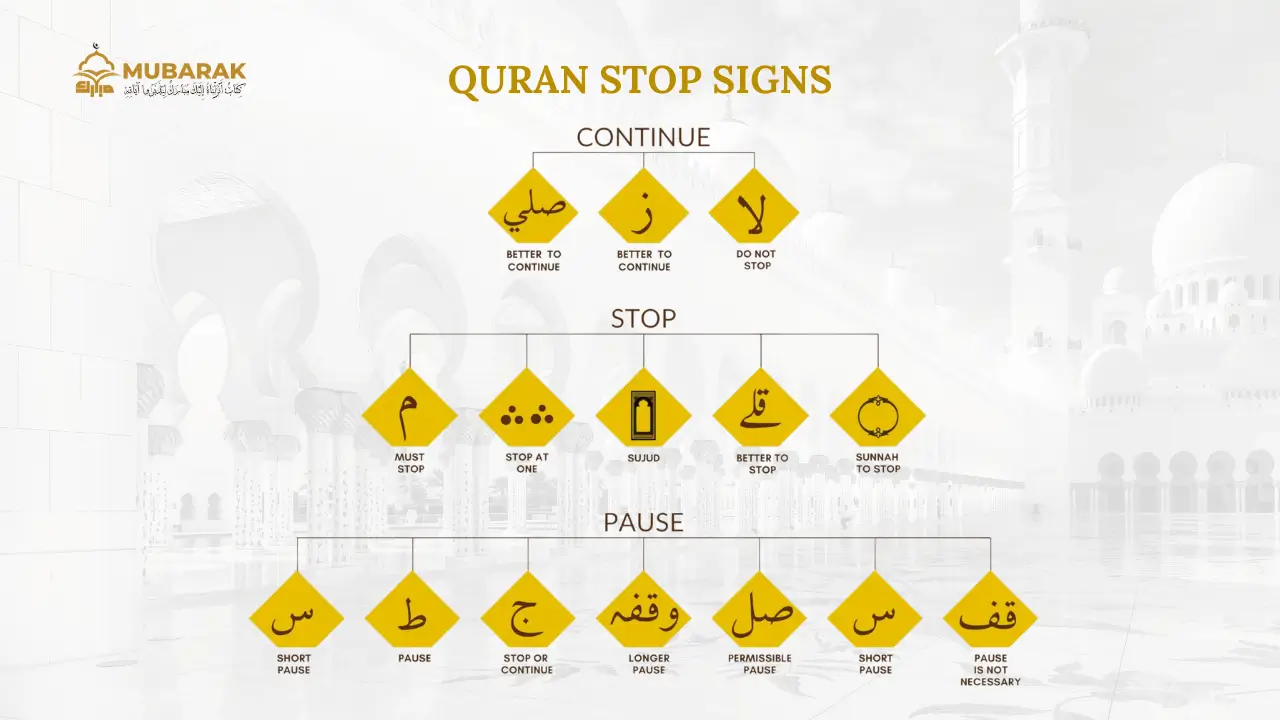
Scholars identified several major types of waqf signs to guide proper recitation and protect the meaning of the Qur’an. These symbols help you know when to pause, when to continue, and how to keep the message clear and accurate.
Let’s explain quran stop signs with examples in a simple way:
1. لا – Lā (Do Not Stop)
Meaning: Do not stop here.
Rule: Stopping would damage or distort the meaning.
Example in Surah An-Nisa:
يَا أَيُّهَا الَّذِينَ آمَنُوا لَا تَقْرَبُوا الصَّلَاةَ وَأَنْتُمْ سُكَارَىٰ
If someone stopped after “Do not approach prayer,” the meaning would be completely wrong. The rest of the sentence clarifies the condition.
2. ز – Waqf Mujawwaz (Allowed Stop, Better to Continue)
Meaning: Stopping is permitted, though continuation is generally preferred unless needed for breath.
Rule: Stop only if you need to catch your breath.
Example in Surah Ash-Shu‘ara:
قَالُوا إِنَّا إِلَىٰ رَبِّنَا مُنقَلِبُونَ
Continuing the sentence makes it flow more smoothly.
3. صلى – Silā (Better to Continue)
Meaning: Continuing is preferred, but stopping is allowed.
Rule: Try not to stop unless necessary.
Stopping here may slightly weaken the flow of the sentence.
4. قلى – Qilā (Better to Stop)
Meaning: Stopping is better, but continuing is still valid.
Rule: Pause if possible to improve clarity and reflection.
These often appear where a pause helps you reflect more deeply on the meaning.
5. ∴ – Mutual Stop (Mu‘ānaqah)
What it means: You’ll see two possible stopping points. You stop at one — not both.
Rule: Choose one place to pause and continue through the other.
This appears in longer verses with balanced meanings.
6. قف – Qif (Stop Here)
What it means: A direct instruction to stop.
Rule: Stopping is recommended to maintain clarity and structure.
7. م – Waqf Lāzim (Mandatory Stop)
Meaning: You must stop here. Continuing would change or distort the meaning.
Rule: Stopping is required to avoid changing the meaning.
Example in Surah Al-An‘am:
إِنَّمَا يَسْتَجِيبُ الَّذِينَ يَسْمَعُونَ ۘ وَالْمَوْتَىٰ يَبْعَثُهُمُ اللَّهُ ثُمَّ إِلَيْهِ يُرْجَعُونَ
Stopping after يَسْمَعُونَ is required. If you continue without stopping, it may incorrectly link the living and the dead in meaning.
8. ط – Waqf Mutlaq (Complete Stop)
Meaning: The meaning of the sentence is complete.
Rule: Stopping is strongly recommended, though continuing is still allowed.
Example in Surah Al-Baqarah:
ذَٰلِكَ الْكِتَابُ لَا رَيْبَ ۛ فِيهِ ۛ هُدًى لِّلْمُتَّقِينَ
The statement feels naturally complete. Pausing here makes the recitation clearer and more powerful.
9. ج – Waqf Jā’iz (Permissible Stop)
Meaning: Both stopping and continuing are acceptable.
Rule: Choose based on breath and rhythm.
Example in Surah Al-Baqarah:
لَيْسَ عَلَيْكُمْ جُنَاحٌ أَن تَبْتَغُواْ فَضْلاً مِّن رَّبِّكُمْ
Stopping or continuing does not affect the meaning.
10. ص / س – Waqf Saktah (Light Silent Pause)
Meaning:
Saktah (سكتة) is not the same as a normal stop sign system. It refers to specific transmitted pauses in certain recitations (especially Hafs), and they are very limited (like in Surah Kahf, Yasin, Qiyamah, Mutaffifin).
Rule: Pause briefly, then continue immediately.
Example in Surah Al-Mutaffifin:
كَلَّا ۖ بَلْ ۜ رَانَ عَلَىٰ قُلُوبِهِم
This small pause adds emphasis without breaking the rhythm of recitation.
Descriptive Waqf Types (Meaning-Based)
Beyond printed symbols, scholars classify stops based on meaning. When studying all symbols in quran, it is important to understand both printed and meaning-based categories.
These include:
- Waqf Tām (Complete Stop): Meaning fully complete (Stopping here is completely correct).
- Waqf Kāfī (Sufficient Stop): Meaning is complete, but the next part is still related (Stopping is allowed and correct).
- Waqf Ḥasan (Good Stop): Stopping is acceptable, but the sentence is still connected to what comes after (It’s better to continue if possible).
- Waqf Qabīḥ (Bad Stop): Stopping here is incorrect because it changes or harms the meaning (This type of stop should be avoided).
These categories explain the deeper waqf meaning in quran, beyond just following printed symbols.
Importance of Knowing Waqf Meaning in Quran
The Quran is the word of Allah, revealed with beauty and accuracy. Nothing in it is random, not even the pauses between words. The way we recite matters.
Allah says:
And recite the Quran with measured recitation (Surah Al-Muzzammil 73:4)
That’s why learning symbols in the quran and their meaning protects the message of the Qur’an.
If you stop in the wrong place:
- The meaning can change
- The message can become unclear
When you apply the correct stopping signs in Tajweed:
- Your recitation becomes clearer
- Your Tajweed improves
- Your understanding deepens
Mastering these quran stop signs is not optional for serious students. It is a foundational part of Tajweed and Qur’anic accuracy.
Learn Also: How to Learn Quran with Tajweed at Home
Start Your Learning Journey with Mubarak Academy
Learning quran signs and symbols is not just about memorizing symbols; it’s about understanding how they protect meaning.
At Mubarak Academy, an Online Quran Academy, students receive structured guidance in:
- Tajweed rules
- Waqf and Ibtidaa (stopping and starting rules)
- Understanding Arabic symbols in quran
- Correct pronunciation
- Practical recitation training
- One-on-one correction with qualified teachers
Our system ensures students master the stop sign in quran, apply proper Tajweed rules stop signs, and confidently understand the symbols in quran and their meaning.
With live online sessions and guided practice, students from around the world can master Qur’anic recitation from home.
Whether you are a beginner or improving your Tajweed, understanding Waqf is a powerful step forward in your Qur’anic journey.
Conclusion
Quran stop signs may look small, but they carry great importance. These quran signs of stopping preserve meaning, protect clarity, and ensure correct recitation.
By studying quran stop signs with examples, you can see how each symbol guides you and prevents mistakes in meaning, and your recitation becomes clearer and more meaningful.
Understanding the sign of stopping when reading quran is not optional for serious learners; it is a necessary step toward accurate and meaningful recitation.
FAQs About Quran Stop Signs (Waqf)
1. What are Qur’an signs of stopping?
They are special symbols (Waqf marks) placed in the Mushaf to guide the reader on where to stop or continue during recitation.
2. Are stop signs part of the original Qur’an?
The symbols were added later by scholars to help preserve correct meaning and pronunciation, but they are not part of the original revealed text.
3. Is it sinful to ignore stop signs?
It depends on the case. Ignoring a mandatory stop may change the meaning, which should be avoided to maintain accurate recitation.
4. Do beginners need to learn Waqf symbols?
Yes. Learning them early improves fluency, accuracy, and understanding of the Qur’an’s meaning.
5. How long does it take to master Qur’an stop signs?
With structured study and regular practice, most students understand the basics within a few weeks.