Salah isn’t just something we check off our daily list; it’s a moment of calm in the middle of everything going on in life. It’s where you pause, take a breath, and reconnect with Allah. No matter how busy or overwhelming your day feels, these five prayers bring you back to what truly matters.
That’s why understanding the Steps on how to perform Salah isn’t just about doing things correctly; it’s about feeling present, focused, and connected. This guide will walk you through everything you need to know.
Importance of Salah in Quran and Hadith
Salah isn’t just an obligation we perform; it’s a daily moment where we pause, breathe, and reconnect with Allah. That’s why it holds such a central place in Islam, mentioned again and again in both the Qur’an and the teachings of the Prophet ﷺ.
In the Qur’an
Allah says in Surah Ankabut:
﴿ إِنَّ الصَّلَاةَ تَنْهَىٰ عَنِ الْفَحْشَاءِ وَالْمُنكَرِ ﴾
This beautiful ayah reminds us that Salah is not just movements; it’s protection. When you stay consistent with your prayers, it naturally keeps you away from wrong actions and helps you stay on the right path.
In the Hadith
The Prophet ﷺ said:
«إِنَّ أَوَّلَ مَا يُحَاسَبُ بِهِ الْعَبْدُ يَوْمَ الْقِيَامَةِ الصَّلَاةُ»
This hadith shows the true weight of Salah. Before anything else, before fasting, charity, or any good deed, you will be asked about your prayer.
Steps on How to Perform Salah
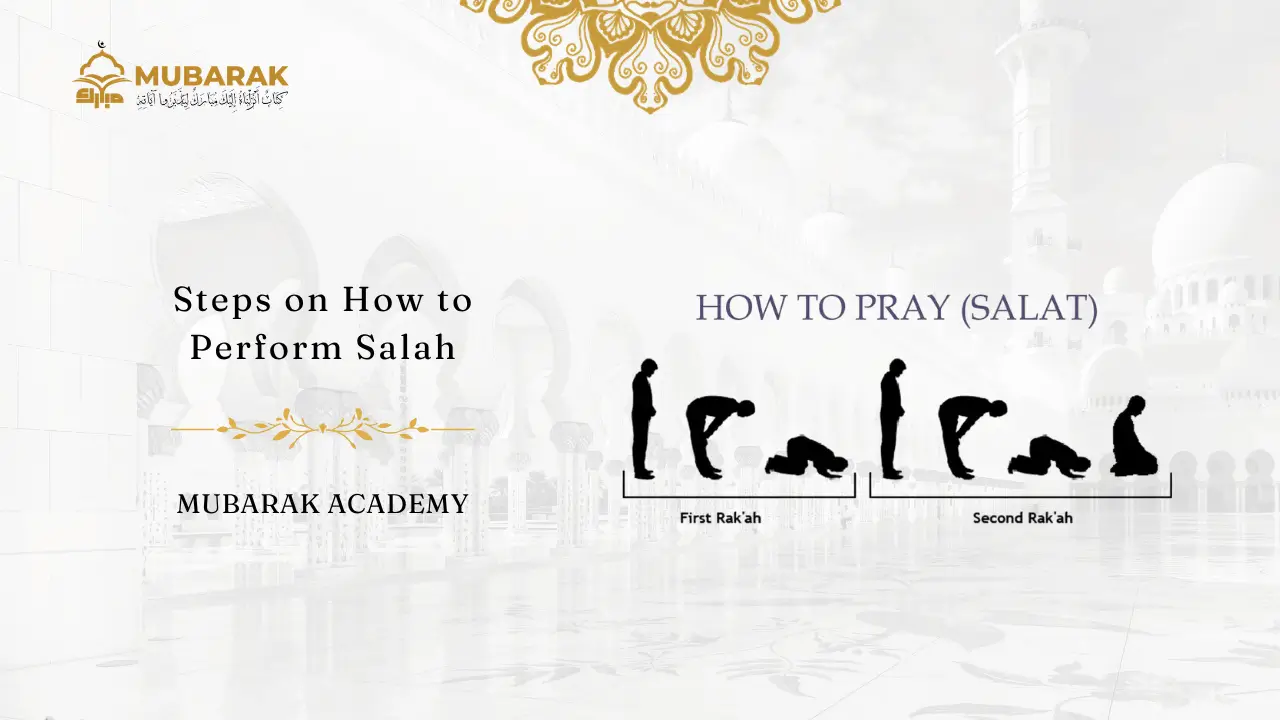
Performing Salah correctly is essential. Here are the steps on how to perform salah:
1. Make the Intention (Niyyah)
Before starting Salah, make a sincere intention in your heart for the specific prayer you are about to perform (e.g., Fajr, Dhuhr). The intention does not need to be spoken aloud.
2. Perform Ablution (Wudu)
Before Salah, you need to be clean by performing Wudu. It’s a simple process that prepares you to stand before Allah.
Allah says:
“O you who believe, when you rise to pray, wash your faces and your hands…” (Surah Al-Ma’idah 5:6)
Simple Steps of Wudu
- Make intention in your heart
- Say Bismillah
- Wash your hands (3 times)
- Rinse your mouth (3 times)
- Clean your nose (3 times)
- Wash your face (3 times)
- Wash your arms up to elbows (3 times, right then left)
- Wipe your head (once)
- Wipe your ears
- Wash your feet up to ankles (3 times, right then left)
After completing Wudu, say:
“Ashhadu an la ilaha illa Allah, wa ashhadu anna Muhammadan ‘abduhu wa rasuluh.”
The Prophet ﷺ said:
“Whoever performs Wudu perfectly, then says this dua, the gates of Paradise will be opened for him.” (Muslim)
3. Face the Qiblah
Before you start praying, take a moment to face the direction of the Kaaba in Mecca. This direction is called the Qiblah, and it’s an essential part of Salah.
If you’re not sure which way to face, don’t worry, just use a Qiblah finder app or compass to guide you. Once you know the direction, you’re ready to begin.
4. Start with Takbir (Takbirat Al-Ihram)
Now, gently raise your hands and say: “Allahu Akbar” (Allah is the Greatest)
This is the moment your prayer officially begins. Take a breath, clear your mind, and focus, you’re now standing in front of Allah 🤍
5. Recite Surah Al-Fatihah
While standing, recite Surah Al-Fatihah, the opening chapter of the Quran. It is a mandatory part of every unit (Rak‘ah) of Salah.
The Prophet ﷺ said:
“There is no prayer for the one who does not recite the Opening of the Book.” (Bukhari)
6. Recite Another Surah
After Al-Fatihah, add a short Surah like Surah Al-Ikhlas or Surah Al-Falaq.
7. Perform Ruku (Bowing)
Now gently bow down, placing your hands on your knees. Keep your back straight and steady.
As you bow, say: “Subhana Rabbiyal Adheem” (Glory be to my Lord, the Most Great) — three times.
8. Stand Up from Ruku
Return to a standing position and say: “Sami’ Allahu liman hamidah” (Allah hears those who praise Him)
Then say: “Rabbana lakal hamd” (Our Lord, to You belongs all praise)
9. Perform Sujood (Prostration)
Place your forehead on the ground and say: Subhana Rabbiyal A’la (3 times)
The Prophet ﷺ said: “The closest a servant comes to his Lord is when he is prostrating.” (Muslim)
10. Sit Between Two Sujood
Sit briefly and say: “Rabb ighfir li” (My Lord, forgive me)
11. Perform the Second Sujood
Repeat the prostration again, saying: “Subhana Rabbiyal A’la” three times.
12. Complete the Rak‘ah
After finishing the second sujood, you’ve now completed one full Rak‘ah (unit of prayer).
If your prayer has more Rak‘ahs, simply stand up again and repeat the same steps:
- Recite Al-Fatihah
- Add a short Surah (in the first two Rak‘ahs)
- Go into Ruku, then Sujood
The number of Rak‘ahs depends on the prayer:
- Fajr → 2 Rak‘ahs
- Dhuhr → 4 Rak‘ahs
- Asr → 4 Rak‘ahs
- Maghrib → 3 Rak‘ahs
- Isha → 4 Rak‘ahs
13. Tashahhud (Sitting for Testimony)
In the final Rak‘ah, instead of standing up again after sujood, you sit down calmly.
Here, you recite the Tashahhud:
at-taḥiyyātu li-llāhi, wa-ṣ-ṣalawātu wa-ṭ-ṭayyibātu. as-salāmu ʿalayka ʾayyuhā n-nabiyyu wa raḥmatu -llāhi wa barakātuhu. as-salāmu ʿalaynā wa ʿalā ʿibādi -llāhi ṣ-ṣāliḥīna. ʾashhadu ʾan lā ʾilāha ʾillā -llāhu wa ʾashhadu ʾanna muḥammadan ʿabduhu wa rasūluhū.
14. End the Prayer with Tasleem
To finish your Salah, gently turn your head to the right and say: “Assalamu Alaikum wa Rahmatullah”
Then turn to the left and repeat it.
This is called Tasleem, and it marks the end of your prayer.
Punishment for Not Praying Salah on Time
After explaining the steps on how to perform salah, let’s explain the punishment of neglecting Salah or delaying it without a valid reason, which is considered a serious matter in Islam.
- The Qur’an warns against those who are careless about their prayers
- Missing Salah can weaken faith and distance a person from Allah
- Some scholars mention severe consequences in the Hereafter for abandoning prayer
The Prophet ﷺ emphasized that Salah is what separates belief from disbelief, showing how critical it is to maintain it on time.
Conclusion
At its core, Salah is a blessing. It’s your personal time with Allah, no distractions, no filters, just you and Him. Every prayer is a chance to reset, to let go of stress, and to ask for guidance and forgiveness.
When you follow the steps on how to perform Salah with care and sincerity, it starts to feel less like an obligation and more like something your heart needs. So don’t rush it, embrace it, stay consistent, and let your Salah bring peace into your life.
If you’d love to explore our classes and meet our experienced teachers, just fill out the form, and we’ll reach out shortly. Just click Register Now!
Frequently Asked Questions About Salah
1. How many times a day should Muslims pray?
Muslims are required to pray five times a day: Fajr, Dhuhr, Asr, Maghrib, and Isha.
2. Can I pray Salah without knowing Arabic?
Yes, you can begin learning gradually. However, essential parts such as Surah Al-Fatihah should be learned in Arabic over time for correct prayer.
3. What invalidates Salah?
Actions such as talking, laughing, eating, or breaking Wudu can invalidate the prayer.
4. How long does it take to learn Salah?
It varies from person to person, but with consistent practice, most people can learn the basics within a few days to a couple of weeks.
5. Can I pray sitting if I am unable to stand?
Yes. Islam allows flexibility, if you are unable to stand due to illness or weakness, you may pray sitting or even lying down.