The Quran is recited in more than one authentic way, and these Different Types of Recitation of Quran are known as the qira’at. There are seven canonical qira’at, each named after a leading imam who mastered it and preserved through named transmitters whose chains reach back to the Prophet Muhammad ﷺ. These variations affect pronunciation, elongation, and points of dialect. They never change the meaning of a single verse. For over 1,400 years, this is how the Qur’an has been kept precise across every generation and region. Understanding the types of Quran recitation helps you recognize why one reader in Egypt may sound different from another in Morocco, even though both recite the same revealed words. In this guide, we explain what the qira’at are, list the 7 qira’at of the Quran and their transmitters, and clarify how a qira’ah differs from a riwayah such as Hafs or Warsh.
What Does Quran Recitation (Tilawah) Mean?
The word “Tilawah” (تلاوة) in Arabic means to follow, to read, and to recite in order, while in Islam, it carries a deeper meaning; it means reciting the Qur’an with correct pronunciation, humility, and heart, just as it was revealed to our beloved Prophet ﷺ.
Tilawah is more than reading aloud; it’s a spiritual journey. Each letter recited brings reward, as the Prophet ﷺ said:
Whoever recites a letter from the Book of Allah will be rewarded with a good deed, and each good deed is multiplied by ten (Tirmidhi)
To recite the Qur’an the right way, you must learn both Tajweed Quran (how to pronounce each letter correctly) and understand the different Types of Recitation of Quran (Qira’at), which together make your recitation accurate, beautiful, and full of meaning.
The 7 Different Types of Recitation of Quran:
The different types of Quranic recitation are called the qira’at (singular qira’ah). There are seven canonical qira’at, each named after the imam who mastered and taught it, and each preserved through two primary transmitters known as rawis. All seven are mutawatir, meaning they were passed down by so many reliable reciters in every generation that error or invention is impossible, and all trace back to the Prophet Muhammad ﷺ.
Before the list, one distinction makes everything clearer. A qira’ah is the reading attributed to one of the seven imams. A riwayah is the specific version of that reading transmitted by one of his students. So “Hafs” and “Warsh,” the two readings most Muslims have heard of, are not qira’at themselves; they are riwayat. Hafs is a transmission of the qira’ah of ‘Asim, and Warsh is a transmission of the qira’ah of Nafi’. The seven qira’at were formally documented by the scholar Ibn Mujahid (d. 324 AH) in his work Kitab al-Sab’ah, which fixed the canonical seven that scholars teach today.
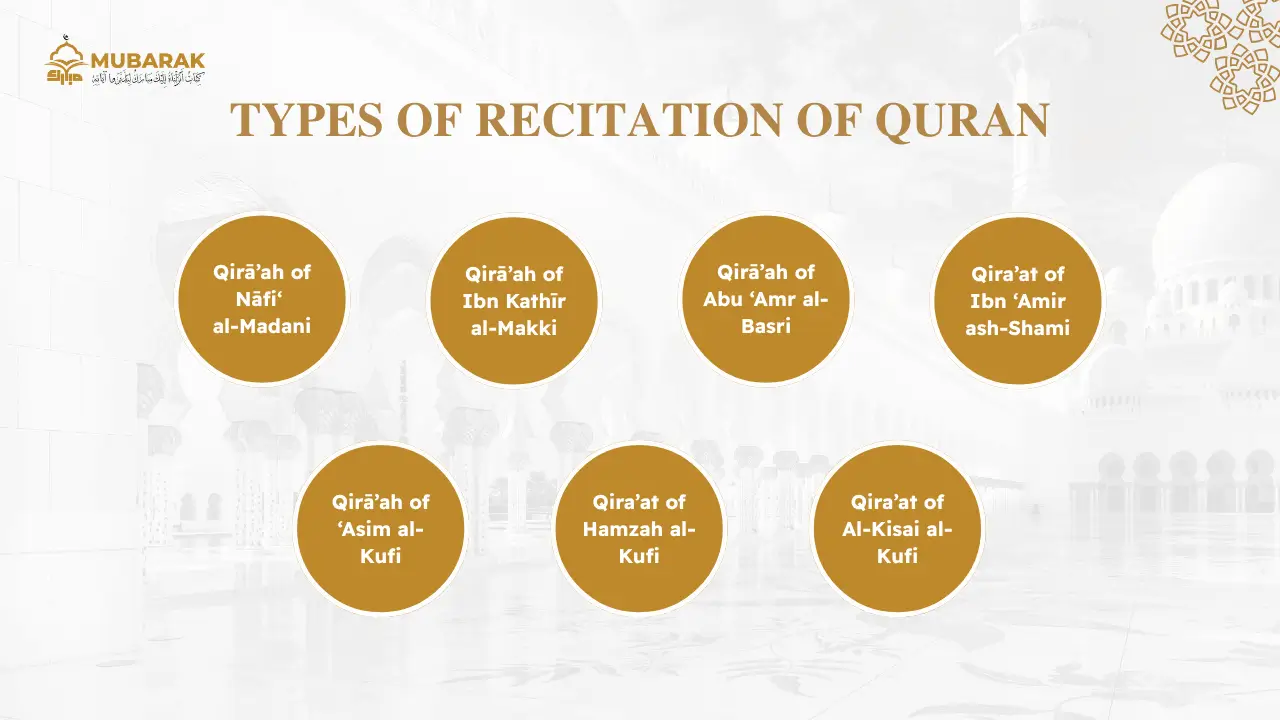
1. Qira’ah of Nafi’ al-Madani
Nafi’ ibn ‘Abd al-Rahman (Madinah, d. 169 AH / 785 CE). His reading is soft and flowing, and it remains the most common style across North and West Africa. Its two transmitters are Qalun (his own student and stepson) and Warsh (who settled in Egypt). The riwayah of Warsh dominates Algeria, Morocco, and much of West Africa, while Qalun is read in Libya and parts of Tunisia.
2. Qira’ah of Ibn Kathir al-Makki
‘Abdullah ibn Kathir (Makkah, d. 120 AH / 738 CE). His recitation is valued for its clarity, giving each word its full and distinct articulation. It was transmitted by Al-Bazzi and Qunbul, both associated with the Hijaz.
3. Qira’ah of Abu ‘Amr al-Basri
Abu ‘Amr ibn al-‘Ala’ (Basra, d. 154 AH / 770 CE). His reading is gentle and evenly paced, which makes it easy to follow. Its transmitters are Al-Duri and Al-Susi. The riwayah of Al-Duri from Abu ‘Amr is still widely recited in Sudan and parts of Central Africa.
4. Qira’ah of Ibn ‘Amir ash-Shami
‘Abdullah ibn ‘Amir (Damascus, d. 118 AH / 736 CE). His recitation carries a distinctive strength and depth of tone. It was transmitted by Hisham and Ibn Dhakwan, both centered in Greater Syria (Sham).
5. Qira’ah of ‘Asim al-Kufi
‘Asim ibn Abi al-Najud (Kufa, d. 127 AH / 745 CE). His reading is clear and well balanced, which is one reason it became the standard for learners. Its two transmitters are Hafs and Shu’bah, and the riwayah of Hafs from ‘Asim is by far the most widely used recitation in the world today, printed in the majority of Qur’ans across the Middle East, South Asia, Turkey, and Southeast Asia.
6. Qira’ah of Hamzah al-Kufi
Hamzah ibn Habib (Kufa, d. 156 AH / 772 CE). His recitation is deliberate and highly precise, with careful attention to articulation and the rules of elongation and pausing. It was transmitted by Khalaf and Khallad.
7. Qira’ah of Al-Kisa’i al-Kufi
‘Ali ibn Hamzah al-Kisa’i (Kufa, d. 189 AH / 804 CE). A student of Hamzah, he was also one of the great Arabic grammarians of his era, and his reading is known for its elegance and smooth tone. Its transmitters are Al-Duri and Abu al-Harith.
| # | Imam (Qari) | Origin | Two Transmitters (Rawis) | Notable Use Today |
|---|---|---|---|---|
| 1 | Nafi’ al-Madani | Madinah | Qalun, Warsh | North & West Africa |
| 2 | Ibn Kathir al-Makki | Makkah | Al-Bazzi, Qunbul | Studied worldwide |
| 3 | Abu ‘Amr al-Basri | Basra | Al-Duri, Al-Susi | Sudan, Central Africa |
| 4 | Ibn ‘Amir ash-Shami | Damascus | Hisham, Ibn Dhakwan | Studied worldwide |
| 5 | ‘Asim al-Kufi | Kufa | Hafs, Shu’bah | Most of the Muslim world |
| 6 | Hamzah al-Kufi | Kufa | Khalaf, Khallad | Studied worldwide |
| 7 | Al-Kisa’i al-Kufi | Kufa | Al-Duri, Abu al-Harith | Studied worldwide |
Read Also: The Top 10 Best Quran Reciters in the World
Why Are There Different Types of Quran Recitation?
Many people wonder why the Qur’an has different recitation styles. The answer is simple: it’s a mercy from Allah. The Prophet ﷺ told us that the Qur’an was revealed “in seven Ahruf” (seven dialects or modes), so people from different Arab tribes could recite and understand it with ease.
These variations appear in things like:
- Slight differences in pronunciation or dialect
- Word forms that change but keep the same meaning
- Unique rhythms and recitation styles
All of these Types of Recitation of Quran were taught by the Prophet ﷺ and passed down through trusted chains of narrators, which reveal the richness of the Arabic language and show how Allah has protected His Book in both its words and its sound. So, learning them helps you understand how to beautify your Quran recitation, improving both accuracy and heartfelt expression.
The Most Common Qira’at of the Quran:
Among all the types of recitation of the Quran, Hafs ‘an ‘Asim is the most widely used today. It is the reading found in the majority of printed Qur’ans and recited in nearly every masjid worldwide, from the Middle East and Turkey to South Asia and Southeast Asia. Strictly speaking, Hafs is a riwayah, meaning a transmission of the qira’ah of the imam ‘Asim al-Kufi, carried down by his student Hafs ibn Sulayman. The second most widespread reading is Warsh ‘an Nafi’, a transmission of the qira’ah of Nafi’ al-Madani. It dominates North and West Africa, including Morocco, Algeria, and much of the Sahel. A related transmission from the same imam, Qalun ‘an Nafi’, is recited in Libya and parts of Tunisia. A fourth reading, Al-Duri ‘an Abi ‘Amr, remains common in Sudan and parts of Central Africa. Why is Hafs the most common? Its spread owes much to history rather than any ruling that it is superior. The Ottoman Empire adopted and printed the Qur’an in Hafs across its vast territory, and the widely distributed 1924 Cairo edition standardized it further. Every one of these readings, however, is equally authentic. Each is mutawatir, transmitted through an unbroken chain to the Prophet Muhammad ﷺ, and the differences between them never alter the meaning of the text.
Read: Difference Between Hafs and Warsh Quran
Difference Between Tajweed and Qirat:
Many learners confuse Tajweed with Qira’at, but they are not the same.
In short, Tajweed is the technique, while Qira’at is the style.
Master the Different Types of Recitation of Quran with Mubarak Academy:
Learning the different types of Quran recitation at Mubarak Academy is more than just studying rules, it’s a meaningful journey with the Qur’an. You will learn step by step with caring, certified teachers who listen to your recitation, correct you gently, and help you improve with confidence.
Through clear lessons and regular practice, you’ll understand the beauty of the Qirā’āt and apply Tajweed naturally, not mechanically. With an authentic sanad and supportive guidance, Mubarak Academy helps you to learn how to recite the Quran properly, beautifully, and from the heart.
Contact Us Now For More Details!
Conclusion:
Tilawah means reciting the Qur’an with correct pronunciation, respect, and heart. Understanding the Types of Recitation of Quran deepens your relationship with the Book of Allah and helps preserve the divine legacy of revelation.
With proper practice, listening, and guidance from qualified teachers (like those at our online Qur’an academy), you can master your recitation and experience the true sweetness of the Qur’an.
FAQs About Types of Recitation of the Qur’an
Which Recitation Is Most Commonly Used Today?
The Hafs ‘an ‘Asim recitation is the most widely utilized method across the globe today, accounting for the vast majority of printed Mushafs. Renowned for its balanced phonetic rules and clarity, it serves as the standard instructional style in most Islamic schools and international institutions worldwide.
Can I Learn Multiple Qira’at at the Same Time?
It is highly recommended to completely master one foundational Qira’ah, typically Hafs ‘an ‘Asim, before attempting to study others. Learning multiple recitation styles simultaneously can lead to linguistic confusion and mistakes in Tajweed rules, whereas sequential learning under a qualified scholar ensures precision and absolute clarity.
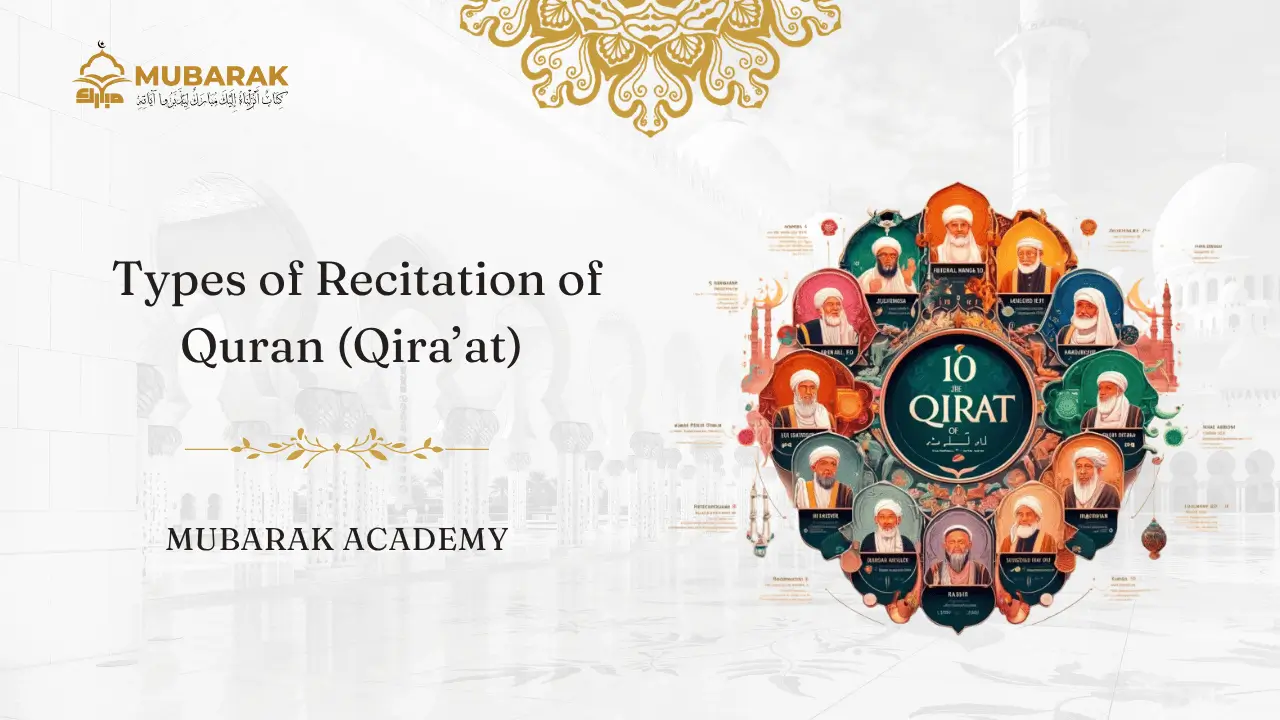
What Are the 10 Types of Recitation of the Qur’an?
The Ten Qira’at represent ten authentic methodologies of reciting the Quran, each named after a master scholar who preserved it through an unbroken chain back to the Prophet ﷺ. These recitations are divided into the seven main styles (Mutawatir) and three complementary styles (Mashhur), all thoroughly documented.
Are All Qira’at of the Qur’an Authentic?
Yes, the Ten Qira’at are entirely authentic, divine, and mass-transmitted (Mutawatir) from the Prophet Muhammad ﷺ. Every single recitation style has undergone rigorous historical scrutiny by Islamic scholars to verify its continuous chain of transmission, linguistic accuracy, and conformity to the original Uthmanic codex.
Is There a Difference in Meaning Between the Qira’at?
The various Qira’at do not contradict each other; rather, they enrich and expand the contextual depth of the divine text. Variations occur strictly within established Arabic dialects, pronunciation styles, and vocalizations, serving to beautifully illustrate the linguistic miracles of the Quran without altering its core theological message.
What’s the Best Qira’ah to Start Learning?
For the vast majority of students, Hafs ‘an ‘Asim is the ideal Qira’ah to start with. Because it is the most frequently printed and taught recitation style globally, finding premium learning resources, specialized online classes, and certified teachers who can guide your early Tajweed journey is exceptionally straightforward.

Ustadh Ahmed Mahmoud Abdulaziz is an experienced teacher of Arabic and the Holy Quran for native and non-native speakers. He holds a verified Ijazah in Hafs ‘an Asim and is certified in the foundational Tajweed texts Al-Jazariyyah and Tuhfat Al-Atfal. Drawing on his extensive background in traditional Quranic recitation and international pedagogy, he writes scholar-verified, accessible articles to help students worldwide master Tajweed rules and Arabic linguistics safely and accurately.