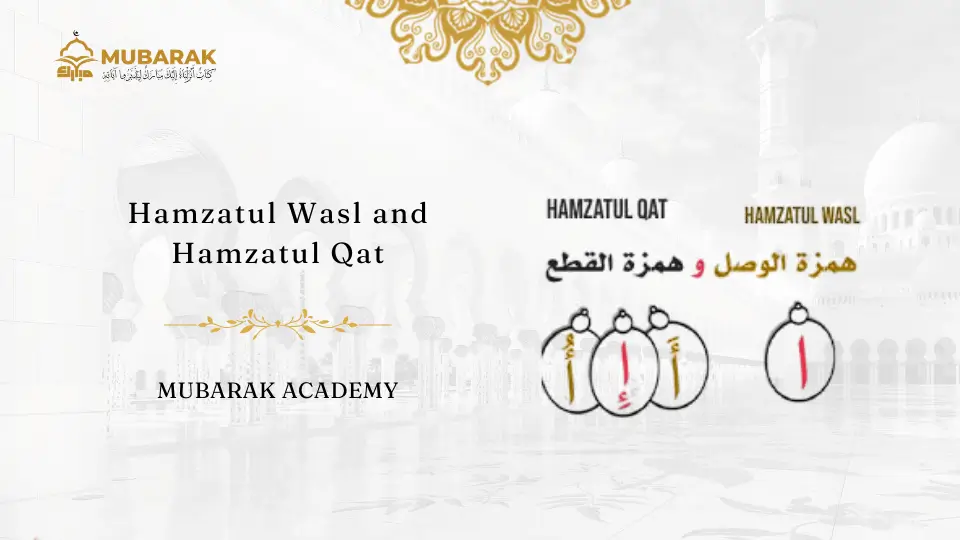
Every student of the Quran encounters a moment of confusion: why does the hamza sound disappear in some words but remain firm in others? The answer lies in one of the most foundational distinctions in Tajweed, the difference between Hamzatul Wasl (همزة الوصل) and Hamzatul Qat’ (همزة القطع). Mastering this distinction is not optional for anyone who wishes to recite the Quran correctly. It shapes the rhythm of every sentence, the flow of every verse, and the precision of Arabic pronunciation at its most essential level.
This guide covers both types of hamza in full, their definitions, grammatical rules, correct vowel sounds, special Tajweed cases, categorized examples from Arabic word classes, Quranic evidence, and the most common mistakes learners make. Whether you are a beginner or refining an existing foundation, this is the complete reference.
What Are Hamzatul Wasl and Hamzatul Qat’?
Hamzatul Wasl (همزة الوصل) and Hamzatul Qat’ (همزة القطع) are the two forms of hamza, the glottal stop letter, in Arabic grammar and Tajweed. Hamzatul Wasl is pronounced only at the start of speech and drops when connected to a preceding word. Hamzatul Qat’ is always pronounced regardless of its position in a sentence. Together, these two rules govern how vowel-initial words connect and separate in both spoken Arabic and Quranic recitation.
The word wasl (وصل) means “connection”, the hamza connects or links to what comes before it by disappearing. The word qat’ (قطع) means “cutting”, the hamza cuts through and remains audible no matter what precedes it. This etymological distinction is itself a memory aid for students of Tajweed.
Hamzatul Wasl vs. Hamzatul Qat’: Side-by-Side Comparison:
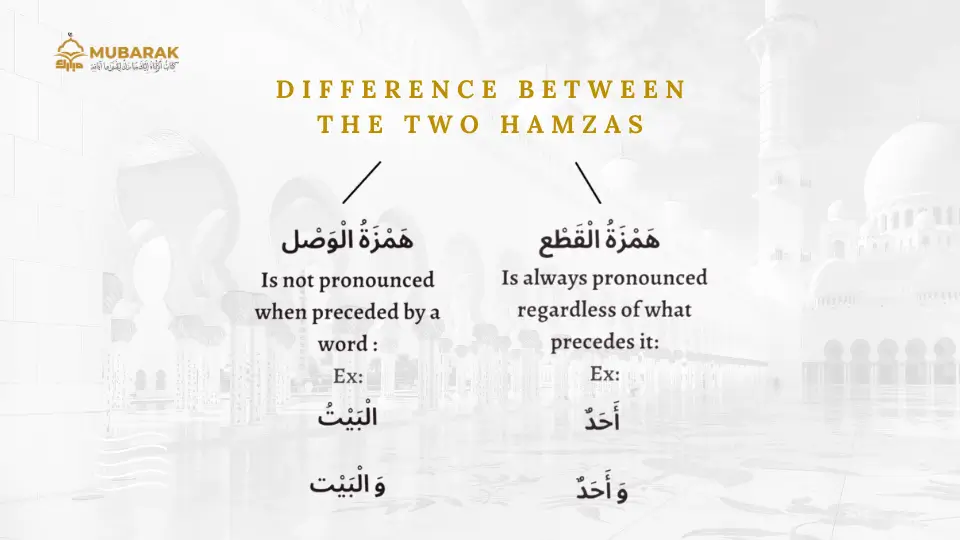
The core difference is simple: Hamzatul Wasl is pronounced only at the start of speech and drops when connected to the word before it, while Hamzatul Qat’ is always pronounced no matter where it appears. The table below breaks down every point of difference, from how each is written in the Mushaf to how it behaves in connected recitation.
| Feature | Hamzatul Wasl (همزة الوصل) | Hamzatul Qat’ (همزة القطع) |
|---|---|---|
| Pronunciation | Only at the start of speech; drops completely when connected mid-sentence. | Always pronounced, whether starting speech or connected mid-sentence. |
| Written form | Plain alif ا, or carries a small saad sign ٱ in the Mushaf. | Carries an explicit hamza sign: أ (above) or إ (below). |
| Position in word | At the beginning of the word only. | Can appear at the beginning, middle, or end of the word. |
| Effect on recitation | Words connect smoothly; the hamza sound disappears during transition. | Words retain a clean, sharp glottal stop every single time. |
| How to identify | No standard hamza diacritic on or under the alif stem. | Visible, explicit hamza sign is written on, under, or next to the letter. |
| Quran example |
﴿ٱلْحَمْدُ لِلَّهِ﴾
Al-Fatiha 1:2 |
﴿إِنَّ اللَّهَ﴾
Al-Baqarah 2:173 |
One practical test: place a single word before the target word in speech. If the hamza sound disappears, it is Hamzatul Wasl. If it remains, it is Hamzatul Qat’. Scholars of Tajweed and Arabic grammar rely on this insertion test as a reliable diagnostic tool.
What Is Hamzatul Wasl (همزة الوصل)?
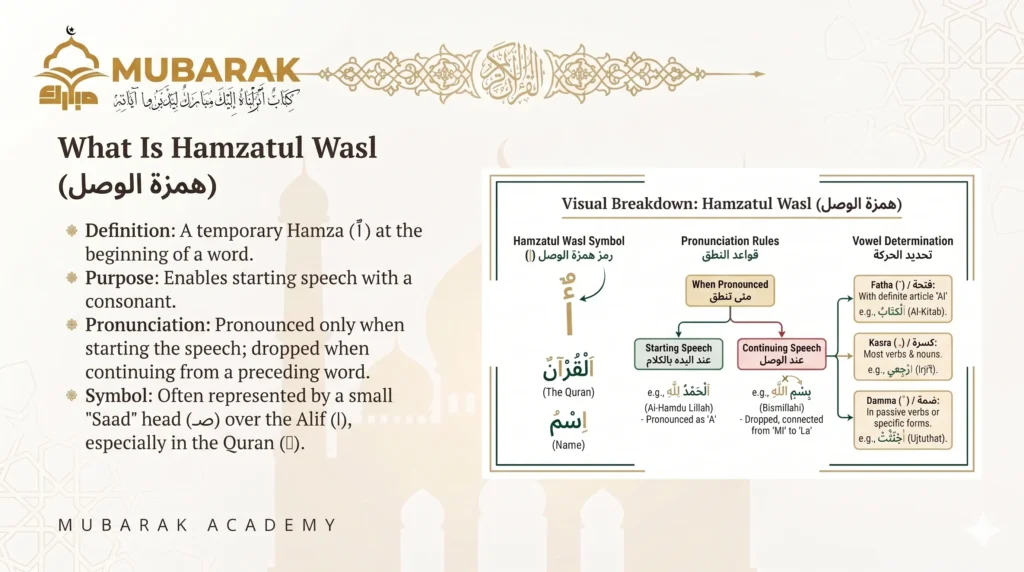
Hamzatul Wasl is a hamza that appears at the beginning of a word and is pronounced only when that word starts a sentence or clause. When the word connects to the word before it in continuous speech, the hamza sound is dropped entirely, allowing the two words to flow together without interruption. In written Arabic and the Quran, Hamzatul Wasl is typically written as a plain alif (ا) without any hamza sign above or below it.
In the Arabic linguistic tradition, Hamzatul Wasl is classified as a hamza zaidah, an added hamza that serves a functional purpose in speech rather than carrying a distinct phonemic identity of its own.Its role is structural: it provides a starting point for a word that begins with a consonant cluster or sukoon, a vowel-less letter. Understanding the Makhraj of the hamza, its articulation point deep in the throat, helps explain why this starting vowel is needed at all.
Rules of Hamzatul Wasl, Three Core Principles:
The following three rules govern the pronunciation of Hamzatul Wasl in all contexts:
- Pronounce Hamzatul Wasl when it begins a sentence or clause. Any time a word with Hamzatul Wasl is the first word spoken, whether at the opening of a verse or after a pause in recitation, the hamza is given a vowel sound and pronounced clearly.
- Drop Hamzatul Wasl when the word follows another word in continuous speech. When reciting without stopping, the hamza sound merges silently with the vowel at the end of the preceding word. The transition is smooth; no glottal stop occurs.
- Apply the tanween rule when a word ending in tanween precedes Hamzatul Wasl. The tanween (double vowel marker) at the end of the first word merges with the Hamzatul Wasl of the second word, creating a connected pronunciation. For example, in the phrase كِتَابٌ اسْمُهُ (a book whose name), the tanween on كِتَابٌ flows directly into اسْمُهُ without a break.
Determining the Correct Vowel Sound for Hamzatul Wasl:
When Hamzatul Wasl must be pronounced at the start of speech, it requires a vowel, but which vowel depends on the type of word:
- Definite article ٱلـ (Al): Always receives a kasrah (i-sound). You pronounce it as ‘i-l’, for example, ٱلْكِتَابُ is pronounced ‘il-kitaabu’ at the start of speech.
- Nouns: The Hamzatul Wasl in nouns (such as ٱسْم and ٱبْن) typically takes a kasrah as well.
- Verbs, three-letter root (thulathi): The vowel depends on the third letter of the verb’s root. If the third root letter carries a dammah (u-sound) or kasrah (i-sound), the Hamzatul Wasl takes a dammah. If the third root letter carries a fathah (a-sound), the Hamzatul Wasl takes a kasrah.
- Verbs, five-letter or six-letter forms: The Hamzatul Wasl in these verb forms always takes a kasrah.
This rule is critical for anyone learning to recite the Quran, since starting a verse from a mid-point, as is common in Tarteel and Tahqeeq recitation, requires knowing the correct opening vowel for every word.
Special Tajweed Case: Tanween Followed by Hamzatul Wasl:
When a word ending in tanween (ـٌ, ـً, ـٍ) is immediately followed by a word beginning with Hamzatul Wasl, the reciter does not pause or re-pronounce the hamza. Instead, the tanween’s final vowel extends smoothly into the following word. This is one of the more nuanced points of connected recitation (wasl) in Tajweed, and it is where many intermediate students make errors.
A well-known Quranic instance occurs in Surah Al-Baqarah, the phrase ghafuurun raheem (غَفُورٌ رَّحِيمٌ), where the tanween at the end flows directly into the next syllable. Scholars of Tajweed, including those who teach the narration of Hafs ‘an ‘Asim, emphasise this point specifically when teaching connected recitation.
Where Does Hamzatul Wasl Appear in Arabic Words?
Hamzatul Wasl appears in three categories of Arabic words:
- The definite article ٱلـ (Al): This is the most frequent occurrence of Hamzatul Wasl. Every Arabic noun with the definite article carries a Hamzatul Wasl, ٱلْكِتَابُ (the book), ٱلْمَسْجِدُ (the mosque), ٱلْقُرْآنُ (the Quran).
- Imperative verb forms (command forms): Three-letter, five-letter, and six-letter root verb commands all begin with Hamzatul Wasl, for example, ٱقْرَأْ (read/recite), ٱنْظُرْ (look), ٱسْتَغْفِرْ (seek forgiveness).
- Specific nouns: A small set of Arabic nouns carry Hamzatul Wasl by convention, ٱسْم (name), ٱبْن (son), ٱبْنَة (daughter), ٱمْرُؤ (man), ٱمْرَأَة (woman), ٱثْنَانِ (two), ٱثْنَتَانِ (two, feminine).
Hamzatul Wasl Examples: Nouns, Verbs, and Particles:
The following categorized examples show how Hamzatul Wasl functions across different word types in Arabic:
- In nouns: ٱسْمٌ (name), ٱبْنٌ (son), ٱبْنَةٌ (daughter), ٱمْرُؤٌ (man), ٱثْنَانِ (two)
- In three-letter imperative verbs: ٱقْرَأْ (read/recite), ٱكْتُبْ (write), ٱجْلِسْ (sit)
- In five-letter imperative verbs: ٱنْطَلِقْ (depart), ٱنْتَظِرْ (wait), ٱنْكَسَرَ (broke)
- In six-letter imperative verbs: ٱسْتَغْفِرْ (seek forgiveness), ٱسْتَعِنْ (seek help), ٱسْتَقِمْ (be steadfast)
- In the definite article: ٱلْكِتَابُ (the book), ٱلْمُؤْمِنُونَ (the believers), ٱلصِّرَاطُ (the path)
Hamzatul Wasl Examples in the Quran:
The Quran provides the most reliable and complete source of Hamzatul Wasl examples. The following verses are among the most frequently recited:
- ٱهْدِنَا الصِّرَاطَ الْمُسْتَقِيمَ (Guide us to the straight path), Surah Al-Fatiha, 1:6. The ٱهْدِنَا begins with Hamzatul Wasl, pronounced only if starting recitation from this word.
- ٱلْحَمْدُ لِلَّهِ رَبِّ الْعَالَمِينَ (All praise is due to Allah, Lord of all the worlds), Surah Al-Fatiha, 1:2. The definite article ٱلـ carries Hamzatul Wasl throughout this verse.
- ٱقْرَأْ بِاسْمِ رَبِّكَ الَّذِي خَلَقَ (Recite in the name of your Lord who created), Surah Al-Alaq, 96:1. The opening command ٱقْرَأْ is a three-letter imperative beginning with Hamzatul Wasl.
- ٱنطَلِقُوا إِلَىٰ مَا كُنتُم بِهِ تُكَذِّبُونَ (Proceed to what you used to deny), Surah Al-Mursalat, 77:29. A five-letter verb beginning with Hamzatul Wasl.
What Is Hamzatul Qat’ (همزة القطع)?
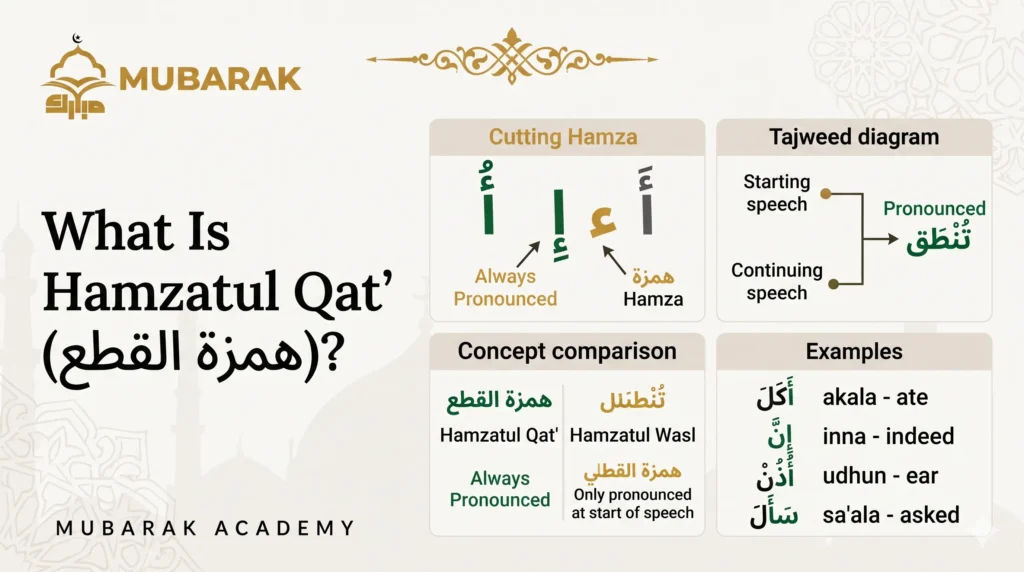
Hamzatul Qat’ is a hamza that is always pronounced with a full glottal stop, regardless of its position in a sentence or its relationship to surrounding words. Unlike Hamzatul Wasl, it never drops in connected speech. It appears at the beginning, middle, or end of Arabic words, and it is always marked in writing with a visible hamza sign, either above the alif (أ), below it (إ), above the waw (ؤ), above the ya’ without dots (ئ), or as a standalone hamza (ء). Hamzatul Qat’ is by far the more common of the two types of hamza in Arabic.
The term qat’ (قطع), meaning “cutting”, reflects exactly what this hamza does: it cuts into the flow of speech with a clean, firm stop. In phonetic terms, it is a glottal stop produced by a momentary closure of the vocal cords, followed by a vowel. Every scholar of Tajweed and classical Arabic grammar treats its pronunciation as non-negotiable.
Rules of Hamzatul Qat’, Three Core Principles:
- Hamzatul Qat’ is always pronounced, without exception. Whether the word containing Hamzatul Qat’ comes at the start of a sentence, in the middle, or follows a word ending in a vowel, the hamza sound remains fully audible.
- Hamzatul Qat’ can appear at the beginning, middle, or end of a word. This sets it apart from Hamzatul Wasl, which only appears at the beginning. Examples of initial position: أَحْمَدُ (Ahmad), إِسْلَامٌ (Islam). Middle position: سَأَلَ (he asked), بِئْرٌ (well). End position: شَيْءٌ (thing), ضَوْءٌ (light).
- Hamzatul Qat’ carries its own vowel and is always marked in writing. The hamza sign itself appears in one of five written forms depending on the vowel it carries and the letters surrounding it, on alif, waw, ya’, or standing alone. This written visibility is one of the clearest ways to identify Hamzatul Qat’ in any Arabic text.
Hamzatul Qat’ Examples: Nouns, Verbs, and Particles:
- In nouns: أَحْمَدُ (Ahmad), إِسْلَامٌ (Islam), أُمَّةٌ (nation/community), إِيمَانٌ (faith), أَخٌ (brother), أَرْضٌ (earth), أَمَانَةٌ (trust)
- In verbs, beginning of word: أَكَلَ (he ate), أَرْسَلَ (he sent), أَنْزَلَ (he revealed), إِسْتَغْفَرَ (he sought forgiveness)
- In verbs, middle of word: سَأَلَ (he asked), يَأْمُرُ (he commands), تَأْخُذُ (she/you take)
- In particles: أَنَّ (that/verily), إِنَّ (indeed), أَوْ (or), إِذَا (when/if)
- At the end of words: شَيْءٌ (thing), ضَوْءٌ (light), مَلْجَأٌ (refuge)
Hamzatul Qat’ Examples in the Quran:
- إِنَّ اللَّهَ غَفُورٌ رَّحِيمٌ (Indeed, Allah is Forgiving and Merciful), Surah Al-Baqarah, 2:173. The opening إِنَّ carries Hamzatul Qat’ and must be pronounced clearly even mid-sentence.
- إِنَّا أَنزَلْنَاهُ فِي لَيْلَةِ الْقَدْرِ (Indeed, We sent it down during the Night of Decree), Surah Al-Qadr, 97:1. Both إِنَّا and أَنزَلْنَاهُ contain Hamzatul Qat’, each hamza sound must be fully pronounced.
- إِنَّا أَعْطَيْنَاكَ الْكَوْثَرَ (Indeed, We have granted you Al-Kawthar), Surah Al-Kawthar, 108:1. A clear example of two consecutive Hamzatul Qat’ forms opening the surah.
- أَلَمْ نَشْرَحْ لَكَ صَدْرَكَ (Did We not expand for you your chest?), Surah Ash-Sharh, 94:1. The opening أَلَمْ carries Hamzatul Qat’ as an interrogative particle.
Common Mistakes When Pronouncing Hamzatul Wasl and Hamzatul Qat’:
These four errors appear repeatedly among students learning Tajweed, from beginners to those at intermediate level. Identifying them by name is the first step to correcting them.
Mistake 1: Pronouncing Hamzatul Wasl in the Middle of Speech:
When reciting continuously, many students give a full glottal stop to words with Hamzatul Wasl even though they follow another word without pause. This interrupts the flow of the verse and violates the rule of wasl. The correction is to let the final vowel of the preceding word carry directly into the first consonant of the next word, bypassing the hamza entirely.
Example: When reciting Bismillah ir-rahman ir-rahim. Al-hamdulillah, some students re-pronounce the alif in ٱلْحَمْدُ with a fresh glottal stop. This is incorrect, the alif should be silent, connected by the kasrah at the end of the preceding syllable.
Mistake 2: Dropping Hamzatul Qat’ in Connected Speech:
This is the opposite error, treating Hamzatul Qat’ as if it were Hamzatul Wasl and dropping the glottal stop when connecting words. Since Hamzatul Qat’ must always be pronounced, dropping it changes both the word and the meaning.
Example: Dropping the hamza in إِنَّ اللَّهَ by connecting it without a glottal stop alters the opening of the verse in both sound and precision. Scholars of Tajweed classify this as a clear recitation error (lahn jali), the same category of error that applies when the breath properties of hams letters are incorrectly applied..
Mistake 3: Using the Wrong Vowel Sound When Starting Hamzatul Wasl:
When a reciter resumes from a word with Hamzatul Wasl after a pause, they must supply the correct opening vowel, kasrah, dammah, or fathah depending on the word type. A common error is defaulting to fathah (an ‘a’ sound) for all cases. This produces an incorrect pronunciation of the word and may even alter its grammatical function.
The correct approach: identify whether the word is a noun, the definite article, or a verb, then apply the corresponding vowel rule described earlier in this guide.
Mistake 4: Not Applying the Tanween Rule:
Students who have memorised the basic Hamzatul Wasl rule sometimes forget it when tanween precedes the hamza. They insert a pause or glottal stop between the tanween and the following word, when in fact the tanween should connect directly to the next syllable without any break.
The phrase ghafuurun raheem (غَفُورٌ رَّحِيمٌ) is a classroom example used by Tajweed teachers to practice this connection, the tanween flows smoothly into the ra’ of رَّحِيمٌ without any hamza being heard.
How to Identify Hamzatul Wasl and Hamzatul Qat’ in Written Arabic:
Reading a vowelled Mushaf or a fully diacritised Arabic text makes identification straightforward once you know what to look for.
- Look for the hamza sign: If a letter carries a hamza mark, أ, إ, ؤ, ئ, or ء, it is Hamzatul Qat’. Pronounce it every time, without exception.
- Look for the plain alif at the start of a word: If an alif begins a word without any hamza sign and carries a small subscript symbol (ٱ, called the wasla sign in a fully marked Mushaf), it is Hamzatul Wasl. Drop it when connecting, pronounce it when starting.
- Apply the insertion test: Say the word بِ (bi, meaning ‘with’) before the target word. If the hamza disappears naturally, it is Hamzatul Wasl. If the hamza remains, it is Hamzatul Qat’.
- Check the word class: If you are looking at the definite article ال, an imperative verb from the patterns described above, or one of the seven special nouns, it is Hamzatul Wasl. If you are looking at a verb in the past or present tense starting with a hamza, a noun with a hamza-initial root, or any particle beginning with أ or إ, it is Hamzatul Qat’, and its Sifaat (characteristic properties) remain fully active in pronunciation.
Why Hamzatul Wasl and Hamzatul Qat’ Matter for Quran Recitation:
The rules of Tajweed are not merely academic, they are the means by which the Quran has been preserved in its exact oral form since the time of the Prophet Muhammad (peace be upon him). The distinction between Hamzatul Wasl and Hamzatul Qat’ is one of the transmission rules verified through the mutawatir chain of narration, meaning it was confirmed by so many reciters across generations that its authenticity is beyond doubt.
Misapplying these rules affects the intelligibility and correctness of recitation. In some cases, dropping or adding a hamza changes the meaning of a word entirely. Arabic is a language where a single vowel or consonant can transform a noun into a verb, a command into a statement, or a name into a common word. For this reason, scholars of Tajweed from the earliest generations, including Imam Al-Jazari (rahimahullah), whose foundational text Al-Muqaddimah Al-Jazariyyah remains the standard reference for Tajweed students worldwide, treated Hamzatul Wasl and Hamzatul Qat’ as among the essential topics every reciter must master.
Learning these rules also has a practical benefit beyond correctness: it improves fluency. Students who understand when hamza drops and when it must be held find their recitation becomes smoother, more natural, and closer to the sound of the classical Arabic in which the Quran was revealed.
Frequently Asked Questions About Hamzatul Wasl and Hamzatul Qat’:
What is Hamzatul Wasl in Arabic?
Hamzatul Wasl (Connecting Hamza) is a structural glottal stop that appears exclusively at the beginning of a word. It is pronounced only when starting speech or after a pause. During continuous recitation, its sound drops entirely, allowing the preceding word to blend seamlessly into the next consonant.What is Hamzatul Qat’ in Arabic?
Hamzatul Qat’ (Cutting Hamza) is a permanent glottal stop that must be pronounced clearly in all positions, whether starting a sentence or connecting words mid-phrase. Unlike the connecting hamza, it never drops during recitation and is written explicitly with a distinct hamza character above or below its carrier.How do I know which type of hamza I am looking at?
The easiest method is visual inspection. Hamzatul Qat’ always displays a visible hamza graphic (أ, إ, ء). Conversely, Hamzatul Wasl appears as a plain alif (ا), often topped with a small saad symbol (ٱ) in the Quran. You can also test it by adding the prefix “Wa” or “Bi”; if the sound drops, it is Wasl.Does Hamzatul Wasl appear anywhere other than at the beginning of a word?
No, Hamzatul Wasl is phonologically restricted and occurs strictly at the very beginning of Arabic nouns, verbs, or particles to facilitate the pronunciation of an initial silent letter. In contrast, Hamzatul Qat’ is highly flexible and can occupy the word-initial, word-medial, or word-final position within any given Arabic root.Why are these rules important for reciting the Quran?
Mastering these rules is critical because blending a permanent Hamzatul Qat’ or forcing the pronunciation of a temporary Hamzatul Wasl alters the rhythmic structure and can corrupt the theological meaning of Quranic words. Tajweed scholars deem this preservation an individual duty to protect the text from structural corruption (Lahn).Can beginners learn the difference between Hamzatul Wasl and Hamzatul Qat’?
Yes, foundational students can easily master this distinction within a few weeks of structured practice. The rules are highly systematic, relying on explicit visual markers in the Uthmani script and straightforward prefix tests. Practicing under a qualified teacher ensures correct articulatory habits right from the beginning.Conclusion:
Hamzatul Wasl and Hamzatul Qat’ represent two of the most frequently applied rules in Arabic pronunciation and Quranic Tajweed. Every verse of the Quran containing the definite article, every command form, every particle beginning with أ or إ, all of them depend on the reader correctly identifying which type of hamza they are dealing with and applying the appropriate rule, The distinction comes down to a single principle: Hamzatul Wasl connects and disappears; Hamzatul Qat’ cuts through and remains. With the rules, examples, comparison table, and identification methods in this guide, both principles are now available in one place, from the written form on the page to the sound in the recitation to the classical scholarly framework behind them, Consistent practice under qualified guidance is the path from knowing the rule to applying it fluently. The rules of Tajweed were not designed to burden the reader, they were designed, as scholars have said for centuries, so that the tongue of the reciter can honour what the heart already holds.

Ustadh Ahmed Mahmoud Abdulaziz is an experienced teacher of Arabic and the Holy Quran for native and non-native speakers. He holds a verified Ijazah in Hafs ‘an Asim and is certified in the foundational Tajweed texts Al-Jazariyyah and Tuhfat Al-Atfal. Drawing on his extensive background in traditional Quranic recitation and international pedagogy, he writes scholar-verified, accessible articles to help students worldwide master Tajweed rules and Arabic linguistics safely and accurately.