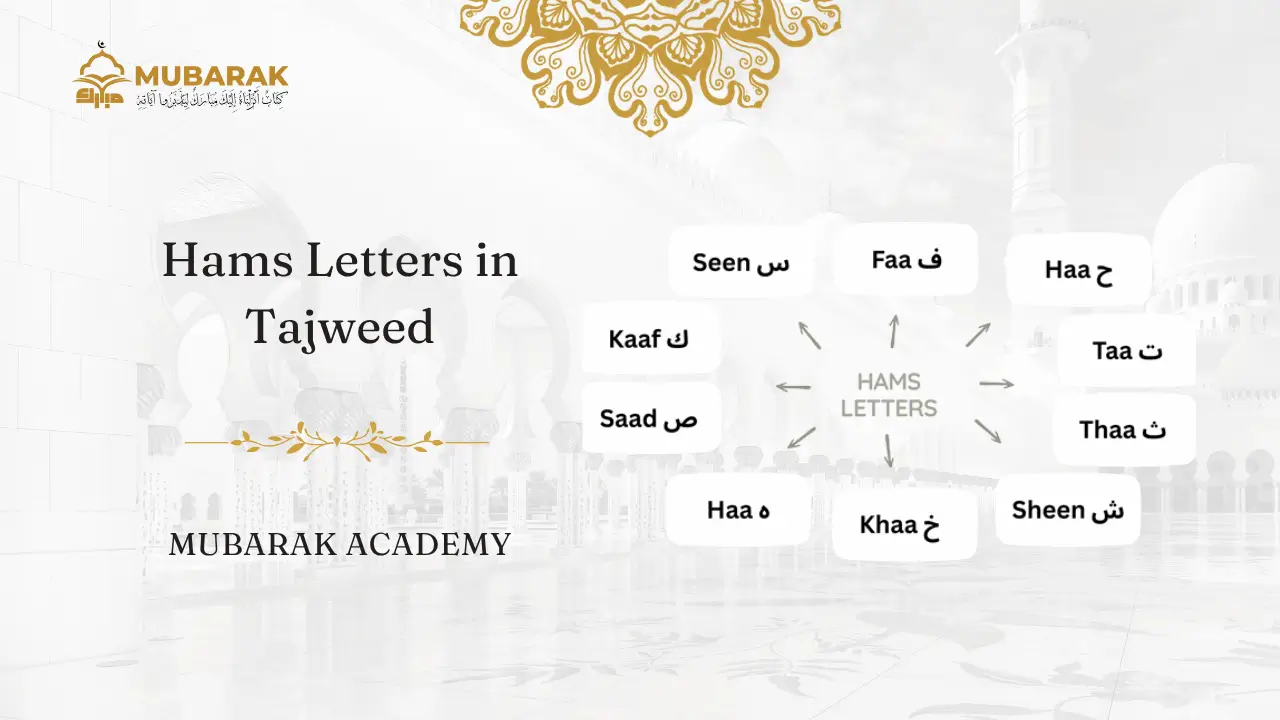
Hams is a crucial aspect of Tajweed rules that impacts the articulation of Arabic letters to enhance the pronunciation of the Quranic text during recitation. Mastering it helps reciters pronounce the Qur’an clearly and beautifully.
In this article, we’ll explore the meaning of Hams in Tajweed, list the Hams letters in Tajweed with Quranic examples, explain the difference between Hams and Jahr, and provide practical tips to recognize and apply this rule in recitation.
What Is Hams in Tajweed?
The word Hams (الهمس) in Arabic means “whisper” or “lowering your voice” while speaking. In the context of Tajweed, Hams indicates the quality of certain Arabic letters pronounced with a specific flow of breath and a softer, whisper-like sound, without vibration in the vocal cords.
When it comes to hams letters in tajweed, the breath is gently escaping while articulating them. On the other hand, we have another term in Tajweed that is the opposite of Hams, which is Jahr, where the sound is produced with a stronger voice and the airflow is stopped.
How Hams Affects Quran Recitation
When you start reciting and you come across one of Hams letters in tajweed, you must consider a gentle and continuous stream of air as the sound is produced, just as a whisper. Ensure your vocal cords are not vibrated.
However, with its counterpart, Jahr (الجهر), the airflow is restricted and makes you produce a more powerful sound.
Understanding this difference between Hams and Jahr is essential for mastering correct Qur’anic recitation and applying Tajweed rules accurately.
Hams is one of the important Sifaat (Characteristics of Arabic letters) in Tajweed. To explore this concept further, you can read our detailed guide:
Discover What Is Sifaat in Tajweed with Simple Examples
Hams Letters in Tajweed (Huruf al-Hams)
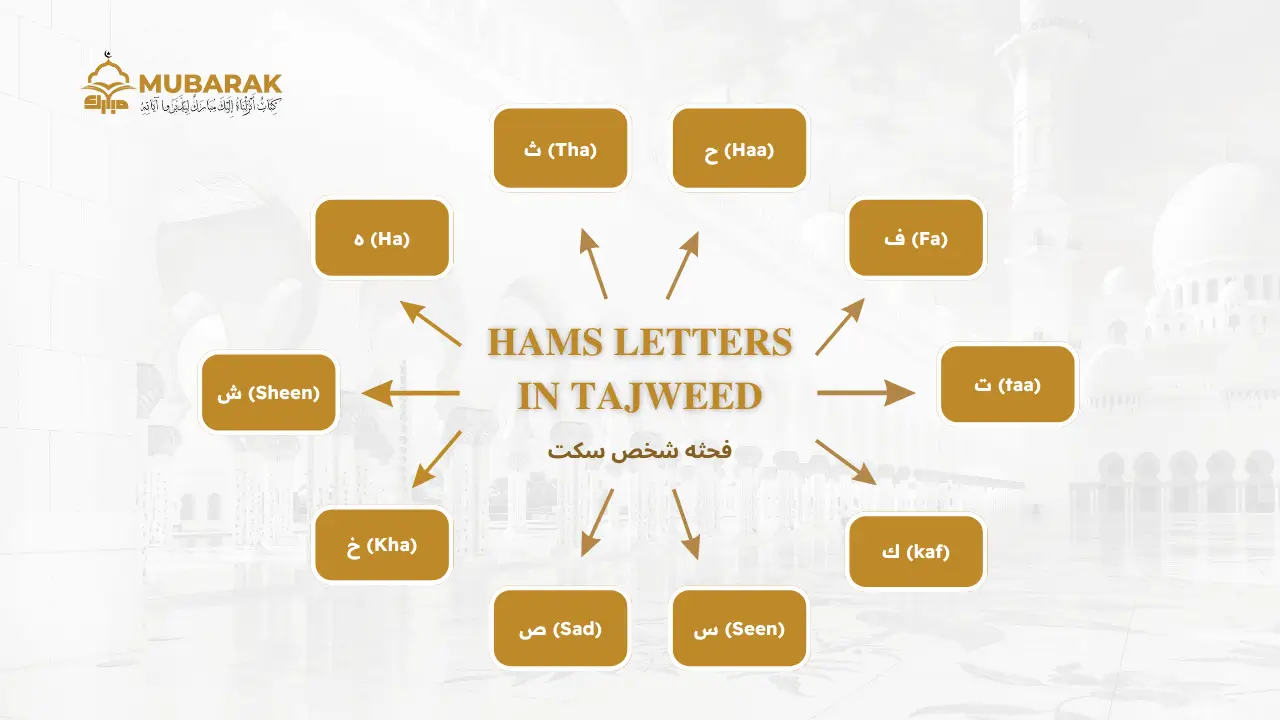
We have 10 Arabic letters that require the characteristic of Hams, which are pronounced with a whisper-like, breathy quality. Hams’ letters in tajweed are combined in the sentence:
فحثه شخص سكت
Now, let’s take a deeper look at Tajweed hams letters:
- ف (Fa): It needs a flow of breath, a little bit different from the English ‘f’, which is pronounced with less breath flow. ف is produced as if the breath is escaping in a reduced volume.
- ث (Tha): You should pronounce it with an airy quality, similar to the sound ‘th’ in ‘thin’. It needs a more pronounced emission of breath.
- ح (Ha): Actually, this sound does not have an equivalent in the English alphabet, but you can produce a deep sound in the throat with an accompanying flow of breath. It can be the hardest one and requires some practice to excel at it.
- خ (Kha): A strong breathy sound should be produced that comes from the back of the throat.
- ه (Ha): This is a smooth, breathy version of the English letter ‘h’, it resembles the exhaling of breath on a cold day.
- ك (kaf): It has a deep, guttural sound from the deepest part of the tongue.
- ص (Sad): Is pronounced with a breathy and heavy sound.
- س (Seen): It’s close to the letter s in English, pronounced with a breathy sound, with an additional emphatic quality.
- ش (Sheen): Similar to the ‘sh‘ sound in ‘she’, but with a softer, breathier quality.
- ت (taa): It needs careful pronunciation to ensure the breath flows smoothly.
Mastering the Hams letters in Tajweed refines your recitation, helping you pronounce each letter with accuracy and grace, just as the Qur’an was revealed to be recited.
Join Mubarak Academy today to learn Tajweed the right way
Hams Letters Examples in the Qur’an
To pronounce Hams letters in Tajweed correctly, you should couple the theoretical knowledge with a practical approach. Here are some Quranic verses that clear up the meaning of Hams:
Discover Also: Qalqalah Letters in Quran
Difference Between Hams and Jahr in Tajweed
Jahr is the opposite of Hams in Tajweed, which means the retention of breath with power and fullness to the letter’s pronunciation. Let’s see the difference between breathiness and bold articulation, Jahr and Hams, in Quranic recitation.
Understanding the difference between Hams and Jahr helps you recite the Qur’an with both clarity and beauty.
Learn the Sifaat of Letters with Mubarak Academy
Our Online Tajweed Quran Classes help you walk in the way of perfect Quranic recitation. With practical engaging sessions that gradually enhance your skills to be able to recite the Quran as it was revealed.
Why Mubarak Academy:
- Advanced methods are used to facilitate all the tajweed rules for you and make you grasp the information effortlessly.
- In addition, we provide a positive environment that encourages learners at all levels so that you will never feel shy or embarrassed to make mistakes and learn.
- Flexibility in your schedule to be able to attend your sessions whenever suits you from your cozy home.
- Proficient teachers are communicating the rules in a simplified way with interactive methods to ensure fully understanding. To learn Tajweed, it is highly recommended to learn under the guidance of a qualified Quran teacher that helps you learn faster and gives you instant feedback.
- This feedback can help enhance your pronunciation and address any errors effectively.
Lay the solid foundation for a lifelong connection with the Quran with the best Online Quran academy.
Conclusion
According to the flow of breath, Arabic letters are classified into Hams and Jahr letters. Mastering them and how to produce each letter properly reflects on your recitation quality. Plus, learning Hams letters in tajweed affects many aspects, from the beauty of your recitation to the meaning and authenticity of the words. Master this rule today to pronounce the letters naturally without effort.
Frequently Asked Questions About Hams in Tajweed
1. How can I learn Hams and other Tajweed rules correctly?
Learn with a qualified Quran teacher who provides live feedback. Join Mubarak Academy’s Online Tajweed Classes for interactive, guided learning and personalized correction.
2. What’s the best way to practice Hams letters?
Practice slowly and mindfully, focusing on the airflow from your mouth. Listen to expert reciters, imitate their pronunciation, and record yourself to track your progress.
3. Are all Hams letters pronounced with the same level of breathiness?
No. Some letters, like خ (Kha) and ف (Fa), have a stronger breath sound, while others, like ص (Sad), are heavier and less airy.
4. Can beginners learn Hams and other Tajweed rules online?
Yes! With structured lessons and live guidance, beginners can easily learn Hams and all other Tajweed rules online through Mubarak Academy’s expert tutors.
5. Is there an easy way to remember the Hams letters?
Yes, memorize the Arabic phrase فحثه شخص سكت, which contains all ten Hams letters for easy recall.

Ustadh Ahmed Mahmoud Abdulaziz is an experienced teacher of Arabic and the Holy Quran for native and non-native speakers. He holds a verified Ijazah in Hafs ‘an Asim and is certified in the foundational Tajweed texts Al-Jazariyyah and Tuhfat Al-Atfal. Drawing on his extensive background in traditional Quranic recitation and international pedagogy, he writes scholar-verified, accessible articles to help students worldwide master Tajweed rules and Arabic linguistics safely and accurately.