The Quran mentions parents in no fewer than eight distinct passages — always pairing their honor directly with the worship of Allah. But reading a translation alone misses half the meaning. The Arabic words chosen by Allah in these verses carry layers of linguistic precision that no English equivalent fully captures.
This guide presents every Quran Verses on Parents in Arabic with full text, transliteration, word-by-word meaning, and authentic Hadith — so you can read, understand, and recite them as they were revealed.
What Does the Quran Say About Parents? (Direct Answer)
The Quran commands honor toward parents in no fewer than eight distinct passages, placing this duty immediately after the command to worship Allah alone. The Arabic word used across these verses is Ihsān (إِحْسَانًا) — a term that means far more than basic kindness. It describes excellence, beauty, and proactive devotion in conduct. The Quran also singles out the mother’s sacrifice with specific detail, establishing her rights with particular force. This article presents every major Quran verse on parents in Arabic with full transliteration, meaning, and linguistic depth — arranged for study, memorization, and daily family life.
The Linguistic Foundation: Why Arabic Matters Here
Before reading these verses, one Arabic insight transforms how you understand all of them.
The Name of Allah, Ar-Raḥmān (الرَّحْمَن) — the Entirely Merciful — shares the same three-letter root ر-ح-م (ra-ḥa-ma) as the Arabic word ar-raḥim (الرَّحِم), meaning the womb. The place where every human being begins physical existence is, in the Arabic language, directly rooted in the concept of divine mercy. Allah bound the first mercy we experience in this world — the mercy of a mother’s womb — to His own attribute of mercy through the very structure of the language in which He revealed His Book.
This is not a coincidence. It is the context in which every Quranic verse about parents must be understood.
The Three Levels of Parental Duty in the Quran:
Not every Quranic term for treating parents means the same thing. Three distinct Arabic words describe three distinct levels of obligation, and understanding this distinction separates surface-level reading from genuine understanding.
| Arabic Term | Transliteration | Meaning | Verse |
|---|---|---|---|
| إِحْسَانًا | Iḥsānā | Excellence in conduct — proactive, beautiful service | Al-Isra 17:23; Luqman 31:14; Al-Ahqaf 46:15 |
| بَرًّا | Barran | Deep, vast dutifulness — a quality of the Prophets | Maryam 19:14, 19:32 |
| مَعْرُوفًا | Maʿrūfā | Recognized goodness — kindness even when disagreeing | Luqman 31:15 |
Each term appears in a different context and carries a different weight. Together they form a complete framework: excellence as the standard, prophetic dutifulness as the aspiration, and dignified kindness as the minimum — even in conflict.
Quran Verses on Parents in Arabic: Complete Reference
1. The Foundation Verse — Surah Al-Isra (17:23)
This is the verse that establishes the hierarchy of all duties in Islam. It does not merely suggest kindness toward parents; it places that command in the same divine decree as monotheism itself.
Arabic Text:
وَقَضَىٰ رَبُّكَ أَلَّا تَعْبُدُوا إِلَّا إِيَّاهُ وَبِالْوَالِدَيْنِ إِحْسَانًا ۚ إِمَّا يَبْلُغَنَّ عِندَكَ الْكِبَرَ أَحَدُهُمَا أَوْ كِلَاهُمَا فَلَا تَقُل لَّهُمَا أُفٍّ وَلَا تَنْهَرْهُمَا وَقُل لَّهُمَا قَوْلًا كَرِيمًا
Transliteration: Wa qaḍā rabbuka allā taʿbudū illā iyyāhu wa bil-wālidayni iḥsānā. Immā yablughanna ʿindaka al-kibara aḥaduhumā aw kilāhumā fa-lā taqul lahumā uffin wa-lā tanharhumā wa-qul lahumā qawlan karīmā.
Translation: “And your Lord has decreed that you worship none but Him, and that you be dutiful to your parents. If one or both of them reach old age with you, do not say to them a word of disrespect, nor rebuke them, but speak to them a noble word.” (Surah Al-Isra, 17:23)
Word-by-Word Analysis
| Arabic | Root | Meaning |
|---|---|---|
| وَقَضَىٰ | ق-ض-ي | Decreed, ruled — a binding divine judgment, not a suggestion |
| إِحْسَانًا | ح-س-ن | Excellence; from the same root as beauty (ḥusn) |
| أُفٍّ | — | The smallest expression of annoyance; a sigh or sound of impatience |
| تَنْهَرْهُمَا | ن-هـ-ر | To rebuke harshly, to push away with a raised voice |
| قَوْلًا كَرِيمًا | ك-ر-م | Noble, generous speech — karam means generosity; the word carries dignity |
The word qaḍā (قَضَى) is significant. It is the same word used for divine rulings and decrees. This is not a recommendation. It is a decree of the same category as the command to worship Allah alone — the most fundamental obligation in Islam.
The prohibition of uff (أُفٍّ) is the minimum. If the smallest sound of annoyance is forbidden, the scale of what is prohibited above it — a raised voice, a dismissive word, neglect — becomes self-evident.
2. The Wing of Humility — Surah Al-Isra (17:24)
The verse immediately following builds on the first, offering both a posture and a supplication — one of the most recited du’ā’ for parents in the Islamic tradition.
Arabic Text:
وَاخْفِضْ لَهُمَا جَنَاحَ الذُّلِّ مِنَ الرَّحْمَةِ وَقُل رَّبِّ ارْحَمْهُمَا كَمَا رَبَّيَانِي صَغِيرًا
Transliteration: Wakhfiḍ lahumā janāḥa al-dhulli mina al-raḥmati wa-qul rabbi-rḥamhumā kamā rabbayānī ṣaghīrā.
Translation: “And lower to them the wing of humility out of mercy, and say: My Lord, have mercy upon them as they brought me up when I was small.” (Surah Al-Isra, 17:24)
Linguistic Depth: جَنَاحَ الذُّلِّ
The Arabic image here is precise. Janāḥ (جَنَاح) means wing. Al-dhull (الذُّلّ) means lowness, submission, humility. The full phrase — janāḥa al-dhull — is a metaphor drawn from the natural world: a parent bird that lowers its wing gently over its young, covering and protecting them with softness. We are commanded to assume that same posture toward our parents. Not the humility of weakness, but the humility of a person who has the capacity to stand tall and chooses — out of love and mercy — to bow.
The Du’ā’ for Parents
رَّبِّ ارْحَمْهُمَا كَمَا رَبَّيَانِي صَغِيرًا
Rabbi-rḥamhumā kamā rabbayānī ṣaghīrā.
“My Lord, have mercy upon them as they brought me up when I was small.”
This supplication is among the most recommended du’ā’s for Muslim adults to recite for their parents — whether living or deceased. It draws an explicit parallel between the mercy Allah shows His servants and the mercy parents showed their child during helplessness and infancy. Reciting it acknowledges a debt that cannot be repaid, and places its repayment in the hands of the Most Merciful.
3. Weakness Upon Weakness — Surah Luqman (31:14)
If Surah Al-Isra establishes the command, Surah Luqman explains why — specifically, and with anatomical honesty — by naming the mother’s physical sacrifice.
Arabic Text:
وَوَصَّيْنَا الْإِنسَانَ بِوَالِدَيْهِ حَمَلَتْهُ أُمُّهُ وَهْنًا عَلَىٰ وَهْنٍ وَفِصَالُهُ فِي عَامَيْنِ أَنِ اشْكُرْ لِي وَلِوَالِدَيْكَ إِلَيَّ الْمَصِيرُ
Transliteration: Wa waṣṣaynā al-insāna bi-wālidayhi ḥamalathu ummuhu wahnan ʿalā wahnin wa-fiṣāluhu fī ʿāmayni ani-shkur lī wa-li-wālidayka ilayya al-maṣīr.
Translation: “And We have enjoined upon man [care] for his parents. His mother carried him, [enduring] weakness upon weakness, and his weaning is in two years. Be grateful to Me and to your parents; to Me is the [final] destination.” (Surah Luqman, 31:14)
The Phrase: وَهْنًا عَلَىٰ وَهْنٍ
Wahnan ʿalā wahn — weakness upon weakness. This is not a single moment. The Arabic construction ʿalā (upon) indicates accumulation: each layer of weakness is built upon the one before it. The mother does not recover between stages. Her physical strength diminishes progressively as the child’s grows. The verse makes this explicit so that no one can claim ignorance of what motherhood actually costs.
Notice that the verse places gratitude to parents in the same sentence — and grammatically at the same level — as gratitude to Allah: ashkur lī wa-li-wālidayk (be grateful to Me and to your parents). This pairing is deliberate and profound. It is the Quranic standard of relational priority.
4. Hardship and Forty Years — Surah Al-Ahqaf (46:15)
This verse covers a unique dimension that the others do not: it follows the child from the moment of conception to the age of forty, showing that the duty toward parents is not a phase of childhood but a lifelong obligation.
Arabic Text:
وَوَصَّيْنَا الْإِنسَانَ بِوَالِدَيْهِ إِحْسَانًا ۖ حَمَلَتْهُ أُمُّهُ كُرْهًا وَوَضَعَتْهُ كُرْهًا ۖ وَحَمْلُهُ وَفِصَالُهُ ثَلَاثُونَ شَهْرًا ۚ حَتَّىٰ إِذَا بَلَغَ أَشُدَّهُ وَبَلَغَ أَرْبَعِينَ سَنَةً قَالَ رَبِّ أَوْزِعْنِي أَن أَشْكُرَ نِعْمَتَكَ الَّتِي أَنْعَمْتَ عَلَيَّ وَعَلَىٰ وَالِدَيَّ وَأَنْ أَعْمَلَ صَالِحًا تَرْضَاهُ وَأَصْلِحْ لِي فِي ذُرِّيَّتِي ۖ إِنِّي تُبْتُ إِلَيْكَ وَإِنِّي مِنَ الْمُسْلِمِينَ
Transliteration: Wa waṣṣaynā al-insāna bi-wālidayhi iḥsānā. Ḥamalathu ummuhu kurhan wa-waḍaʿathu kurhan wa-ḥamluhu wa-fiṣāluhu thalāthūna shahran. Ḥattā idhā balagha ashuddahu wa-balagha arbaʿīna sanatan qāla rabbi awziʿnī an ashkura niʿmataka allatī anʿamta ʿalayya wa-ʿalā wālidayya wa-an aʿmala ṣāliḥan tarḍāhu wa-aṣliḥ lī fī dhurriyyatī. Innī tubtu ilayka wa-innī mina al-muslimīn.
Translation: “And We have enjoined upon man goodness to his parents. His mother carried him with hardship and gave birth to him with hardship, and his gestation and weaning is thirty months. Until, when he reaches maturity and reaches forty years of age, he says: ‘My Lord, enable me to be grateful for Your favor which You have bestowed upon me and upon my parents, and to work righteousness of which You will approve, and make righteous for me my offspring. Indeed, I have repented to You, and indeed, I am of the Muslims.'” (Surah Al-Ahqaf, 46:15)
The Word: كُرْهًا (Kurhan)
Where Surah Luqman used wahnan ʿalā wahn (weakness upon weakness) to describe the gradual toll of pregnancy, Surah Al-Ahqaf uses kurhan (كُرْهًا) — a word that conveys difficulty, pain, and even aversion. It is an honest, unvarnished description of what the body endures. The repetition — ḥamalathu kurhan wa waḍaʿathu kurhan (carried him with pain and delivered him with pain) — leaves no room for understatement.
5. The Boundary of Obedience — Surah Luqman (31:15)
The Quran does not present an absolutist model of parental obedience. This verse defines the single boundary — and then immediately reinforces the duty of kindness.
Arabic Text:
وَإِن جَاهَدَاكَ عَلَىٰ أَن تُشْرِكَ بِي مَا لَيْسَ لَكَ بِهِ عِلْمٌ فَلَا تُطِعْهُمَا ۖ وَصَاحِبْهُمَا فِي الدُّنْيَا مَعْرُوفًا
Transliteration: Wa-in jāhadāka ʿalā an tushrika bī mā laysa laka bihī ʿilmun fa-lā tuṭiʿhumā wa-ṣāḥibhumā fī al-dunyā maʿrūfā.
Translation: “But if they strive to make you associate with Me that of which you have no knowledge, do not obey them, but accompany them in this world with appropriate kindness.” (Surah Luqman, 31:15)
This verse establishes one limit — Tawhīd (التَّوْحِيد), the Oneness of Allah — and then immediately commands maʿrūfā (recognized goodness, dignified kindness) in all worldly interaction. The instruction is not “disobey them and distance yourself.” It is: “maintain the relationship with integrity, even in disagreement.” Islamic scholarship is unanimous that this applies equally when parents are non-Muslim — they retain their rights to care, companionship, and respectful conduct.
6. The Prophetic Standard — Surah Maryam (19:14 & 19:32)
When Allah praises His Prophets, He names their relationship with their parents as a mark of their character. This is one of the most instructive observations in the entire Quranic framework on parents.
Verse 1 — About Prophet Yahya ibn Zakariyya (John the Baptist):
Arabic Text:
وَبَرًّا بِوَالِدَيْهِ وَلَمْ يَكُن جَبَّارًا عَصِيًّا
Transliteration: Wa barran bi-wālidayhi wa-lam yakun jabbāran ʿaṣiyyā.
Translation: “And dutiful to his parents, and he was not arrogant or disobedient.” (Surah Maryam, 19:14)
Verse 2 — Prophet ʿĪsā ibn Maryam (Jesus, son of Mary) speaking from the cradle:
Arabic Text:
وَبَرًّا بِوَالِدَتِي وَلَمْ يَجْعَلْنِي جَبَّارًا شَقِيًّا
Transliteration: Wa barran bi-wālidatī wa-lam yajʿalnī jabbāran shaqiyyā.
Translation: “And [He has made me] dutiful to my mother, and He has not made me arrogant or wretched.” (Surah Maryam, 19:32)
The Word: بَرًّا (Barran)
This word deserves particular attention. Barr (بَرّ) — of which barran is the accusative form — comes from the root ب-ر-ر, carrying the meanings of vast open land, expanse, and goodness that spreads outward. It denotes a goodness that is not minimal but boundless — encompassing, generous, and consistent.
Allah chose this specific word — not muṭīʿ (obedient) or ṭayyib (good) — to describe the relationship of His Prophets Yahya and ʿĪsā with their parents. The aspiration for Muslims is not merely compliance. It is birr — the prophetic quality of expansive, unlimited devotion.
7. A Universal Covenant — Surah Al-Baqarah (2:83)
This verse confirms that honoring parents was not introduced with the Quran. It was a core obligation given to the Children of Israel as part of their foundational covenant with Allah.
Arabic Text:
وَإِذْ أَخَذْنَا مِيثَاقَ بَنِي إِسْرَائِيلَ لَا تَعْبُدُونَ إِلَّا اللَّهَ وَبِالْوَالِدَيْنِ إِحْسَانًا
Transliteration: Wa-idh akhadhnā mīthāqa banī isrāʾīla lā taʿbudūna illā-llāha wa-bil-wālidayni iḥsānā…
Translation: “And [recall] when We took the covenant from the Children of Israel: ‘Worship none but Allah, and be good to parents…'” (Surah Al-Baqarah, 2:83)
The word mīthāq (مِيثَاق) — covenant, solemn pledge — indicates that this was not a casual instruction. It was a binding agreement between Allah and the community. The duty of iḥsān toward parents transcends any single religion, nation, or era. It is woven into every monotheistic tradition.
8. Parents at the Center of Society — Surah An-Nisa (4:36)
This verse positions the duty toward parents within a broader social framework, showing that Quranic ethics begin in the home and expand outward to the whole community.
Arabic Text:
وَاعْبُدُوا اللَّهَ وَلَا تُشْرِكُوا بِهِ شَيْئًا ۖ وَبِالْوَالِدَيْنِ إِحْسَانًا وَبِذِي الْقُرْبَىٰ وَالْيَتَامَىٰ وَالْمَسَاكِينِ وَالْجَارِ ذِي الْقُرْبَىٰ وَالْجَارِ الْجُنُبِ وَالصَّاحِبِ بِالْجَنبِ وَابْنِ السَّبِيلِ
Transliteration: Waʿbudū-llāha wa-lā tushrikū bihī shayʾan wa-bil-wālidayni iḥsānan wa-bidhī al-qurbā wa-l-yatāmā wa-l-masākīni wa-l-jāri dhī al-qurbā wa-l-jāri al-junubi wa-ṣ-ṣāḥibi bi-l-janbi wa-bni al-sabīl.
Translation: “Worship Allah and associate nothing with Him, and to parents do good, and to relatives, orphans, the needy, the near neighbor, the farther neighbor, the companion at your side, and the traveler.” (Surah An-Nisa, 4:36)
The sequence here is a social map: from Allah, to parents, to family, to orphans, to neighbors, to strangers. A healthy Muslim community radiates outward from a foundation of taqwā (consciousness of Allah) and proper treatment of parents. The Quran’s social ethics do not begin in the abstract. They begin in the home.
All Verses at a Glance: Quick Reference Table
| Surah | Verse | Core Teaching | Key Arabic Term |
|---|---|---|---|
| Al-Isra | 17:23 | Worship + parents = one decree; no uff | Iḥsānā, Qawlan Karīmā |
| Al-Isra | 17:24 | Lower the wing of humility; du’ā’ for parents | Janāḥ al-Dhull, Raḥmah |
| Luqman | 31:13 | Luqman teaches his son Tawhīd with tenderness | Yā bunayya, Shirk |
| Luqman | 31:14 | Mother’s sacrifice: weakness upon weakness | Wahnan ʿalā wahn, Iḥsān |
| Luqman | 31:15 | One limit: Tawhīd; otherwise accompany with kindness | Maʿrūfā |
| Al-Ahqaf | 46:15 | From birth to forty — lifelong duty; du’ā’ at maturity | Kurhan, Awziʿnī |
| Maryam | 19:14 | Yahya’s character: prophetic dutifulness to parents | Barran |
| Maryam | 19:32 | ʿĪsā from the cradle: dutiful to his mother | Barran bi-wālidatī |
| Al-Baqarah | 2:83 | Universal covenant: Children of Israel commanded Iḥsān | Mīthāq |
| An-Nisa | 4:36 | Parents at the center of social obligations | Iḥsānā |
Authentic Hadith on Honoring Parents
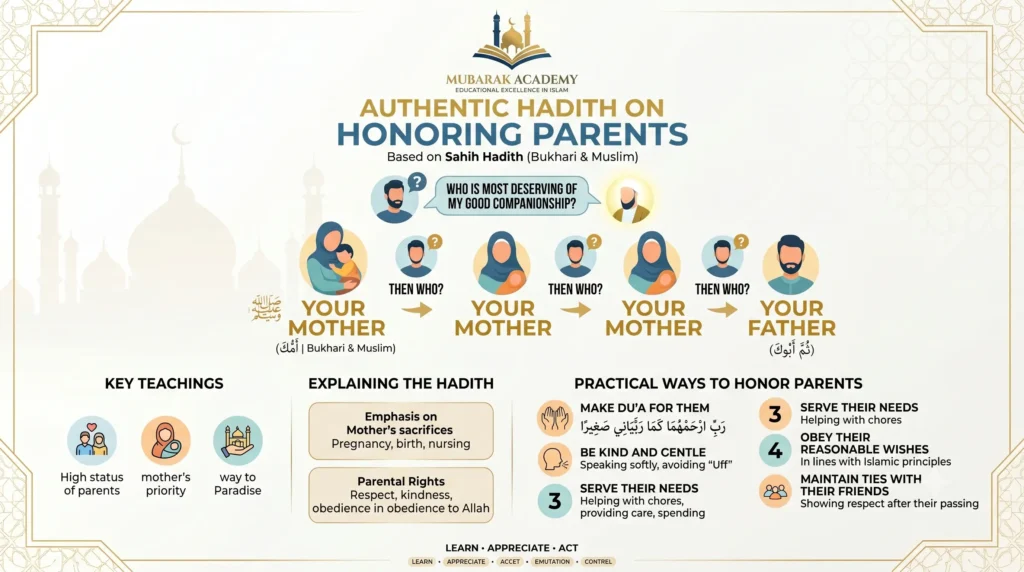
The Sunnah of the Prophet Muhammad ﷺ brings these Quranic principles into lived practice. The following narrations are among the most authenticated.
The Hadith of the Three Questions
A man came to the Prophet ﷺ and asked: “Who among people is most deserving of my good company?” The Prophet said: “Your mother.” The man asked: “Then who?” He said: “Your mother.” He asked again: “Then who?” He said: “Your mother.” He asked a fourth time: “Then who?” Only then did the Prophet say: “Your father.” (Sahih al-Bukhari, 5971; Sahih Muslim, 2548)
Three consecutive responses naming the mother before the father is not an accident of narration. It is emphasis by repetition — a recognized rhetorical device in Arabic — to convey that the mother’s right is threefold before the father’s share begins.
Paradise Under the Mother’s Feet
The Prophet ﷺ said: “Al-jannatu taḥta aqdāmi al-ummahāt” — “Paradise is at the feet of mothers.” (Sunan al-Nasā’ī, 3104)
The Arabic taḥta aqdāmi (under the feet) is an expression of service and proximity. It conveys that the path to Jannah runs through the pleasure of one’s mother — through serving her, caring for her, and honoring her in her daily life.
The Hadith of the Missed Opportunity
The Prophet ﷺ said: “May he be humiliated, may he be humiliated, may he be humiliated — the one who finds one or both of his parents reaching old age and does not enter Paradise through serving them.” (Sahih Muslim, 2551)
Three-fold emphasis again. Old age is presented not as a burden but as an opportunity — the final, greatest chance to earn Jannah through direct service to those who raised you.
The Mercy of a Mother as a Metaphor for Allah’s Mercy
Some prisoners of war were brought before the Prophet ﷺ. A nursing woman searched among them and, finding a child, pressed it to her chest and nursed it. The Prophet said: “Do you think this woman would throw her child into the fire?” The companions said: “No, not if she was able to prevent it.” He said: “Allah is more merciful to His servants than this woman is to her child.” (Sahih al-Bukhari, 5653; Sahih Muslim, 2754).
know more: Quran Memorization Schedule
The Parents’ Responsibilities: What the Quran Says to Fathers and Mothers?
The Quranic framework is not unilateral. Alongside the duties of children toward parents, the Quran assigns clear responsibilities to parents themselves.
Protecting the Family from the Fire
يَا أَيُّهَا الَّذِينَ آمَنُوا قُوا أَنفُسَكُمْ وَأَهْلِيكُمْ نَارًا
“O you who have believed, protect yourselves and your families from a Fire whose fuel is people and stones.” (Surah At-Tahrīm, 66:6)
The primary responsibility of a parent is spiritual guardianship — not career or status, but the eternal safety of those under their care. This is not achieved through authority alone. It is achieved through example, education, and consistent presence.
The First Lesson: Tawhīd
يَا بُنَيَّ لَا تُشْرِكْ بِاللَّهِ ۖ إِنَّ الشِّرْكَ لَظُلْمٌ عَظِيمٌ
“O my dear son! Do not associate anything with Allah. Indeed, associating others with Him is a great injustice.” (Surah Luqman, 31:13)
The model parent in the Quran is Luqman al-Ḥakīm (Luqman the Wise) — a man commended for wisdom, not prophethood. His first instruction to his son is not about manners, education, or worldly success. It is lā tushrik billāh — do not commit Shirk. The Quranic model of parenting begins with the theological foundation before anything else.
Note also the form of address: yā bunayya (يَا بُنَيَّ) — a diminutive of tenderness, meaning “my dear little son.” Connection and gentleness precede instruction in the Quranic parenting model.
Provision and Protection
وَالْوَالِدَاتُ يُرْضِعْنَ أَوْلَادَهُنَّ حَوْلَيْنِ كَامِلَيْنِ ۖ وَعَلَى الْمَوْلُودِ لَهُ رِزْقُهُنَّ وَكِسْوَتُهُنَّ بِالْمَعْرُوفِ ۚ لَا تُكَلَّفُ نَفْسٌ إِلَّا وُسْعَهَا
“Mothers may breastfeed their children for two complete years, for those who wish to complete the nursing period. Upon the father is the mothers’ provision and their clothing according to what is acceptable. No soul is charged with more than its capacity.” (Surah Al-Baqarah, 2:233)
The father’s financial responsibility toward the nursing mother — rizquhunna wa kiswatuhunna (their sustenance and clothing) — is a divine right given to the mother who is dedicating her body to the child’s nourishment. The verse closes with the principle of justice: lā tukallafu nafsun illā wusʿahā — no soul is obligated beyond its capacity. The Quran is not punitive. It is equitable.
Read More: benefits of reciting Quran daily
How to Apply These Verses in Daily Family Life
Reading is the beginning. The Quran descends to be lived, not merely studied. Here are the practical implications that Islamic scholarship draws from these verses:
While parents are alive:
- Lower your voice in their presence, even during disagreement. The prohibition of uff is an active daily standard, not a poetic ideal.
- Rise when they enter a room as an expression of honor — a Sunnah practice derived from the general principle of iḥsān.
- Recite the du’ā’ of Surah Al-Isra 17:24 daily — and if you are ready to go further, our complete guide on how to memorize Quran easily shows you exactly how to build that habit step by step.
- Attend to their needs before they ask. Iḥsān is proactive, not reactive.
After a parent passes: Scholars of all four major schools (Ḥanafī, Mālikī, Shāfiʿī, and Ḥanbalī) are in agreement that the duty toward parents does not end at death. It continues through regular supplication (du’ā’), honoring their relationships and friends, fulfilling any outstanding promises made on their behalf, and giving in charity with the intention of reward reaching them.
Frequently Asked Questions
What is the most important Quran verse about parents?
Surah Al-Isra (17:23) is widely considered the foundational verse on parents in the Quran. It places the command of Iḥsān (excellence in treatment) to parents immediately after the command to worship Allah alone — establishing the duty as second only to monotheism in the hierarchy of obligations.
What does the Quran say about a mother specifically?
The Quran specifically acknowledges the mother’s physical sacrifice in Surah Luqman (31:14) with the phrase wahnan ʿalā wahn (weakness upon weakness) and in Surah Al-Ahqaf (46:15) with kurhan (hardship, pain). The Prophet ﷺ named the mother three times before the father in the famous hadith about priority of companionship (Sahih al-Bukhari, 5971).
What is the du’ā’ for parents in the Quran?
The Quranic du’ā’ for parents is from Surah Al-Isra (17:24): Rabbi-rḥamhumā kamā rabbayānī ṣaghīrā — “My Lord, have mercy upon them as they brought me up when I was small.” It is recommended to recite this supplication regularly for both living and deceased parents.
Does the duty to honor parents apply if they are non-Muslim?
Yes. Surah Luqman (31:15) explicitly addresses a scenario where parents urge their child toward Shirk — the most serious form of religious deviation — and still commands maʿrūfā (dignified kindness) in worldly interaction. The limit is obedience in sin; the obligation of respectful treatment, care, and companionship remains.
What does Ihsan mean in the Quran?
Iḥsān (إِحْسَانًا) comes from the root ح-س-ن (ḥusn), meaning beauty and excellence. In the context of parents, it means proactive, beautiful conduct — anticipating their needs, serving with genuine warmth, and treating them with the highest standard of care. It is above mere obedience and above basic kindness. The Prophet ﷺ defined Iḥsān in worship as: “to worship Allah as if you see Him, for even if you do not see Him, He sees you.” The same spirit of complete awareness and excellence applies to one’s conduct with parents.
Deepen Your Understanding with Mubarak Academy
The verses explored in this guide are most fully appreciated when understood in their original Arabic — not through translation alone, but through direct encounter with the language in which they were revealed. Learning to read, recite, and understand the Quran in Arabic opens a dimension of meaning that no translation, however precise, can fully convey.
Mubarak Academy offers structured, live one-on-one Quran and Arabic language courses taught by certified teachers who hold academic and Islamic qualifications, including Ijazah certification with an authenticated chain (Sanad) reaching back to the Prophet ﷺ. Courses are available for all ages and levels — from absolute beginners learning the Arabic alphabet to advanced students pursuing Hifz (memorization) and Ijazah.
If you want to read these verses in Arabic with the accuracy and beauty they deserve, start with a free trial class at Mubarak Academy.
Ustadh Ahmed Mahmoud Abdulaziz is an experienced teacher of Arabic and the Holy Quran for native and non-native speakers. He holds a verified Ijazah in Hafs ‘an Asim and is certified in the foundational Tajweed texts Al-Jazariyyah and Tuhfat Al-Atfal. Drawing on his extensive background in traditional Quranic recitation and international pedagogy, he writes scholar-verified, accessible articles to help students worldwide master Tajweed rules and Arabic linguistics safely and accurately.