
Allah (SWT) commands in Surah Al-Muzzammil (73:4): “And recite the Quran with measured recitation (tarteel).” That single word — tarteel — is the doctrinal foundation of every structured Quran memorisation timetable. Measured, deliberate, consistent. Not rushed, not irregular, not left to motivation. The student who builds a timetable for Quran memorisation is not merely getting organised — they are fulfilling a Quranic instruction about how the Book of Allah is to be approached, This guide provides every schedule a hifz student needs: a daily Quran Memorization Schedule, a weekly timetable, a revision plan, three completion programmes by pace, and nine evidence-based habits that keep students consistent from the first juz’ to the last.
Why Timetable for Quran Memorization is Important ?
A timetable for Quran memorisation is a structured daily and weekly plan that allocates fixed time blocks for new memorisation (sabaq), recent revision (sabqi), and older revision (manzil) — the three-part classical hifz framework used by scholars and students for centuries. Without all three components running simultaneously, memorised portions are lost faster than new ones are added.
The Prophet Muhammad ﷺ said: “Keep refreshing your knowledge of the Quran, for by the One in Whose Hand is my soul, it escapes faster than a camel from its tying ropes.” [Sahih al-Bukhari, No. 5033; narrated by Abu Hurairah (رضي الله عنه)]. This hadith is not a general encouragement — it is a precise description of what happens to unrevised memorisation. A timetable is the practical response to that warning.
Beyond retention, consistency itself carries spiritual weight. The Prophet ﷺ said: “The most beloved deeds to Allah are those done consistently, even if they are small.” [Sahih al-Bukhari, No. 6464; narrated by Aisha (رضي الله عنها)]. A daily hifz schedule of thirty focused minutes, maintained without interruption, is more valuable before Allah — and more effective for memory — than sporadic three-hour sessions.
Understanding the Classical Hifz Framework: Sabaq, Sabqi and Manzil
Before building any timetable, a student must understand the three-tier revision system that has governed hifz for generations:
| Term | Arabic | What It Means | Recommended Daily Time |
|---|---|---|---|
| Sabaq | سَبَق | New memorisation — the portion being learned today | 20–40 minutes |
| Sabqi | سَبْقِي | Recent revision — pages memorised in the past 7–14 days | 15–20 minutes |
| Manzil | مَنْزِل | Old revision — all previously memorised sections cycled over 7 days | 20–30 minutes |
A student who only memorises new material (sabaq) without maintaining sabqi and manzil will find that each new page comes at the cost of an old one. The timetable must protect all three — not just the new.
Download Your Free Quran Memorization Schedule PDF: 5 Pages, Ready to Print
A timetable you read is useful. A timetable you hold, write in, and carry to every session becomes a hifz system. The Mubarak Academy Quran Memorization Planner gives every student — from a 10-year-old in a structured hifz school to a working adult fitting sabaq into 20 minutes after Fajr — a single printable resource that covers every layer of the classical three-tier revision framework.
The planner is free, requires no sign-up to download, and is designed to be used alongside any of the three completion programmes in this guide.
explore Online Quran memorization courses
Page 1: Weekly Hifz Tracker
Seven rows, one per day, with dedicated columns for your sabaq (new verses), sabqi (pages under active revision), manzil cycle, duration, and a completion checkbox. A weekly summary strip at the bottom captures total new verses, total pages revised, and days completed — the three numbers that determine whether your pace is sustainable or needs adjusting. Students who track weekly progress in writing identify their weak days within two to three weeks, before a pattern becomes a problem.
Page 2: Monthly Progress Chart
Thirty individual day-cells across a 6×5 grid. Each cell captures the surah and verse range memorised, whether revision was completed, and a circle to shade green when the day’s full goal — new memorisation and revision both — is met. The monthly summary bar at the bottom records total new verses, total pages revised, and overall juz’ progress. Seeing 28 shaded circles out of 30 at month-end is a more powerful motivator than any generic encouragement.
explore online Quran hafiz course
Page 3: Full Quran Completion Timeline (3 Pace Options)
Three plan cards — Intensive (2 years, 1 full page per day), Standard (3–4 years, half a page per day), and Steady (5–7 years, a quarter page per day) — sit above a 30-juz’ completion grid. Each of the 30 Juz’ boxes shows the classical Arabic name of that juz’, a completion circle to mark when it has been memorised and teacher-verified, and a running progress counter at the bottom. For students who struggle to sustain motivation across a multi-year programme, seeing the grid fill is a concrete record that the journey is moving forward.
Page 4: Daily Revision Log
Twenty-five rows covering date, sabaq range, sabqi pages, manzil juz’, time spent, a five-point fluency rating, and teacher initials. The fluency column — five circles to shade, from 1 (significant hesitation) to 5 (no pause, correct tajweed) — is the most important field in the log. Students who rate their recitation honestly discover within one month that certain pages consistently score below 3. Those pages are the ones that need isolation drilling, not continued forward progress. The log makes that pattern visible before it becomes a problem that requires months to correct.
Learn Quran Recitation Classes Online With a Certified Teacher
Page 5: Your Next Step With a Certified Hifz Teacher
A planner organises the work. A qualified teacher ensures the work is correct. The final page connects students who are ready to move from self-directed memorisation to structured, teacher-supervised hifz — with a direct link to Mubarak Academy’s free trial lesson for online one-to-one classes with certified Egyptian teachers who specialise in Tajweed and Hifz.
Download the Mubarak Academy Quran Memorization Planner ( Free PDF )
5 pages. Print once, use for your entire hifz journey. Includes the Weekly Hifz Tracker, Monthly Progress Chart, Full Quran Completion Timeline, Daily Revision Log, and your next step toward teacher-supervised memorisation.
Daily Quran Memorization Schedule:
Following a daily timetable for Quran memorization helps you learn new verses, review what you’ve memorized, and remember them for the long term. Here’s a recommended daily timetable for Quran memorization:
| Time | Duration | Activity | Tip |
|---|---|---|---|
| After Fajr | 30-60 min | New memorisation (sabaq) — repeat each line 10–15 times aloud; listen to Sheikh Al-Sudais, Sheikh Mishary Rashid Al-Afasy, or Sheikh Al-Minshawi for correct pronunciation | Prime retention window; tarteel over speed |
| Midday | 15-20 min | Review morning’s memorization | Consolidates short-term memory before it fades |
| After Asr | 20-30 min | Revise older memorization (sabaq & sabqi) | Cycles older material back into active memory |
| Before sleep | 5-10 min | Listen to the day’s verses via audio recitation | Sleep consolidates auditory memory; established in cognitive science and consistent with the Sunnah of night remembrance |
One Mushaf, always. Use the same physical copy of the Quran throughout the entire hifz journey. Visual memory — knowing that a particular ayah sits at the top-left of a right-hand page — is a documented and powerful retention tool. Switching between different editions disrupts this visual mapping and should be avoided.
For students who want to understand the recitation principles underlying correct memorisation, the complete guide to Tajweed rules covers every rule with examples — essential reading before beginning any hifz programme.
Weekly Timetable for Quran Memorization:
A weekly structure prevents the most common hifz failure: accumulating new pages without consolidating them. The following framework balances five days of active memorisation with one day of deep review and one lighter day:
| Day | Activity | Notes |
|---|---|---|
| Days 1–5 | Memorise 1–2 new pages (sabaq) + revise previous week’s pages (sabqi) | Never memorise more than the revision system can sustain |
| Day 6 | Weekly deep review: recite all pages memorised during the week from memory, without looking | Identify weak verses before they become permanent errors |
| Day 7 | Light manzil review or structured rest | Rest is not absence of hifz — it is consolidation |
The weekly consolidation session on Day 6 is not optional. Students who skip it consistently will notice, within three to four weeks, that early pages become uncertain while recent pages feel strong. The manzil system exists precisely to prevent this imbalance.
Explore Online Tajweed Classes
Quran Revision Timetable: The 4-Layer System
Revision (muraaja’ah) is not a supplement to memorisation — in the classical hifz tradition, it is the primary work. New memorisation adds pages; revision keeps them. The following four-layer system ensures that no memorised portion is left unvisited long enough to fade:
Layer 1:Daily Revision
Spend 15–30 minutes each day reciting the verses memorised the previous day. Recite aloud and correct any Tajweed errors immediately. Silent reading does not constitute revision for hifz purposes — the tongue must be engaged.
Layer 2: Weekly Revision
Dedicate one session per week to reciting everything memorised in the current week. This is the sabqi cycle, extended. Combine newer and slightly older pages in a single sitting to reinforce the connections between them.
explore our Online Quran Classes for kids
Layer 3: Monthly Revision
Once per month, allocate a full session to revisiting all sections memorised in the past thirty days. This session reveals which pages have settled firmly and which are still fragile — and determines where the following month’s extra attention should go.
Layer4: Quarterly Review
Every three to six months, recite all memorised sections in a single extended session — or across two to three days. This is the manzil cycle at its widest scope. Students who reach Juz’ 10 or beyond will find quarterly reviews essential for maintaining the earliest-memorised sections, which are most at risk of fading.
Layer 5: Revision Through Salah
The simplest and most spiritually integrated revision tool available: recite memorised verses in the voluntary rak’ahs of Sunnah and Tahajjud prayers. The Prophet ﷺ himself stood in night prayer reciting long passages of the Quran [Sahih al-Bukhari, No. 1135]. What is recited in Salah is reinforced by both repetition and spiritual context simultaneously.
Quran Memorization Program for Effective Hifz Online
Timetable for Busy Adults: Memorizing the Quran Around Real Life:
The traditional model of hifz — four to six hours daily in a dedicated Islamic institute — is not accessible to the majority of adult Muslims living in the West. Working professionals, parents, and university students face a reality that full-time hifz programmes were not designed for. The answer is not to abandon hifz. It is to build a timetable that works within the actual shape of a busy life, not an imagined ideal one.
The Prophet ﷺ said: “The most beloved deeds to Allah are those done consistently, even if they are small.” [Sahih al-Bukhari, No. 6464; narrated by Aisha (رضي الله عنها)]. That hadith is the doctrinal permission for the busy adult’s hifz approach: small, daily, and without interruption.
Hifz Course for Adults for Confident Quran Memorization
The 3-Window Method for Busy Adults
Rather than one long session that a packed schedule will inevitably cancel, divide the day into three short windows — each with a specific function:
| Window | Time | Duration | Task |
|---|---|---|---|
| Window 1 — New Lesson | After Fajr | 15–20 min | Memorise 3–5 new verses (sabaq). Repeat each line aloud 10 times minimum before moving to the next. |
| Window 2 — Recent Revision | Commute or lunch break | 10–15 min | Recite yesterday’s verses from memory — no Mushaf. Use your phone’s audio to verify. |
| Window 3 — Old Revision | After Isha or before sleep | 10–15 min | Cycle through older memorised pages (manzil). One quarter-juz is sufficient at this stage. |
Total daily commitment: 35–50 minutes, distributed across the day rather than concentrated in one sitting. This model respects the cognitive reality that distributed practice produces stronger long-term retention than the same amount of time spent in a single block — a principle established in memory research and consistent with the classical sabaq/sabqi/manzil framework.
Hifz Quran at Home Step by Step for Beginners
Using Dead Time for Hifz
Experienced adult huffaz consistently report that the hours between formal sessions are where revision is won or lost. Practical dead-time opportunities:
Commuting: Play the audio recitation of your current sabaq on repeat during your commute. By the time the commute ends, the auditory pattern of the verse is already embedded — your evening formal session will consolidate what the morning audio prepared.
Between adhan and iqamah: This period — typically 15 to 20 minutes in a masjid setting — is one of the most underused revision windows available. The Prophet ﷺ established that supplication between the adhan and iqamah is not rejected [Sunan Abu Dawud, No. 521]. Pair the supplication for hifz with active recitation of current sabqi verses during this window.
Waiting time: Appointments, queues, and transition moments throughout the day can absorb 5 to 10 minutes of manzil recitation. A student who captures three such windows daily adds 15 to 30 minutes of revision to their schedule without changing a single formal session.
Realistic Pace for the Busy Adult
On the 3-window model with 3 to 5 verses per day, a busy adult will complete Juz’ Amma (the 30th juz’, the standard entry point for new hifz students) in approximately 3 to 4 months. The full Quran, maintained at this pace without interruption, takes 6 to 7 years. That timeline should not discourage — it should clarify. A student who begins at age 30 and maintains this pace completes hifz before 37, carrying a memorised Quran for the rest of their life.
What to Do When You Miss a Day of Your Hifz Timetable?
Every hifz student will miss days. What separates students who recover from those who quietly stop is what happens in the session immediately after.
The Prophet ﷺ warned: “Keep refreshing your knowledge of the Quran, for it escapes faster than a camel from its tying ropes.” [Sahih al-Bukhari, No. 5033; narrated by Abu Hurairah (رضي الله عنه)]. A missed day is exactly when verses begin to loosen — the recovery session is not optional.
The 4-Step Recovery Protocol
- No new memorisation. The session after a missed day is a repair day. Adding new sabaq on top of unrevised material compounds the damage.
- Full sabqi revision. Recite everything from the past 7 to 14 days entirely from memory. Mark every verse where hesitation occurs.
- Repair weak verses. Recite each marked verse 15 to 20 times in isolation — not the surrounding passage, just the weak verse itself.
- Resume normally the next session. Once sabqi is clean, hifz continues as scheduled. One missed day, handled immediately, costs one session — nothing more.
Two things to avoid: attempting to memorise double the next day to compensate (this produces shallow memorisation on both days), and dropping the manzil cycle during stressful periods (this is the single most common reason early surahs fade while recent ones stay sharp), One missed day addressed immediately stays one missed day. Left unaddressed, it becomes a week.
Quran Hifz Classes for Ladies with Female Teachers Online
3 Hifz Completion Programmes: Which Pace Is Right for You?
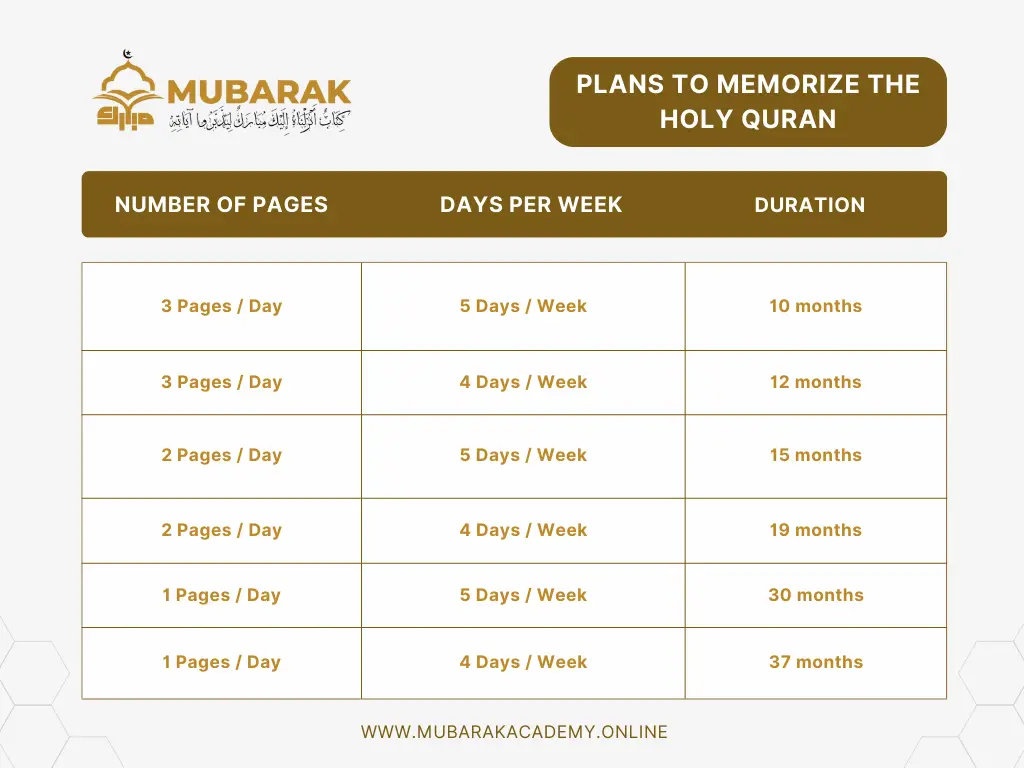
The Quran contains 604 pages across 30 juz’. The following three programmes provide realistic timelines based on daily memorisation volume and consistency levels:
Programme 1: The Intensive Plan (2 to 3 Years)
- Memorise 10–15 verses per day (approximately 1 full page)
- Daily revision: 45–60 minutes of manzil and sabqi
- Weekly consolidation session: 2 hours
- Requires: No significant life disruptions; strong existing Arabic and Tajweed foundation; qualified teacher available at least 3 times per week
- Best for: Full-time students, those studying at an Islamic institute, or young children in a structured Hifz school
Programme 2: The Standard Plan (4 to 5 Years)
- Memorise 5–8 verses per day (approximately half a page)
- Daily revision: 20–30 minutes
- Weekly consolidation: 1 hour
- Requires: Consistent daily commitment; basic Tajweed knowledge; teacher access 2 times per week
- Best for: School-age students, working adults, or parents memorising alongside other responsibilities
Programme 3: The Steady Plan (6 to 7 Years)
- Memorise 3–5 verses per day
- Daily revision: 15–20 minutes
- Best for: Older beginners, those with limited time, or students building Arabic comprehension alongside memorisation
The Quran memorization word by word method pairs naturally with the Steady Plan — understanding each word before committing it to memory produces retention that is far more durable than phonetic repetition alone.
For students beginning with Juz’ Amma — the standard entry point for new hifz students — the guide on How to Memorize Juz Amma Fast provides a specific week-by-week breakdown for completing the 30th juz’ before moving into the full Quran programme.
How Long Does It Take to Memorize the Quran?
The Quran contains 6,236 verses across 114 surahs and 604 pages. The time required to complete hifz depends on three variables: daily time invested, consistency maintained, and whether a qualified teacher is involved.
| Pace | Daily Memorisation | Estimated Completion |
|---|---|---|
| Intensive | 1 full page (±15 verses) | 2 to 3 years |
| Standard | Half a page (±8 verses) | 4 to 5 years |
| Steady | Quarter page (±4 verses) | 6 to 7 years |
These timelines assume consistent daily practice and regular teacher-supervised revision. Students who memorise without a teacher typically take 30–40% longer and carry a higher rate of Tajweed errors that require correction later. Juz’ Amma (the 30th juz’) — the standard starting point — can be completed in 1 to 3 months on the Standard Plan.
9 Habits That Keep Your Hifz Timetable Running:
A timetable on paper means nothing without the habits that sustain it. The following nine practices are grounded in both Islamic tradition and what experienced hifz students consistently report:
- Begin with a small, non-negotiable daily minimum. A student who memorises three verses every day without exception will outperform one who aims for a page and achieves it only four days a week.
- Memorise at the same time each day. Consistency of time trains the mind to enter a focused state at that hour — this is the principle of environmental anchoring applied to hifz.
- Recite aloud, always. Silent reading is reading. Hifz requires the tongue, the ear, and the mind working together. The Prophet ﷺ recited the Quran aloud in night prayer — the auditory dimension is inseparable from the memorisation process.
- Give the memorisation session your complete attention. Phone notifications, background noise, and divided attention are the primary enemies of durable memorisation. The session is an act of worship — treat it accordingly.
- Use the Pomodoro technique for longer sessions. For sessions exceeding 30 minutes, working in 25-minute focused intervals followed by a 5-minute break prevents mental fatigue from degrading the quality of memorisation in the later portion of the session.
- Recite new memorisation in Salah the same day. What is recited in prayer is reinforced by the standing, the ruku’, and the sujood — the full-body engagement of Salah locks new verses into kinesthetic as well as auditory memory.
- Prioritise revision over new memorisation on difficult days. On days when focus is low or time is limited, revise rather than pushing forward. A revised page is always more valuable than a poorly-memorised new one.
- Track progress in writing. A simple hifz planner — noting the date, surah, and ayah numbers completed each day — provides both accountability and a record of achievement that sustains motivation across the years.
- Learn with a qualified teacher. No app, audio recording, or written guide substitutes for a teacher who hears the student’s recitation, catches errors before they solidify, and adjusts the pace to match actual retention. This is the single variable most correlated with successful hifz completion.
For a comprehensive breakdown of memorisation methods beyond the timetable — including the 3×3 method, spaced repetition, and listening-first approaches — the guide on How to Memorize Quran Easily covers each method with practical implementation steps.
Additionally, research published by the Learning Scientists on spaced practice confirms that distributed review sessions — the foundation of the sabaq/sabqi/manzil system — produce significantly stronger long-term retention than massed practice. The classical hifz framework anticipated this finding by centuries.
How Mubarak Academy Helps You Memorize the Quran?
As a leading Online Quran Academy, we provide a structured and supportive environment to make Quran memorization easier and more effective:
- One-on-one online Hifz classes.
- Qualified Egyptian teachers specializing in Tajweed & Hifz.
- Personalized timetable for Quran memorization tailored to your pace.
- Weekly progress reports.
- Recorded recitations for tracking improvement.
- Flexible timings for students and working adults.
Whether you’re starting from zero or continuing your journey, our teachers guide you step-by-step with patience and expertise.
Conclusion:
A timetable for Quran memorisation is not administrative overhead — it is the structure through which a Muslim fulfils the Quranic command of tarteel and responds to the Prophetic warning about forgetting. The student who builds a daily schedule, protects their revision through the sabaq, sabqi, and manzil system, and learns under qualified supervision has created the conditions in which Allah’s permission for hifz completion is most likely to be granted.
The Quran contains 604 pages. With the Standard Plan — half a page per day, six days a week, with consistent revision — a student can complete Hifz in four to five years. That is not a long time. It is a decision made once, and renewed every morning after Fajr.
If you are ready to begin with a structured programme under qualified Egyptian teachers who specialise in Tajweed and Hifz, the Quran memorization course at Mubarak Academy offers personalised timetables, weekly progress reports, and flexible scheduling for students and working adults worldwide.
Frequently Asked Questions about Quran Memorization Schedule:
What is a timetable for Quran memorization?
A timetable for Quran memorisation is a structured daily and weekly plan that divides study time between new memorisation (sabaq), recent revision (sabqi), and older revision (manzil). It gives the hifz student fixed sessions, clear daily targets, and a systematic revision cycle — the three elements required for durable, long-term memorisation of the Quran.How many hours a day should I spend memorizing the Quran?
For most learners, 45 to 90 minutes distributed across two to three sessions is optimal. The post-Fajr session of 30–60 minutes for new memorisation, combined with a 15–20 minute afternoon revision, covers both sabaq and sabqi. Attempting more than 90 minutes of active memorisation in a single sitting typically produces diminishing returns after the first hour.What is the best time to memorize the Quran?
The period immediately after Fajr prayer is the most productive time for Quran memorisation, established by both the Sunnah and cognitive research on morning alertness. The Prophet ﷺ supplicated for barakah in the early hours of the day [Sunan al-Tirmidhi, No. 1212]. The mind is clearest, the environment is quietest, and the spiritual state following Fajr is uniquely suited to engaging with the words of Allah.Can beginners start memorizing right away?
Yes, beginners can start their journey, but mastering basic Tajweed rules first is highly recommended. Memorising with incorrect pronunciation builds muscle memory for errors that become incredibly difficult to unlearn later. A foundation in correct articulation ensures you build your hifz on a sound and accurate baseline.Does Mubarak Academy offer Quran memorization courses?
Yes, Mubarak Academy provides structured, one-to-one online Quran memorization courses tailored for all ages and skill levels. These classes feature flexible scheduling, professional native Arabic instructors, and personalized learning plans that integrate sabaq, sabqi, and manzil tracking to support your long-term hifz goals.
Ustadh Ahmed Mahmoud Abdulaziz is an experienced teacher of Arabic and the Holy Quran for native and non-native speakers. He holds a verified Ijazah in Hafs ‘an Asim and is certified in the foundational Tajweed texts Al-Jazariyyah and Tuhfat Al-Atfal. Drawing on his extensive background in traditional Quranic recitation and international pedagogy, he writes scholar-verified, accessible articles to help students worldwide master Tajweed rules and Arabic linguistics safely and accurately.




Abdulrahman kabir
31 May, 2026I just want to say jazakumullahu khairan for this wonderful advice may Allah SWT reward you abudantly!