Fiqh (الفقه), pronounced “feekh,” is an Arabic term meaning deep understanding. In Islam, it refers to Islamic jurisprudence, the human process of interpreting and applying Islamic law (Sharia) to everyday life, worship, and religious duties, The Prophet Muhammad ﷺ said: “Whoever Allah wishes good for, He gives him understanding (fiqh) in the religion.” (Sahih al Bukhari, No. 71). Mu’awiyah ibn Abi Sufyan (رضي الله عنه) narrated this hadith, and it frames Fiqh not as an academic subject but as a sign of divine favor. This guide covers what Islamic Fiqh is, where its rulings originate, how scholars organized it into schools and categories, and how a Muslim can begin studying it.
What Is Islamic Fiqh (Islamic Jurisprudence)?
Islamic Fiqh (الفقه) is the science of deriving practical legal rulings from their detailed scriptural evidence in the Quran and the Sunnah of Prophet Muhammad ﷺ. Its root, فَقِهَ, means deep comprehension. That meaning is deliberate. Fiqh is not surface level rule following; it is the scholar’s trained understanding of why a ruling exists, how it was derived, and when it applies.
Fiqh governs four broad areas of Islamic life: worship (ʿibādāt), family law (aḥwāl shakhṣiyyah), financial transactions (muʿāmalāt), and public conduct (siyāsah sharʿiyyah).
Islamic Fiqh covers two main areas of life:
1. Acts of worship (ʿIbadat):
Through studying Fiqh, Muslims learn how to pray, fast properly, give zakat, and perform Hajj.
2. Social dealings (Muʿamalat):
including marriage, family matters, business transactions, ethics, and halal and haram practices.
In essence, Islamic Fiqh is the bridge between faith and daily life, teaching Muslims how to apply Islamic values with wisdom and mercy in real-life situations.
Sources of Islamic Fiqh
Islamic fiqh is derived from several authentic sources:
- The Qur’an: The primary and most important source of all Islamic rulings
- The Sunnah: The teachings, actions, and sayings of Prophet Muhammad ﷺ
- Ijma‘ (Consensus): The agreement of qualified Islamic scholars on a ruling
- Qiyas (Analogy): Applying existing rulings to new situations with similar causes
Some scholars also rely on secondary principles such as Istihsan (juristic preference) and Maslahah (public interest) when needed to address new or complex issues.
What Is Usul al-Fiqh (Principles of Islamic Jurisprudence)?
Usul al-Fiqh (أصول الفقه) — literally “the roots of Fiqh” — is the discipline that studies the methodology by which Islamic legal rulings are derived. If Fiqh is the practical output (the rulings themselves), Usul al-Fiqh is the scholarly framework used to reach those rulings from the Quran, the Sunnah, scholarly consensus (Ijma’), and analogical reasoning (Qiyas).
The science of Usul al-Fiqh was formally codified by Imam Muhammad ibn Idris al-Shafi’i (rahimahullah, 150–204 AH) in his landmark work Al-Risalah — the first systematic treatise on Islamic legal theory. Before al-Shafi’i, jurists applied these principles intuitively; after him, Usul al-Fiqh became a defined academic discipline studied in every school of Islamic law.
Understanding Usul al-Fiqh is what distinguishes a qualified Islamic jurist (mujtahid) from someone with general religious knowledge. A mujtahid is a scholar qualified to exercise ijtihad — independent legal reasoning applied to new situations not explicitly addressed in the Quran or Sunnah. This capacity is what allowed Islamic jurisprudence to remain applicable across fourteen centuries and every geography in the Muslim world.
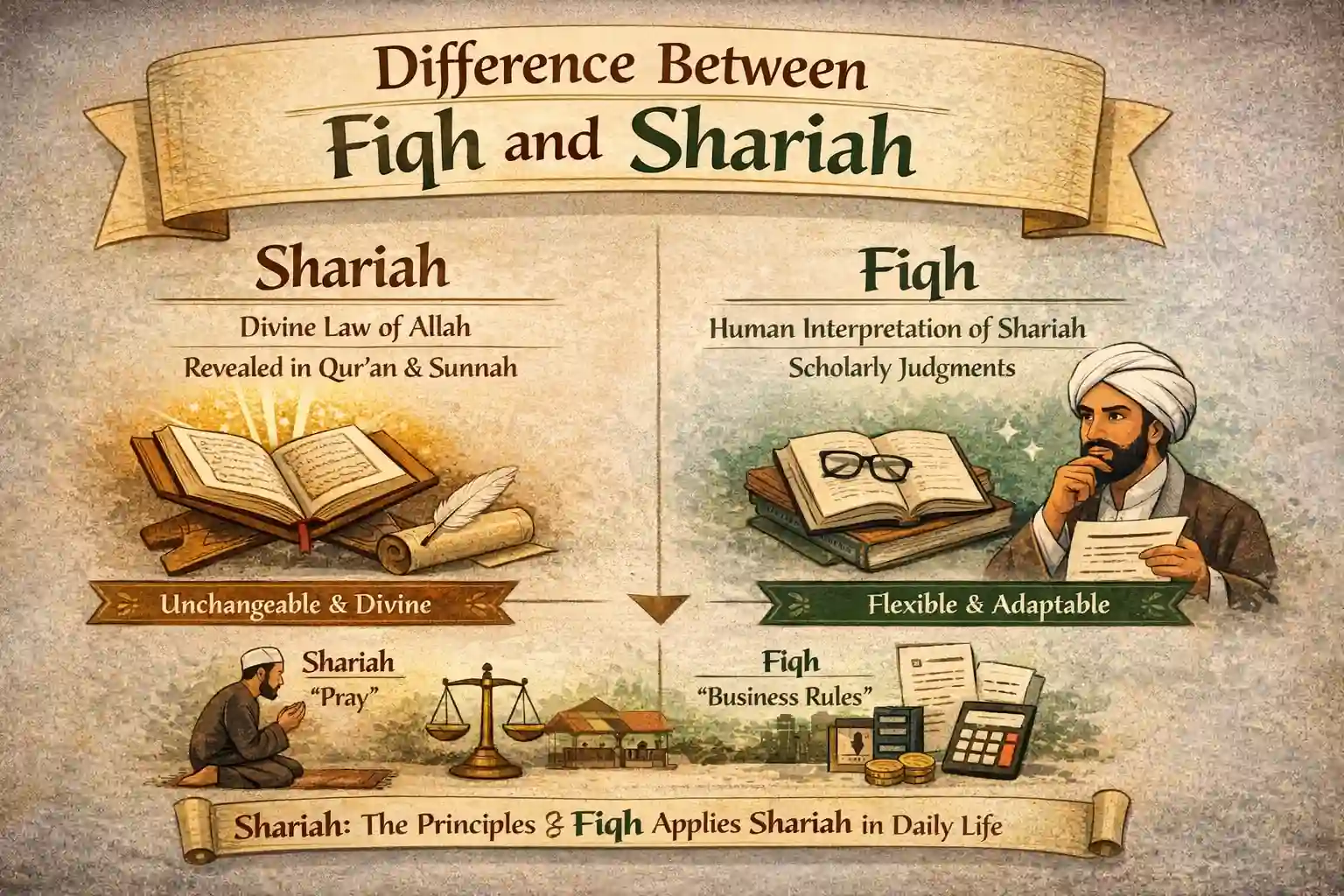
Difference Between Fiqh and Shariah:
Many people use the terms Fiqh and Shariah as if they mean the same thing, but in reality, they serve different roles in Islam
1. Shariah: The divine law of Allah, revealed in the Qur’an and Sunnah ( It is unchangeable).
2. Fiqh: Human understanding and interpretation of Shariah (It can differ based on context, time, and scholarly interpretation).
Examples for Explaining the Difference Between Fiqh and Shariah
- Shariah says: “Pray.”
- Fiqh explains: how many prayers there are, when to pray, how to perform each prayer, and what might invalidate it.
Another Example:
- Shariah says: “Be fair in trade.”
- Fiqh explains: what makes a sale halal or haram, how contracts should be written, and how modern business practices fit within Islamic ethics.
In short, Shariah provides the divine principles, Fiqh turns those principles into practical rulings that Muslims can follow in daily life.
📚 Learn Islamic Fiqh with Certified Scholars Online
Structured Islamic Studies — Fiqh, Aqeedah, Seerah & Quran.
Kids & adults · Native Arab scholars · First class free
Why Islamic Fiqh Is Important in Daily Life?
Islamic Fiqh matters because it translates Islamic teachings into practical guidance Muslims can apply correctly in real life, covering worship, ethics, and lawful conduct. Without it, a Muslim would know the general principles of Islam but lack the detailed framework needed to act on them with confidence.
This practical role becomes clearer once the difference between Fiqh and Sharia is understood: Sharia sets the broad divine objectives, while Fiqh works out how to live by them in specific, everyday situations. That is what makes it indispensable rather than academic. Islamic Fiqh is important because it:
- Helps Muslims worship Allah correctly, by detailing the conditions and procedures of acts such as prayer and fasting
- Guides daily behavior and ethics, shaping how a Muslim speaks, trades, and treats others
- Clarifies what is halal and haram, removing ambiguity in situations the Quran does not address explicitly
- Protects society through justice and balance, particularly in family law, criminal law, and governance
- Makes Islam practical and livable in every era, since scholars apply established principles to new and emerging circumstances
A Muslim without access to Fiqh would have the values of Islam but not the tools to apply them consistently, which is precisely the gap this science was developed to close.
The Four Schools of Islamic Jurisprudence (Madhahib) Explained:
| School | Founder | Region of Origin | Distinctive Approach |
|---|---|---|---|
| Hanafi | Imam Abu Hanifa al-Nu’man (699–767 CE) | Kufa, Iraq | Extensive use of Qiyas and Istihsan (juristic preference) |
| Maliki | Imam Malik ibn Anas (711–795 CE) | Medina, Arabia | Strong reliance on the practice of the people of Medina as a source |
| Shafi’i | Imam Muhammad ibn Idris al-Shafi’i (767–820 CE) | Gaza/Egypt | Systematised Usul al-Fiqh; balanced Hadith and analogical reasoning |
| Hanbali | Imam Ahmad ibn Hanbal (780–855 CE) | Baghdad, Iraq | Strict adherence to hadith; minimal analogical reasoning |
All four schools are based on the Qur’an and the Sunnah and differ only in scholarly interpretation and methodology, not in core beliefs.
6 Types of Fiqh in Islam:
Islamic Fiqh is not a single undivided subject. Scholars classified it into distinct branches centuries ago, each governing a different dimension of a Muslim’s life, from personal worship to public governance.
1. Fiqh al ʿIbādāt (Worship)
Fiqh al ʿIbādāt governs the five pillars and other acts through which a Muslim worships Allah directly: prayer (ṣalāh), fasting (ṣawm), obligatory charity (zakāh), and pilgrimage (ḥajj). Scholars in this branch detail the conditions, timings, and invalidators of each act, so that worship is performed correctly rather than approximately. A missed prerequisite, such as the state of ritual purity (wuḍūʾ) before prayer, can render the entire act invalid, which is why precision in this branch carries real religious weight.
2. Fiqh al Muʿāmalāt (Transactions)
Fiqh al Muʿāmalāt regulates how Muslims interact financially and contractually with one another. It covers buying and selling, lending, partnerships, leasing, and the ethical boundaries of trade, including the prohibition of ribā (interest) and gharar (excessive uncertainty in a contract). This branch is the foundation of modern Islamic finance, since contemporary scholars apply its principles to banking, investment, and commercial law.
3. Fiqh al Aḥwāl al Shakhṣiyyah (Personal and Family Law)
This branch addresses the structure of family life: marriage contracts, divorce procedures, child custody, inheritance distribution, and the mutual responsibilities between spouses and relatives. Inheritance in particular is governed by detailed, fixed shares specified in the Quran, making it one of the most technically precise areas of Fiqh, often requiring specialized scholarly calculation.
4. Fiqh al Jināyāt (Criminal Law)
Fiqh al Jināyāt deals with crimes, evidentiary standards, and punishments within an Islamic legal framework. It distinguishes between categories of offenses, such as ḥudūd (fixed punishments prescribed in the Quran), qiṣāṣ (retribution), and taʿzīr (discretionary punishment determined by a judge). The branch places heavy emphasis on due process and proof, since Islamic legal tradition sets a deliberately high evidentiary bar before any punishment is applied.
5. Fiqh al Siyāsah al Sharʿiyyah (Governance and Public Affairs)
This branch governs leadership, public policy, and the relationship between rulers and citizens within an Islamic legal framework. It addresses how a just ruler should administer resources, protect citizens’ rights, and maintain social order in line with Sharia objectives, particularly the preservation of justice (ʿadl) and public welfare (maṣlaḥah).
6. Fiqh al Akhlāq (Ethics and Morality)
Fiqh al Akhlāq centers on character, manners, and moral conduct in daily interactions. Unlike the more procedural branches, this one shapes how a Muslim treats others, speaks, and carries themselves, covering honesty, humility, patience, and kindness as legally and spiritually significant traits rather than optional virtues.
The 5 Principles of Fiqh (Qawa‘id Fiqhiyyah):
Islamic rulings are built upon five universal legal principles:
- Actions are judged by intentions
- Certainty is not removed by doubt
- Hardship brings ease
- Harm must be removed
- Custom is considered
These principles make fiqh flexible and merciful.
Who Can Study Islamic Fiqh?
Islamic Fiqh is open to anyone who wants to understand Islam more deeply, regardless of background or level. Here’s who can study it:
- Muslims seeking deeper knowledge
- Beginners with no prior background
- Students of Islamic studies
- Imams, teachers, and da‘wah workers
- New Muslims (Reverts)
- Non-Muslims interested in Islamic law
- Men and women of all ages
- Anyone who wants clarity in halal and haram
If you want to understand how Islam guides daily life with wisdom and balance, Islamic Fiqh is for you.

How to Learn Islamic Fiqh Step by Step at Mubarak Academy?
If you’re still wondering what is Islamic Fiqh or how to apply it correctly in your daily life, you’re not alone. Learning Fiqh can feel overwhelming at first, but it doesn’t have to be.
Mubarak Academy’s Islamic Studies course, which includes Islamic Fiqh, is designed to guide you step-by-step. With qualified teachers and a structured learning approach, the course helps you understand Islamic rulings clearly and apply them with confidence in real life.
Enroll at Mubarak Academy today!
Conclusion:
Islamic Fiqh is more than just a set of rules; it is the practical guide that turns faith into everyday action. By understanding what is Islamic Fiqh, Muslims learn how to worship correctly, interact ethically with others, and make decisions that are in harmony with Islamic teachings. From prayer and fasting to family life, business, and social conduct, Fiqh helps make Islam a living, practical way of life.
Take the next step in your journey and start learning how to apply Islam in your daily life with confidence and clarity.
FAQs About Islamic Fiqh:
What is Islamic jurisprudence?
Islamic jurisprudence, known as Fiqh, is the science of understanding and applying Allah’s rulings to daily life. Derived from the Quran and Sunnah, it explains what is required, permitted, disliked, or forbidden, giving Muslims a practical framework for worship, conduct, and decision making in everyday situations.How many Fiqh are there in Islam?
There is one Islamic Fiqh, built on the Quran and Sunnah, but scholars organized it into four main Sunni schools of jurisprudence: Hanafi, Maliki, Shafi’i, and Hanbali. Each school applies the same core sources using a slightly different methodology of legal reasoning.Is one Fiqh school better than another?
No single Fiqh school is better than another. All four Sunni schools, Hanafi, Maliki, Shafi’i, and Hanbali, are authentic and valid, each deriving rulings correctly from the Quran and Sunnah. Their differences come from methodology, not from any disagreement on core Islamic belief.Can I study Fiqh without being a scholar?
Yes, any Muslim can study basic Fiqh without being a scholar. Understanding the fundamentals, how to pray, fast, and distinguish halal from haram, is considered essential knowledge for every Muslim, while advanced legal reasoning (ijtihad) is reserved for trained jurists.Does Fiqh change over time?
The core principles of Fiqh remain fixed, since they are rooted in the Quran and Sunnah, but their application can change. Scholars use established methodology to address new situations, from modern finance to medical ethics, that earlier generations never encountered.Is Fiqh only about worship?
No, Fiqh is not limited to worship. It also governs family life, business transactions, criminal justice, governance, and personal ethics, covering virtually every area of a Muslim’s daily life, not just acts of ritual devotion like prayer and fasting.
Ustadh Ahmed Mahmoud Abdulaziz is an experienced teacher of Arabic and the Holy Quran for native and non-native speakers. He holds a verified Ijazah in Hafs ‘an Asim and is certified in the foundational Tajweed texts Al-Jazariyyah and Tuhfat Al-Atfal. Drawing on his extensive background in traditional Quranic recitation and international pedagogy, he writes scholar-verified, accessible articles to help students worldwide master Tajweed rules and Arabic linguistics safely and accurately.