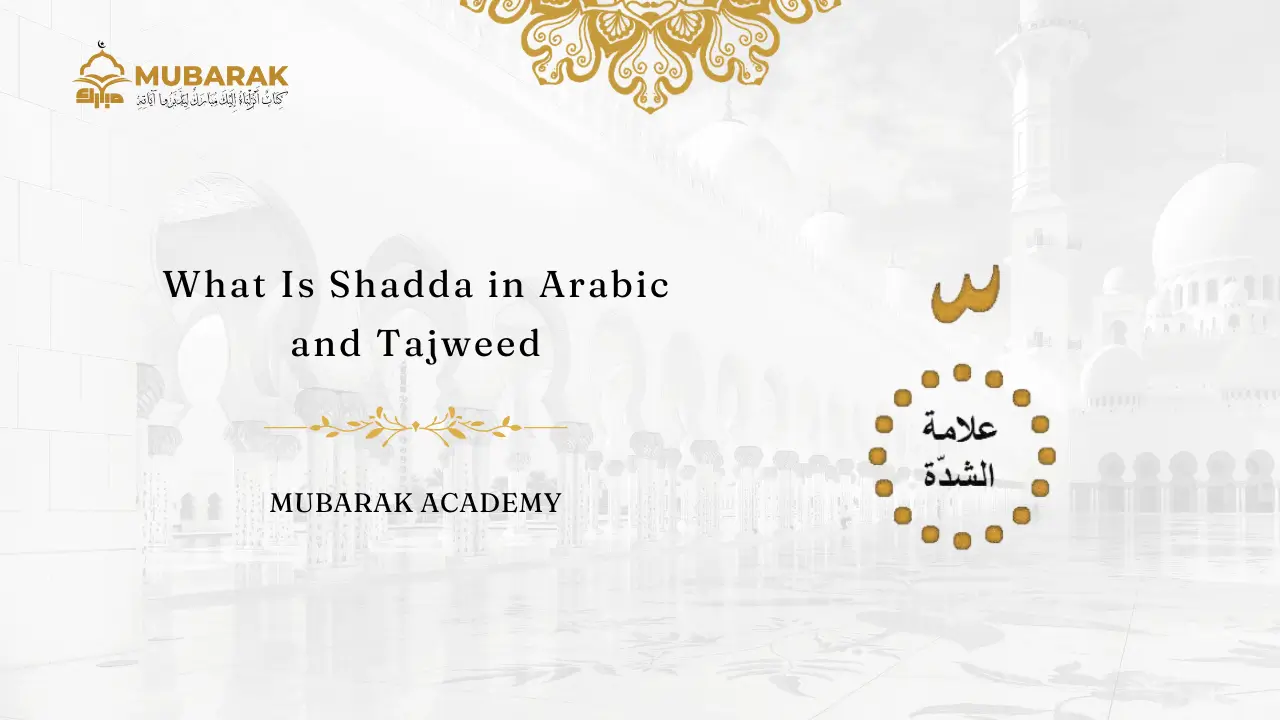
Learning to recite the Qur’an correctly starts with understanding basic Arabic pronunciation, and one small but powerful sign you must not overlook is Shadda (الشدة), because even though it looks tiny, it plays a big role in how words are pronounced and understood, and ignoring it can change the sound and sometimes the meaning, which is why this article explains what is Shadda, why it matters in Tajweed, and how to practice it correctly.
What Is Shadda in Arabic?
If you are wondering “what is Shadda in Arabic?”, it’s simply a small symbol ( ّ ) written above a letter in Arabic. It indicates that the letter should be pronounced twice, as if it were two letters combined into one.
In simple terms, Shadda means letter emphasis or doubling.
Shadda Arabic Examples:
- رَبّ (Rabb) → The letter بّ is doubled in pronunciation
- مُحَمَّد (Muḥammad) → The مّ is pronounced twice
- إيّاك (Iyyāka) → The يّ is emphasized and doubled
That small mark makes a big difference.
What is Shadda in Tajweed
In Tajweed, Shadda ( ّ ) means that the letter consists of:
- A silent letter (with sukoon)
- Followed by a moving letter (with a vowel)
This means the sound of the letter is stressed and strengthened, taking slightly more time and emphasis during recitation.
Why Shadda Is Important in Tajweed
Shadda is essential because:
- It preserves the correct meaning
- It follows the rules of Tajweed
- It helps recite the Qur’an as it was revealed
- Ignoring it can cause serious recitation errors
That’s why a proper understanding of what is Shaddah, and its importance is a key part of accurate and respectful Qur’an recitation. Scholars emphasize the importance of mastering Shadda early in Tajweed studies.
Explore: What is Tajweed in Quran
Types of Shadda in Arabic
In Arabic, Shadda has only one shape, but the way it sounds changes depending on the vowel that comes with it. Think of it as the same rule with different voices. Here are the main types of Shadda, explained simply:
1. Shadda with Fatha (ــّـَ)
The letter is doubled and pronounced with a fatha, giving it a clear, open sound.
2. Shadda with Damma (ــّـُ)
Here, the doubled letter is pronounced with a damma, producing a rounded sound.
3. Shadda with Kasra (ــّـِ)
In this case, the doubled letter is pronounced with a kasra, creating a lighter, sharper sound.
4. Shadda with Sukoon (ــّـْ)
This usually appears when stopping at the end of a word during recitation, such as حَقّْ (haqq). The sound ends firmly on the doubled letter without adding a vowel.
How Shadda Affects Pronunciation
When a letter has a Shadda:
- The sound becomes stronger
- The tongue or lips stay longer on the letter
- The pronunciation becomes clear and more noticeable.
When you see a Shadda, the letter needs a bit more time and focus. For example, in the word إيّاكَ, the يّ is held slightly longer. Skipping that emphasis can make the word sound wrong or change its meaning altogether.
In Tajweed, paying attention to Shadda helps your recitation sound clear, correct, and natural, just as the Qur’an was meant to be recited.
Read Also: How to Recite the Quran Properly
Examples of Shadda in the Qur’an
Here are common examples of Shadda in Quran:
1. إِيَّاكَ نَعْبُدُ (Surah Al-Fātiḥah 1:5)
- The يّ in إِيَّاكَ is stressed
- Meaning: You alone we worship
2. الرَّحْمَٰنِ الرَّحِيمِ (Surah Al-Fātiḥah 1:3)
- رّ in الرَّحْمَٰن and الرَّحِيم
- The ر is pronounced with emphasis
3. إِنَّا أَعْطَيْنَاكَ الْكَوْثَرَ (Surah Al-Kawthar 108:1)
- نّ in إِنَّا
- The ن is doubled clearly
4. ثُمَّ أَمَاتَهُ فَأَقْبَرَهُ (Surah ʿAbasa 80:21)
- مّ in ثُمَّ
- The م is stressed with a clear nasal sound
5. وَالسَّمَاءِ وَالطَّارِقِ (Surah Aṭ-Ṭāriq 86:1)
- سّ in السَّمَاءِ
- طّ in الطَّارِق
Important Tajweed Rule
If a Shadda is on نّ or مّ → it must be pronounced with Ghunnah (nasal sound) for 2 counts.
Example:
- إِنَّا
- ثُمَّ
In all these words, missing the Shadda changes how the word sounds and may affect the meaning.
Difference Between Shadda and Non-Shadda Letters
Here is a clear, simple explanation of the difference between Shadda and non-Shadda letters:
| Feature | Shadda Letter | Non-Shadda Letter |
| Symbol | Has Shadda (ّ) | No Shadda |
| Pronunciation | Double sound | Single sound |
| Strength | Strong & stressed | Light & normal |
| Length | Slightly longer | Short |
| Ghunnah | Required on نّ / مّ | Only if other rules apply |
Simply, whenever you see a Shadda, imagine two letters instead of one.
Example:
- رَبِّ = رب + بِ
- إِنَّ = إن + نَ
5 Common Mistakes When Pronouncing Shadda (الشَّدَّة)
A Shadda ( ّ ) is a vital rule. Many recitation mistakes happen when this rule is not applied correctly.
1. Pronouncing the Shadda Letter Only Once
Mistake: Treating the Shadda letter like a normal (non-Shadda) letter.
Example: ثُمَّ read as ثُما, which is wrong; because the letter must be doubled ثُمَّ → Thum-ma
2. Weakening the Shadda Sound
Mistake: Pronouncing the letter lightly instead of giving it strength.
Shadda letters should sound firm and emphasized, especially with heavy letters (ق، ط، ص، ض، ظ).
3. Forgetting Ghunnah on نّ and مّ
Mistake: Reading نّ or مّ without nasalization.
Example:
- إِنَّا without Ghunnah
- أَمَّا without Ghunnah
Correct:
Apply Ghunnah for 2 counts on:
- نّ
- مّ
4. Over-stretching the Shadda
Mistake: Holding the Shadda too long, making it sound like Madd.
So, remember that Shadda ≠ Madd
5. Confusing Shadda with Similar Letters
Mistake: Losing clarity because of fast reading or poor articulation (Adding Shadda where there is none). So, always check the symbol before stressing the letter.
Read Also: Major and Minor Mistakes in Tajweed
How to Practice Shadda Correctly
Practicing Shadda becomes much easier when you take it one step at a time and don’t rush your recitation. Since a letter with Shadda is pronounced twice, it simply needs a bit more focus and calm reading.
At Mubarak Academy, teachers guide students patiently, explaining Shadda in a clear and friendly way. You listen, repeat, and practice until it feels natural, with kind corrections along the way.
With consistent practice and supportive guidance, Shadda stops feeling confusing and starts becoming a natural part of your Qur’an recitation.
Conclusion
Shadda may be small, but its impact on Qur’an recitation is huge. It strengthens pronunciation, protects meaning, and helps Muslims recite the Qur’an correctly and beautifully. When learners truly understand what is shadda and practice it correctly, they gain more confidence and fluency in their recitation.
Mastering Shadda is a simple step, but it makes a meaningful difference in reading the Qur’an the way it was meant to be recited. So, don’t wait and start your learning journey today.
FAQs About Shadda in Arabic & Tajweed
1. Do I really need to use Shadda when reciting the Qur’an?
Yes! Shadda is an important part of Tajweed, and skipping it can change the pronunciation and sometimes the meaning of words, so it’s best to get it right from the start.
2. Can Shadda really change the meaning of a word?
Absolutely. Even a small Shadda can completely change a word in Arabic. That’s why paying attention to it during Qur’an recitation is so important.
3. Is Shadda hard for beginners?
It may feel challenging at first, but with patience, listening, and slow repetition, it becomes much easier over time.
4. Can every Arabic letter have a Shadda?
Most Arabic letters can take a Shadda, but there are specific rules to follow, which helps ensure correct recitation.
5. How long does it take to master Shadda?
With daily practice and proper guidance, most learners notice clear improvement in a short time.
6. What is Shadda in English?
In English, Shadda refers to letter doubling or emphasizing a consonant sound.