Shadda (الشَّدَّة) is a small diacritical mark written above an Arabic letter that doubles its sound — turning one letter into two in pronunciation. In Tajweed, ignoring it is not a minor slip; it can alter the meaning of a Quranic word entirely. At Mubarak Academy, our teachers correct this mistake more than almost any other in beginner recitation sessions. This guide explains exactly what Shadda is, how it functions within the rules of Tajweed, where it appears in the Quran, and how to master it step by step — even if you are just starting out.
What Is Shadda in Arabic? (The Core Definition)
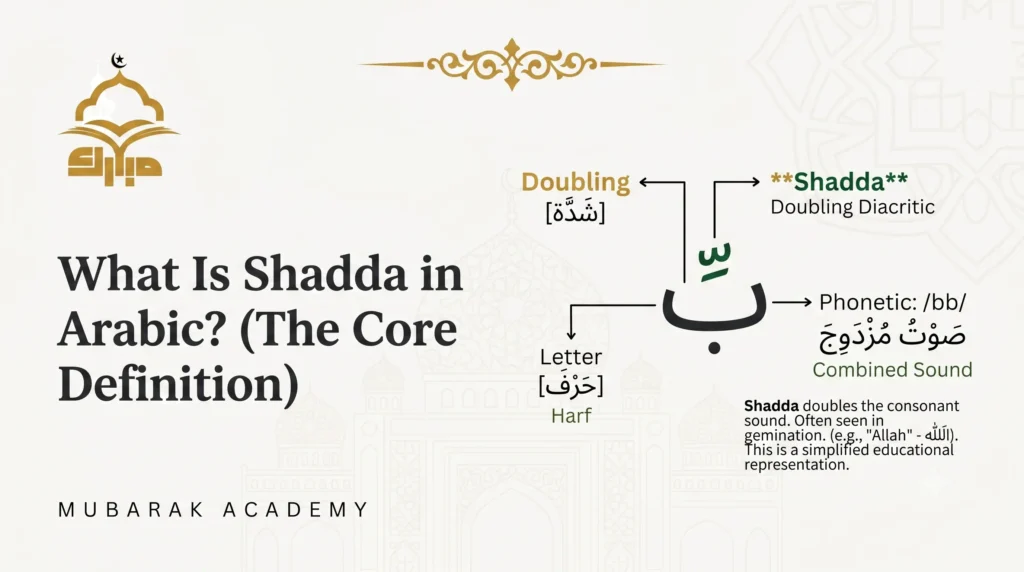
Shadda (الشَّدَّة), written as (ّ) above a letter, is the Arabic diacritical mark that signals gemination — the doubling of a consonant at a single articulation point. It is not a vowel marker and it is not a length marker the way Madd is. It is a consonant instruction: produce this letter twice, compressed into one unbroken movement at the same exit point (makhraj) in the mouth.
A letter carrying Shadda contains two distinct phonetic layers fused together:
Layer 1 — The silent consonant (with sukoon): The letter is produced but held at its articulation point — lips closed, tongue pressed, or throat contracted — without releasing into a vowel. This is the preparatory beat.
Layer 2 — The voiced consonant (with its vowel): From the same position, the letter releases fully into its vowel (fatha, kasra, or damma). This is the resolved beat.
The two layers happen at the same makhraj without separation. The result is a sound that feels held, then released — stronger and slightly longer than a single consonant, but with no gap between the two beats.
So رَبِّ is not “Ra-bi” with a light B. It is “Rab-bi” — you close your lips for the first B (silent beat), hold briefly, then release into the kasra for the second B. If your lips never fully close at the B, you have not produced the Shadda. Similarly, إِنَّ is not “Ina” — it is “In-na,” with the Noon closing at the gum ridge, holding, then releasing forward into the fatha.
How Shadda Is Written and Positioned
| Combination | Written Form | What It Means | Example |
|---|---|---|---|
| Shadda + Fatha | ـَّ (fatha above Shadda) | Double the letter, release into open “a” sound | إِنَّ → “in-na” |
| Shadda + Kasra | ـِّ (kasra below letter, Shadda above) | Double the letter, release into lifted “i” sound | رَبِّ → “rab-bi” |
| Shadda + Damma | ـُّ (damma above Shadda) | Double the letter, release into rounded “u” sound | عَدُوٌّ → “aduw-wu” |
| Shadda at stop (waqf) | ـَّْ (sukoon added at pause) | Double the letter, close firmly — no vowel release | حَقّ → “haqq” (firm stop) |
Identifying the vowel on a Shadda letter before you open your mouth is a mark of Tajweed literacy — students who do this almost never mispronounce it.
Where Shadda Comes From — Its Arabic Grammar Root
Shadda does not appear randomly in Arabic. It marks one of two grammatical realities, and recognising which one you are looking at deepens your understanding of why the doubling is there.
- Idghaam (إدغام) — Assimilation of two adjacent identical letters: When a sukoon letter is followed immediately by the same letter with a vowel, Arabic merges them into one Shadda letter. This is why إِنَّ is written with Shadda on نّ — underneath, it is إِنْ + نَ collapsed into one. The Shadda is the written record of that merger. This is the same principle behind the Tajweed rule of Idghaam encountered with Noon Sakinah and Tanween throughout the Quran.
- Morphological doubling — where the root itself requires it: Some Arabic words carry a doubled consonant as part of their root structure, not as a result of assimilation. The word رَبّ (Lord) has a doubled ب in its root (ر-ب-ب). The Shadda here is not a merger — it is the original double consonant of the root itself.
This distinction matters because it confirms that every Shadda in the Uthmani script has a grammatical reason behind it. It was placed there by scholars working from the exact pronunciation transmitted from the Prophet Mohamed (ﷺ) — it is never decorative.
Why the Definition Matters for Tajweed Students
Many beginners read the Shadda symbol and interpret it loosely as “say this louder” or “emphasise this word.” That interpretation leads to the wrong physical action — raising volume instead of closing the articulation point — and the Shadda never actually gets produced.
In Tajweed, Shadda means something anatomically precise: two consonant beats at the same makhraj, with the first held and the second released into its vowel. Understanding this correctly produces three immediate results:
- You stop thinking about volume and start thinking about articulation point contact
- You produce the silent first beat before the vowel — which is the whole mechanism
- You can physically feel whether you applied the Shadda correctly, because you will notice the hold and release at the letter’s exit point
The six core Arabic diacritical markers — fatha (َ), kasra (ِ), damma (ُ), sukoon (ْ), tanween, and Shadda (ّ) — each carry a distinct phonetic instruction. Shadda is the only one that doubles the consonant itself rather than modifying its vowel. That uniqueness is precisely why it requires its own category of understanding and its own dedicated practice.
What Is Shadda in Tajweed? Rules You Must Know
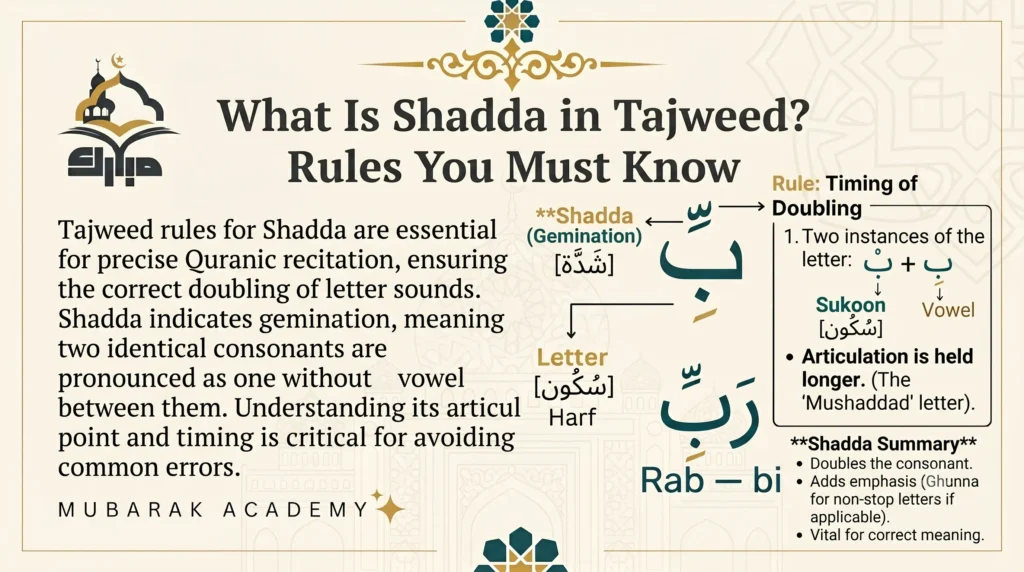
In Tajweed, Shadda carries specific obligations beyond simple doubling. It interacts with other rules, particularly Ghunnah, and its correct application is measured and deliberate — not approximate.
The Ghunnah Rule on نّ and مّ
When Shadda falls on the letters ن (Noon) or م (Meem), an additional rule applies: Ghunnah (الغُنَّة), the nasal resonance that must be held for 2 counts (2 harakaat).
This is one of the most important — and most missed — Tajweed intersections in the entire Quran. Examples you will encounter constantly:
- إِنَّا — the نّ carries Shadda + Ghunnah for 2 counts
- أَمَّا — the مّ carries Shadda + Ghunnah for 2 counts
- ثُمَّ — the مّ carries Shadda + Ghunnah for 2 counts
- إِنَّهُ — same rule applies to the نّ
If you recite these without the nasal resonance, you are making an error in Tajweed even if the doubling sounds correct.
Shadda Is Not Madd
A common confusion among intermediate students: Shadda does not extend the letter like Madd does. Madd stretches a vowel sound across 2, 4, or 6 counts. Shadda compresses two consonants into one point of articulation — it is emphasis, not elongation. Mixing these two up produces a noticeably incorrect recitation.
Shadda and Stop Signs
When you stop (waqf) at a word ending in Shadda, the final letter is pronounced with sukoon — the vowel after the Shadda is dropped. For example, حَقّ when you stop becomes “haqq” with a firm, closed ending. Understanding Quran stop signs helps you apply this correctly throughout your recitation.
Read Also: How to Recite the Quran Properly
Types of Shadda in Arabic (by Vowel Combination)
Shadda has one shape but four distinct sounds depending on the vowel that accompanies it. Each produces a different phonetic result.
| Type | Symbol | Sound Quality | Example | Transliteration |
|---|---|---|---|---|
| Shadda + Fatha | ـَّ | Open, forward, clear | إِنَّ | inna |
| Shadda + Kasra | ـِّ | Light, sharp, lifted | رَبِّ | Rabbi |
| Shadda + Damma | ـُّ | Rounded, backed, full | عَدُوٌّ | ‘aduww |
| Shadda + Sukoon (at stop) | ـَّْ | Firm, closed, resolved | حَقّ | haqq |
Recognising which type you are reading before you reach the letter is a mark of fluency. Strong Tajweed students do not react to diacritics — they anticipate them.
How Shadda Affects Pronunciation in Practice
When you apply Shadda correctly, three physical things happen simultaneously:
- Your articulation point holds briefly — the tongue, lips, or throat close at the letter’s exit point and stay there for one beat before releasing.
- The release carries the full vowel — after the hold, the vowel sounds clearly and completely.
- The result is audibly stronger — a doubled consonant is noticeably more resolved than a single one. Native speakers and trained Tajweed teachers will hear the difference immediately.
In contrast, when Shadda is skipped or weakened:
- رَبِّ sounds like “Rabi” — a different word
- إِيَّاكَ sounds like “Iyaka” — the doubled emphasis of divine address is lost
- إِنَّا sounds like “Ina” — the meaning shifts
This is why scholars across the centuries of Tajweed study have treated Shadda as a foundational mark, not a decorative one.
Examples of Shadda in the Quran
These are high-frequency examples every student encounters early. Each shows a different letter carrying Shadda in a different context — different articulation point, different vowel, different Tajweed rule triggered.
يّ in إِيَّاكَ — Shadda on Yaa with Fatha (Surah Al-Fatihah 1:5)
The يّ in إِيَّاكَ carries Shadda with fatha. This phrase — “You alone we worship” — opens with an addressed pronoun that must sound distinct and deliberate. The Shadda on يّ carries the weight of exclusivity in the meaning. A light, undoubled يّ softens the word into something approximating “Iyaka” — and the directness of divine address is lost entirely.
رّ in الرَّحْمَٰنِ — Shadda from a Sun Letter Rule (Surah Al-Fatihah 1:3)
The رّ in both الرَّحْمَٰن and الرَّحِيم carries Shadda because of the definite article ال meeting a Shamsiyyah letter (sun letter). When ال precedes one of the 14 sun letters, the Lam assimilates into that letter — producing a Shadda. This is not an optional emphasis; it is a rule of Arabic grammar and Tajweed combined. The Lam of ال disappears into the رّ, and the رّ is doubled as a result.
نّ in إِنَّا — Shadda + Ghunnah on Noon (Surah Al-Kawthar 108:1)
The نّ in إِنَّا is one of the first Ghunnah + Shadda combinations students encounter in full recitation. The Noon is doubled at its articulation point — tongue tip to gum ridge — and the nasal resonance (Ghunnah) must hold for 2 full counts before the vowel releases forward. Students who produce the doubling but skip the Ghunnah are applying half the rule.
مّ in ثُمَّ — Shadda + Ghunnah on Meem (Surah ʿAbasa 80:21)
The مّ in ثُمَّ demonstrates Shadda on Meem — another Ghunnah obligatory case. The lips close for the first silent Meem, the nasal resonance holds for 2 counts through the nose, then the lips release into the fatha. Students who master this word transfer the rule automatically to every مّ they encounter: أَمَّا، مِمَّا، لَمَّا — the mechanism is identical each time.
سّ and طّ in وَالسَّمَاءِ وَالطَّارِقِ — Light vs. Heavy Shadda (Surah Aṭ-Ṭāriq 86:1)
Two Shadda letters appear in a single verse: سّ in السَّمَاءِ and طّ in الطَّارِق. Both are sun letter assimilations — ال absorbing into the first letter of the word. But the sound quality is noticeably different: سّ is a light, front-of-mouth letter whose Shadda produces a crisp hiss-and-release, while طّ is a heavy emphatic letter whose Shadda produces a stronger, backed, fuller sound from deeper in the mouth. This verse is an excellent drill for feeling the difference between a light Shadda and a heavy one in immediate succession.
Shadda vs. Non-Shadda Letters: The Key Differences
| Feature | Letter with Shadda | Letter without Shadda |
|---|---|---|
| Symbol | ّ present above letter | No ّ |
| Consonant beats | Two (silent + vowelled) | One |
| Articulatory hold | Yes — brief closure before release | No — direct release |
| Perceived strength | Strong, emphasised | Normal, light |
| Duration | Slightly longer | Short |
| Ghunnah obligation | Yes, if نّ or مّ (2 counts) | Only under separate Tajweed rules |
| Meaning impact | Can change word meaning entirely | Standard pronunciation |
A useful mental model: every letter with Shadda is two letters written as one. رَبِّ = رَبْ + بِ. إِنَّ = إِنْ + نَ. If you treat it as a single letter, you will always under-pronounce it.
5 Common Mistakes When Pronouncing Shadda
These are the exact errors our teachers at Mubarak Academy identify most often in student recitation — from beginners through to intermediate learners.
Mistake 1: Pronouncing the Shadda Letter Only Once
The most frequent error. The student sees the doubled mark but does not produce the articulatory hold — they simply say the letter once with a slightly firmer vowel.
Wrong: ثُمَّ → “Thuma” (single م) Correct: ثُمَّ → “Thum-ma” (double م with hold and release)
The test: say رَبِّ slowly. You should feel your lips close once before the vowel releases. If your lips never fully close, the Shadda is missing.
Mistake 2: Weakening the Sound on Heavy Letters
Heavy (emphatic) letters — ق، ط، ص، ض، ظ — carry a backed, fuller Shadda than light letters. Students often apply the doubling correctly but lose the heaviness of the articulation point, producing a light doubled sound instead of a heavy one.
الطَّارِق demands a Shadda on ط that is both doubled and backed in the throat. A light-ط Shadda is technically incomplete.
Mistake 3: Forgetting Ghunnah on نّ and مّ
This is the most consequential mistake in this list. Shadda on Noon or Meem without Ghunnah is an error even when the doubling itself sounds correct. The nasal resonance through the nose must last 2 harakaat.
Compare this to Qalqalah letters — another Tajweed rule where the articulation produces a distinct echo at the point of release. Both rules require you to do something specific at the letter level, beyond simply reading the vowel correctly.
Affected letters: نّ (in إِنَّ, إِنَّا, مِنَّ, etc.) and مّ (in ثُمَّ, أَمَّا, مِمَّا, etc.)
Mistake 4: Over-Stretching the Shadda into Madd
Some students — particularly those who have studied Madd rules and are trying to be careful — hold the Shadda too long, turning it into a vowel extension. The result sounds like a Madd where there is none.
Shadda does not elongate a vowel. It doubles a consonant. The moment the vowel after the Shadda starts, Madd rules apply only if a Madd letter follows. If not, the vowel is short and normal.
Mistake 5: Adding Shadda Where It Does Not Exist
Speed reading without checking diacritics causes students to pattern-match incorrectly, applying Shadda to letters that are visually similar to ones they have seen with Shadda. Always verify the symbol before stressing the letter — this habit alone eliminates a significant class of Tajweed errors.
Read Also: Major and Minor Mistakes in Tajweed
How to Practice Shadda Correctly
Effective Shadda practice is not about drilling vowels faster — it is about slowing down and building the articulatory habit at the letter level.
- Isolate the letter first. Take رَبِّ. Say رَبْ (with sukoon on the ب) separately. Then say بِ separately. Then merge them: رَبْ-بِ → رَبِّ. Repeat until the merge feels natural. This isolation method forces you to feel the hold and release as two distinct physical actions before you combine them into one.
- Use Surah Al-Fatihah as your training ground. It contains multiple Shadda examples — الرَّحْمَٰن، الرَّحِيم، إِيَّاكَ، الصِّرَاطَ — all within a short, familiar passage. Recite slowly, pausing at each Shadda letter, and confirm the hold and release before moving to the next word. Familiarity with the Surah removes the mental load of reading, so your full attention goes to the articulation.
- Record yourself and compare. Record your recitation and play it back against a certified reciter. The ear catches what the tongue misses. Many students are genuinely surprised to hear they have been skipping Shadda on letters they believed they were doubling — the gap between what we think we are producing and what we actually produce is where most errors hide.
- Apply the Ghunnah test separately. For every نّ and مّ you encounter, hold the nasal resonance through the nose for a deliberate 2-count before releasing into the vowel. This is a separate layer on top of the doubling — train it independently first, then combine it with the Shadda mechanism once each feels stable on its own.
- Learn under a qualified teacher. Written and audio resources explain the rules, but live correction identifies which specific letters you are applying incorrectly. The rules of Tajweed were historically transmitted teacher-to-student for precisely this reason — some errors are only audible, not visible on the page, and only a trained ear can catch and correct them in real time.
FAQ about What is Shadda?
What is Shadda in English?
Shadda is the Arabic diacritical mark that indicates consonant doubling — a letter is pronounced twice, once silently and once with its vowel. In phonetic terms, it marks a geminate consonant. In Tajweed, it additionally triggers Ghunnah when it falls on Noon or Meem.
Can Shadda change the meaning of a Quranic word?
Yes, directly. Arabic meaning is highly sensitive to consonant quantity. Dropping the Shadda on a doubled letter can produce a different word or an ambiguous sound that distorts the intended meaning. This is why Tajweed scholars classify an error on Shadda as a لحن جلي (clear mistake) that must be corrected.
Does every Arabic letter take a Shadda?
Almost every Arabic consonant can carry Shadda, but it is not arbitrary — it appears in specific words following Arabic morphological and phonological rules. In the Quran, every instance of Shadda in the Uthmani script is precisely marked and agreed upon by scholars of recitation.
Is Shadda the same as stress in English?
No. English stress means a syllable receives more volume and duration. Arabic Shadda means a consonant is doubled — two beats at the same articulation point. The result may sound like “stress” to an English speaker, but the mechanism and rules are different.
How long does it take to master Shadda correctly?
With daily practice and correction from a qualified teacher, most students produce Shadda acceptably within 4–8 weeks. Full naturalness in fast or melodic recitation typically takes longer — but the foundational rule is learnable quickly once the articulatory habit is established.
What is the difference between Shadda and Sukoon?
Sukoon (ْ) marks a consonant that has no vowel — a single silent letter. Shadda marks a letter that is effectively two consonants merged — the first with sukoon, the second with a vowel. They share the silent-first-beat in their internal structure, which is why Tajweed describes Shadda as containing a sukoon layer, but Sukoon alone does not double the letter.
Conclusion
Shadda is small in appearance and enormous in consequence. It doubles a consonant, strengthens pronunciation, and — when it falls on Noon or Meem — activates the Ghunnah rule that adds a nasal resonance lasting 2 counts. Missing it changes words. Applying it correctly is one of the clearest markers of a careful, respectful recitation.
If you are working through the rules of Tajweed systematically, Shadda should sit near the top of your practice list — not because it is the hardest rule, but because it appears constantly and its errors are immediately audible. Pair it with your study of Madd, Qalqalah, and Waqf (stop signs) to build a complete foundation.
At Mubarak Academy, every Tajweed course covers Shadda with practical exercises, live correction, and graded progression — so you learn it once and carry it into every recitation afterwards.

Ustadh Ahmed Mahmoud Abdulaziz is an experienced teacher of Arabic and the Holy Quran for native and non-native speakers. He holds a verified Ijazah in Hafs ‘an Asim and is certified in the foundational Tajweed texts Al-Jazariyyah and Tuhfat Al-Atfal. Drawing on his extensive background in traditional Quranic recitation and international pedagogy, he writes scholar-verified, accessible articles to help students worldwide master Tajweed rules and Arabic linguistics safely and accurately.