If you’ve heard terms like Sanad, Ijazah, or chain of narration but never fully understood what they mean, don’t worry. This guide breaks everything down in a simple, clear way so you can truly understand What Is a Sanad in Islam, it’s types, difference between Sanad and Ijazah and how to get a Sanad from a trusted Academy.
What Is a Sanad in Islam?
A Sanad is basically a trustworthy chain of teachers. If someone asks you, “What Is a Sanad in Islam? Imagine your teacher tells you something, and then you tell your little brother, who tells a friend, who tells someone else. Now imagine if that “something” is significant, like a Hadith. You’d want to know exactly who said it to whom to trust it, right?
So, for example, the Golden Chain (a famous example of sanad hadith) might look like this:
- Imam Malik narrated from Nafi
- Nafi narrated from Abdullah ibn Umar
- Abdullah ibn Umar narrated from Prophet Muhammad ﷺ
See? Each person in the chain learned it directly from the one before them. That’s the explanation of Sanad’s meaning in Islam, it’s like a family tree of knowledge!
Learn Also: Quran Ijazah Meaning
Importance of Sanad in Quran Recitation and Ijazah
Now that we’ve answered “what is a sanad in Islam?”, let’s look at the Importance of Sanad in Quran Recitation and Ijazah:
1. Ensures Accurate Recitation:
A Sanad guarantees that your pronunciation, tajweed, and style match exactly what was taught by the Prophet ﷺ. It’s like having a precise map that keeps every word authentic.
2. Builds Trust & Confidence:
Learning through a Sanad connects you directly to qualified scholars (real teachers with verified chains back to the Prophet ﷺ), which builds confidence, as you learn from an authentic, trusted lineage
3. Foundation of the Ijazah:
An Ijazah isn’t just a piece of paper; it’s your teacher saying, “I trust your recitation, and you’re ready to pass it on.” But that trust only comes through a proper Sanad, a chain that proves your recitation has been checked, corrected, and verified.
When you join a structured Quran Ijazah course, you’re not just studying rules; you’re making sure your Sanad is authentic, and your Ijazah carries real value and credibility.
4. Protects the Qur’an Across Generations:
Sanad is one of the reasons the Qur’an sounds the same today as it did over 1,400 years ago. It’s a living chain that prevents mistakes or changes from slipping in. Because of it, every generation learns the Qur’an exactly as it was revealed.
Difference Between Sanad and Ijazah
Here’s a clear explanation of the difference between Sanad and Ijazah in the context of Islamic scholarship:
|
Aspect |
Sanad | Ijazah |
| Definition | The chain of teachers who passed knowledge to you |
The certificate or permission to teach what you learned |
|
Purpose |
Shows your learning comes from trusted, authentic sources | Proves that you have mastered the Qur’an and can teach it confidently |
| Focus | The teachers and their connection to the Prophet ﷺ |
Your achievement as a student |
|
Example |
Teacher A → Teacher B → You |
Certificate saying: “You can teach this Qur’an” |
Simple Example:
- The Sanad is the chain of teachers who taught you.
- The Ijazah is the certificate you receive at the end, confirming your learning is correct and authentic.
Types of Sanad in Islamic Tradition
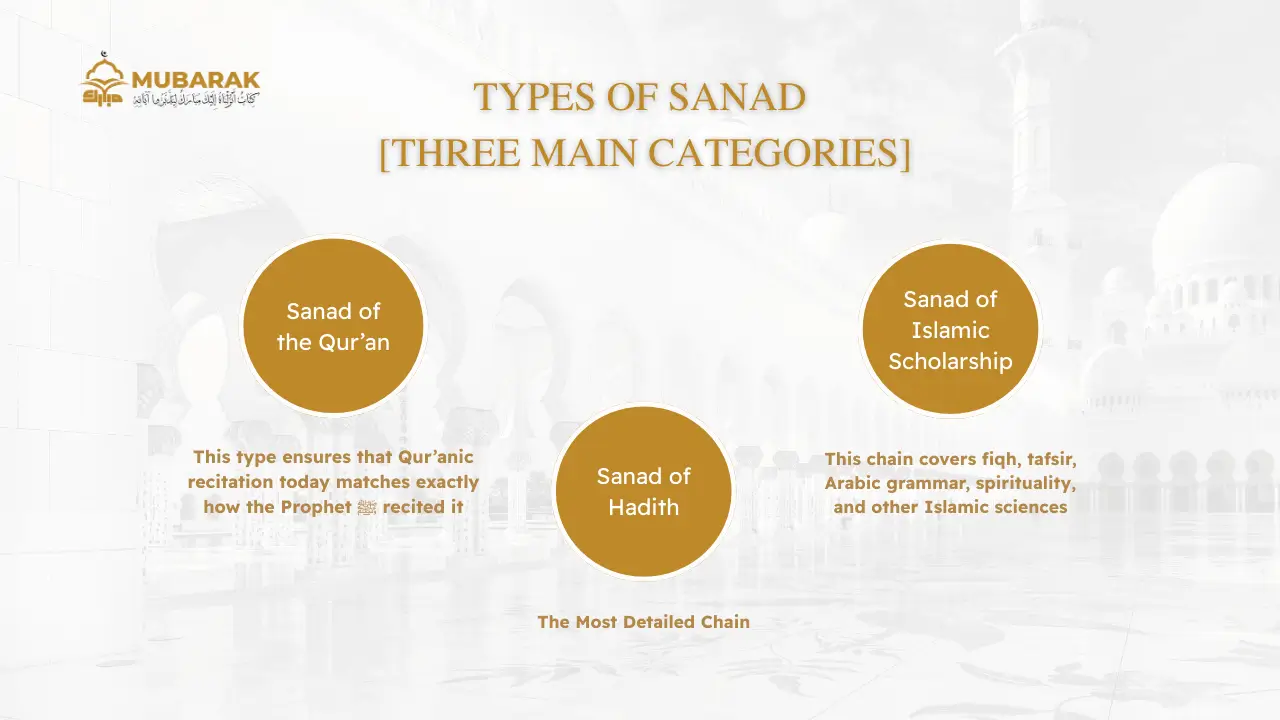
These types show the depth of What Is a Sanad in Islam across different sciences, Hadith, Quran recitation, fiqh, tafsir, and more.
Here’s a clear, simplified breakdown of the three main categories:
1. Sanad of Hadith (The Most Detailed Chain)
This is the sanad most people think of, as it records every narrator who transmitted a Hadith (teacher by teacher) until the chain reaches the Prophet ﷺ
Main subtypes include:
- Muttaṣil (Connected): A complete chain with no missing narrators.
- Munqaṭi‘ (Broken): One or more narrators are missing.
- Musnad: Fully connected to the Prophet ﷺ
- Mu‘allaq (Hanging): Early narrators are skipped, so the chain starts late.
- Mursal: A Successor narrates directly from the Prophet ﷺ (Companion skipped).
- Mu‘ḍal: Two or more narrators missing in a row.
- ‘Ali (High chain): Fewer narrators, closer to the Prophet ﷺ (considered stronger).
- Nazil (Low chain): More narrators, a longer route.
Scholars use these variations to determine if a Hadith is authentic, weak, or strong.
2. Sanad of the Qur’an (Chains of Qirā’āt & Ijāzah)
This type ensures that Qur’anic recitation today matches exactly how the Prophet ﷺ recited it.
It includes:
- Sanad of a Qirā’ah: A full recitation method like Ḥafṣ or Warsh.
- Sanad of a Riwayah: A narration within that qirā’ah (Like Ḥafṣ ‘an ‘Āṣim).
- Sanad of a Ṭarīq: A detailed transmission path such as al-Shāṭibiyyah.
- Ijāzah Chain: Certification proving a student has mastered a recitation and can teach it.
This chain protects the accuracy of pronunciation, tajwīd, and preservation.
3. Sanad of Islamic Scholarship (Knowledge / Academic Sanad)
This chain covers fiqh, tafsir, Arabic grammar, spirituality, and other Islamic sciences. It shows exactly how knowledge was passed down from one scholar to the next across generations.
Main examples include:
- Sanad in Fiqh: Chains leading back to the founders of the madhāhib
(Such as, al-Shāfi‘ī → Mālik → the Companions → the Prophet ﷺ). - Sanad in Tafsīr: Tracing explanations of the Qur’an to early authorities like Ibn ʿAbbās.
- Sanad in ʿAqīdah: Chains preserving the core beliefs taught by early scholars.
- Sanad in Tasawwuf (Silsila): Spiritual lineages connecting teachers to early pious predecessors.
- Sanad in Arabic Grammar: Chains back to early grammarians like Sībawayh and al-Khalīl.
Examples of Sanads in Islamic History
Below are some of the most significant Sanads in Islamic history:
1. The Golden Chain in Hadith (سلسلة الذهب)
One of the strongest chains ever recorded in Hadith studies:
Mālik → Nāfi‘ → Ibn ʿUmar → Prophet ﷺ
Why it’s special:
- All narrators are extremely trustworthy
- Called “Silsilat al-Dhahab” (The Golden Chain) by major scholars
- Imam al-Bukhārī called this one of the strongest chains in Hadith.
- Each narrator learned directly from the previous one
- Used widely in Ṣaḥīḥ al-Bukhārī
This chain is considered one of the purest examples of Hadith transmission.
2. Qur’an Recitation Sanad (Ḥafṣ ʿan ʿĀṣim)
The recitation used by most of the Muslim world today.
Main Chain:
- Ḥafṣ → ʿĀṣim → Zirr ibn Ḥubaysh → Ibn Masʿūd → Prophet ﷺ
Another connected route:
- Āṣim → Abū ʿAbd al-Raḥmān al-Sulamī → ʿUthmān, ʿAlī, and Zayd ibn Thābit → Prophet ﷺ
These two chains are the well-known routes of the Hafs recitation.
3. Sanad of Warsh ʿan Nāfiʿ
A recitation widely used in North and West Africa.
Chain:
- Warsh → Nāfiʿ → Abu Jaʿfar → Companions → Prophet ﷺ
Notes:
- Nāfiʿ learned from multiple Companions, including Ibn ʿAbbās and Ubayy ibn Kaʿb
Warsh studied directly under Nāfiʿ in Madinah
4. Fiqh Sanad (Shāfiʿī → Mālik → Nāfiʿ → Ibn ʿUmar)
In fiqh, scholars transmitted rulings through teacher-to-student chains.
Chain:
- Imām al-Shāfiʿī → Imām Mālik → Nāfiʿ → Ibn ʿUmar → Prophet ﷺ
This is one reason why many rulings in the Shāfiʿī school trace back through Imām Mālik’s scholarship.
5. Tafsīr Sanad (Qur’an Interpretation)
Classical Tafsīr was also passed through chains.
Chain:
- Mujāhid → Ibn ʿAbbās → Prophet ﷺ
- This chain is considered the strongest Tafsīr chain.
- Mujāhid is the most famous student of Ibn ʿAbbās.
Mujāhid said:
“I recited the Qur’an to Ibn ʿAbbās three times, stopping at every verse.”
6. Sufi/Tasawwuf Sanad (Silsila)
Spiritual knowledge was also transmitted through reliable lineages.
Chain:
- Shāh Naqshband → Abd al-Khaliq Ghujdawani → Junayd → Hasan al-Basri → Ali → Prophet ﷺ
Some Naqshbandi chains go through Abu Bakr as-Siddiq instead of ʿAlī, depending on the Sufi order.
7. Arabic Grammar Sanad
Even language and grammar were passed down through scholarly chains.
Chain:
- Sībawayh → al-Khalīl ibn Aḥmad → early Arab linguists and Bedouin experts
This is how classical Arabic grammar was preserved with accuracy.
These real historical chains help demonstrate What Is a Sanad in Islam through lived examples, from Hadith to Qirā’āt, fiqh, tafsir, and spiritual lineages.
How to Obtain a Sanad in Quran Recitation Today
Understanding what does sanad means naturally leads to the next question: how can you earn one today, and what is sanad certificate in practical terms?
At Mubarak Academy, students learn step-by-step with certified teachers who carry authentic chains back to the Prophet ﷺ.
Steps to Obtain a Sanad:
1. Learn Tajweed Properly
Before anything else, you must recite the Qur’an clearly and correctly. At Mubarak Academy, certified teachers guide you step-by-step until your pronunciation and rules are solid.
2. Memorize the Qur’an (Optional but Recommended)
Some sanad programs require full hifz, while others accept strong reciters without complete memorization.
3. Recite the Entire Qur’an to a Certified Shaykh
This is known as a “khatmah for Ijazah.” You read the entire Qur’an under the supervision of a teacher with an authentic chain.
4. Pass the Recitation Evaluation
Your teacher will assess:
- Makharij (pronunciation)
- Tajweed rules
- Fluency
- Accuracy and consistency
Mubarak Academy’s instructors provide feedback with patience and precision.
5. Receive Your Ijazah & Sanad
If you meet the standard, your teacher grants you a written or verbal Ijazah, including the full Sanad tracing back to the Prophet ﷺ.
👉 Enroll now at Mubarak Academy and book your first trial session!
Conclusion
The more you learn about What Is a Sanad in Islam, the more you appreciate how deeply it has preserved Islamic knowledge. Sanad ensures that every verse, every interpretation, and every ruling is passed down accurately and authentically.
Frequently Asked Questions
1. Do I need to memorize the entire Qur’an to get a Sanad?
Not necessarily. Some recitation Ijazahs don’t require full Hifz, though many traditional programs prefer students who have memorized the Qur’an.
2. How long does it take to earn an Ijazah?
It depends on your level; some students finish in a few months, while others may take a year or more.
3. Can beginners aim for a Sanad?
Yes, but they must first master Tajweed and develop fluent, accurate recitation.
4. Is a Sanad only for the Qur’an?
No. Sanads also exist for Hadith, fiqh, tafsir, Islamic texts, and even disciplines like tasawwuf.
5. Is online Ijazah valid?
Yes, online Ijazah is valid as long as the teacher is certified and holds a recognized Sanad.
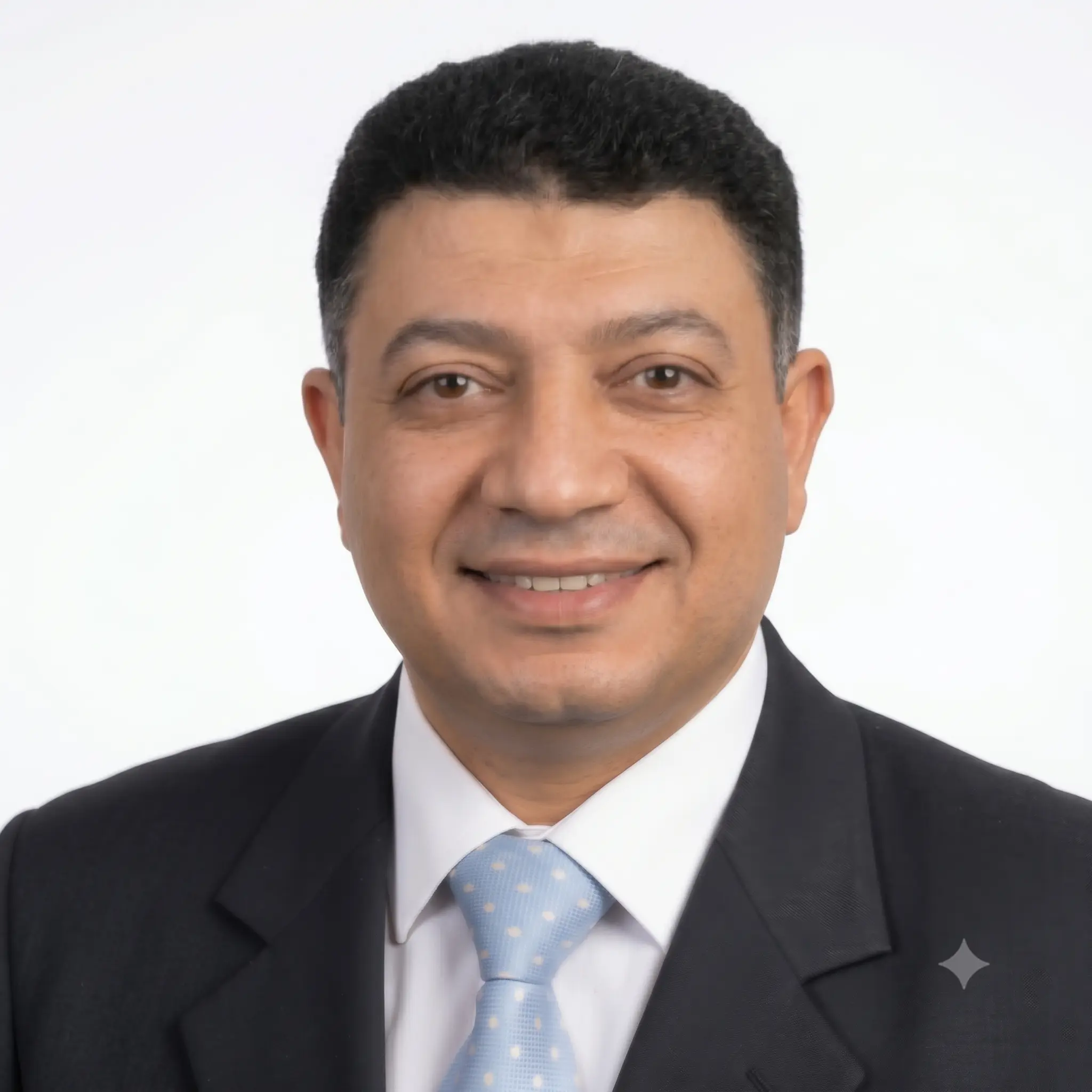
Ustadh Ahmed Mahmoud Abdulaziz is an experienced teacher of Arabic and the Holy Quran for native and non-native speakers. He holds a verified Ijazah in Hafs ‘an Asim and is certified in the foundational Tajweed texts Al-Jazariyyah and Tuhfat Al-Atfal. Drawing on his extensive background in traditional Quranic recitation and international pedagogy, he writes scholar-verified, accessible articles to help students worldwide master Tajweed rules and Arabic linguistics safely and accurately.