Quran stop signs, known in Tajweed as Waqf (الوقف), are essential symbols placed throughout the Mushaf to guide reciters on where to pause, stop, or continue during recitation. Originally established by classical Islamic scholars, these markers protect the sacred meaning of the Quranic text from being distorted during oral delivery.
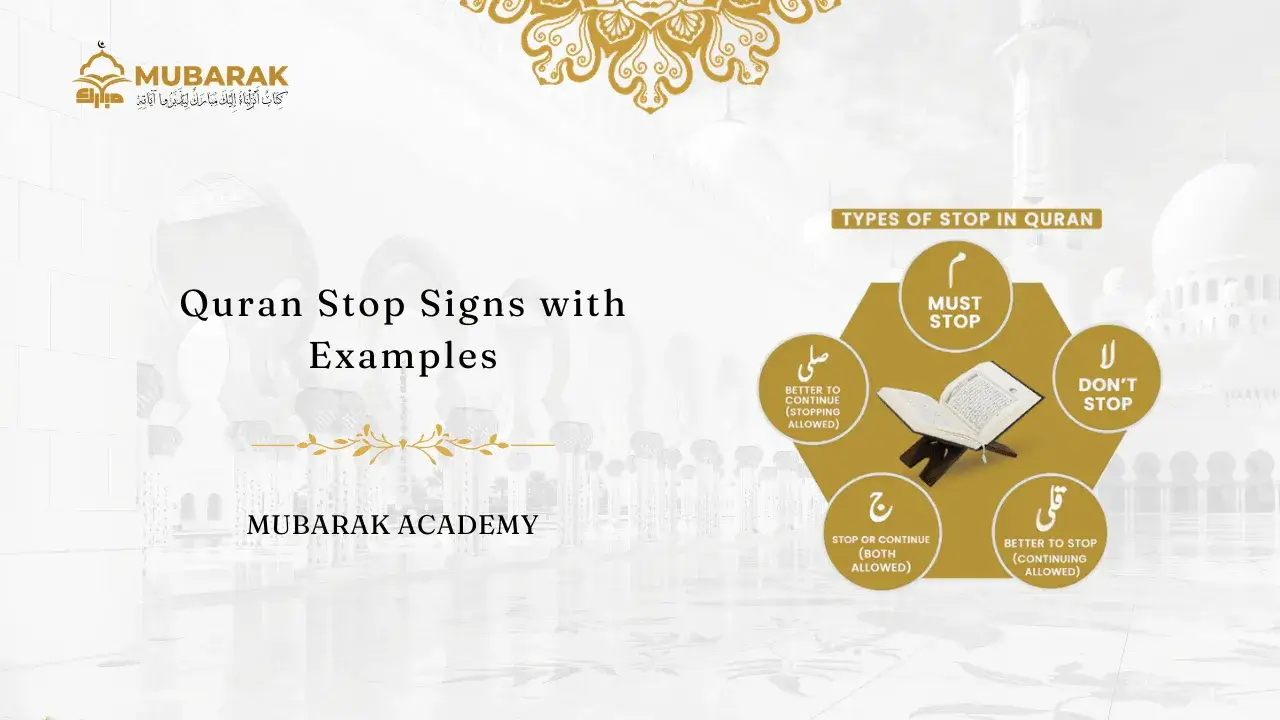
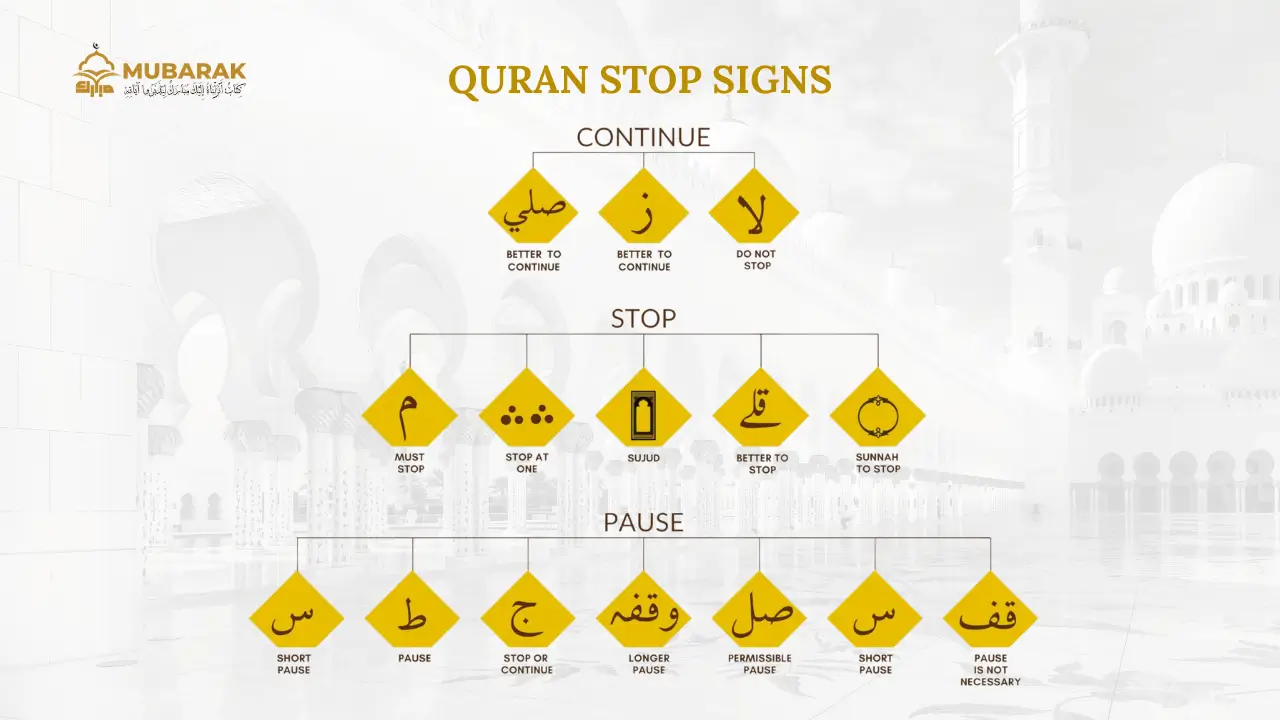
There are ten primary Waqf symbols you will encounter—ranging from the mandatory stop (مـ — Waqf Lāzim) to the strict prohibition on stopping (لا — Lā). Correctly applying these rules ensures your recitation remains linguistically intact, beautiful, and fully aligns with the divine standard of Tarteel described in Surah Al-Muzzammil (73:4): “And recite the Quran with measured recitation.”
Whether you are a beginner or looking to perfect your Tajweed, this guide will unlock the secrets behind every Arabic stop sign in the Quran, complete with rules, symbols, and practical examples.
What Is Quran Stop Signs (Waqf)?
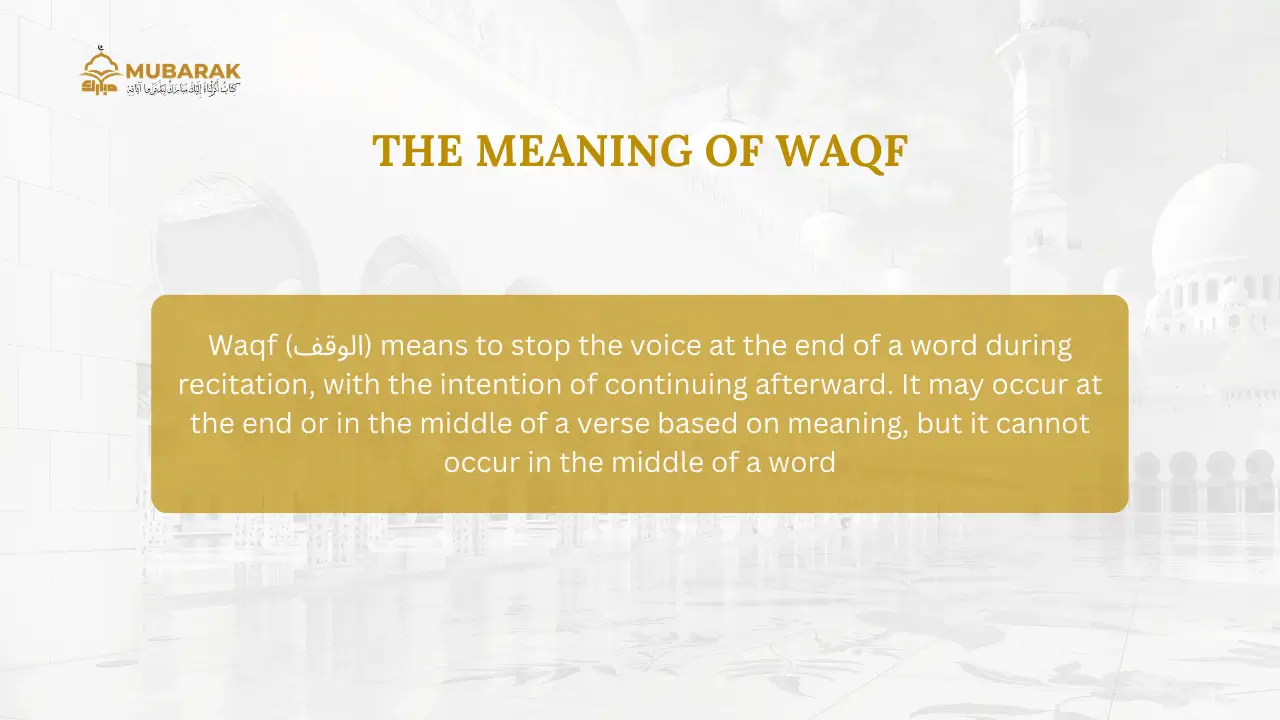
In Tajweed, Waqf (الوقف) literally means “stopping” or “pausing.” Practically, it refers to the intentional pause a reciter makes at the end of a word, accompanied by taking a breath, with the specific intention of continuing the recitation afterward.
If you are trying to learn Tajweed Quran online, mastering Waqf is one of the most critical pillars of accurate recitation. The scholars of Quranic orthography introduced these stop signs to help readers avoid three major recitation pitfalls:
- Distorting the Divine Message: Stopping abruptly at a place that completely alters or corrupts the sentence’s theological meaning.
- Breaking Grammatical Flow: Continuing past a point where a pause is syntactically required to separate independent clauses.
- Losing Breath Mid-Verse: Helping non-native speakers manage their breath patterns systematically without breaking the rules of the Arabic language.
Did You Know? Many classical scholars considered mastering the rules of stopping (Waqf) and starting (Ibtida’) so critical that they deemed it half of Tajweed science. This is why students studying Tajweed rules with examples always learn stopping rules hand-in-hand with letter pronunciation.
By understanding the symbols in the Quran and their meaning, you transform your recitation from simple word-reading to a deep, accurate, and spiritually fulfilling experience.
10 Quran Stop Signs with Examples Summary Table and Their Meaning
Here is a quick reference table of the 10 major Waqf symbols you will encounter in the Quran:
| Symbol | Name | Arabic Term | Rule | When to Use |
|---|---|---|---|---|
| مـ | Waqf Lāzim | وقف لازم | Mandatory stop | Continuing the recitation would alter or distort the intended meaning. |
| لا | Lā | لا | Do not stop | Stopping abruptly at this point would damage or corrupt the sentence meaning. |
| ط | Waqf Mutlaq | وقف مطلق | Complete stop recommended | The grammatical sentence and context are fully complete. |
| ج | Waqf Jā’iz | وقف جائز | Stop or continue — either is fine | Both options are grammatically acceptable; choose based on breath and flow. |
| ز | Waqf Mujawwaz | وقف مجوز | Stop allowed, continuation preferred | It is permissible to stop, but continuing maintains better textual cohesion. |
| صلى | Silā | صلى | Continuation preferred | Stopping is permissible, but continuing yields a better sentence flow. |
| قلى | Qilā | قلى | Stopping preferred | Continuing is permissible, but taking a pause helps in reflection and meaning. |
| ∴ | Mu’ānaqah | معانقة | Stop at one of two points | You must stop at either the first or second symbol, but never at both. |
| قف | Qif | قف | Stop here | The structure or clarity of the verse strongly requires a brief pause. |
| ص / س | Saktah | سكتة | Brief silent pause, then continue | Take a short pause without drawing a new breath, then resume reading. |
Detailed Explanation of the 10 Quran Stop Signs
1. مـ — Waqf Lāzim (The Mandatory Stop)
Rule: You must stop here. Continuing past this sign will merge two thoughts, completely changing or distorting the meaning of the verse.
Example (Surah Al-An’am, 6:36):
إِنَّمَا يَسْتَجِيبُ الَّذِينَ يَسْمَعُونَ مـ وَالْمَوْتَىٰ يَبْعَثُهُمُ اللَّهُ
“Only those who hear will respond. [Must Stop] As for the dead, Allah will raise them.”
Why it matters: If you do not stop at يَسْمَعُونَ (those who hear), the verse would phonetically link “those who hear” and “the dead” together as the ones responding, which is linguistically and contextually incorrect.
2. لا — Lā (Do Not Stop)
Rule: Do not stop here. The sentence is incomplete, and cutting it off here breaks the core message.
Example (Surah An-Nisa, 4:43):
يَا أَيُّهَا الَّذِينَ آمَنُوا لَا تَقْرَبُوا الصَّلَاةَ لا وَأَنْتُمْ سُكَارَىٰ
“O you who have believed, do not approach prayer [Do Not Stop] while you are intoxicated…”
Why it matters: Stopping at “do not approach prayer” creates a false prohibition of prayer itself. You must continue to read the condition: “while you are intoxicated.”
3. ط — Waqf Mutlaq (The Complete Stop)
Rule: The sentence is grammatically and contextually complete. It is highly recommended to stop here to let the meaning settle before moving to the next point.
Example (Surah Al-Qasas, 28:88):
كُلُّ شَيْءٍ هَالِكٌ إِلَّا وَجْهَهُ ط لَهُ الْحُكْمُ وَإِلَيْهِ تُرْجَعُونَ
“Everything will be destroyed except His Face. [Complete Stop] To Him belongs all ruling, and to Him you will be returned.”
Why it matters: Taking a full breath here separates the absolute reality of Allah’s eternity from the subsequent statement about His absolute authority.
4. ج — Waqf Jā’iz (The Permissible Stop)
Rule: You have complete freedom here. Stopping and continuing are equally acceptable. Choose based on your breath control and the rhythm of your recitation.
Example (Surah Al-Baqarah, 2:282):
ذَٰلِكُمْ أَقْسَطُ عِندَ اللَّهِ وَأَقْوَمُ لِلشَّهَادَةِ وَأَدْنَىٰ أَلَّا تَرْتَابُوا ج إِلَّا أَن تَكُونَ تِجَارَةً حَاضِرَةً
“…That is more just in the sight of Allah and stronger as evidence and more likely to prevent doubt among you [Optional Stop] except when it is an immediate transaction…”
5. ز — Waqf Mujawwaz (Permissible, Continuation is Better)
Rule: Stopping is fully allowed (especially if you are running out of breath), but continuing without pausing is preferred to maintain the beautiful textual cohesion.
Example (Surah Ash-Shu‘ara, 26:50):
قَالُوا لَا ضَيْرَ ز إِنَّا إِلَىٰ رَبِّنَا مُنقَلِبُونَ
“They said, ‘No harm. [Stop Allowed] Indeed, to our Lord we will return.'”
6. صلى — Silā (Better to Continue)
Rule: While stopping is permissible, continuing is highly preferred. The flow of the sentence remains much stronger if you do not pause.
Example (Surah Al-Ahzab, 33:17):
قُلْ مَن ذَا الَّذِي يَعْصِمُكُم مِّنَ اللَّهِ إِنْ أَرَادَ بِكُمْ سُوءًا صلى أَوْ أَرَادَ بِكُمْ رَحْمَةً
“Say, ‘Who is it that can protect you from Allah if He intends for you an ill [Continuation Preferred] or intends for you a mercy?'”
7. قلى — Qilā (Better to Stop)
Rule: While continuing is technically valid, stopping is highly preferred. Pausing here allows the listener to absorb and deeply reflect on the profound meaning of the phrase.
Example (Surah Al-Kahf, 18:22):
قُل رَّبِّي أَعْلَمُ بِعِدَّتِهِم مَّا يَعْلَمُهُمْ إِلَّا قَلِيلٌ قلى فَلَا تُمَارِ فِيهِمْ
“Say, ‘My Lord is most knowing of their number. None knows them except a few.’ [Stopping Preferred] So do not argue about them…”
8. ∴ — Mu‘ānaqah (The Mutual / Linked Stop)
Rule: This symbol always appears as a pair of three dots close to each other in a verse. You must stop at one of them, but never at both. If you stop at the first, you must continue through the second (and vice versa).
Example (Surah Al-Baqarah, 2:2):
ذَٰلِكَ الْكِتَابُ لَا رَيْبَ ∴ فِيهِ ∴ هُدًى لِّلْمُتَّقِينَ
“This is the Book about which there is no doubt [Option A], in it [Option B] is guidance for those conscious of Allah.”
How to read it:
- Method 1: Stop at the first dot: “This is the Book about which there is no doubt. (Stop) In it is guidance…”
- Method 2: Stop at the second dot: “This is the Book about which there is no doubt in it. (Stop) Guidance for those conscious…”
9. قف — Qif (Anticipated Stop)
Rule: “Qif” literally means “Stop”. It is an explicit recommendation to stop here because the structural clarity of the verse strongly benefits from a brief pause.
Example (Surah Al-A’raf, 7:187):
قُلْ إِنَّمَا عِلْمُهَا عِندَ اللَّهِ قف وَلَٰكِنَّ أَكْثَرَ النَّاسِ لَا يَعْلَمُونَ
“Say, ‘Its knowledge is only with Allah,’ [Stop Here] but most of the people do not know.”
10. س — Saktah (The Brief Silent Pause)
Rule: Saktah is a unique and very precise rule in Quranic recitation (especially in the narration of Hafs an ‘Asim). You must pause silently for a brief second without taking a new breath, and then immediately resume reading.
Example (Surah Al-Mutaffifin, 83:14):
كَلَّا س بَلْ رَانَ عَلَىٰ قُلُوبِهِم مَّا كَانُوا يَكْسِبُونَ
“No! [Silent Pause – No Breath] Rather, the stain has covered their hearts of that which they were earning.”
Why it matters: This precise pause creates a beautiful linguistic suspension that emphasizes the transition of thought and meaning without breaking the spiritual rhythm of the recitation.
Descriptive Waqf Types (Meaning-Based)
Beyond printed symbols, scholars classify stops based on meaning. When studying all symbols in quran, it is important to understand both printed and meaning-based categories.
These include:
- Waqf Tām (Complete Stop): Meaning fully complete (Stopping here is completely correct).
- Waqf Kāfī (Sufficient Stop): Meaning is complete, but the next part is still related (Stopping is allowed and correct).
- Waqf Ḥasan (Good Stop): Stopping is acceptable, but the sentence is still connected to what comes after (It’s better to continue if possible).
- Waqf Qabīḥ (Bad Stop): Stopping here is incorrect because it changes or harms the meaning (This type of stop should be avoided).
These categories explain the deeper waqf meaning in quran, beyond just following printed symbols.
Importance of Knowing Waqf Meaning in Quran
The Quran is the word of Allah, revealed with beauty and accuracy. Nothing in it is random, not even the pauses between words. The way we recite matters.
Allah says:
And recite the Quran with measured recitation (Surah Al-Muzzammil 73:4)
That’s why learning symbols in the quran and their meaning protects the message of the Qur’an.
If you stop in the wrong place:
- The meaning can change
- The message can become unclear
When you apply the correct stopping signs in Tajweed:
- Your recitation becomes clearer
- Your Tajweed improves
- Your understanding deepens
Mastering these quran stop signs is not optional for serious students. It is a foundational part of Tajweed and Qur’anic accuracy.
Learn Also: How to Learn Quran with Tajweed at Home
What You Need to Know about Quran Stop Signs with Examples ?
Waqf (وقف) refers to the system of stopping signs used in Quranic recitation, classified by scholars of Tajweed to protect the meaning of the revealed text. The Mushaf contains ten primary Waqf symbols: Waqf Lāzim (م) requires a mandatory stop; Lā (لا) prohibits stopping; Waqf Mutlaq (ط) indicates a complete pause; Waqf Jā’iz (ج) permits both stopping and continuing; Saktah (ص/س) signals a brief silent pause without disconnecting the breath; and Mu’ānaqah (∴) marks two possible stopping points, of which a reciter must choose one. These symbols were not part of the original revelation but were introduced by early Quranic scholars to preserve accurate recitation. Mastery of Waqf is a foundational requirement for students seeking Ijazah in the Hafs ‘an ‘Asim recitation.
Start Your Learning Journey with Mubarak Academy
Learning quran signs and symbols is not just about memorizing symbols; it’s about understanding how they protect meaning.
At Mubarak Academy, an Online Quran Academy, students receive structured guidance in:
- Tajweed rules
- Waqf and Ibtidaa (stopping and starting rules)
- Understanding Arabic symbols in quran
- Correct pronunciation
- Practical recitation training
- One-on-one correction with qualified teachers
Our system ensures students master the stop sign in quran, apply proper Tajweed rules stop signs, and confidently understand the symbols in quran and their meaning.
With live online sessions and guided practice, students from around the world can master Qur’anic recitation from home.
Whether you are a beginner or improving your Tajweed, understanding Waqf is a powerful step forward in your Qur’anic journey.
Conclusion
Quran stop signs may look small, but they carry great importance. These quran signs of stopping preserve meaning, protect clarity, and ensure correct recitation, By studying quran stop signs with examples, you can see how each symbol guides you and prevents mistakes in meaning, and your recitation becomes clearer and more meaningful, Understanding the sign of stopping when reading quran is not optional for serious learners; it is a necessary step toward accurate and meaningful recitation.
FAQs About Quran Stop Signs (Waqf)
What are Qur’an signs of stopping?
Quranic stop signs (Waqf symbols) are dedicated calligraphic marks positioned above the Arabic text in the Mushaf. They serve as authoritative punctuation guides, instructing the reciter on when to make a complete stop, when to continue reading, or when choosing either option is grammatically acceptable to preserve the correct meaning.Are stop signs part of the original Qur’an?
These symbols were not present in the original compiled Uthmanic manuscripts, which lacked diacritics entirely. Instead, they were meticulously developed and integrated by classical Arabic grammarians and Tajweed scholars over subsequent centuries to prevent misinterpretation and protect the structural integrity of the divine text as non-native speakers embraced Islam.Is it sinful to ignore stop signs?
It is generally not a sin unless ignoring a mandatory stop (Waqf Lazim) or stopping at a forbidden point (La) deliberately distorts the theological meaning of a verse. If a reciter alters the core message of the Quran due to negligent disregard for these structural signs, it becomes highly disliked or impermissible.Do beginners need to learn Waqf symbols?
Yes, foundational students should study these symbols early in their journey. Mastering Waqf markings immediately prevents the development of bad breathing habits, improves overall reading fluency, and provides beginners with intuitive structural cues that instantly reveal where safe transitions, natural pauses, and complete semantic clauses occur in the text.How long does it take to master Qur’an stop signs?
With dedicated, structured study, most students can easily memorize the definitions and rules of the primary stop signs within two to three weeks. However, automatically identifying them and applying the correct pausing or breathing mechanics smoothly during active, real-time recitation typically requires a few months of guided practice.Are Quran stop signs the same in all copies of the Quran?
Standard stop signs are highly consistent across modern prints like the Madinah Mushaf. However, structural notation variations exist in South Asian (Indo-Pak) scripts, which frequently utilize distinct symbols such as “ط” or “ص”. Despite these visual calligraphic differences, the underlying grammatical rules governing where pauses must occur to protect divine meaning remain entirely unified.What should I do if I run out of breath where stopping is prohibited?
If you run out of breath at a prohibited sign like “La”, you must stop safely. However, you cannot simply resume from the following word. To protect textual integrity, you must backtrack one or two words, re-reciting the partial phrase to connect the syntax and complete the scriptural passage smoothly.What is the difference between Saktah and a normal stop?
A normal stop (Waqf) allows a reciter to pause completely, break their vocal delivery, and take a fresh breath before proceeding. Conversely, a Saktah (س) represents a highly specialized, brief silent pause of roughly two counts where you must hold your breath completely before instantly resuming the continuous recitation.How can I practice Quran stop signs effectively?
The most efficient method is actively listening to professional, certified reciters (Qurra) while tracking the text visually within your Mushaf to study their breathing choices. For definitive correction, personalized feedback, and structural mastery, practicing your pauses regularly under the direct guidance of a qualified Tajweed teacher remains highly recommended.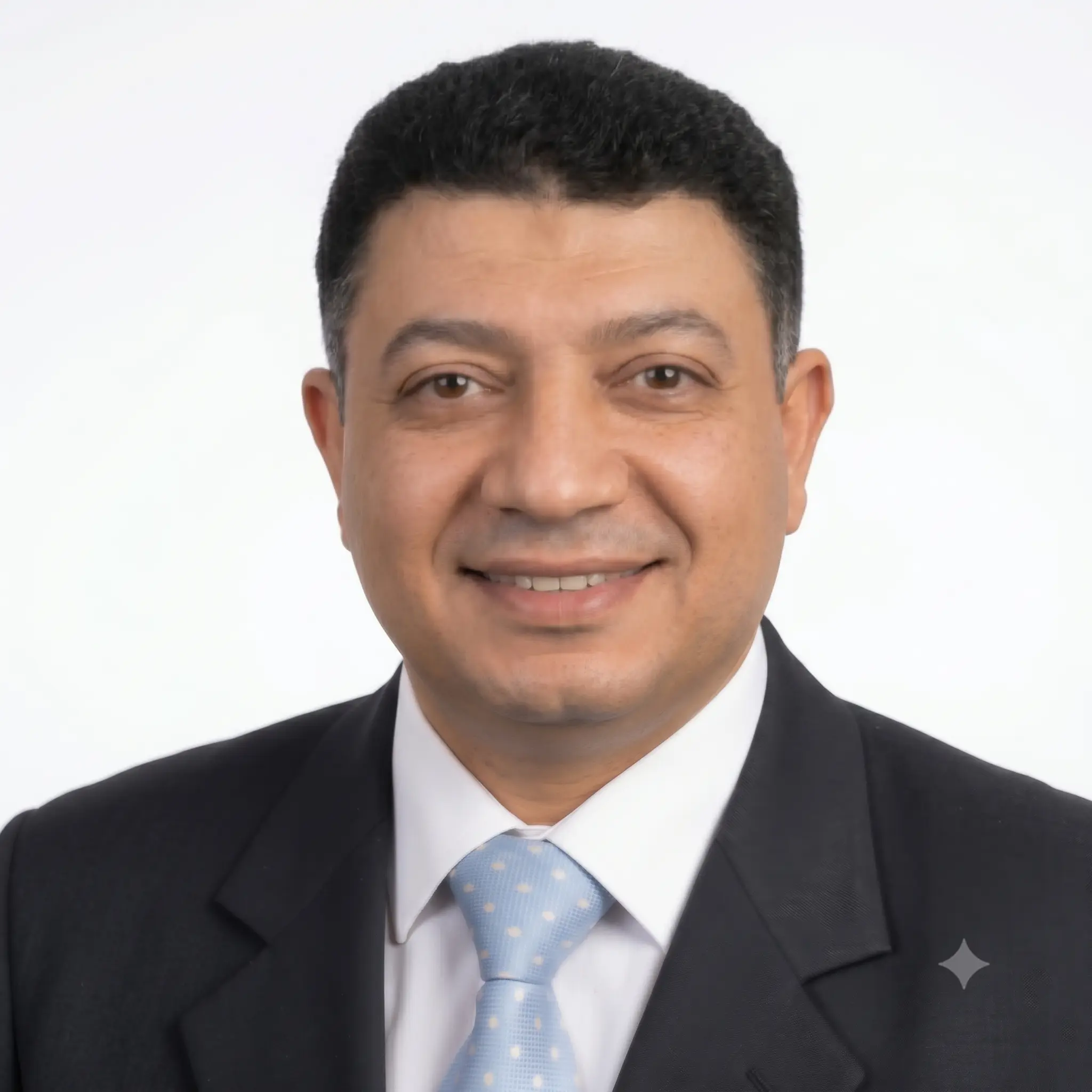
Ustadh Ahmed Mahmoud Abdulaziz is an experienced teacher of Arabic and the Holy Quran for native and non-native speakers. He holds a verified Ijazah in Hafs ‘an Asim and is certified in the foundational Tajweed texts Al-Jazariyyah and Tuhfat Al-Atfal. Drawing on his extensive background in traditional Quranic recitation and international pedagogy, he writes scholar-verified, accessible articles to help students worldwide master Tajweed rules and Arabic linguistics safely and accurately.