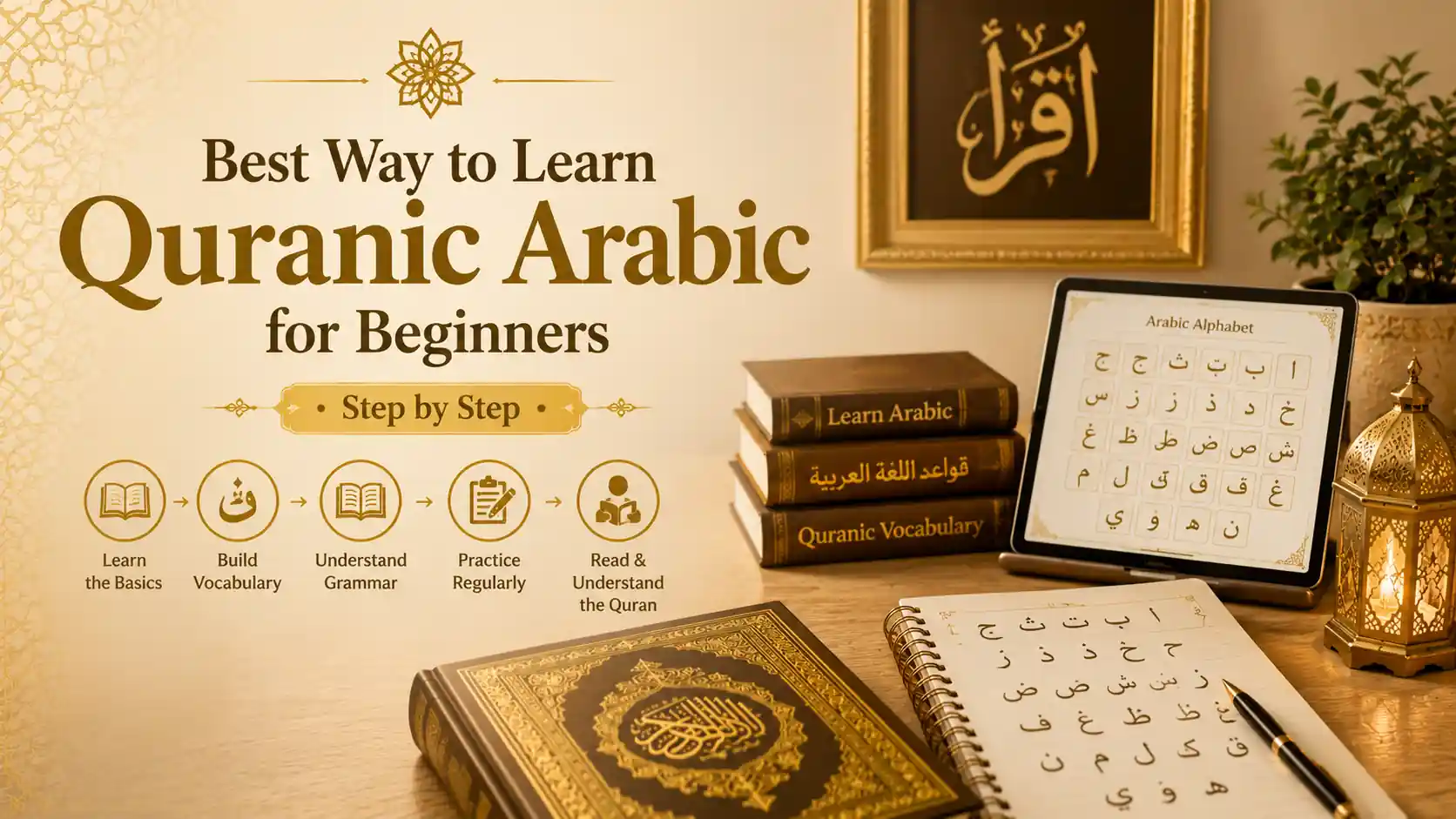
It is important that the best way to learn Quranic Arabic is to take the basic vocabulary, basic grammar, and regular guided practice with a qualified teacher, not study on their own without structure. Many students learn a bunch of words, but they never get to learn the meaning of a complete verse or how sentence structure works. This guide reveals what to learn first, how many words are really necessary, how long it takes realistically, and how to establish a routine to make vocabulary.
What Is the Best Way to Learn Quranic Arabic?
Learning the most frequent words from the Quran, the basic sentence structure, and the correct pronunciation of the letters in combination is the best way to learn Quranic Arabic, not learning them one after the other. Students who are taught vocabulary words in isolation fail to understand the way the words relate to each other in the actual meaning of verses.
They will start learning to read, comprehend, and pronounce the meaning of each word from the beginning, thus increasing understanding Quran text faster since every new word is connected to how it is actually used in the Quran.
Best Way to Learn Quranic Arabic: With a Teacher or Alone?
Self-study apps can be helpful when it comes to quranic vocabulary and pronunciation drills in the beginning, but they cannot correct your errors in real time. A structured course in quranic Arabic, with a live teacher, picks up misreadings of meaning and pronunciation before they become ingrained in the student’s scripture.
which is far more critical with the Quran than in regular Arabic, simply because a slight misreading can turn a verse upside down, so it is the best way to learn Quranic Arabic.
How Do I Start Learning Quranic Arabic as a Beginner?
In the best way to learn quranic arabic Learn the Arabic letters and sounds, then the words that you will encounter frequently. A basic novice sequence is as follows:
- Learn Arabic Letters and how to pronounce them (makharij al-huroof)
- Memorize 100 – 150 common words from the Quran
- Understand simple sentence structures (possessive and Predicate structures)
- Read a familiar short verse regularly (at least one a day) to develop reading skills
- Listen to feedback from teacher weekly to correct pronunciation and meaning early on
Best Way to Learn Arabic Online for Beginners and Adults
Is Quranic Arabic Different from Regular Arabic?
Yes, the vocabulary, sentence structure, and grammar are different from those of everyday spoken Arabic. It follows Classical Arabic rules, not any modern dialect, and older forms of words and case endings, which most spoken Arabic has abandoned. Even for those who know Arabic but not the Arabic used in the Quran, sentence structure is not something they are used to.
Arabic Course for English Speaking Students Step by Step Guide
What Should I Learn First in Quranic Arabic?
Practice the Arabic letters and sounds first, the most common words in the Quran next, and basic sentence structure last. Students become slower when they attempt to learn the grammar rules and uncommon words without this foundation. After the basics of pronunciation and key words, sentence structure and verse meaning begin to gel.
Arabic Classes for 3 Year Olds That Build Early Language Skills
How Many Words Do I Need to Understand the Quran?
You need much less than people think – there are a few words that are repeated throughout the text. Based on frequency analysis of the text of the Quran:
- The 125 most common words account for about 50% of the Quran.
- The Top 250 most used words account for about 75% of the Quran
- There are 500 words that appear in the Quran about 85% of the time.
This is because the study of a few hundred words will provide most learners with a working knowledge of the Quranic language, without having to learn the full Arabic dictionary.
Best Way to Learn Fusha Arabic
Do I Need to Learn Arabic Grammar to Understand the Quran?
Yes, but not to the extent of mastery. There should be enough nahw (syntax) to be able to determine the subject and verb in a sentence and enough sarf (word patterns/morphology) to be able to recognize a word’s root and its change of form that alters its meaning. This is sufficient to learn the meanings of most verses; detailed study of grammar is required for detailed interpretations (tafsir) later.
Arabic Course for English Speaking Students Step by Step Guide
How Long Does It Take to Learn Quranic Arabic?
Timelines depend on your goal and your consistency in your study:
- Identifying familiar words and simple phrases: a few weekly, short sessions every day
- Around 3-4 months of regular vocabulary and grammatical instruction: following the general meaning of most of the verses
- Extensive, advanced knowledge of the language: years of guided study
The key is to study for 10–15 minutes per day (with spaced repetition) and go further than studying for hours at a time every few weeks.
Arabic Classes for 3 Year Olds That Build Early Language Skills
Can I Learn Quranic Arabic at Home by Myself?
Yes, self study at home is good for vocabulary and daily reading. What it can’t do, however, is detect pronunciation or meaning errors while you are using it it will not inform you that you have misread a word in the book or while you are talking on the phone.
Harakat in Arabic Language: The Ultimate Beginner’s Guide to Arabic Vowels
What Is the Easiest Way to Learn Quranic Arabic Fast?
The quickest way is to learn the most common words first, then, use spaced repetition to remember them, and then practise using real Quranic text rather than a general Arabic book. General learning of Arabic is based on words that may never be heard in the Quran, so that valuable study time is lost. Keeping the memory of every word in the Quranic text makes it immediately useful.

Should I Learn Tajweed Before Quranic Arabic?
No, they are not to be studied in order, Tajweed and Quranic Arabic vocabulary can be learned concurrently. Tajweed describes how to say the text and how to recite the text correctly and vocabulary and grammar describe the meaning of the text.
Memorizing them together from the beginning is a better strategy than trying to memorize the pronunciation of words that come before and after the four vowels and the digraphs,as it is to have to learn them again later when incorrect habits have already been formed.
What Are the Most Common Quran Words to Learn First?
Begin with the handful of words found the majority of the time in almost all surahs;
- High-frequency particles: مِن (from), فِي (in), إِلَى (to), عَلَى (on)
- Common pronouns: هُوَ (he), أَنتَ (you), نَحْنُ (we)
- Important verbs: said, believed.
- A noun is called a core noun when it is made of the word “Allah” or “Rab”.
Knowledge of these words will provide you with a significant portion of the total number of words in the text, and therefore you will get the most output from your study input.
Best Fusha Arabic Course with Certificate
Is Quranic Arabic the Same as Classical Arabic?
Not quite Classical Arabic is the umbrella for Quranic Arabic, but Quranic Arabic is a sub-type of Classical Arabic. It also contains pre-Islamic poetry and early Arabic literature, other than the Quran. In reality the grammar and the vast majority of the vocabulary is common, so that if you learn Quranic Arabic, you have a solid foundation in Classical Arabic in general.
The Best Way to Learn to Speak Arabic
What Is the Best Daily Routine for Quranic Arabic Study?
It’s better to have a short, regular daily program than the occasional long session:
- 10-15 minutes of vocabulary review, with a spaced repetition system.
- Read (or listen) one short verse and its meaning
- Scrunch the previously learnt words before learning new ones
- One weekly lesson with a teacher for pronunciation and to check understanding
An Easy Arabic Course for English Speaking Students
Should I Use a Teacher for Quranic Arabic?
Yes, particularly with regard to pronunciation and the meaning. It’s possible to learn the vocabulary with apps and self-study materials, but you can’t hear yourself make a mistake and correct it in the moment. At Mubarak Academy, the courses have a licensed teacher who monitors the students’ individual work and regularly follows up with parents on younger children’s progress.
Errors are caught on the spot by a licensed teacher. Every course is supervised by a licensed teacher who monitors each student’s work individually and regularly follows up with parents for younger children so that errors don’t become habits.
Start Your Quranic Arabic Journey Today
Learning as many words in Arabic as you can is not the best approach to learning Quranic Arabic; the best approach is to learn the appropriate words first, to understand some basic sentence structure, and to receive feedback on the words and sentence structure you are learning.
Start small, be consistent, and avoid passing up on the teacher-corrected practice because that’s where it becomes a true understanding of the Quran, helping you build confidence and strengthen your long-term learning progress. Ready to start? Enroll in a free trial course with a certified Mubarak Academy teacher and receive a tailored starting point depending on your level.
Frequently Asked Questions
Can I learn Quranic Arabic without knowing regular Arabic first?
Yes. Typical courses in Quranic Arabic are geared towards total beginners, starting with the Arabic alphabet, pronunciation, and proper vocabulary for the Quran. No spoken or modern standard Arabic required prior to starting. Gradual teaching of words and grammar of the Quran.
What age is best to start learning Quranic Arabic?
There is no best age ever to start learning Quranic Arabic. With regular studying, children, teens, and grown-ups may all have the ability to excel. Younger children can use repetition; older children may be more motivated and focused. The importance of age is far outweighed by daily practice and quality instruction.
Do online Quranic Arabic courses work as well as in-person classes?
Yes. Quranic Arabic classes can be as effective when conducted online. High-quality teachers offer instant feedback and tailored teaching and practice. Students can enhance their reading, vocabulary, grammar, and understanding of the Quran anywhere with regular attendance and active participation.
How much does it cost to learn Quranic Arabic with a tutor?
This varies from tutor to tutor, lesson type to type, and class schedule to class schedule. Free learning resources are available, and private live lessons come with a fee. By looking at various academies, tutors, and course plans, you can determine which one will suit not only your learning objectives but also your budget.
Ustadh Ahmed Mahmoud Abdulaziz is an experienced teacher of Arabic and the Holy Quran for native and non-native speakers. He holds a verified Ijazah in Hafs ‘an Asim and is certified in the foundational Tajweed texts Al-Jazariyyah and Tuhfat Al-Atfal. Drawing on his extensive background in traditional Quranic recitation and international pedagogy, he writes scholar-verified, accessible articles to help students worldwide master Tajweed rules and Arabic linguistics safely and accurately.