Proper pronunciation is one of the most important aspects of reciting the Quran. Tajweed rules help Muslims recite the Quran correctly, preserving the beauty and meaning of the words. Among the essential Tajweed rules are Tafkheem and Tarqeeq, which control whether certain letters are pronounced with a heavy or light sound.
Understanding these rules helps learners improve their Quran recitation and pronounce Arabic letters more accurately. In this guide, we will explain Tafkheem and Tarqeeq in Tajweed, their importance, and how students can master them.
What Are Tafkheem and Tarqeeq in Tajweed?
In Tajweed, Tafkheem and Tarqeeq are rules that explain how certain Arabic letters should sound when reciting the Quran. These rules help determine whether a letter is pronounced with a heavy sound or a light sound, which is important for correct and beautiful recitation.
Meaning of Tafkheem in Tajweed
Tafkheem means pronouncing a letter with a strong, deep sound. When saying these letters, the tongue rises slightly toward the roof of the mouth, which gives the letter a heavier tone.
Meaning of Tarqeeq in Tajweed
Tarqeeq is the opposite of Tafkheem. It means pronouncing a letter with a soft and light sound. The tongue stays relaxed, making the pronunciation thinner and smoother.
Understanding the difference between Tafkheem and Tarqeeq helps learners recite the Quran more accurately and clearly, while also preserving the correct meaning of the words.
Read Also: What is Tajweed in Quran?
Importance of Tafkheem and Tarqeeq in Tajweed
Tafkheem and Tarqeeq are important rules in Tajweed because they help ensure the Quran is recited clearly and correctly.
There are several reasons why these rules matter:
- They help preserve the correct pronunciation of Arabic letters
- They prevent mistakes that could change the meaning of words
- They improve the beauty and clarity of Quran recitation
- They help learners recite the Quran with confidence
When students understand and practice Tafkheem and Tarqeeq, their recitation becomes more accurate and closer to the traditional way the Quran has been recited and taught for generations.
Read Also: How to Learn Quran with Tajweed at Home
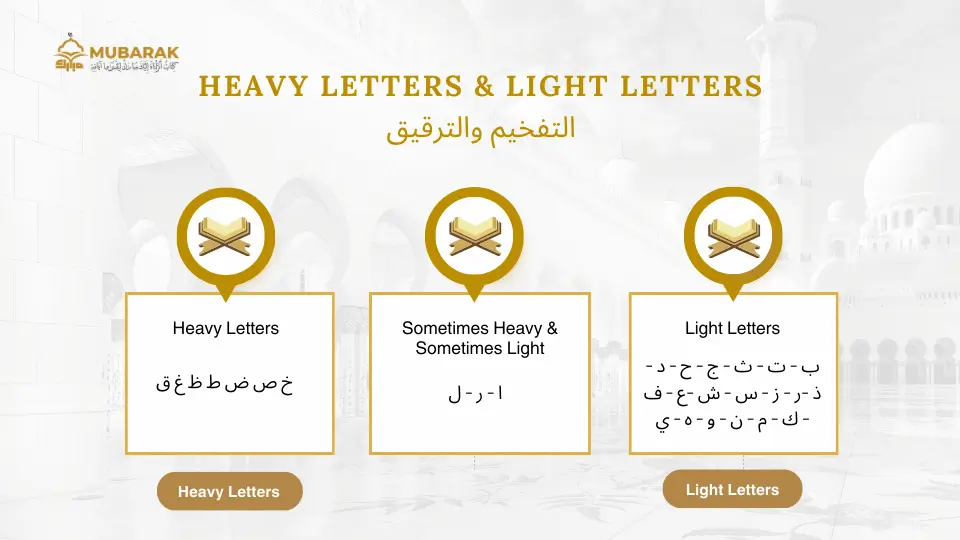
The Seven Heavy Tafkheem Letters in Arabic
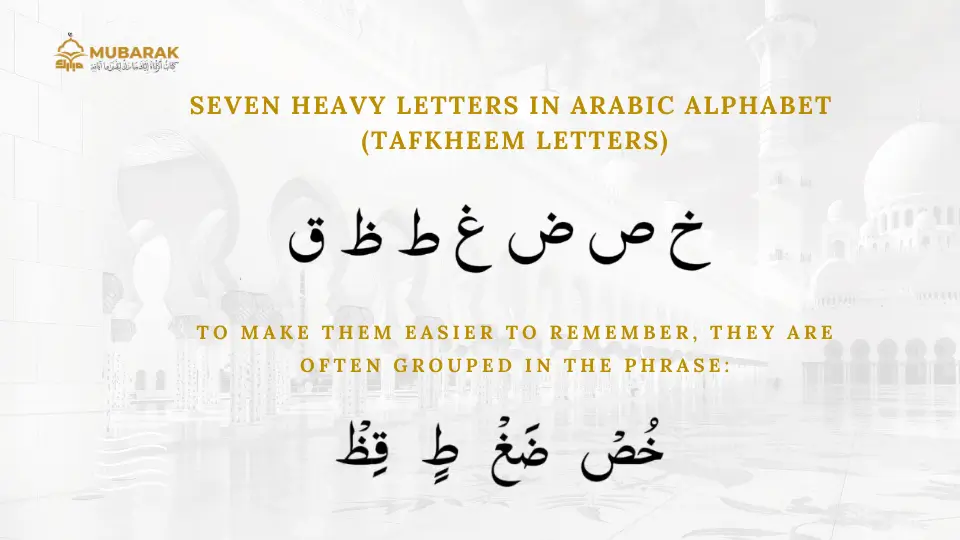
In Tajweed, some Arabic letters are always pronounced with Tafkheem, which means they are said with a heavy or deep sound. These letters are known as the seven heavy letters.
To make letters of Tafkheem in Arabic easier to remember, they are often grouped in the phrase:
“خص ضغط قظ”
The seven Tafkheem letters in Arabic are:
- خ (Khaa) like in خَلَقَ
- ص (Saad) like in الصِّرَاطَ
- ض (Daad) like in وَالضُّحَى
- غ (Ghayn) like in غَفُورٌ
- ط (Taa) like in طَيِّبًا
- ق (Qaaf) like in قُلْ
- ظ (Zhaa) like in ظَلَمُوا
When these letters are pronounced, the tongue rises slightly toward the roof of the mouth, creating a strong and deep sound. Learning these letters helps students apply the rule of Tafkheem correctly during Quran recitation.
The 5 Levels of Tafkheem with Examples
Tafkheem can appear at different levels depending on the vowel or position of the letter in the word. Scholars often describe five levels of Tafkheem.
- Strongest Level: Letter with Fatha followed by Alif (Example: قَالَ)
- Strong Level: Letter with Fatha (Example: قَ)
- Medium Level: Letter with Damma (Example: قُ)
- Lighter Level: Letter with Sukun (Example: يَقْطَعُ)
- Lightest Level: Letter with Kasra (Example: قِ)
Understanding these levels helps students pronounce the heavy letters correctly in different contexts.
The Light Letters in Arabic (Tarqeeq Letters)
In Tajweed, Tarqeeq refers to pronouncing letters with a light and soft sound. Most Arabic letters are pronounced with Tarqeeq, except for the seven Tafkheem (heavy) letters.
Some common examples of Tarqeeq letters include:
- ب (Baa)
- ت (Taa)
- ج (Jeem)
- د (Daal)
- ر (Raa) in certain cases
- ل (Laam) in most cases
These letters are pronounced softly, with the tongue remaining relaxed and not rising toward the roof of the mouth.
It is also important to know that some letters, such as ر (Raa) and ل (Laam), may sometimes be pronounced with Tafkheem or Tarqeeq depending on specific Tajweed rules and the vowels surrounding them.
Master Tafkheem and Tarqeeq with Mubarak Academy
Learning Tajweed rules like Tafkheem and Tarqeeq becomes much easier when guided by experienced teachers. At Mubarak Academy, students receive structured Quran and Tajweed lessons that help them improve their recitation step by step.
Our Online Quran Academy offers:
- Qualified Quran teachers
- Interactive online lessons
- Clear explanations of Tajweed rules
- Practice sessions to improve pronunciation
Through a well-designed learning approach, students can master Tajweed rules and recite the Quran with confidence and accuracy.
Conclusion
Tafkheem and Tarqeeq are essential Tajweed rules that determine whether Arabic letters are pronounced with a heavy or light sound, that’s why it is important to understand these rules, which helps learners pronounce Quranic words correctly and maintain the beauty of Quran recitation.
By studying the heavy letters, light letters, and different levels of Tafkheem, students can improve their Tajweed skills and avoid common pronunciation mistakes. With proper guidance and practice, mastering these rules becomes an achievable goal.
FAQs About Tafkheem and Tarqeeq
1. What is Tafkheem in Tajweed?
Tafkheem refers to pronouncing certain Arabic letters with a heavy or thick sound, giving the letter a deeper and stronger tone during recitation.
2. What is Tarqeeq in Tajweed?
Tarqeeq means pronouncing letters with a light and soft sound without raising the tongue toward the roof of the mouth.
3. How many Tafkheem letters are there?
There are seven main Tafkheem letters in Arabic: خ، ص، ض، غ، ط، ق، ظ.
4. Are all other Arabic letters pronounced with Tarqeeq?
Yes, most other Arabic letters are pronounced with Tarqeeq. However, some letters such as ر and ل can sometimes be pronounced with Tafkheem depending on their position and surrounding vowels.
5. Why are Tafkheem and Tarqeeq important?
These rules ensure accurate pronunciation during Quran recitation and help prevent mistakes that could change the meaning of words.
6. Where can I learn Tafkheem and Tarqeeq properly?
These Tajweed rules can be learned through structured Quran courses. Programs such as those offered by Mubarak Academy allow students to practice recitation with qualified teachers and receive guided feedback.
Ustadh Ahmed Mahmoud Abdulaziz is an experienced teacher of Arabic and the Holy Quran for native and non-native speakers. He holds a verified Ijazah in Hafs ‘an Asim and is certified in the foundational Tajweed texts Al-Jazariyyah and Tuhfat Al-Atfal. Drawing on his extensive background in traditional Quranic recitation and international pedagogy, he writes scholar-verified, accessible articles to help students worldwide master Tajweed rules and Arabic linguistics safely and accurately.