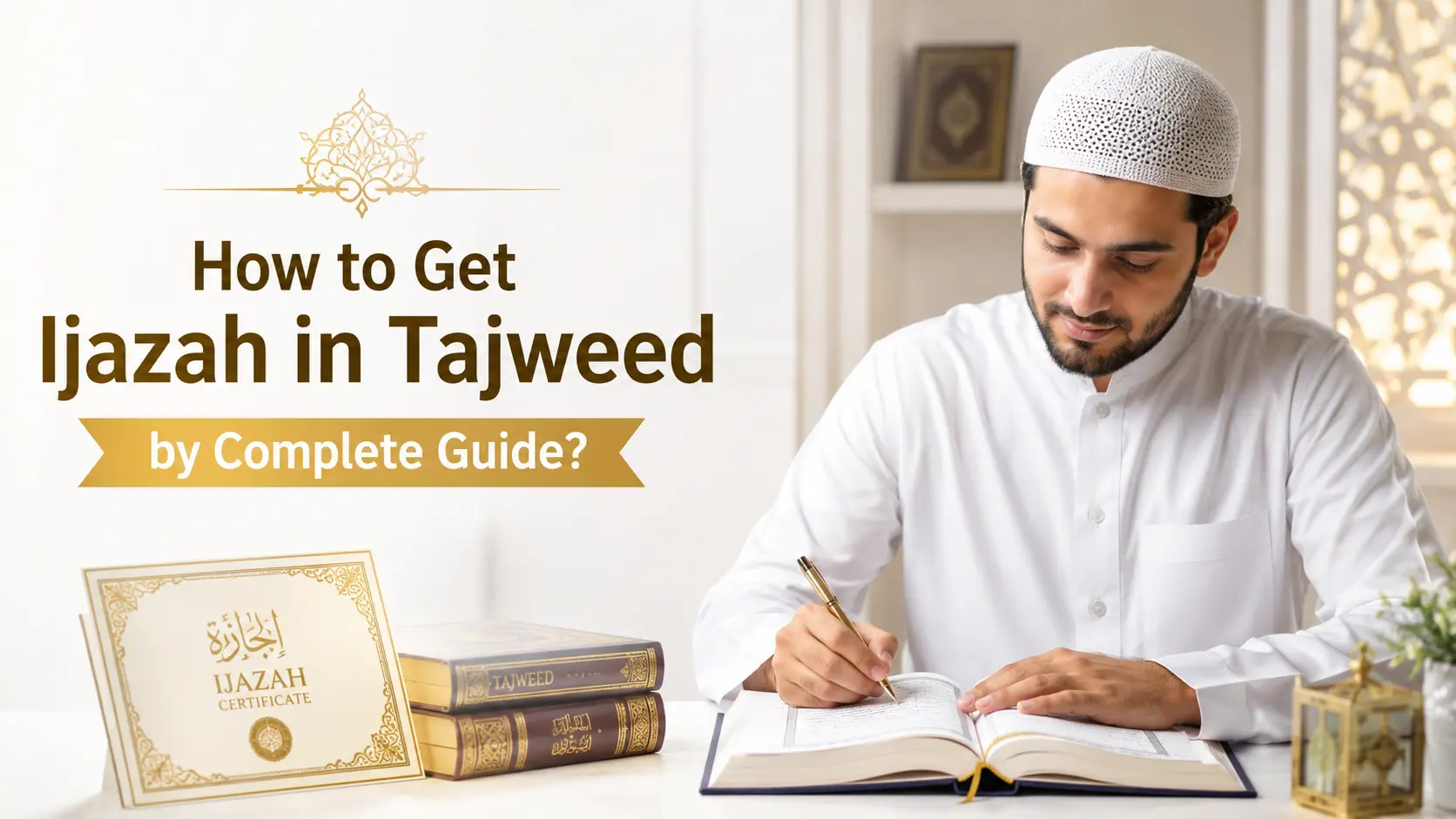
Wondering how to get Ijazah in Tajweed and don’t want to move to study with a scholar? Though it’s easier than most students think, it is important to have a clear pathway. Learning rules from a book does not count as a real Sanad, and a generic course online that is hurried does not count either. This guide explains what exactly Ijazah is, what comes with it, what the realistic timelines and requirements are, and what exactly the online process is from the first trial class to the final recitation test.
What is Ijazah in Tajweed?
Ijazah in Tajweed is a formal certificate that certifies that a student is qualified to recite the Quran with Tajweed rules and has a valid Sanad from the qualified teacher who owns one as well. It is not a completion badge; it’s a formal certificate of authority to recite, teach, and transmit the Quran.
The certification is important because it is connected to an uninterrupted chain of transmission (Sanad), which starts from the Prophet Muhammad ﷺ. A teacher has the right to grant what he or she can give, and before one enrolls anywhere, it is important to check the teacher’s own Sanad.
What is Ijazah in Quran, its types, and Requirements
How to get Ijazah in Tajweed online?
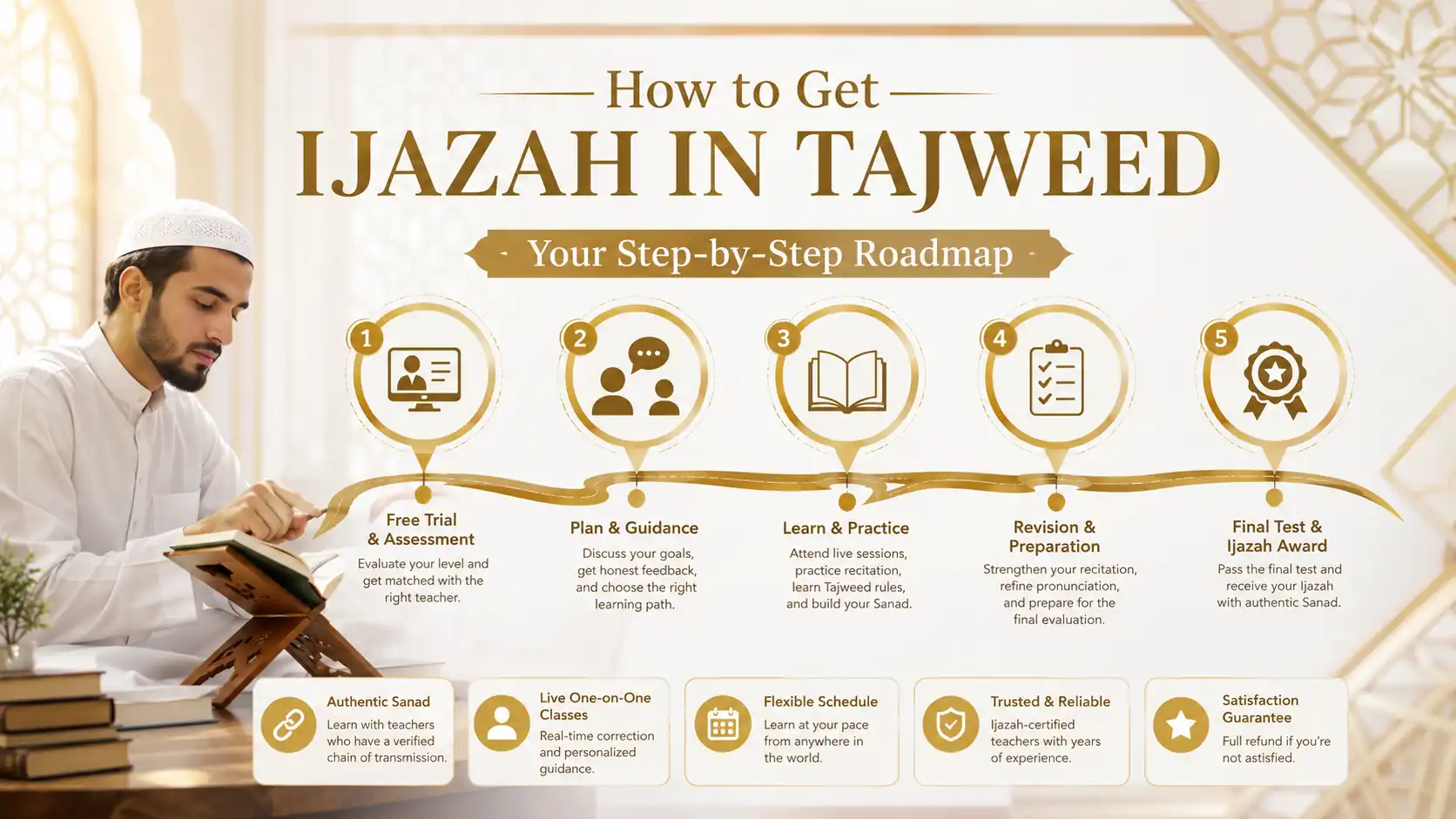
The first question that comes to mind is “how to get Ijazah in Tajweed?”, one must first look for a teacher who already has a valid Sanad and who teaches live, one-on-one, not pre-recorded lessons. There are some general steps to this process:
- Request a free trial class and fill out a placement form to be matched with a teacher and level appropriate for you.
- Talk with your teacher about the truth and not the sales pitch; they will hear your recitation and let you know a realistic schedule.
- Select your package; private or group sessions depending on schedule and learning style.
- Start attending lessons, practice the recitation, refine the Tajweed, train the Sanad, and have an overall test.
Do I need to memorize the entire Quran to get Ijazah?
No, there is no obligation for memorizing the whole of the Quran for the purpose of receiving the Ijazah in Tajweed; rather, Ijazah in Tajweed and Ijazah in Hifz are two different certificates. The recitation from Ijazah is not the memorization of the entire Quran but instead the recitation of the full Quran in sessions.
The memorization of the entire text is required only for the Hifz Ijazah (graduation) certificate, which certifies complete memorization of the Quran. Most students opting for online Ijazah course options work on Tajweed from the Mushaf itself with their teacher.
Explor Quran memorization courses
How long does it take to get Ijazah in Tajweed?
The duration of learning how to get ijazah in tajweed depends on the individual student’s level. For the one already reciting with accuracy, it is faster to obtain Ijazah than the student who requires a lot of correction in his recitation first. Programs generally last from a few months to more than a year.
A sincere evaluation at your first class trial provides a measurement of your actual ability rather than a generic recitation. For students who are already well versed in tajweed, sometimes a course of tajweed ijazah is completed in less than a year.
Can I get Ijazah from an online teacher?
Yes, an online teacher can absolutely give a valid Ijazah. How to get Ijazah in Tajweed without ever being abroad: for this to be possible, it needs to be a session where the teacher is able to correct the students in real-time, not stream live videos.
Live Zoom sessions are very similar to in-person ijazah instruction: one student, one teacher, one correction. A good quran ijazah online program online will monitor homework, recordings, and progress between lessons just as a face-to-face class would do.
What is the difference between Tajweed certificate and Ijazah?
| Feature | Tajweed Certificate | Ijazah |
|---|---|---|
| Goal | Learn recitation rules | Achieve certified mastery with Sanad |
| Certification | Certificate of completion | Authenticated Ijazah with Sanad |
| Authorized to teach after? | No | Yes, graduates can transmit the Quran |
| Typical duration | Weeks to months | Months to over a year |
| Entry requirement | Any level | Must already read with reasonable Tajweed |
A certificate is issued for attendance and progress. Ijazah signifies that your recitation has been personally verified by a scholar, and formally links you with his Sanad.
What is sanad in Quran recitation?
The proof of the chain of teachers that connects a student to his teacher, the teacher to the teacher, and so on up to the Prophet Muhammad (sallallahu alaihi wasallam). It is the one most crucial element in achieving the correct Ijazah in Tajweed, as the difference between an ordinary certificate and Ijazah is this.
The fewer the teachers in that chain, the “higher” the Sanad will be regarded; the closer to the source, the “higher” the Sanad. Traditionally, the two are almost inseparable, with each Ijazah being accompanied by its Sanad.
Learn What is Isnād and Matn in Hadith with Examples
Do I need to know Arabic before starting Ijazah?
How to get Ijazah in Tajweed is not for complete beginners and requires reading Quranic Arabic with reasonable accuracy and having a bit of knowledge of Tajweed already. For those students who are still learning the alphabet, they are recommended to take basic Quran or Arabic lessons first.
It is easy to tell if you are prepared or need some more work with a free trial evaluation. Too early to enter Ijazah training in Tajweed will inevitably result in having to begin again later, wasting time and tuition.
What is the role of makharij in Tajweed Ijazah?
The basic points of articulation of Arabic letters within the mouth and throat are known as Makharij and lie at the heart of every Ijazah assessment as the pronunciation is incorrect, it means nothing and meets the standard of Ijazah certification. Teacher listens for makharij errors during the actual process.
The knowledge of makharij is typically taught alongside the study of the classical didactic poem of matn al Jazariyyah (matn) by the poet and grammarian Ibn al-Jazari, from which the actual spoken correction, or refinement, students receive is derived at each lesson
Learn How to Become a Quran Teacher Online in 5 Steps
Can women get Ijazah in Tajweed online?
Yes, there are women-online Ijazah schools and female teachers who are certified and have their own authenticated Sanad and are licensed to pass it on to others, so you can definitely learn Ijazah with them. Gender has no bearing on eligibility for certification.
Reputable programs have both male and female teachers (with Ijazahs) and can arrange for students to study with a female teacher for private lessons if they so desire, but without sacrificing the rigor of the curriculum taught here.
Is Ijazah the same as certification?
No, Ijazah is a specific type of certification, but not every certificate is an Ijazah the distinction matters more than it sounds. A generic completion certificate simply confirms a student attended and progressed through a course. Ijazah specifically confirms that a qualified scholar personally verified the student’s recitation as accurate enough to authorize them to teach and transmit it further, carrying the Sanad chain forward to the next generation of reciters.
What are the requirements for Quran recitation Ijazah?
The core requirements for how to get Ijazah in Tajweed are consistent across reputable programs: accurate baseline Tajweed already in place, full Quran recitation completed under a certified teacher’s supervision, Sanad training, and a final assessment confirming readiness.
- Baseline Tajweed accuracy demonstrated during the initial trial assessment.
- Live, one-on-one or small-group sessions with a Sanad-holding teacher.
- Consistent attendance across the full recitation of the Quran.
- A passed final assessment, reciting under direct scholarly supervision.
Difference Between Hafs and Warsh Quran
Can I get Ijazah in Hafs an Asim only?
Yes, most students pursue Ijazah specifically in the Hafs ‘an ‘Asim riwayah, the recitation transmission used in the vast majority of printed Mushafs worldwide and taught by nearly every online program by default. Advanced students who complete this path with demonstrated proficiency sometimes go on to introductory study of other Qira’at, but Hafs ‘an ‘Asim alone is a complete, standalone, and widely respected Ijazah on its own.
What is the difference between Hifz Ijazah and Tajweed Ijazah?
Tajweed Ijazah, the more common answer to how to get Ijazah in Tajweed for most students, certifies accurate recitation of the Quran with correct pronunciation without requiring the text to be memorized. Students may read directly from the Mushaf during their sessions and assessment.
Hifz Ijazah is stricter, requiring the entire Quran to be committed to memory and recited flawlessly from memory alone. Both share the same Sanad structure and final-assessment format, just with different starting requirements for the student.
Learn What Is a Sanad in Islam with Mubarak Academy
What happens in the final Ijazah test?
The final Ijazah test, the last real hurdle in how to get Ijazah in Tajweed, involves reciting substantial portions or the entirety of the Quran directly to your certifying teacher, who listens for Tajweed accuracy, correct makharij, and consistent rule application throughout, not just isolated verses.
Passing means the teacher is confident enough in your recitation to attach their own Sanad to your name. Once granted, you can teach and transmit the Quran to future students carrying that same authenticated chain forward.
Start your Ijazah journey with certified teachers
Choosing the right teacher is an essential part of learning how to get Ijazah in Tajweed. A qualified instructor should have proven experience in Quran recitation, a verified Sanad, and the ability to assess and correct Tajweed errors through direct recitation. At Mubarak Academy, students learn under Ijazah-certified teachers who understand the standards required for accurate Quranic recitation and can guide each student.
Learning how to get Ijazah in Tajweed the right way means training with a teacher who already holds a verified Sanad, not just a confident reciter. Mubarak Academy’s Ijazah-certified male and female teachers offer live, one-on-one correction, flexible scheduling across time zones, and a full refund if the experience doesn’t meet expectations. Book your free trial today and get an honest assessment of where you stand.
FAQs
Is it possible to obtain Ijazah without the memorization of the Quran?
Yes, there is a Tajweed Ijazah course without having to memorize the whole Quran! Tajweed Ijazah is different from Hifz Ijazah because it is concerned with the correct recitation, pronunciation, and application of the rules of Tajweed. Students generally recite straight from the Mushaf while completing the required assessment.
How long does it take to get Ijazah in Tajweed?
Depending on the level of your recitation, Tajweed knowledge, and consistency. The process might take a couple of months for students with strong foundational skills, but it may take a year or more for students whose skills are in need of extensive correction.
Is it possible for an online teacher to give Ijazah?
Yes, an online teacher can be one of those who gives an authentic Ijazah if he has an authentic Sanad and is physically supervising your recitation. One-on-one sessions enable the teacher to correct pronunciation, the rules of Makharij, and the rules of Tajweed throughout the entire process of the recitation of the Quran.
What is the difference between a Tajweed certificate and an Ijazah?
Typically, a Tajweed certificate is a document that certifies that you took a course or learned a certain set of recitation rules. The Ijazah (certificate) is more formal since a qualified teacher will confirm your recitation and provide authorization that is linked to a Sanad.
What is needed for gaining the Ijazah of Tajweed?
Usually, it involves proper reading of the Quran, mastery of the rules of Tajweed, continuous instruction by a qualified teacher with a proper Sanad, and reciting the Quran with supervision, followed by an evaluation at the end. This evaluation will involve the student’s consistent pronunciation, Makharij, and application of the rules of Tajweed.
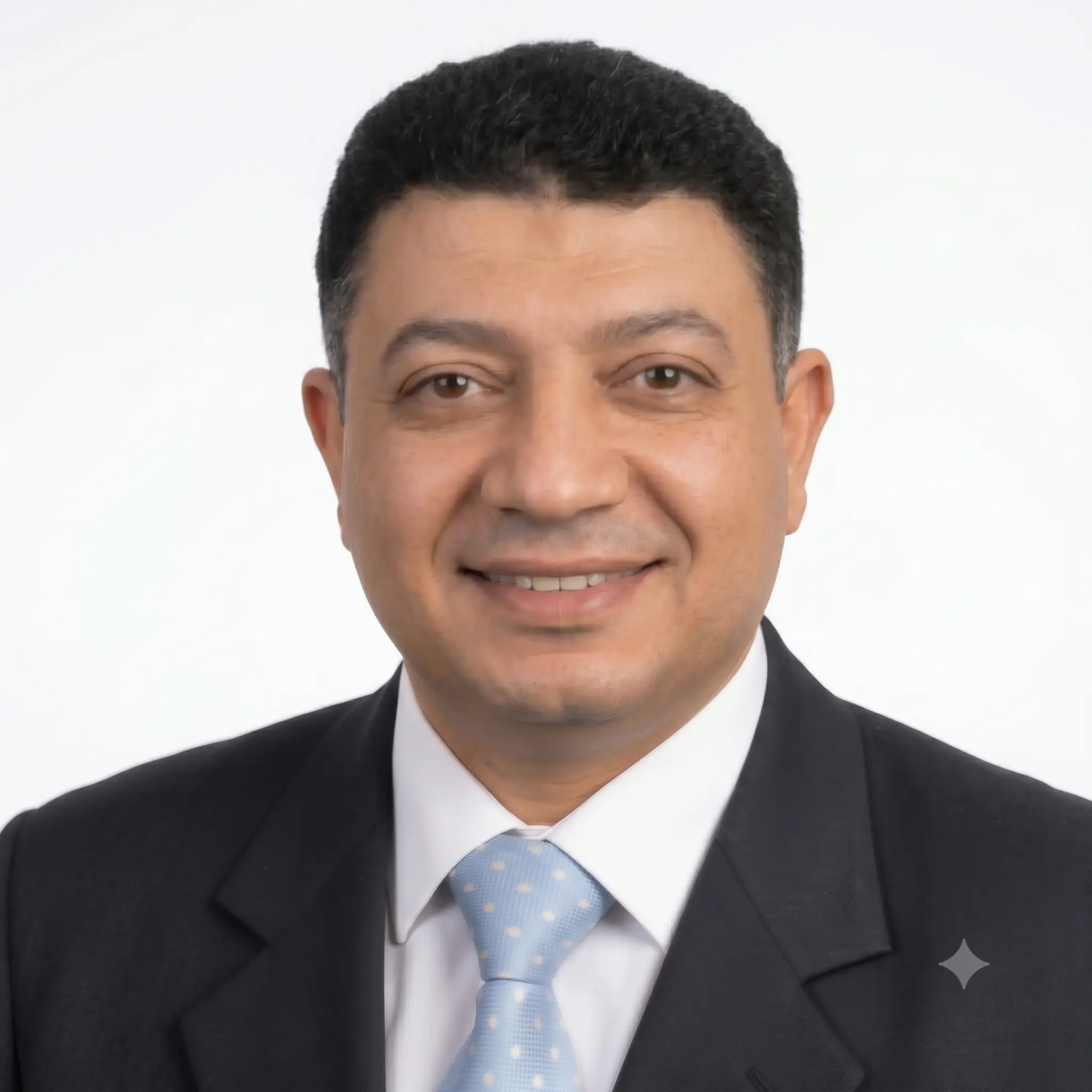
Ustadh Ahmed Mahmoud Abdulaziz is an experienced teacher of Arabic and the Holy Quran for native and non-native speakers. He holds a verified Ijazah in Hafs ‘an Asim and is certified in the foundational Tajweed texts Al-Jazariyyah and Tuhfat Al-Atfal. Drawing on his extensive background in traditional Quranic recitation and international pedagogy, he writes scholar-verified, accessible articles to help students worldwide master Tajweed rules and Arabic linguistics safely and accurately.