

Want to find the easiest surahs to memorise without getting confused? Most beginners begin with short surahs and gain confidence verse by verse, and you’re not alone. This guide helps you identify the easiest surahs to memorise by word count, understand why they are so easy to remember, and provides you with an order, a daily plan, and tips for revising. Whether you are a little child, an adult, or a complete beginner in Hifz quran, you will find out where to start today!
What Makes a Surah Easy to Memorise?
It is easy to memorize a surah which is short, rhythmic and composed of repeated sounds. This is why the easiest surahs to memorise are placed at the end of the Quran, as the verses are short and rhyme easily.
| Factor | Example |
|---|---|
| Short length | Al-Kawthar |
| Matching verse endings | Al-Ikhlas |
| Repeated phrases | Al-Falaq |
With these factors in mind, here is the beginner list.
The Easiest Surahs to Memorise for Beginners:
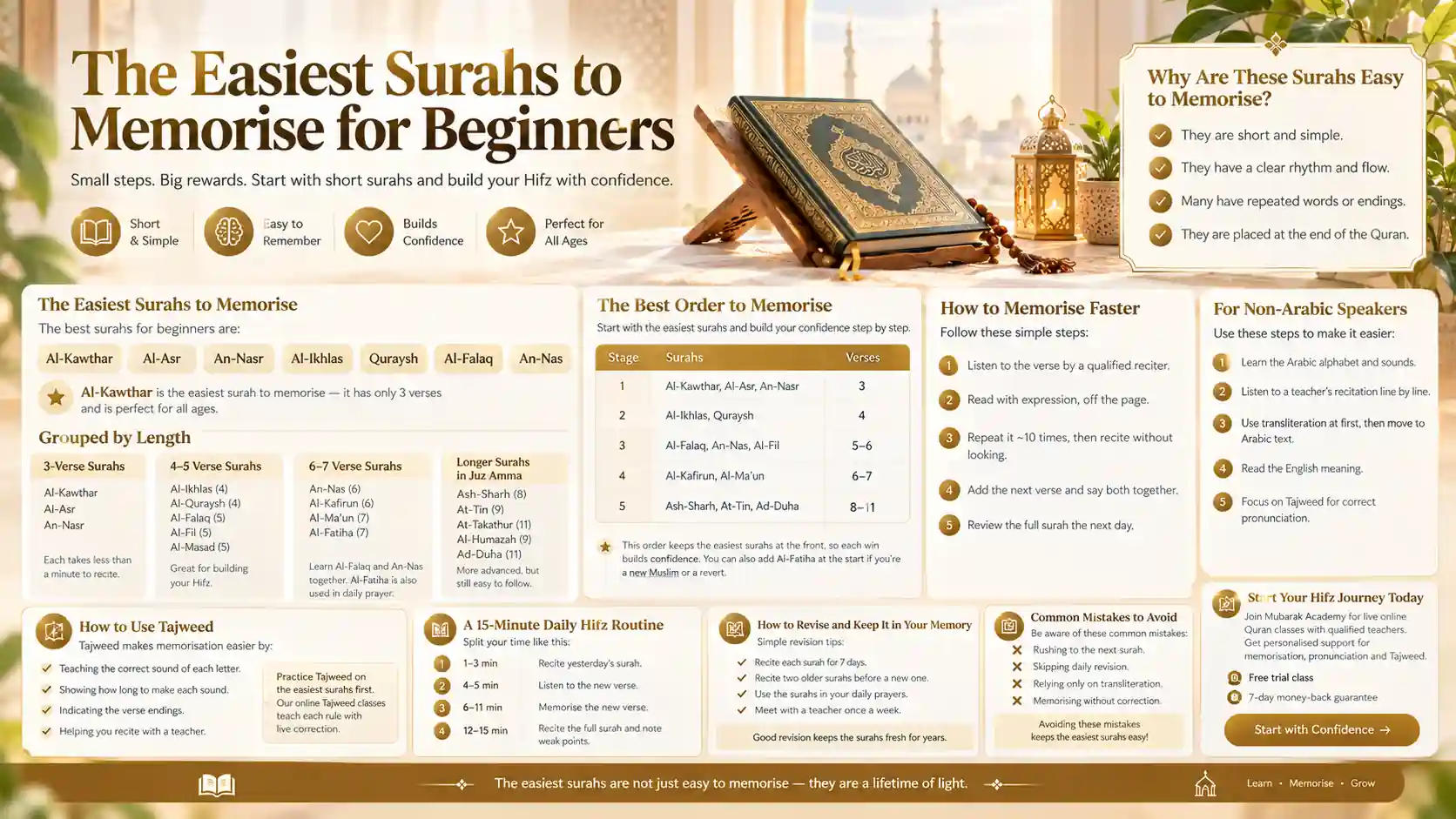
Al-Kawthar, Al-Asr, An-Nasr, Al-Ikhlas, Quraysh, Al-Falaq and An-Nas are the easiest surahs to memorise. Al-Kawthar is the easiest surah to memorize in quran , and the shortest surah in Quran, which is 3 verses. Also, it is the easiest surah for the beginner of any age to memorize. The groups below sort these surahs by length.
The Easiest Surahs to Memorise First: 3-Verse Surahs:
The 3-verse surahs are Al-Kawthar, Al-Asr, and An-Nasr, and each takes well under a minute to recite. Start with Al-Kawthar. These are also easy surahs for kids to memorize, and our online Quran classes for kids teach them gently.
Easy 4 to 5-Verse Surahs for Building Your Hifz:
There are easy surahs that contain 4 or 5 verses, namely Al-Ikhlas, Al-Quraysh (10 verses), Al-Falaq, Al-Fil, and Al-Masad (5 verses each). Everyone adds a bit of the Quran that you do not know, and so your Hifz continues to increase.
Easy 6 to 7-Verse Surahs for Your Next Step:
The easy 6 to 7-verse surahs are An-Nas and Al-Kafirun (6 verses), plus Al-Ma’un and Al-Fatiha (7 verses). It is recommended to learn Al-Falaq and An-Nas together, as they are companion surahs. Al-Fatiha is already known from prayer; it will help you to remember the verses of the Quran that you use daily.
Easy Longer Surahs to Memorise in Juz Amma:
The easy long Surahs in Juz Amma are Ash-Sharh (8 verses), At-Tin (9 verses), At-Takathur (11 verses), Al-Humazah (9 verses), and Ad-Duha (11 verses). These are Juz Amma easy surahs, which are further advanced for students because Juz Amma is the 30th part of the Quran.
Explore how to memorize juz amma?
The Best Order to Memorise Short Surahs for Beginners:
The easiest surah to memorize for beginners , starting with Al-Kawthar and ending with Ad-Duha.
| Stage | Surahs | Verses |
|---|---|---|
| 1 | Al-Kawthar, Al-Asr, An-Nasr | 3 |
| 2 | Al-Ikhlas, Quraysh | 4 |
| 3 | Al-Falaq, An-Nas, Al-Fil | 5–6 |
| 4 | Al-Kafirun, Al-Ma’un | 6–7 |
| 5 | Ash-Sharh, At-Tin, Ad-Duha | 8–11 |
This order keeps the easiest surahs to memorise at the front, so each win builds confidence. It also gives the easiest surahs for revert Muslims, who can add Al-Fatiha at the start because it is recited in every prayer.
10 Short Surahs to Learn Easily for Quran Memorization
How to Memorise the Easiest Surahs Faster?
Learn one verse at a time, repeat it out loud and revision daily to memorise faster.
- Listen to the verse by a qualified reciter.
- Read with expression, deliberately, off the page.
- Repeat it approximately 10 times then do it without seeing.
- Add the following verse and say both together.
- Edit the entire surah the next day.
Follow the procedure on any of the easiest surahs to memorise. A few additional supports are needed for learners who are new to the Arabic language.
Hifzul Quran & Islamic Education Centre Guide
How Non-Arabic Speakers Can Memorise Short Surahs?
Short surahs can be memorized by non-Arabic speakers by learning by heart the letters first, copying the teacher’s audio, and using transliteration in a short-term manner.
- Study the Arabic alphabet and sounds.
- Recite a teacher’s recitative, line-by-line.
- In the first place use transliteration as a bridge and then move to the Arabic text.
- Read the English meaning so that the words are familiar.
It makes the easiest surahs to memorise easily to your first week. Next comes pronunciation, and that’s where Tajweed comes in handy.
Best Online Quran Memorization Program for Every Student
How to Use Tajweed to Make Surah Memorisation Easier?
Correct sound and stretches will lock each verse into your ear, making memorizing easier; this is Tajweed.
- Practice the location of the sound each letter makes in the throat, tongue, or lips.
- Take notice to how long to make each long sound.
- Indicate the end of the verses.
- Recite it to a teacher who will correct you while you do it.
Practise Tajweed on the easiest surahs to memorise, since short surahs are the best place to start. Our Tajweed classes online teach each rule with live correction. Once your recitation is accurate, you need a routine you can keep.
A 15-Minute Daily Hifz Routine for Busy Beginners:
A 15-minute Hifz routine splits your time into revision, listening, new memorisation, and one full recitation.
| Time | What to do |
|---|---|
| Minutes 1–3 | Recite yesterday’s surah from memory |
| Minutes 4–5 | Listen to the new verse |
| Minutes 6–11 | Memorise the new verse by repetition |
| Minutes 12–15 | Recite the full surah and note the weakest verse |
Repeat it daily to move through the easiest surahs to memorise in order. A routine only works if the surahs stay with you, so revision is next.
Explore Quran hafiz course from Mubarak Academy
How to Revise Short Surahs Without Forgetting Them?
Read short surahs, recite each one each day for a week then space out your reading of the surahs and use them in prayer.
- Recite each surah one a day for 7 days.
- Recite two of the older surahs before reciting a new one.
- In your prayers use the surahs you know.
- Recite once a week to a teacher.
The surahs that are easiest to memorize are kept fresh for years through good revision. However, for some verses it is not that much different, and here are some ways to differentiate them.
Perfect Your Islamic Recitation of Holy Quran With Tajweed
How to Avoid Confusing Similar Verses in Short Surahs?
Avoid confusion by marking the one or two words that differ between similar verses and practising those spots. Al-Falaq and An-Nas, for example, open with the same words of seeking refuge.
- Write similar verses side by side and mark what differs.
- Learn one surah fully before starting its look-alike.
- Ask your teacher to start you from a random verse.
Learn Quran Recitation Classes Online With a Certified Teacher
Common Mistakes When Memorising Short Surahs:
The most common mistakes are rushing, skipping revision, relying only on transliteration, and memorising without correction.
| Mistake | Better approach |
|---|---|
| Rushing to the next surah | Move on only when you recite without errors |
| Skipping daily revision | Recite old surahs before every new one |
| Relying only on transliteration | Learn the Arabic letters and sounds |
| Memorising without correction | Recite to a teacher regularly |
Avoiding these four mistakes keeps the easiest surahs to memorise easy.
Explor Mubarak Academy Courses
Start Memorising Your First Surah Today:
When learners are guided with a structured plan, provided with feedback on their recitations and revise their recitations regularly, it will be easier to remember short surahs. Students at Mubarak Academy can study the Quran with authentic teachers via live online sessions with personalised support for memorisation, pronunciation and Tajweed.
Guided Lessons can help you grow a steady Hifz routine and will take you through it step-by-step, regardless of how new you are to it, how you’re a parent supporting your child, or how you’re not a native speaker of Arabic.
Ready to memorise the easiest surahs and build a consistent Hifz routine? Join Mubarak Academy for live online Quran classes with qualified teachers who can guide your memorisation, correct your recitation, and help you revise each surah with confidence., book a free trial class with Mubarak Academy and start your Hifz with confidence.
Frequently Asked Questions:
Do I need a teacher to memorise short surahs?
Yes, a teacher is strongly recommended for this reason: a qualified teacher will know what the pronunciation errors are, correct your recitation and provide guidance for revision. Mubarak Academy provides online quran memorisation classes with teacher feedback, to ensure that those who are starting to memorise the quran use the correct recitation method and memorise regularly.
Can I memorise surahs out of order?
Yes, it is possible to memorise surahs in any sequence that you desire in line with the learning objectives. Some people begin to memorize shorter surahs at the end of the Quran and then go on to longer surahs. Revising a text following a structured order can help maintain motivation and make revision easier.
How long does a short surah take to memorise?
The duration varies according to the surah, the level of knowledge of Arabic and your level of consistency. Depending on your ability to memorize it, a three-verse surah could take a couple of days to learn by heart. Intensive rehearsal, listening and editing can reinforce recall over time.
Can I learn short surahs online?
Yes, you can memorize quran short surahs with the help of the qualified teacher in the online Quran classes. Live classes offer chances to recite, have pronunciation corrected and to rehearse verses that have been memorised earlier. Small classes or individual classes may be appropriate for varying learning styles and/or time commitments.

Ustadh Ahmed Mahmoud Abdulaziz is an experienced teacher of Arabic and the Holy Quran for native and non-native speakers. He holds a verified Ijazah in Hafs ‘an Asim and is certified in the foundational Tajweed texts Al-Jazariyyah and Tuhfat Al-Atfal. Drawing on his extensive background in traditional Quranic recitation and international pedagogy, he writes scholar-verified, accessible articles to help students worldwide master Tajweed rules and Arabic linguistics safely and accurately.