
Perfecting Quranic recitation needs a good grasp of Tajweed rules, plus knowing the major and minor mistakes in Tajweed (known as Lahn), which prevent you from falling into serious mistakes that can change the meaning of Allah’s words.
By learning these types of mistakes, you can recite the Qur’an accurately, reflect proper reverence, and preserve the divine message as it was revealed. In this guide, we’ll explain what Lahn means in Tajweed and explore the two types of Lahn recognized by scholars.
What is Lahn in Tajweed?
The term Lahn (اللحن) in Tajweed Quran refers to major and minor mistakes in Tajweed, which lead to mistakes in the recitation of the Quran. They can also affect the pronunciation or the meaning of the Quranic text.
Understanding Lahn in Tajweed is essential for every Muslim who seeks to recite the Qur’an correctly and beautifully. Lahn in Tajweed can take different forms, such as:
- Mispronunciation of some letters
- Prolonging Madd more than it should take
- Incorrectly applying Waqf (stopping) or Ibtida (starting) rules
- Merging or separating sounds improperly
Recognizing and avoiding these errors ensures your recitation of the Qur’an aligns with how it was revealed to the Prophet ﷺ.
The Two Types of Lahn in Tajweed
Scholars divide Lahn in Tajweed into two main types, which are called major and minor mistakes in Tajweed, Lahn Jali and Lahn Khafi. Both Lahn have an impact on your recitation, but in different ways:
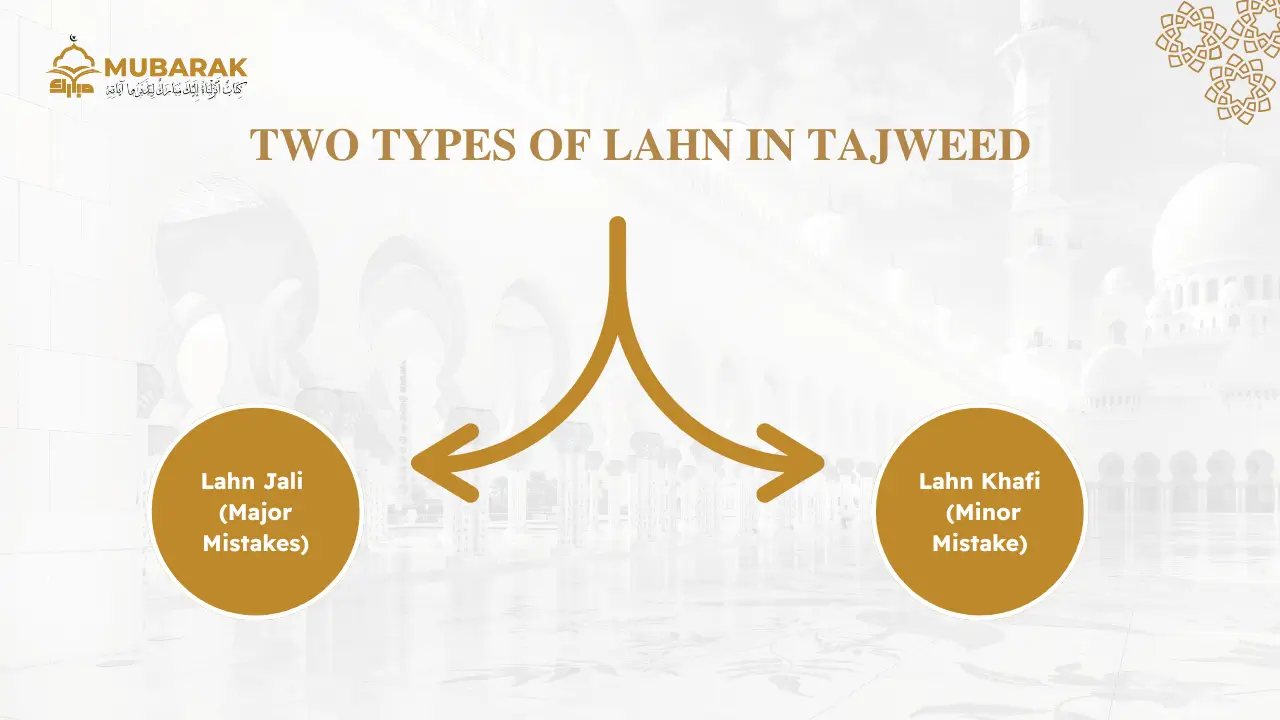
1. Lahn Jali (Major Mistakes in Tajweed):
Lahn Jali (اللحن الجلي) refers to clear mistakes that change the meaning or structure of Quranic words, like mispronouncing the word. These are serious errors because they alter the intended message of the Qur’an.
For example:
- Mispronouncing the word “القلب” (heart) and saying it like “الكلب” (dog), which completely alters the verse’s meaning.
Therefore, it’s called “Jali” which means clear, because the mistakes are noticeable even to non-experts.
2. Lahn Khafi (Minor Mistakes in Tajweed):
Lahn Khafi (اللحن الخفي) refers to subtle mistakes in applying Tajweed rules that don’t change the meaning but affect the beauty and accuracy of recitation.
For example:
- Decreasing the six Harakat of this word “وَلَا ٱلضَّآلِّينَ” in Surah Al-Fatiha
Lahn Khafi does not change the word’s meaning but impacts the recitation quality. It often occurs due to a lack of mastery of Tajweed details, such as rules of Idgham, Qalqalah, or Ikhfa.
Read Also: How Long Does It Take to Learn Tajweed
Examples of Lahn Jali in Quran Recitation (Major Mistakes)
When learning the rules of Tajweed, it’s essential to understand the difference between major and minor mistakes in Tajweed, especially the major ones known as Lahn Jali (اللحن الجلي). These are clear and obvious mistakes in Quranic recitation that alter the structure or meaning of the words.
Below are some common examples of major mistakes in Tajweed that fall under Lahn Jali:
1. Confusing Similar Letters
One of the most frequent major mistakes is mixing up letters that sound alike, for example:
- Reading “قُلْ” (Qul) as “كُلْ” (Kul) in the first verse of Surah Al-Ikhlas:
قُلْ هُوَ ٱللَّهُ أَحَدٌ
Changing “Qul” (Say) to “Kul” (Eat) completely alters the verse’s meaning
This shows how a single letter can shift the message of the Qur’an, indicating the importance of mastering correct articulation (Makharij al-Huroof).
2. Adding Madd to the End of Words
Extending the last letter of a word is another form of Lahn Jali.
For example:
- Saying “ذَهَبَا” (They went) instead of “ذَهَبَ” (He went) changes the meaning as it refers to two people instead of one
Such small extensions may seem harmless, but can transform the meaning completely.
3. Failure in Commitment to the Correct Harakat
Harakatm, like Fatḥah (ـَ), Ḍammah (ـُ), and Kasrah (ـِ) play a vital role in Arabic pronunciation and meaning; that’s why replacing one with another can result in major mistakes in Tajweed and alter the grammar and message of a verse.
For instance, consider the verse:
﴿فَتَلَقَّىٰ آدَمُ مِن رَّبِّهِ كَلِمَاتٍ فَتَابَ عَلَيْهِ ۚ إِنَّهُ هُوَ التَّوَّابُ الرَّحِيمُ﴾
Then Adam received from his Lord [some] words, and He accepted his repentance. Indeed, He is the Accepting of repentance, the Merciful (Surah Al-Baqarah 2:37)
If the word “آدَمُ” (Ādamu) is read as “آدَمَ” (Ādama),you unintentionally change the meaning from Adam is the receiver to All is the receiver. This example shows how one small vowel can shift an entire meaning.
Learning Arabic pronunciation and grammar through a structured Arabic language course can help you master these subtleties.
4. Mispronouncing Arabic Letters
Some letters in Arabic do not exist in other languages, which makes their pronunciation challenging for non-native speakers. Mispronouncing letters such as “ث” as “س”, or “ض” as “ظ”, leads to Lahn Jali because it changes how the word should sound and sometimes, what it means.
For example:
- Saying “سَلاثة” instead of “ثَلاثة” (three) changes the correct articulation of the letter “ث”.
Examples of Minor Mistakes in Tajweed (Lahn Khafi)
Here are some examples of Lahn Khafi that a reciter can fall into:
1. Prolonging a sound for the Proper Duration
Failure in applying the proper duration of Madd or Ghunnah, which seems different from the typical recitation.
2. Errors in Tafkheem and Tarqeeq
When a reciter pronounces a thick letter (Tafkheem) like خ (khaa) or ر (raa) too lightly, or a thin letter too heavily, it affects the natural sound of the Qur’an. Mastering these fine differences preserves the unique rhythm and balance of each verse.
3. Incorrect Waqf (Stopping)
Stopping while reciting the Holy Quran should be according to specific rules, the most important one of them is that it doesn’t alter the meaning. Such as this verse:
﴿إِنَّ اللَّهَ لَا يَسْتَحْيِي أَن يَضْرِبَ مَثَلًا مَّا بَعُوضَةً فَمَا فَوْقَهَا﴾
Indeed, Allah is not timid to present an example – that of a mosquito or what is smaller than it… (Al-Baqarah: 26)
It is forbidden (Haram) to stop at the word “يَسْتَحْيِي” (yastahyi), as doing so completely changes the meaning and turns the verse into an inappropriate statement. Proper knowledge of Waqf and Ibtida (stopping and starting) ensures respect and accuracy in recitation.
How to Avoid Tajweed Mistakes in Recitation
To avoid the major and minor mistakes in Tajweed, you should be teachable and patient, as this process requires both constant learning and rectifying. Mastering the rules of Qur’an recitation isn’t achieved overnight; it’s a continuous process of listening, correcting, and refining every sound and letter.
To perfect your recitation, focus on the details of Tajweed rules and give each letter its due right. Learn to:
- Differentiate between similar letters, such as س and ص
- Understand the characteristics of Arabic letters (Sifaat)
- Recognize each letter’s Makhraj (articulation point)
By doing so, you ensure every sound is produced correctly, preserving the meaning and beauty of the Qur’an as it was revealed.
Read Also: how to learn quran with tajweed at home
Learn Correct Tajweed with Mubarak Academy
Understanding the major and minor mistakes in Tajweed is fundamental for a Muslim who wishes to recite the holy Quran correctly. We offer at Mubarak Academy the best approach to learn Tajweed rules, specifically Lahn Jali (اللحن الجلي) and Lahn Khafi (اللحن الخفي), and how to avoid them, which requires persistent practice under the supervision of qualified Tajweed teachers who can guide you efficiently.
Contact Us Now For More Details!
Conclusion
Beautiful recitation doesn’t depend only on pronunciation and rules; it’s a long journey of faith and patience to grasp the differences between slight things you think are the same. It just requires dedication to refine your recitation and ensure a better understanding of the meanings.