
When you hear the word “ijazah,” you might ask yourself, “For what and who allowed this?” Thus, what is an ijazah in islam? It is a teacher’s permission to transmit what he learned, which is connected in a chain of teachers back to the Prophet ﷺ. Here you will find out what it means, how it has evolved over the years, the different types it has, if it is valid, and how to identify a bogus claim. For the answers, read on.
What Is an Ijazah in Islam, and What Does the Word Mean Linguistically?
The word ‘ijazah’ is derived from the Arabic verb ‘to permit’ or ‘allow to pass’; thus, an ijazah is a permission granted from teacher to student. Some books say “ijaza,” and the meaning of “ijaza” is the same. Authorized transmission is the basic answer to the question, “What is an ijazah in Islam?” Then where did it come from?
How Did the Ijazah System Begin in Hadith Scholarship and Spread to Other Sciences?
It started with the hadith scholars guarding accurate narration and was passed on to other sciences. The stages were:
- The Companions learned directly from the Prophet ﷺ and passed on his words.
- Later students listened to hadiths from their teachers, and the names of those teachers were mentioned in every report.
- Teachers granted spoken or written permission to transmit a whole book.
- Scholars of Quran recitations, fiqh, and Arabic followed the same practice.
That history explains what is an ijazah in islam today, and ijazah in hadith set the pattern for every other field. That pattern depends on the sanad.
What Is a Sanad?
The sanad is the chain of teachers or narrators, named in order, that connects a student to the original source. Every link answers one question: who did you learn from? If there is a broken link in the chain, it becomes a weak link, so scholars check every name. The sanad gives an ijazah its weight, as the next section shows.
How Does Sanad Connect an Ijazah Back to the Prophet ﷺ?
Each teacher learned from the teacher before him, all the way up to the Prophet ﷺ himself. In steps:
- Your teacher gives you an Quran Ijazah after he or she hears you recite or read.
- Your teacher names the teacher who gave him or her the ijazah.
- That naming carries on, link by link, through the generations.
- The chain reaches the Companions.
- The Companions received it from the Prophet ﷺ.
If there are no gaps in the chain, it is connected (muttasil). This uninterrupted chain is the actual answer to what is an ijazah in islam. Chains are passed on in various ways.
How Long Does It Take to Memorize Quran and the Best Plan to Finish?
What Are the Classical Forms of Ijazah: Sama’, Qira’ah, Munawalah and Written Ijazah?
The four classical forms are hearing (sama’), reading to the teacher (qira’ah), handing over a text (munawalah), and written permission.
| Form | How it works |
|---|---|
| Sama’ | Student listens to the teacher read or narrate |
| Qira’ah | The student reads or recites to the teacher, who corrects |
| Munawalah | The teacher hands a book to the student to pass along with permission |
| Written ijazah | The teacher writes the permission (mukatabah), often sent by letter |
Knowing the forms helps you understand what is ijazah in quran in practice. Today, qira’ah is common in Quran study, usually learned through talaqqi, face-to-face teaching. Ijazahs also differ in scope.
General vs Specific Ijazah: What Is the Difference?
An ijazah is usually either specific, naming one student and one text, or general, covering a large body of the teacher’s material or a large group of students.
| Type | Scope | Example |
|---|---|---|
| Specific | One named student and one text or recitation | Allowing one student to teach one book |
| General | A large body of material or a large group of students | Students may narrate all of the teacher’s transmissions |
Most Quran ijazahs are specific, naming the student, the riwayah, and the portion recited. Different subjects grant different ijazahs.
Which Islamic Sciences Grant an Ijazah: Quran, Hadith, Fiqh, Fatwa, Aqeedah and Arabic?
All of them can. Teachers grant ijazahs in Quran, hadith, fiqh, fatwa, aqeedah, and Arabic texts.
| Science | What the ijazah permits |
|---|---|
| Quran | Teaching recitations, hifz, qira’at, or tajweed texts such as al Jazariyyah |
| Hadith | Narrating hadith books along with their chains |
| Fiqh and fatwa | Teaching rulings, and issuing fatwas where the teacher is qualified |
| Aqeedah | Teaching a creed text |
| Arabic | Teaching grammar or poetry texts |
Some people search what is ijazah in islam for one field only, but what is an ijazah in islam always comes back to permission and chain. Quran ijazahs are the ones most students seek, so let’s compare them.
What Is the Difference Between a Quran Recitation Ijazah, a Hifz Ijazah and a Qira’at Ijazah?
A recitation ijazah certifies correct reading, a hifz ijazah certifies the whole Quran Memorization, and a qira’at ijazah certifies mastery of recognized readings.
| Ijazah | What you recited | Main focus |
|---|---|---|
| Quran recitation | The Quran, read in one riwayah | Correct tajweed |
| Hifz | The whole Quran, from memory | Memorization and accuracy |
| Qira’at | One or more recognized readings | Mastery of the differences between readings |
When asked what does ijazah mean in quran studies, it is typically one of these three, and an ijazah in quran recitation is typically the first step. Then who can give them?
Who Has the Authority to Grant an Ijazah?
An ijazah can only be granted by a teacher who has mastered the subject, holds a connected ijazah in it, and has good character. A teacher may not give permission in something he or she is not authorized to teach. An ijazah is only as strong as the one who gave it. Students are also required to meet some conditions.
What Conditions Must the Student Meet?
The student has to read or recite the required text accurately to the teacher and show good character. Typical conditions:
- Read or recite the entire agreed portion to the teacher.
- Display correct Tajweed Quran and memory (if necessary).
- Accept the teacher’s corrections.
- Maintain good character and manners.
- Agree to pass it on faithfully, without change.
When you meet them, it is a sign that you know what an ijazah in islam is: a trust, and not a trophy. What is this document certifying, though?
What Does an Ijazah Certify, and What Does It Not Certify?
It certifies that you studied or recited a specific text correctly with a teacher and may pass it on, and nothing more.
| Certifies | Does not certify |
|---|---|
| Accurate recitation or study of the named text | Mastery of unrelated sciences |
| A connected chain of teachers | A secular academic degree |
| Permission to teach that text | Permission to issue fatwas, unless stated |
What Is an Ijazah in Islam Worth to a Student?
It is worth a trusted connection with the original source and your teacher’s trust in your accuracy. Act like the bearer you are, because you now carry it.
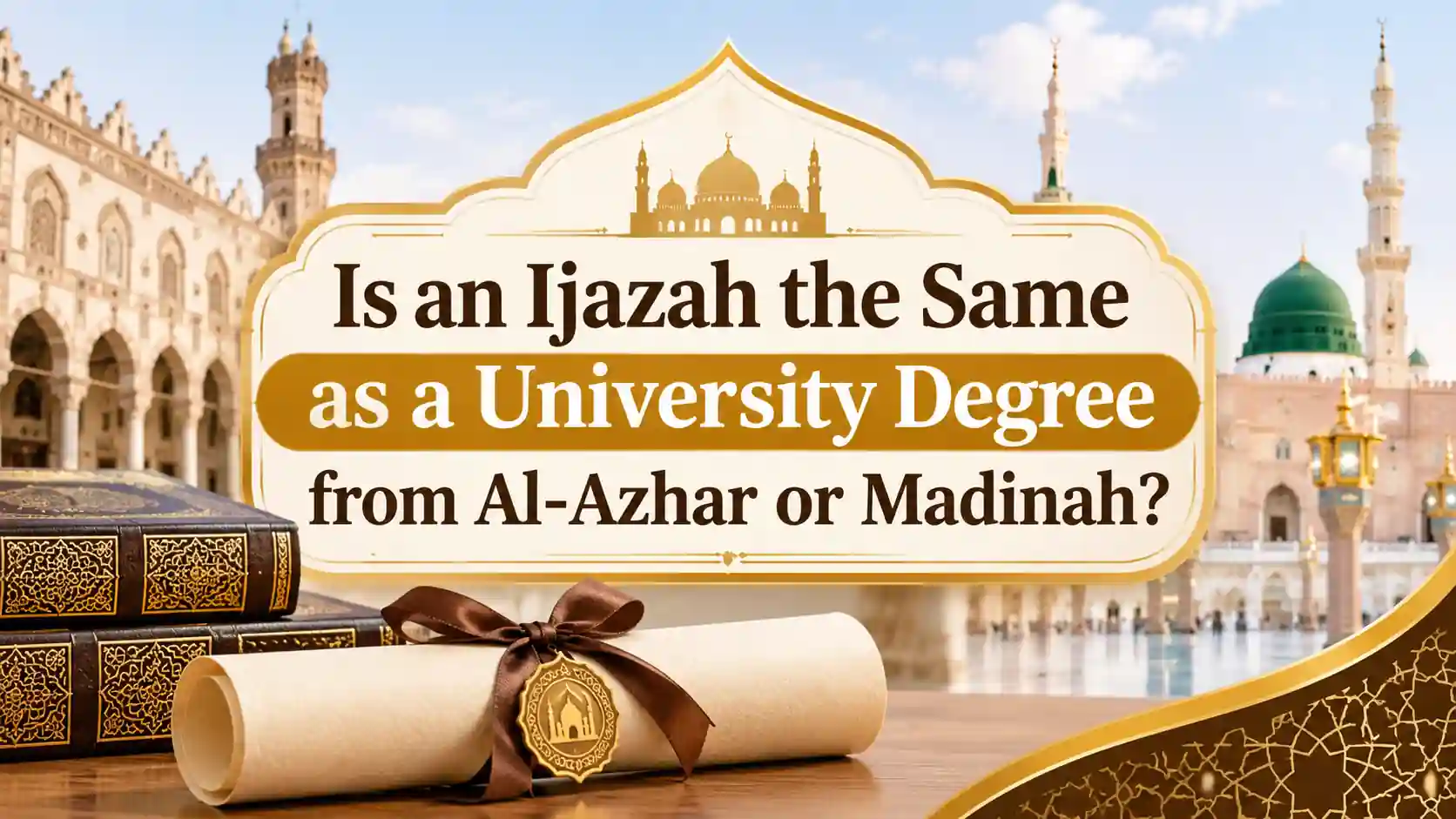
Is an Ijazah the Same as a University Degree from Al-Azhar or Madinah?
No. A university degree is awarded after completing a Courses of study at an institution, while an ijazah is a teacher’s personal permission on a specific text.
| University degree | Ijazah | |
|---|---|---|
| Granted by | An institution | An individual teacher |
| Based on | A curriculum and exams | Reciting or reading a text to the teacher |
| Proves | Academic completion | Authorized, connected transmission |
Many students receive both, as they serve different purposes. History also reveals who gave these permissions.
What Role Did Women Scholars Play in Granting and Receiving Ijazahs?
Women scholars both received and granted ijazahs, particularly in hadith, and many leading male scholars learned from them. A well-known example is Karima al-Marwaziyya, who transmitted Sahih al-Bukhari. Their role shows that what matters is knowledge and a connected sanad. Even today, female teachers grant ijazahs to their female students. Does the format matter?
Is an Ijazah Earned Online Valid Today?
Yes, if the teacher hears you live and holds a verified, connected sanad. Distance is not new, as written ijazahs sent by letter were long accepted. Whether online or in person, what is an ijazah in islam still comes down to permission and chain. Ask teachers about their preferred meeting method, as some prefer to meet in person. Verification still decides validity.
How Can You Verify Someone’s Ijazah and Spot a False Claim?
Ask to see the ijazah and trace the chain before trusting it. Use these steps:
- Ask for a copy of the document and read the full chain.
- Check that each link names a real teacher.
- Confirm the teacher recited to their own teacher, in person or live.
- Look for the text, riwayah, and date written on it.
- Be careful with ijazahs offered for payment without any recitation.
A false claim fails the basic test of what is an ijazah in islam: a real, connected chain. Now, how long does a real one take?
How Long Does It Take to Earn an Ijazah, and Where Should a Beginner Start?
It depends on the text and your pace, so there is no fixed time. A beginner should start with Arabic reading and tajweed, in these steps:
- Learn the Arabic letters and sounds.
- Study tajweed through talaqqi with a teacher.
- Memorize a short tajweed text such as al Jazariyyah, if your teacher advises.
- Choose a goal: recitation, hifz, or qira’at.
- Recite to a teacher who holds an ijazah.
Before you start, be clear on what is an ijazah in islam and which kind you want. Take it one stage at a time.
Noorani Qaida Online Classes at Home for Kids and Adults
Start Your Quran Ijazah Journey at Mubarak Academy with Teachers Who Hold an Authentic Sanad
Mubarak Academy offers structured Quran Ijazah programs with qualified male and female Quran teachers who hold recognized Sanad chains. Through personalized recitation sessions, live Tajweed correction, and individual guidance, students can work toward their Ijazah in Quran recitation or Hifz according to their level and learning goals.
Ready to begin? Contact Mubarak Academy, tell the team your level and goal, and ask to see your teacher’s sanad before you start. Now that you know what is an ijazah in islam, you can take the first step with confidence. Visit mubarakacademy.online today.
Frequently Asked Questions
What is the main purpose of an Ijazah in Islam?
An Ijazah is a license from an experienced teacher to transmit a particular text or recitation. In Quran studies, it confirms that the student has reached the required level of accuracy and has been authorized through a chain of teachers.
Can someone receive an Ijazah without memorizing the entire Quran?
Yes, it is possible to obtain a Quran recitation Ijazah without memorizing the whole Quran. A Hifz Ijazah, however, requires memorizing and reciting the entire Quran from memory, according to the teacher’s assessment.
Is an online Quran Ijazah accepted?
An online Ijazah can be valid if the student is taught and assessed live by a teacher who holds the relevant Sanad. The teacher should verify the student’s recitation and follow the conditions of the particular Ijazah.
What is the difference between Ijazah and Sanad?
An Ijazah is a qualified teacher’s permission to transmit a certain recitation or text. A Sanad is the chain of teachers linking that transmission back to its original source. They are closely related in meaning, but different in form.