
Madd (مَدّ) in Tajweed is the controlled elongation of one of three Arabic vowel letters — ا، و، ي — for a precise number of counts, determined by what follows that letter. It is not stylistic; it is obligatory. A reciter who shortens a Madd that should be six counts, or extends one that should be two, is making a Tajweed error that can distort the sound and sometimes the meaning of the Quran. At Mubarak Academy, our teachers identify incorrect Madd application as one of the three most common recitation errors among students at every level. This guide covers what Madd is, its three letters and their conditions, every major type, the count rules for each, and the exact mistakes to stop making — with clear Quranic examples throughout.
What Is Madd in Tajweed? (The Precise Definition)
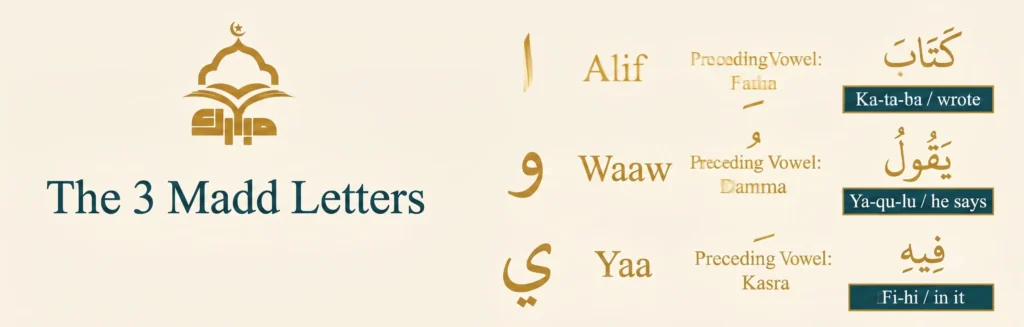
Madd (مَدّ) literally means “extension” or “stretching” in Arabic. In Tajweed, it refers specifically to the prolongation of one of the three Madd letters — ا (Alif), و (Waaw), ي (Yaa) — beyond their natural short-vowel length, according to rules determined by what comes before and after them.
The key distinction that beginners miss: not every ا، و، or ي in the Quran is a Madd letter. These letters only function as Madd letters when precise conditions are met. When those conditions are absent, they carry a completely different phonetic role.
The Three Madd Letters and Their Conditions
For a letter to qualify as a Madd letter, two conditions must be met simultaneously:
Condition 1: The Madd letter must be vowel-free (saakin — no harakah on it). Condition 2: The letter immediately before it must carry the matching short vowel.
| Madd Letter | Arabic | Required Preceding Vowel | Quranic Example |
|---|---|---|---|
| Alif | ا | Fatha (َ) | قَالَ — the ا follows a fatha |
| Waaw | و | Damma (ُ) | يَقُولُ — the و follows a damma |
| Yaa | ي | Kasra (ِ) | الرَّحِيمِ — the ي follows a kasra |
A useful memory anchor: the three conditions are encoded in the Arabic word نُوحِيهَا — it contains all three Madd letters in their correct vowel environments (و with damma before it, ي with kasra before it, ا with fatha before it). Scholars have used this mnemonic for centuries.
The Two Major Types of Madd in Tajweed
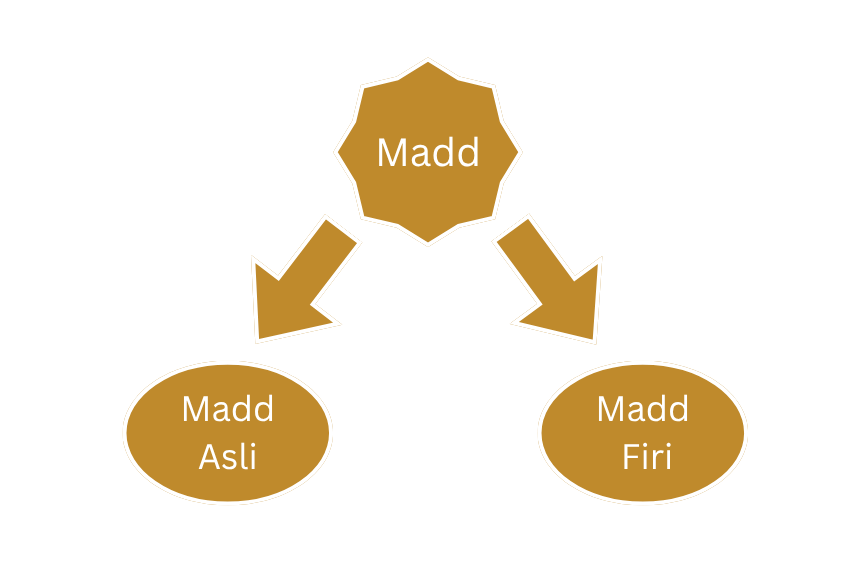
Every Madd type belongs to one of two parent categories. Understanding this tree structure first makes all the sub-types immediately logical.
- Madd Asli (مَدّ أَصْلِي) — Natural Madd. No trigger beyond the Madd letter itself. Always 2 counts.
- Madd Fari (مَدّ فَرْعِي) — Secondary Madd. Triggered by an external cause — either Hamza (ء) or Sukoon (ْ) following the Madd letter. Duration varies: 2, 4, 5, or 6 counts depending on the specific type.
Everything else is a branch of these two.
Read Also: Importance of Tajweed in Quran
Madd Asli (Natural Madd) — The Foundation
Madd Asli, also called Madd Tabee’i (مَدّ طَبِيعِي), is the baseline elongation every Madd letter receives when no trigger follows it. No Hamza follows. No Sukoon follows. The sound simply stretches naturally for 2 counts (2 harakaat).
This is the Madd you hear most frequently throughout the Quran. It is present in nearly every verse.
Examples from the Quran:
- قَالَ (Qaala) — Alif Madd, 2 counts, Surah Al-Baqarah
- يَقُولُ (Yaqoolu) — Waaw Madd, 2 counts
- الرَّحِيمِ (Ar-Raheem) — Yaa Madd, 2 counts, Surah Al-Fatihah
- خَالِدِينَ (Khaalideen) — Alif Madd then Yaa Madd, both 2 counts
The count rule is absolute: Madd Asli is always 2 — never 1, never 3. A student who rushes past it and gives it 1 count has made a clear Tajweed error. A student who stretches it to 4 without a trigger has also erred.
Madd Fari (Secondary Madd) — All Types and Their Count Rules
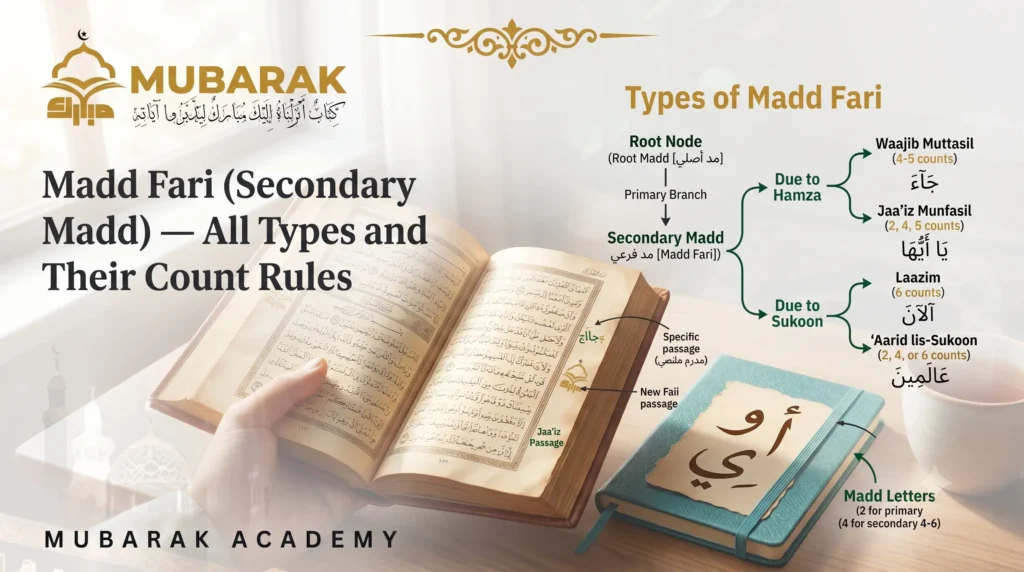
Madd Fari adds length beyond the natural 2 counts because of an external cause. There are two causes: Hamza and Sukoon. Each produces a different set of Madd types.
Madd Fari Due to Hamza
Waajib Muttasil (مَدّ وَاجِب مُتَّصِل) — 4 to 6 Counts
“Waajib” means obligatory. “Muttasil” means connected — the Hamza appears in the same word as the Madd letter.
When a Madd letter is followed by Hamza in the same word, the elongation is compulsory and must be held for 4, 5, or 6 counts (the reader follows one consistent choice — typically the count used by their recitation teacher or Qira’ah style).
Examples:
- جَاءَ — the Alif Madd is followed by Hamza (ء) in the same word → Waajib Muttasil
- جِيءَ — Yaa Madd followed by Hamza in the same word
- سُوءَ — Waaw Madd followed by Hamza in the same word
This is called “Waajib” because skipping the extended count is not permissible — it is an obligatory elongation.
Jaa’iz Munfasil (مَدّ جَائِز مُنْفَصِل) — 2 to 5 Counts
“Jaa’iz” means permissible. “Munfasil” means separated — the Hamza appears in the next word (the Madd is at the end of one word, and Hamza opens the next).
The elongation here is permissible but not obligatory — some reciters extend it, some do not, and both are valid within accepted Qira’at traditions. The range is typically 2, 4, or 5 counts depending on the recitation style.
Examples:
- إِنَّا أَعْطَيْنَاكَ — the Alif at the end of إِنَّا is followed by Hamza at the start of أَعْطَيْنَاكَ
- بِمَا أُنْزِلَ — Alif Madd in بِمَا, followed by Hamza in أُنْزِلَ
Note: Jaa’iz Munfasil connects directly to how you handle Quran stop signs (Waqf) — when you stop mid-verse, Munfasil situations resolve and the Madd rules shift.
Madd Fari Due to Sukoon
Madd Laazim (مَدّ لَازِم) — Always 6 Counts
“Laazim” means necessary or permanent. This Madd is triggered by an original, unchanging Sukoon — one that is part of the word’s root structure, not a Sukoon that appears only when stopping.
Madd Laazim is always 6 counts — the longest Madd, with no variation. It has two sub-categories:
| Sub-type | Arabic | Where it appears | Example | Counts |
|---|---|---|---|---|
| Kalimi (word-level) | لَازِم كَلِمِي | Inside a word | الضَّالِّين — the Alif Madd followed by Shaddah (which contains a sukoon) | 6 |
| Harfi (letter-level) | لَازِم حَرْفِي | Abbreviated letters opening Surahs (Huruf Muqatta’at) | الم — the Lam letter (ل) spelled as لَام contains a Madd + Sukoon | 6 |
The Huruf Muqatta’at (الم، طسم، يس، حم، etc.) at the opening of certain Surahs are among the most important applications of Madd Laazim Harfi. Students who rush these openers are shortening a mandatory 6-count Madd.
‘Madd Aarid lis-Sukoon (مَدّ عَارِض لِلسُّكُون) — 2, 4, or 6 Counts
“‘Aarid” means temporary or circumstantial. This Madd occurs when a Madd letter is followed by a letter that carries Sukoon only because you are stopping (waqf) — in continuous recitation, that letter would carry a vowel.
This is the most commonly encountered Madd in everyday recitation because it appears at the end of every verse and phrase where a student pauses.
Count flexibility: 2, 4, or 6 counts are all valid. Most reciters use 2 when reading quickly and 4 or 6 when reciting melodically (tarteel). Choose one and be consistent.
Examples:
- نَعْبُدُ — if you stop here, the damma on دُ becomes sukoon → دْ, and the Alif Madd in إِيَّاكَ preceding it extends
- الرَّحِيمِ — stopping on the word makes the final kasra disappear → ‘Aarid lis-Sukoon on the Yaa Madd
- الْعَالَمِينَ — stopping here triggers ‘Aarid lis-Sukoon on the Yaa
Understanding this type requires knowing when and how to stop during recitation — the Waqf rules directly affect which Madd applies and for how long.
Madd Count Reference Table
| Madd Type | Trigger | Counts (Harakaat) | Obligation |
|---|---|---|---|
| Madd Asli (Natural) | No trigger | 2 (fixed) | Obligatory |
| Waajib Muttasil | Hamza in same word | 4–6 (consistent choice) | Obligatory |
| Jaa’iz Munfasil | Hamza in next word | 2–5 (style-dependent) | Permissible (variable) |
| Madd Laazim | Original Sukoon in word or letter | 6 (fixed) | Obligatory |
| ‘Aarid lis-Sukoon | Waqf (stopping) creates Sukoon | 2, 4, or 6 (flexible) | Permissible (flexible) |
How Madd Affects Meaning and Recitation Quality
This is not a theoretical concern. Incorrect Madd application produces audible errors with real consequences.
- Example 1 — Altering word rhythm: The phrase بِسْمِ اللَّهِ الرَّحْمَٰنِ الرَّحِيمِ contains two Madd Asli applications (on الرَّحِيمِ’s Yaa and الرَّحْمَٰنِ’s Alif). A reciter who shortens both to barely 1 count produces a clipped, hurried sound that strips the verse of its measured dignity.
- Example 2 — Breaking an obligatory rule: الضَّالِّينَ contains Madd Laazim — the Alif Madd followed by the Shaddah on ل (which contains a sukoon). Giving it 2 counts instead of 6 is a clear Tajweed error, not a stylistic preference.
- Example 3 — Madd and Shadda interact: In الضَّالِّينَ, the Shadda on ل and the Madd on the preceding Alif are two distinct rules applied at the same location — first the 6-count Madd, then the doubled ل. Students who understand Shadda as a rule separate from Madd apply both cleanly; those who confuse them collapse the two into one approximation.
Similarly, Qalqalah letters (ق، ط، ب، ج، د) sometimes appear after a Madd letter. The echo produced by Qalqalah is a separate articulation at the exit point of those letters — it does not extend the Madd count, and the Madd does not suppress the Qalqalah.
Madd in the Word اللَّه (Lafzul Jalaalah)
The word اللَّه carries one of the most discussed pronunciation rules in Tajweed — and Madd is directly involved. The elongation on the Lam (لّ) and the following vowel depends entirely on the vowel of the letter that comes before it.
Rule 1 — Tafkheem (full, heavy pronunciation) with Madd: When the letter before اللَّه carries a fatha (َ) or damma (ُ), the Lam is pronounced heavy and full — and the Alif that follows is extended as a natural Madd Asli for 2 counts.
Examples:
- قَالَ اللَّهُ — the word before carries fatha → heavy Lam + 2-count Madd
- رَسُولُ اللَّهِ — the word before carries damma → heavy Lam + 2-count Madd
Rule 2 — Tarqeeq (light pronunciation) with Madd: When the letter before اللَّه carries a kasra (ِ), the Lam is pronounced light — and the Madd Asli on the Alif still applies for 2 counts, but the overall weight of the word shifts noticeably lighter.
Example:
- بِسْمِ اللَّهِ — the م carries kasra → light Lam + 2-count Madd
Where the Madd sits in اللَّه: The Alif between the two Lams (اللَّه) is the Madd letter — it is an Alif preceded by fatha, vowel-free itself, qualifying as Madd Asli at 2 counts in every case regardless of tafkheem or tarqeeq. The heaviness or lightness of the Lam changes; the Madd count does not.
This rule appears hundreds of times throughout the Quran. Students who apply both the tafkheem/tarqeeq judgment and the 2-count Madd correctly on لفظ الجلالة demonstrate a level of Tajweed awareness that goes well beyond beginner level.
4 Common Mistakes When Applying Madd
These are the errors our teachers at Mubarak Academy identify most often — and the ones that are easiest to correct once you know what to listen for.
Mistake 1: Skipping the Madd Letter Entirely
The student sees ا، و، or ي but reads past it without elongation, treating it as a short vowel. This is most common in fast or distracted reading.
How to fix it: Before reciting any verse, scan it visually for Madd letters first. Identify each one and its type before you start. This habit — even for 30 seconds — eliminates most skipped Madd errors.
Mistake 2: Over-Elongating Madd Asli
A Madd Asli is 2 counts. Students who are trying to be careful sometimes give it 4 counts, turning a natural Madd into what sounds like a Waajib Muttasil. This is also an error.
How to fix it: Practise counting deliberately. Tap your finger: 2 taps for Madd Asli, 4–6 for triggered Madd types. Physical counting externalises the timing until it becomes internal.
Mistake 3: Applying Inconsistent Counts for the Same Type
A student gives Waajib Muttasil 4 counts in one verse and 6 in the next, without a consistent choice. Tajweed requires consistency — once you adopt a count for a type within a recitation session or style, maintain it.
How to fix it: Know which Qira’ah or recitation style you are learning (most beginners learn Hafs ‘an ‘Aasim). Follow the established count for that style, and do not mix styles within one session.
Mistake 4: Confusing Madd Laazim and ‘Aarid lis-Sukoon
Both involve Sukoon following a Madd letter — but one is fixed at 6 counts and the other is flexible (2, 4, or 6). Students often either give ‘Aarid lis-Sukoon a rigid 6 counts when flexibility is allowed, or give Madd Laazim only 2 counts when stopping.
How to fix it: Ask one diagnostic question: “Is this Sukoon always here, or only because I stopped?” Always here → Laazim (6 counts). Only because I stopped → ‘Aarid (choose 2, 4, or 6 consistently). This single question resolves most confusion between the two.
Learn Also: Major and Minor Mistakes in Tajweed
How to Practice Madd Correctly
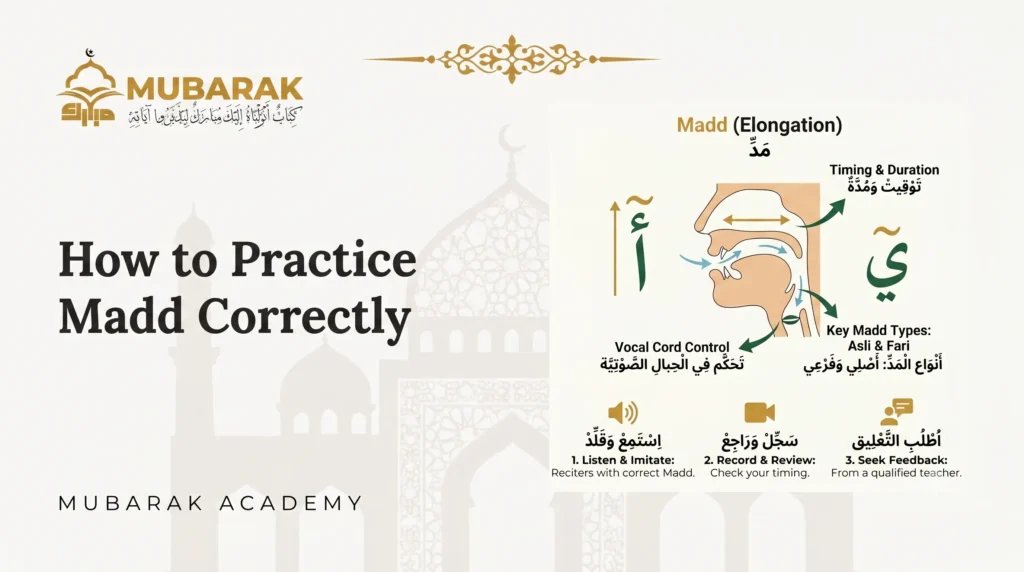
Madd is one of the few Tajweed rules that responds quickly to structured practice — students who apply the following method typically notice clear improvement within 2–3 weeks.
- Learn Madd Asli before anything else. Every Madd Fari type starts with a Madd letter that first qualifies under Madd Asli conditions. If you cannot consistently identify and produce 2-count Madd, the extended types become guesswork.
- Use Surah Al-Fatihah as your training verse. It contains Madd Asli (الرَّحِيمِ, الرَّحْمَٰنِ, الضَّالِّينَ), Madd Laazim (الضَّالِّينَ’s Alif), and ‘Aarid lis-Sukoon at every stopping point. One Surah, multiple types — practise it slowly until you identify each type in real time.
- Record and self-audit. Record a passage of 5–10 verses at a slow pace. On playback, stop at each Madd letter and verify: Did I produce the right count? Was it consistent? Was the vowel quality correct (Alif opens forward, Waaw rounds back, Yaa lifts slightly)?
- Work through the Huruf Muqatta’at. The opening letters of Surahs (الم، طسم، يس، حم، كهيعص) are an excellent Madd Laazim drill — every qualified letter must be held for 6 counts. Reciters who master these openers build a strong 6-count muscle memory that carries into all other Laazim applications.
- Learn from a qualified teacher for live correction. Tajweed was historically transmitted teacher-to-student because some errors — particularly subtle over- or under-elongation — are only audible, not visible on the page. Written resources teach the rules; a teacher corrects your specific pronunciation.
Why Madd Matters — The 5 Reasons Scholars Emphasise It
1. It Preserves the Quran as It Was Revealed
The Quran was revealed with precise elongations that carry meaning and emphasis. Shortening a 6-count Madd in الضَّالِّينَ or الْمُؤْمِنِينَ produces a phonetically different sound from what the Prophet (ﷺ) recited.
2. It Determines Word Clarity and Sometimes Meaning
In Arabic, vowel length can affect meaning. A recitation that consistently under-elongates Madd letters begins to blur distinctions between words, producing a muddled rather than articulate sound.
3. It Distinguishes Between Qira’at
The accepted Qira’at (recitation styles) — Hafs, Warsh, Qalun, and others — differ in how they handle Madd Fari counts, particularly Jaa’iz Munfasil. Understanding Madd is therefore a gateway to understanding the diversity and richness of Quranic transmission.
4. It Creates the Rhythmic Dignity of Tarteel
Allah commands reciting the Quran in tarteel (measured, deliberate recitation — وَرَتِّلِ الْقُرْآنَ تَرْتِيلًا, Al-Muzzammil 73:4). The rhythm of tarteel is built on Madd durations. Remove them and the measured, dignified flow collapses.
5. It Deepens the Spiritual Experience
A correctly applied 6-count Madd on a word of divine praise creates space — a moment of held breath and attention — that short reading does not. Students who apply Madd correctly consistently report that their recitation feels more present and spiritually engaged.
Frequently Asked Questions About Madd in Tajweed
-
What is Madd in Tajweed in simple terms?
Madd is the rule of vowel elongation in Quranic recitation. When one of the three Madd letters (ا، و، ي) appears under the right conditions, it must be extended for 2, 4, 5, or 6 counts depending on what follows it. The word Madd means “extension” in Arabic, and that is exactly what it describes.
-
What are the three letters of Madd?
The three Madd letters are Alif (ا), Waaw (و), and Yaa (ي). To function as Madd letters, they must be vowel-free and preceded by their matching short vowel — fatha before Alif, damma before Waaw, and kasra before Yaa. The mnemonic word نُوحِيهَا encodes all three conditions.
-
What is the difference between Madd Asli and Madd Fari?
Madd Asli is the natural, baseline elongation of 2 counts — it occurs when no external trigger follows the Madd letter. Madd Fari is secondary elongation triggered by either Hamza (ء) or Sukoon (ْ) following the Madd letter, producing extended counts of 4, 5, or 6.
-
Is Madd Laazim always 6 counts?
Yes. Madd Laazim is the only Madd type with a completely fixed, non-negotiable count: always 6 harakaat. It is triggered by an original Sukoon — one that is structurally part of the word, not created by stopping. This distinguishes it from ‘Aarid lis-Sukoon, which is flexible.
-
How is Madd different from Shadda?
Madd elongates a vowel sound. Shadda doubles a consonant. They are completely different rules with different functions. When they appear near each other (as in الضَّالِّينَ), each rule applies independently — the Madd first, then the doubled consonant at the next letter.
-
Does stopping (Waqf) change which Madd applies?
Yes, significantly. ‘Aarid lis-Sukoon only exists because you are stopping — the Sukoon that triggers it disappears when you continue reading. This is why understanding Quran stop signs (Waqf) is directly connected to applying Madd correctly: where you stop determines which Madd type you produce.
-
What is Madd in English?
In English, Madd is best translated as “vowel elongation” or “prolongation.” In phonetic terms, it describes a lengthened vowel segment. In Tajweed, it is a rule system governing exactly how long specific vowel sounds must be held based on the phonological context of the surrounding letters.
Conclusion
Madd is the backbone of Quranic recitation’s measured, dignified sound. Its rules — 2 counts for natural Madd, 4–6 for Hamza-triggered types, a fixed 6 for Laazim, and flexible counts for stopping — are specific, learnable, and audibly impactful. Getting them right is what separates a careful, respectful recitation from a rushed one.
If you are building your Tajweed foundation, Madd sits alongside Shadda, Qalqalah, and Waqf rules as one of the four rules most frequently applied and most frequently mispronounced. Master these together, and your recitation transforms from approximate to accurate. Start with the complete picture of what Tajweed is and why it matters, then work through each rule with the guidance of a qualified teacher.
At Mubarak Academy, our online Tajweed courses teach Madd systematically — starting with Madd Asli, progressing through Madd Fari, and applying live correction at every step so you carry the rules into every recitation confidently.

Ustadh Ahmed Mahmoud Abdulaziz is an experienced teacher of Arabic and the Holy Quran for native and non-native speakers. He holds a verified Ijazah in Hafs ‘an Asim and is certified in the foundational Tajweed texts Al-Jazariyyah and Tuhfat Al-Atfal. Drawing on his extensive background in traditional Quranic recitation and international pedagogy, he writes scholar-verified, accessible articles to help students worldwide master Tajweed rules and Arabic linguistics safely and accurately.




Junior
19 Oct, 2025This has been by far the best experience I’ve ever had when it comes to learning the Arabic language. The teachers take their time to explain and ensure that you are learning the correct grammar and pronunciation. I’ve even enrolled my children to the school as it’s so affordable. If you are looking for a good school then look no further here is where you wanna be .
master ayman othman
1 Jul, 2026thank for your opinion