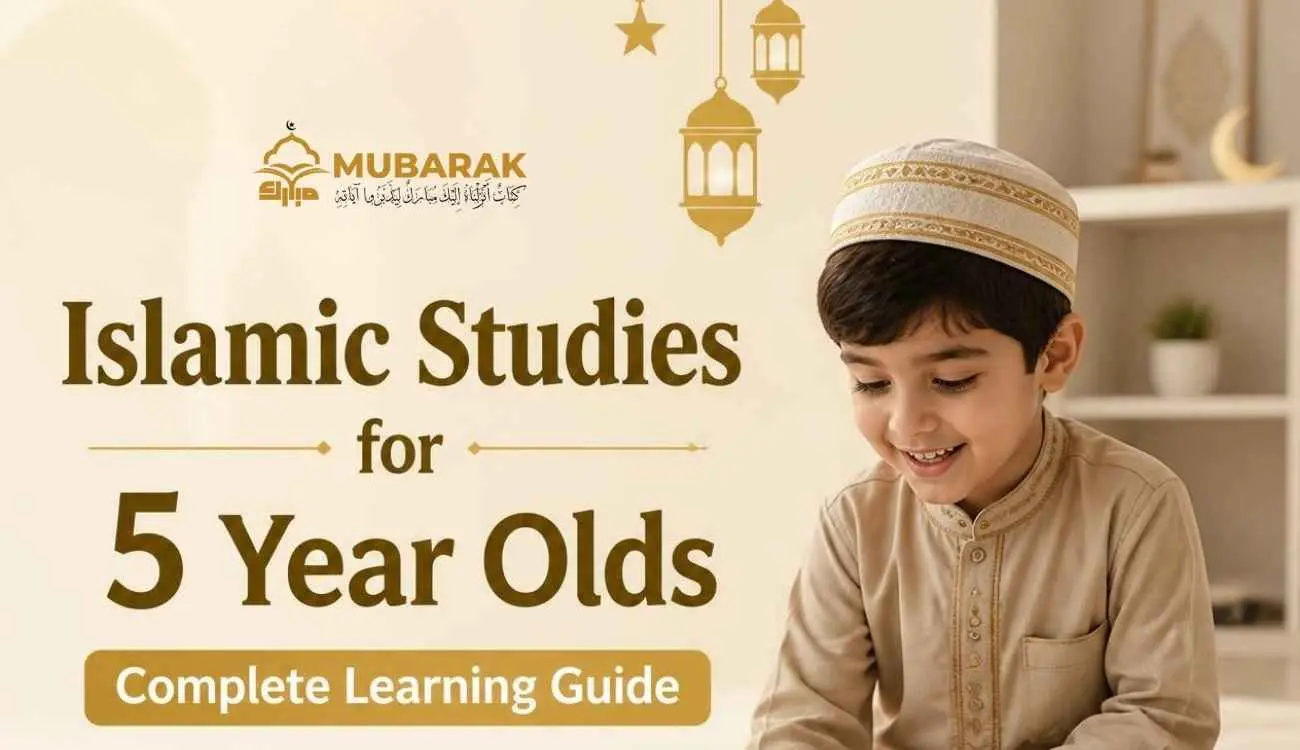
Your 5-year-old asking you, “Who made the sky?” is the key to the door of islamic studies for 5 year olds. Children learn about faith at this stage by listening to stories, by repetition, and through play, not by listening to long sermons or lengthy explanations. You’ll find tips on readiness signs, the five pillars, daily routines, prophet stories, common parent mistakes, and the best curricula and online programs so you can create a happy and enduring Islamic base for your child from the outset.
Is a 5 Year Old Ready for Islamic Studies?
Yes, most 5 year olds are ready: Memory, language, and a sense of right and wrong are maturing at a rapid pace at this age. If a child can sit for 10 minutes to listen to a story, repeat a short phrase, and ask “why” then they have the necessary skills to start.
Before beginning a islamic studies for 5 year olds structured plan:
- Is able to read a story and follow it for 3-4 sentences without getting lost
- Repeats short phrases after one or two repetitions
- Demonstrates interest in Allah, the Prophet, or good and bad
- Attends for a brief Zoom or in-person lesson
If 2 or more apply, your child is now ready to start learning about Islam in a light and story form and is not ready for formal classroom based learning.
What Are Islamic Studies for 5 Year Olds?
islamic studies for 5 year olds is basic instruction in the fundamental principles of Islam: Allah, the Prophet, short duas, and simple manners, learning without textbooks through stories and repetition. It is not memorising fiqh or Arabic grammar but the fundament of emotion and morals that comes before it.
The key elements of the core are the following:
- Aqeedah basics: In simple and concrete language, it is taught about Aqeedah basics, who Allah is.
- Seerah snippets: short stories based on the life of the Prophet Muhammad’s ﷺ youthful years.
- Short duas: are duas that are to be recited for eating, sleeping, and leaving the house.
- Manners (akhlaq): greeting others, sharing and telling the truth
With these base elements established, it’s time to build on them: the five pillars.
Best Islamic Online Courses for Quran Arabic and Tajweed
How to Introduce the Five Pillars of Islam to a 5 Year Old?
Introduce the five pillars one by one rather than a verbal definition introduce a hands-on activity for each pillar. At this age, a child learns a pillar by doing it, not by hearing it explained.
- Shahada: recite together as a morning greeting.
- Salah: have the child copy the movements on their own small mat
- Zakat: donate a coin into a charity box that they have decorated.
- Sawm: Make it about waking up early with Baba/Mama, not fasting
- Hajj: Kaaba picture books and a ‘walk in a circle’ game are used in Hajj.
Don’t do all five pillars in one week, but rather, repeat each one over the course of several weeks. Repetition, not speed, makes it stick!
Islamic Special Religious Education for Children and Teens
Which Duas and Surahs Should a 5 Year Old Memorize First?
Begin memorizing with the shortest surahs and duas that your child has heard repeatedly in the past, because it will be easier for him to memorize than the more difficult ones, and it will take less time.
- Surah Al-Fatiha
- The three surahs that are the last three (Al-Ikhlas, Al-Falaq, An-Nas)
- Dua before taking food and after eating food.
- Prayer before bedtime and after getting up
- Dua for entering and leaving the bathroom
Match each with its time of day: the duas for eating at the table and the duas for sleeping at night, so that the child memorizes through routine and not by rote learning.
Revelation Recording and Memorisation of the Holy Quran
How to Teach Islamic Studies to a 5 Year Old Through Play?
Make each lesson a game because a 5-year-old’s attention span is geared towards play, not listening. Content a child remembers is content a child has learned through play-based teaching.
- Use puppets to enact short stories of the Prophets.
- Make wudu steps a “follow the leader” song!
- Create a feltboard Ka’bah for mini Hajj role play.
- Use a sticker chart, not candy, to reward duas that have been memorized.
- Read one Islamic picture book every night (consistent time)
This style of play-based learning islamic studies for 5 year olds ensures sessions do not exceed 15 minutes, as this is a child’s attention span at this age.
Basic Rules of Tajweed for Beginners and Correct Quran Recitation
Which Prophet Stories Work Best for 5 Year Olds?
The stories with an action and a simple lesson work best; avoid too much detail for a 5-year-old to process in the seerah. It is not historical accuracy that we are aiming for; it is emotional connection with the Prophets.
- Patience and trust in Allah’s plan are the traits of the Prophet Nuh (AS).
- Prophet Ibrahim (AS): Bravery to fight for the truth
- Prophet Musa (AS): Allah’s protection in scary moments
- Prophet Yunus (AS): the importance of saying sorry
- Prophet Muhammad ﷺ : Kindness towards animals and neighbours
Share a story each week and have the child repeat it to you the following day in his own words.
Learn Quran Reading With Tajweed For Beginners Step By Step
How to Build a Simple Daily Islamic Routine for a 5-Year-Old?
Utilize existing timeframes within the day for Islamic learning, such as the time that children spend at breakfast, lunch, and bedtime, rather than have a scheduled “class time” that is a compromise on their playtime.
- Morning: Say the morning duas together as you get ready to get up for morning prayers.
- Before eating, recite the eating dua before taking the first bite.
- Midday: 10-minute story or online learning short story.
- At nighttime: recite a dua or surah while walking or driving in the car.
- Bedtime: Sleep dua and a two-minute summary of learning.
No additional time in the day is needed for the routine; it is simply adding faith to existing routines.
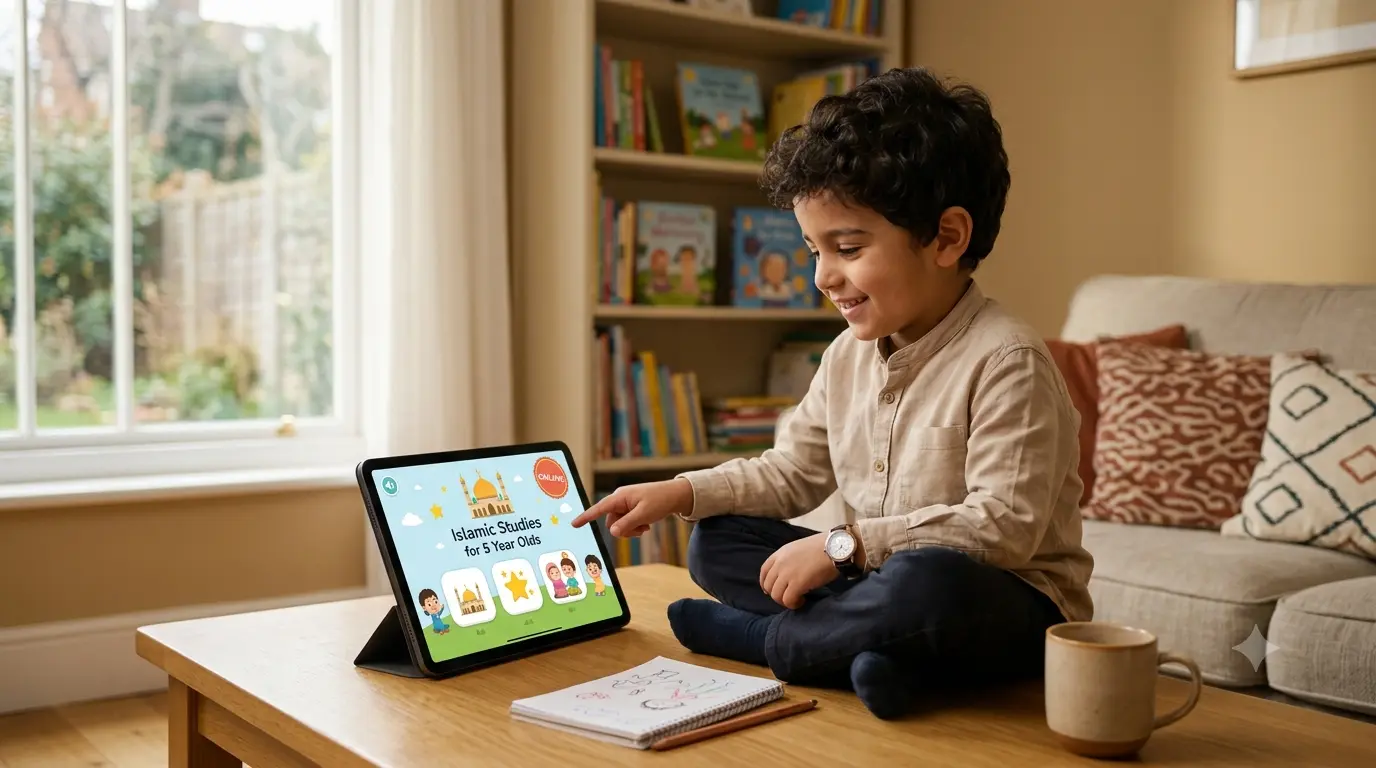
What Are the Best Books and Curricula for Islamic Studies at Age 5?
Workbooks are the best choice that are created for this age level, and they include tracing, coloring and short repeated phrases instead of a lot of text. There are three popular options available to parents that begin at home.
Top Islamic Studies for 5 Year Olds Curricula
- Weekend Learning Series Islamic Studies 1 (ages approximately 5-7) Allah, the Qur’an, and the five pillars 28 lessons
- Islamic Studies Kindergarten for Ages 4-5 by Mohamed Aslam Gafur, tracing and coloring in English and Arabic.
- A free curriculum library of Quranic Tarbiyah, which offers step-by-step lessons on the five pillars for ages 5 and above.
Print curricula are effective supplements, but most families use it in conjunction with a live teacher to correct.
What Are the Best Online Islamic Studies Programs for 5 Year Olds in the USA?
The top online programs combine a licensed teacher with short, individual sessions and frequent parent updates because a 5-year-old will learn better when the teacher is there in real time and can provide feedback than if the teacher is watching a video. Islamic studies for 5-year-old children are taught by academically and religiously qualified teachers.
either individually or in groups, as an option chosen by the family, and before starting lessons, a level assessment is made to ensure that the appropriate age is taught at the right level, and progress is reported directly to parents. Classes are conducted live on Zoom, and teachers are both male and female, and there is a free trial class to meet the teacher before you sign up.
How Do Muslims Prepare for Ramadan: Spiritual, Practical, and Quranic Steps
Online Islamic Classes vs. Islamic Sunday School: Which Is Better at Age 5?
Online classes are better for a 5-year-old than Sunday school, as the teacher is able to give them one-on-one attention rather than dividing their time among a full classroom. The group aspect of Sunday school is still valuable, but a 5-year-old’s attention span generally does not get as much individual correction there.
| Factor | Online 1-on-1 Classes | Islamic Sunday School |
|---|---|---|
| Attention per child | High | Low to moderate |
| Scheduling | Flexible, any weekday | Fixed weekly slot |
| Progress tracking | Individual reports | Rarely detailed |
| Social interaction | Limited | Strong |
Many families use both a weekday online class for progress and Sunday school for social time with other Muslim children.
Holiest Night of The Year, How to Pray on Laylatul Qadr?
How to Teach Islamic Manners and Character to a 5 Year Old?
Copy the behavior first, then call it by name. A 5-year-old copies behavior before understanding the word for it!
- Say “Assalamu Alaikum” together every time you greet someone
- Pray “Bismillah” before eating and “Alhamdulillah” after eating.
- At playdates, demonstrate sharing of toys and reward the behavior.
- Correct gently and immediately, without lengthy explanations;
- Read 1 short story each week about honesty or kindness.
These small, repeated islamic activities for 5 year olds develop character more rapidly than any single lecture on akhlaq.
What Mistakes Do Parents Make When Starting Islamic Studies Too Early?
The most frequent error is to try to teach a 5-year-old the same way they teach an older student: long lessons, high memorization goals, and formal assessments that make faith into pressure.
- Trying to force 30+ minutes of sessions rather than short, frequent sessions.
- Forgetting to play and going directly to workbooks
- What is the difference between **punishing** the forgotten duas and just repeating them?
- Making a comparison between the child’s pace and an older sibling’s pace
- The child is using words in Arabic that he or she does not know but is not translating them.
The avoidance of these matters is more important than any single curriculum decision: a hurried start is worse than a slightly late start.
How to Raise a Muslim Child in a Non-Muslim Country Like the USA?
Develop home identity first, as the child will become influenced by cultural cues more readily than religious ones, unless the home balances that.
- Have a routine of duas and short lessons that are visible every day.
- Get in touch with a local masjid or an islamic studies for kindergarten group
- This is an online tool for Muslim teachers, so that faith doesn’t just have to be a weekend phenomenon.
- Describe differences (holidays, food, clothing) in a nonfearful manner
- Celebrate Islamic events at home, as well as mainstream events.
A child who is raised like this comes to understand that being a Muslim in America is a way of life.
Basic Islamic Knowledge for Kids
What Comes Next After Islamic Studies for 5 Year Olds?
From this, a child is ready to start reading Arabic letters, reading the Noorani Qaidah, memorizing longer surahs with understanding, typically between the ages of 6 and 7. Upon completion of this stage, students at Mubarak Academy move on to structured courses of memorization and the Arabic language with the same teacher, ensuring no repetition or omission of the material.
Start Their Journey Today:
Our team of 100+ academically and religiously licensed teachers has more than 1,000 students from more than 20 countries learning with us, and we report directly to parents on a weekly basis. All Islamic studies for 5-year-olds plans kick off with a free trial class so that you can get to know your child’s teacher, see their classroom experience first-hand, and make an informed decision before enrolling.
Book your free trial class with Mubarak Academy today and provide your child a foundation that will last a lifetime.
Frequently Asked Questions
Is it okay to teach Islamic studies in English only for a 5 year old?
Yes. It is perfectly acceptable to teach Islamic studies in English to a 5-year-old. The child learns best in a language that he or she already understands. English enables them to understand Islamic values, stories, and manners, and Arabic can be gradually introduced through short surahs, duas, and simple Islamic phrases.
How many minutes a day is ideal for a 5 year old’s Islamic lesson?
The recommended amount of focused learning for most 5-year-olds is 10 to 15 minutes per day. Short, regular lessons work best because they match a young child’s attention span and make learning Islam enjoyable instead of feeling like a chore.
Can a non-Arabic-speaking parent still teach Islamic studies at home?
Yes. Parents do not have to be Arabic speakers to teach Islamic studies at home. They can read from English books, watch educational videos, listen to Qur’an recitations, receive guidance from a qualified online teacher, and practice good manners, duas, and Islamic habits through regular family routines.
What if my 5 year old refuses to sit still during lessons?
If your 5-year-old has trouble sitting through lessons, make them shorter and more interactive. Use storytelling, role-playing, songs, simple crafts, or movement activities based on Islamic topics. A positive and playful approach is usually more effective than trying to extend lesson time.

Ustadh Ahmed Mahmoud Abdulaziz is an experienced teacher of Arabic and the Holy Quran for native and non-native speakers. He holds a verified Ijazah in Hafs ‘an Asim and is certified in the foundational Tajweed texts Al-Jazariyyah and Tuhfat Al-Atfal. Drawing on his extensive background in traditional Quranic recitation and international pedagogy, he writes scholar-verified, accessible articles to help students worldwide master Tajweed rules and Arabic linguistics safely and accurately.