

Start Your Study Journey Today
Book a FREE trial class with a certified Quran teacher. No payment, no commitment.
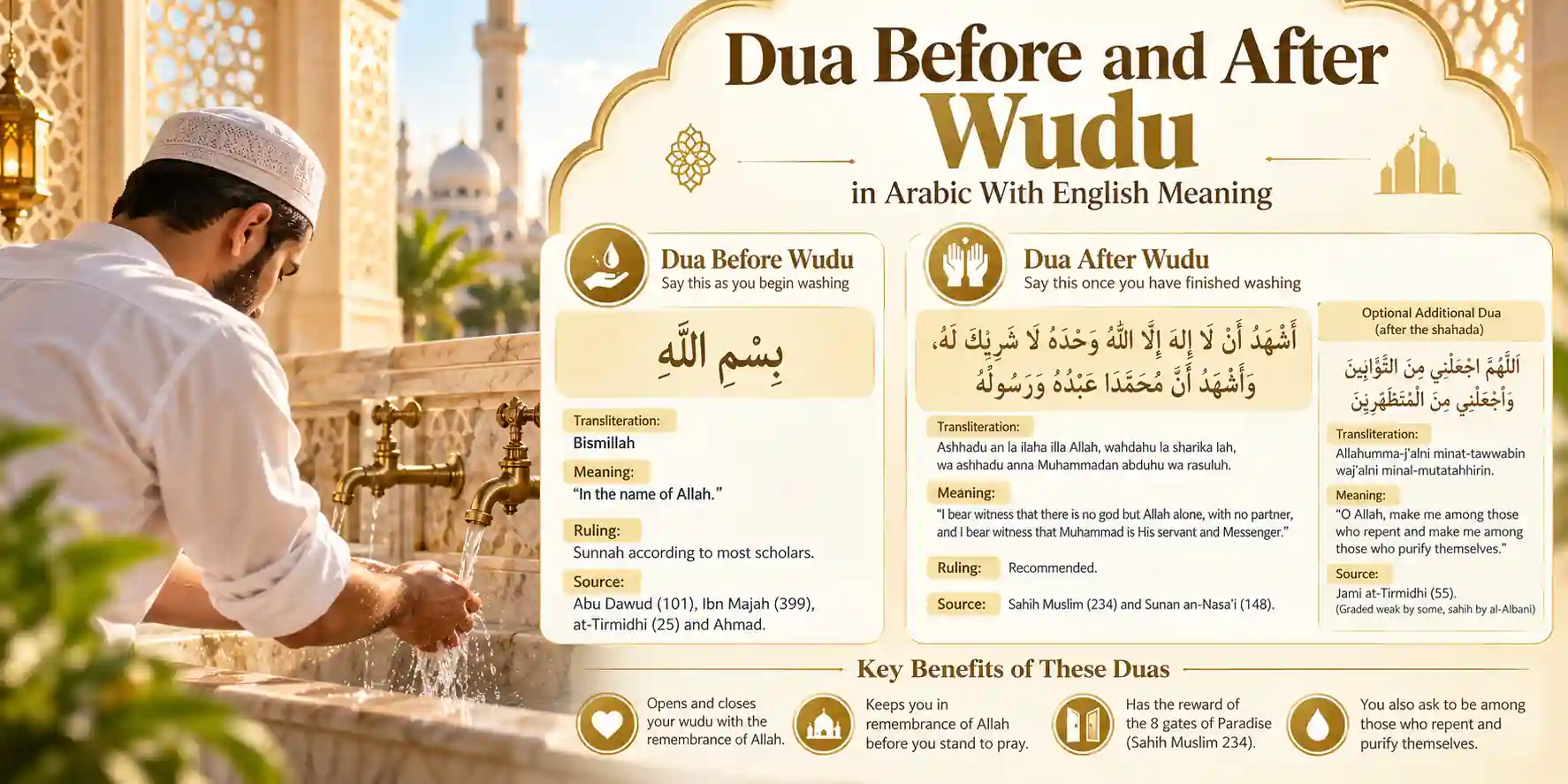
The dua before and after wudu is “Bismillah” (بِسْمِ اللَّهِ) as you begin and the shahada once you finish. These two duas open and close your wudu with the remembrance of Allah. This guide gives both in Arabic, transliteration and English, then explains their rulings, sources, benefits and common beginner mistakes. Each ruling names its source and grading, so you can learn and practise the duas with confidence. We begin with the dua before wudu.
What Is the Dua Before Wudu?
The dua before wudu is “Bismillah” (بِسْمِ اللَّهِ), meaning “In the name of Allah”, said as you begin washing.
It is based on the hadith “There is no wudu for the one who does not mention the name of Allah upon it”, reported by Abu Dawud (101), Ibn Majah (399), at-Tirmidhi (25) and Ahmad. Scholars differ on its grading. Al-Albani graded the Abu Dawud narration sahih, while Imam Ahmad said that no hadith on this topic has a strong chain.
Starting with Allah’s name makes the whole act worship, and the dua after wudu closes it with another remembrance. Next, the dua you say once you finish.
What Is the Dua After Wudu?
The dua after wudu is the shahada, which you say once you have finished washing.
It means: “I bear witness that there is no god but Allah alone, with no partner, and I bear witness that Muhammad is His servant and Messenger.” Here is the dua in Arabic:
أَشْهَدُ أَنْ لَا إِلَهَ إِلَّا اللَّهُ وَحْدَهُ لَا شَرِيكَ لَهُ، وَأَشْهَدُ أَنَّ مُحَمَّدًا عَبْدُهُ وَرَسُولُهُ
The dua is reported in Sahih Muslim 234 and Sunan an-Nasa’i 148. Because the two duas are short and different, a side-by-side comparison makes them easy to remember.
What Is the Difference Between the Dua Before and After Wudu?
Bismillah is said as you begin wudu, while the shahada is said after you finish; they also differ in ruling and source.
| Aspect | Before wudu | After wudu |
|---|---|---|
| Words | Bismillah | The shahada, with an optional additional dua |
| When | As you begin washing | After you finish |
| Ruling | Sunnah according to most scholars | Recommended |
| Source | Abu Dawud 101, Ibn Majah 399, at-Tirmidhi 25 | Sahih Muslim 234, an-Nasa’i 148 |
Say Bismillah before you wash and the shahada after your last step, and treat the extra dua as optional. Now let’s see how each dua is pronounced, starting with the one before wudu.
25 Prophets Named in the Quran and Their Stories
What Is the Transliteration of the Dua Before Wudu?
The transliteration of the dua before wudu is “Bismillah” (bis-mil-lah), meaning “In the name of Allah”.
Say it just before the first act of washing. Saying “Bismillah” alone is enough, because the hadith only asks you to mention the name of Allah. Some people add “ar-Rahman ar-Rahim”, but that is not required. Pronounce the word in 3 syllables, bis, mil and lah, with a clear “h” at the end. The closing dua is longer, so its transliteration deserves a closer look.
What Is the Transliteration of the Dua After Wudu?
The dua after wudu is transliterated: “Ashhadu an la ilaha illa Allah, wahdahu la sharika lah, wa ashhadu anna Muhammadan abduhu wa rasuluh.”
Practise it slowly, syllable by syllable, until each Arabic letter sounds clearly. Pay attention to the long vowel in “ilaha”, the doubled “n” in “anna” and the final “h” in “lah” and “rasuluh”. Once the shahada is smooth, add the additional dua if you wish. Many people ask about that extra line, which follows the shahada in one narration.
Hifzul Quran & Islamic Education Centre Guide
Is There an Additional Dua After Wudu?
Yes, some scholars recommend adding “Allahumma-j’alni minat-tawwabin waj’alni minal-mutatahhirin” after the shahada.
اللَّهُمَّ اجْعَلْنِي مِنَ التَّوَّابِينَ وَاجْعَلْنِي مِنَ الْمُتَطَهِّرِينَ
It means: “O Allah, make me among those who repent and make me among those who purify themselves.” The addition appears in Jami at-Tirmidhi 55 and echoes Quran 2:222, where Allah loves those who repent and those who purify themselves.
Scholars differ on its grading. At-Tirmidhi noted a problem in the chain, and the Darussalam edition grades it weak, while al-Albani graded it sahih. Ibn al-Qayyim listed it among the words said at the end of wudu in Zad al-Ma’ad. Because of this difference, many people treat the shahada as the core dua and the extra line as optional.
Which Hadiths Report the Dua After Wudu?
The dua after wudu is reported in Sahih Muslim 234, Sunan an-Nasa’i 148 and Jami at-Tirmidhi 55.
These narrations report the dua after wudu; the Bismillah hadith is covered above.
- Sahih Muslim 234 reports Umar’s narration: whoever performs wudu well and then says the shahada has the 8 gates of Paradise opened for him, to enter from whichever he wishes.
- Sunan an-Nasa’i 148 reports the same narration of Umar.
- Jami at-Tirmidhi 55 reports it with the additional dua.
- Sahih al-Bukhari 159 and Sahih Muslim 226 report the wudu of Uthman ibn Affan, which the steps below follow.
These narrations also point to the benefits of the dua, which we outline next.
Online Islamic Courses for Ladies and Sisters
What Are the Benefits of Reciting the Dua After Wudu?
Sahih Muslim 234 says that whoever performs wudu well and recites the shahada has the 8 gates of Paradise opened for him.
The main benefits of the dua after wudu are:
- It completes purification with the declaration of tawhid, the oneness of Allah.
- It keeps you in remembrance of Allah before you stand to pray.
- With the additional dua, you also ask to be among those who repent and purify themselves.
- Said daily, it becomes a habit that is easy to recall.
A separate hadith adds a further reward. In the wudu of Uthman ibn Affan (Sahih al-Bukhari 159), the Prophet ﷺ said that whoever performs wudu as he did and prays 2 rak’ahs without distraction will have his previous sins forgiven. That reward belongs to the wudu and the prayer, and not to the dua itself. Beginners most often ask first whether Bismillah is obligatory.
Is Saying Bismillah Before Wudu Obligatory?
No, most scholars consider saying Bismillah before wudu Sunnah, so your wudu remains valid if you omit it.
Abu Hanifa, Malik, ash-Shafi’i and, in the best-known narration, Ahmad took this view. They read the hadith as “no complete wudu”, not “no valid wudu”. Another narration from Ahmad, and some later scholars, make it obligatory for the person who remembers, while excusing the one who forgets. Either way, say Bismillah every time. So what if you forget?
Explore Mubarak Academy — Online Courses
What Happens If You Forget to Say Bismillah Before Wudu?
If you forget Bismillah before wudu, your wudu is still valid; say Bismillah as soon as you remember, even mid-wudu.
Even scholars who consider it obligatory excuse forgetfulness and ignorance, and only deliberate omission concerns them. Making both duas a daily habit helps you remember them. A related question is whether you can say Bismillah in a bathroom.
Can You Say Bismillah Inside a Bathroom?
Inside a toilet room, say Bismillah silently in your heart, because mentioning Allah aloud there is disliked (makruh); outside it, say it aloud.
You may say it aloud if the wudu area is outside the toilet, even when the two rooms are attached. This is part of Islamic bathroom etiquette and protects the honour of Allah’s name. The next question is whether anything is said while washing each limb.
Is There a Specific Dua for Each Part of Wudu?
No authentic dua is reported for each limb during wudu, and popular wordings have no basis.
Ibn al-Qayyim wrote in Zad al-Ma’ad that nothing is preserved from the Prophet ﷺ during wudu except Bismillah at the start and the shahada, with the addition “Allahumma-j’alni minat-tawwabin…”, at the end. He also described every other hadith about wudu supplications as fabricated. Wording such as “O Allah, whiten my face on the day faces turn black” falls under this. So what should you do while washing?
What Should You Think About Between the Steps of Wudu?
Between the steps of wudu, say nothing fixed; keep your heart in remembrance of Allah and focus on washing correctly.
The only authentic duas for ablution are the opening and closing words, so there is no need to add more. You can remember Allah silently while you wash, and you can take the time to complete each limb properly rather than rushing. With the words settled, the actions come next.
How Do You Perform Wudu Step by Step?
Perform wudu in 9 steps, following Uthman ibn Affan’s method (Sahih al-Bukhari 159), with Bismillah first and the shahada last:
- Make the intention for wudu silently in your heart.
- Say “Bismillah”.
- Wash both hands 3 times.
- Rinse your mouth, then sniff water into your nose and blow it out.
- Wash your face 3 times.
- Wash your right arm to the elbow 3 times, then the left.
- Wipe your wet hands over your head, including your ears.
- Wash your right foot to the ankle 3 times, then the left.
- Say the shahada, and the additional dua if you wish.
Washing 3 times is among the Sunnah acts of ablution, since washing once is also valid. Even with the steps clear, a few errors are common.
What Are the Common Mistakes When Reciting the Duas of Wudu?
The most common mistakes are reciting a different dua for each limb, saying the shahada too early and rushing the Arabic.
| Mistake | What to do instead |
|---|---|
| Reciting a different dua for each limb | Say only the opening and closing duas |
| Saying the shahada before wudu is finished | Say it after you wash your last foot |
| Saying Bismillah aloud inside the toilet room | Say it silently in your heart there |
| Believing wudu is void after forgetting Bismillah | Keep your wudu and say Bismillah when you remember |
| Reciting without understanding the meaning | Learn the translation so the words carry meaning |
Guided practice with a teacher corrects these habits faster than memorisation alone.
Learn the Dua Before and After Wudu with Mubarak Academy
Mubarak Academy’s Islamic studies course is designed for beginners and taught online by qualified teachers. Whether you are learning the dua before and after wudu for the first time or correcting your pronunciation, a teacher can explain the meanings, the sources and the correct order of the steps. Short, regular lessons build the habit faster than reading alone. Book a free trial lesson and start with your next wudu.
Frequently Asked Questions About the Duas of Wudu
What is the dua before wudu in English?
The dua before wudu in English is “In the name of Allah”, which is the meaning of “Bismillah” (بِسْمِ اللَّهِ). Muslims say it as they begin ablution. Most scholars consider it Sunnah, though a minority consider it obligatory for the person who remembers, so saying it every time is recommended.
Is the dua after wudu the shahada?
Yes, the main dua after wudu is the shahada, as reported in Sahih Muslim 234, with an optional addition reported in Jami at-Tirmidhi 55. It begins “Ashhadu an la ilaha illa Allah”. It affirms Allah’s oneness and Muhammad’s ﷺ prophethood, and you say it once you have finished washing.
Is wudu valid if I forget to say Bismillah?
Yes, according to most scholars, wudu stays valid if you forget Bismillah, and you do not need to repeat it. Even scholars who consider Bismillah obligatory excuse forgetfulness and ignorance. Say it as soon as you remember, and continue your wudu as normal.
Can I make dua during wudu?
No fixed dua is authentically reported during wudu, though you may remember Allah silently while washing. The recommended practice is Bismillah at the start and the shahada at the end. Beyond that, focus on completing each part of ablution correctly.
Is wudu still valid if I forget the dua after wudu?
Yes, the dua after wudu is recommended, not a condition for validity, so forgetting it does not require repeating wudu. You can say it as soon as you remember. Making it part of every wudu helps the words come naturally.

Ustadh Ahmed Mahmoud Abdulaziz is an experienced teacher of Arabic and the Holy Quran for native and non-native speakers. He holds a verified Ijazah in Hafs ‘an Asim and is certified in the foundational Tajweed texts Al-Jazariyyah and Tuhfat Al-Atfal. Drawing on his extensive background in traditional Quranic recitation and international pedagogy, he writes scholar-verified, accessible articles to help students worldwide master Tajweed rules and Arabic linguistics safely and accurately.