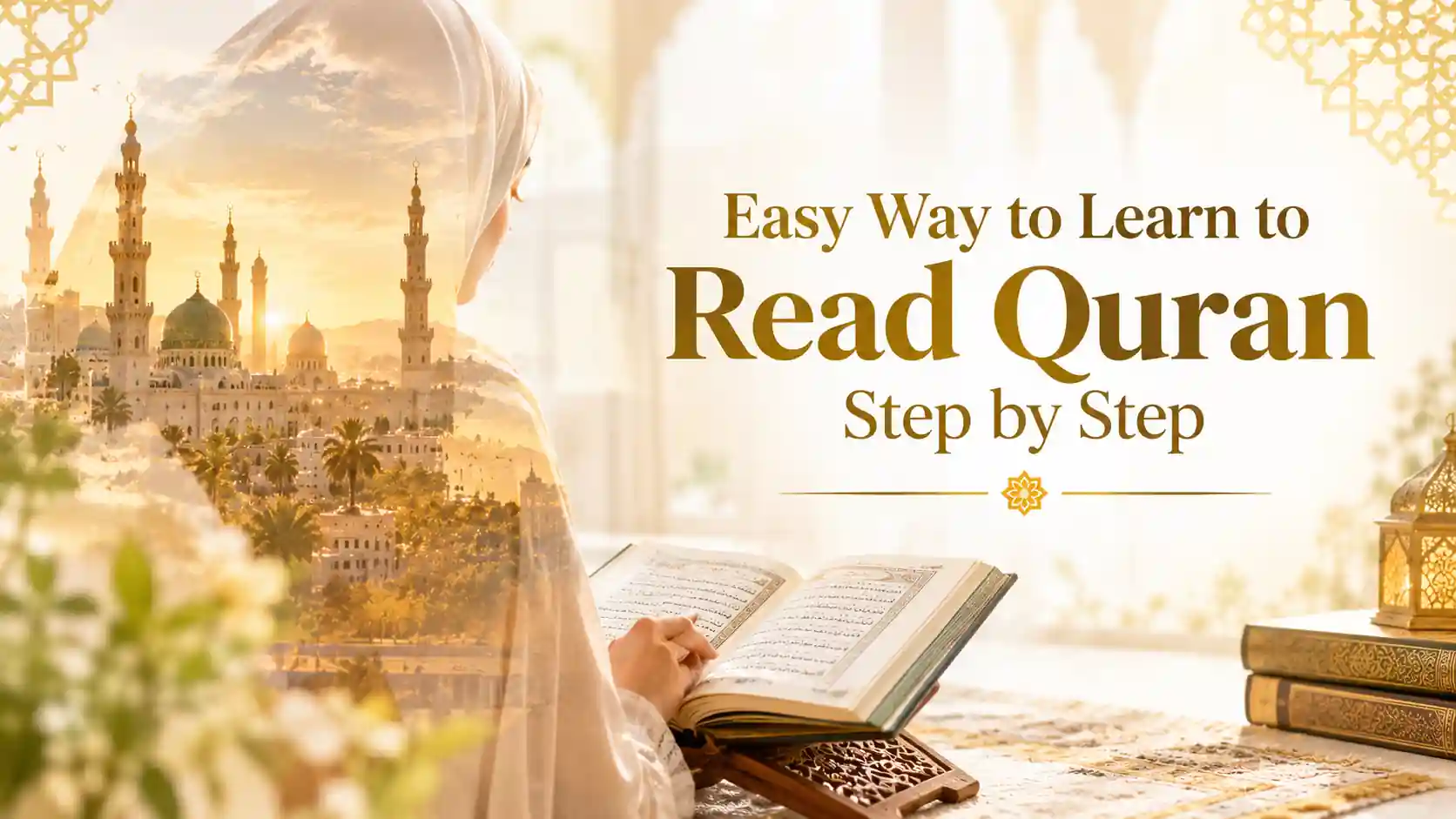
Looking for the easy way to learn to read quran as an adult or beginner? Reading is possible from a distance of zero. This tutorial will teach you the seven clear steps to learning Quran reading as a beginner, the correct method with a short daily routine. You could be studying on your own or have a teacher helping you either way, you will know what to do next. First, if we’re going to make learning easy, we need to know what makes it easy.
Understanding the Easy Way to Learn to Read Quran for Beginners:
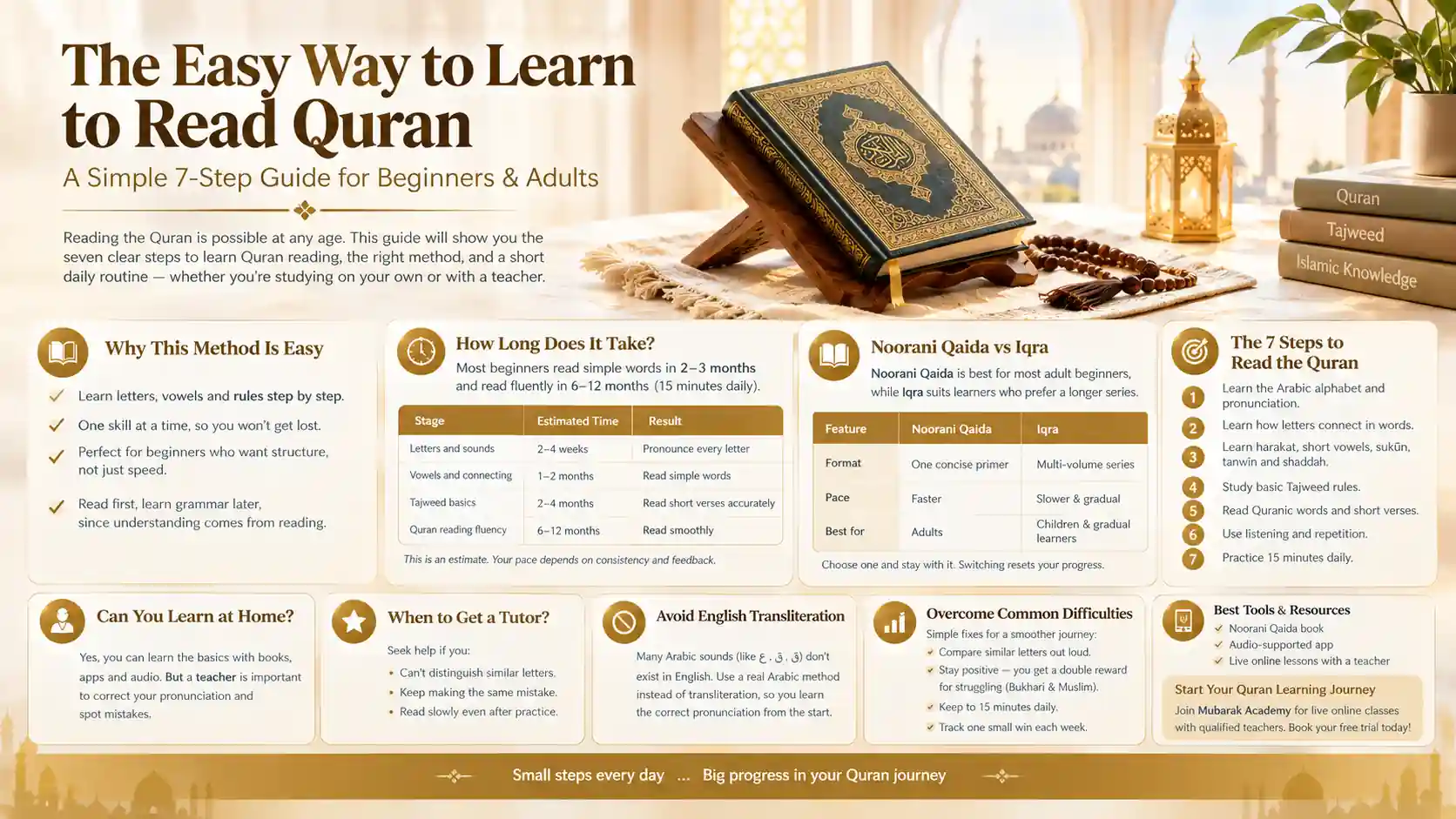
An easy way to learn to read quran is by learning letters, vowels, and rules one step at a time every day. It teaches a skill at a time, so you can’t get lost along the way. It is appropriate for a person who is a beginner to learn how to read quran in arabic from zero and who wants structure rather than speed.
Another way to learn Quranic Arabic easily is to read first and learn the grammar later, since understanding is dependent on reading. Now, let’s get the right idea of time.
How Long Does It Take to Learn to Read the Quran?
Most beginners read simple Quranic words within two to three months and read fluently within six to twelve months, practicing 15 minutes daily.
| Stage | Estimated time | Result |
|---|---|---|
| Letters and sounds | 2–4 weeks | Pronounce every letter |
| Vowels and connecting | 1–2 months | Read simple words |
| Tajweed basics | 2–4 months | Read short verses accurately |
| Quran reading fluency | 6–12 months | Read smoothly |
These are estimates, and your pace depends on consistency and feedback. The method you choose also matters, so let’s compare the two most popular ones.
Noorani Qaida vs Iqra: Which Quran Learning Method Is Best for Beginners?
Noorani Qaida is best for most quran reading for adult beginners because one compact book teaches letters, vowels, and basic Tajweed rules. Iqra suits learners who prefer a longer, graded series.
| Feature | Noorani Qaida | Iqra |
|---|---|---|
| Format | One concise primer | Multi-volume series |
| Pace | Faster | Slower and gradual |
| Best for | Adults | Children and gradual learners |
Pick one and stay with it, since switching resets your progress. With a method chosen, here is the full path.
Learn Quran Recitation Classes Online With a Certified Teacher
What Is the Easy Way to Learn to Read Quran?
Easy Way to learn to read quran is a 7-step process from letter to fluent reading. To learn to read quran step by step follow the steps in order.
Step 1: Learn the Arabic Alphabet and Quranic Pronunciation
Start with 28 Arabic letters: name, shape,, and sound. Correct sounds are dependent on Makharij al Huruf, which are the 17 points of articulation in the throat, tongue, lips, mouth, and nasal cavity.
- Study 4 letters/5 letters per session.
- Practice sounds with a teacher or good sound system.
- Make comparisons between similar letters.
Step 2: Learn How Arabic Letters Connect in Quranic Words
Letters vary in shape: lonely, first, middle, and end. If you have already memorized these forms, words cease to be unintelligible strings.
- Practice the 4 forms of each letter.
- Keep in mind that alif, dal, dhal, ra, zay and waw don’t link to the next letter.
- Read two and three letter combinations.
Learn Quranic Arabic Language Course From Absolute Beginner to Advanced
Step 3: Learn Harakat Short Vowels Sukoon Tanween and Shaddah
Harakat will guide you with the pronunciation of each letter.
- The three short vowels are fatha, kasra and damma.
- Sukoon is a letter for which there is no vowel.
- Tanween is an ‘n’ sound at the end of a word.
- Shaddah doubles a letter.
Step 4: Learn the Essential Tajweed Rules for Quran Reading
The basic rules of Tajweed ensure that you read correctly. Begin with 3 and increase one a week:
- Madd: Extend some vowels.
- The “n” sound: the rules for pronouncing it at noon sakinah and tanween.
- Qalqalah: A partial echo on 5 letters.
Step 5: Learn to Read Quranic Words and Short Verses
Progress from writing letters to words to verses. Read short words, longer words, and one short verse. Read at a slow speed and repeat until fluent. Accuracy is the name of the game, and speed will come along.
Best Online Quran Memorization Program for Every Student
Step 6: Use Listening and Repetition to Improve Quran Pronunciation
Listening trains your ear and tongue together. Play a clear Quran recitation, repeat each verse after the reciter, and record yourself to compare. This habit corrects small errors early, before they become habits.
Step 7: Follow a 15 Minute Daily Quran Reading Practice
Regular sessions are better than any long sessions! Follow this routine:
- Review yesterday’s lesson (3 minutes).
- Read and learn one new thing (7 minutes).
- Read aloud with audio (5 min).
Master Tongue Letters in Arabic for Perfect Quran Recitation
Can You Learn to Read Quran by Yourself at Home?
Yes, Quran learning at home for the basics, but no one can correct his/her own pronunciation. You can learn to read quran in arabic with primer and audio starting from zero, even reading with letters and vowels. However, without feedback, errors are not corrected. Which is why it is important to time your tutor.
When Should You Learn with a Qualified Quran Tutor?
From the first lesson on, have a qualified Quran tutor and not till you start tajweed. The easy way to learn to read quran would rely on the Quran teacher being able to hear the mistakes that you aren’t able to spot.
Seek help if you:
- Is unable to distinguish similar letters.
- Tune in one sound.
- Even after weeks of practice, read slowly.
Hifzul Quran & Islamic Education Centre Guide
Why You Should Not Rely on English Transliteration to Read the Quran?
Many Arabic sounds are not represented by the letters of the English alphabet, therefore using them to transliterate words results in incorrect pronunciation and lack of real reading ability. No match for sounds of ع, ح and q. Use transliteration only for a fleeting glance –learn to read quran the easy way, from the start with letters.
How to Overcome Common Quran Reading Difficulties as an Adult?
Overcome adult difficulties by practicing briefly every day, expecting slower progress, and asking for correction early.
| Difficulty | Fix |
|---|---|
| Similar-sounding letters | Compare pairs aloud with your tutor |
| Fear of mistakes | Remember the double reward for one who struggles while reciting (Bukhari and Muslim) |
| Limited time | Keep to 15 minutes daily |
| Slow progress | Track one small win each week |
These fixes work better with the right resources, so let’s cover them.
Best Digital Tools and Resources to Learn Quran Reading:
Tools that are best include a Noorani Qaida book, an app with audio support, and live online lessons with a Quran tutor. Together they provide you with content, practice, and correction.
Arabic Words With Long Vowels Made Easy
What Surahs Should Beginners Read First?
The first thing to read for the beginners is Al-Fatihah, followed by Al-Ikhlas, Al-Falaq and An-Nas, and Sura from Juz Amma.
- Al-Fatihah: Prayed in all prayers.
- Al-Ikhlas, Al-Falaq, An-Nas: short and frequently heard.
These are also the places where you normally would begin memorizing the Quran since you already hear them in prayer.
Surah Al Fath Reading Guide for Beginners Step by Step
How to Progress from Beginner Quran Reading to Fluent Recitation?
Learning to progress, starting with the short suhars and gradually increasing its length on the pages, applying tajweed, until it feels natural to read the quran.
- Read 1 page per day, orally.
- Use each tajweed rule that you have learnt.
- Record yourself and listen to it and compare it with a reciter.
- Weekly review of weak words with tutor.
- Start recitation of the Quran in the time of prayer.
Start Learning to Read the Quran with Mubarak Academy:
Learning to read the Quran from the beginning takes consistent practice, clear instruction, and feedback on pronunciation. At Mubarak Academy, beginners can learn through live online Quran classes with qualified teachers who guide students through Arabic letters, vowel sounds, and essential Tajweed rules.
Whether you are an adult starting from zero, a non-Arabic speaker, or a parent looking for lessons for your child, structured learning can help you build reading skills gradually and develop more accurate Quran recitation.
Ready to take your first steps towards easy way to learn to read quran? Join Mubarak Academy for live online Quran classes with qualified teachers who can help you learn Arabic letters, practise pronunciation, and apply Tajweed rules at your own pace. Book your free trial class today and start building a consistent Quran reading routine with guided support.
Frequently Asked Questions
What Is the Easiest Way to Learn to Read the Quran?
It is easiest to begin with the Arabic letters, learn the sounds of the letters, and the connected forms, and then practice the short words and verses. A qualified teacher can correct pronunciation, explain the basic rules of Tajweed and guide you through the regular lessons.
Can Adults Learn to Read the Quran from Scratch?
Yes, it is possible for adults to read the Quran without knowing Arabic. Learning the alphabet, and practicing it daily, can help develop reading skills slowly. Lessons with a qualified teacher are taught online and offer individual feedback and support to overcome pronunciation problems.
How Long Does It Take to Learn to Read the Quran?
This will be dependent on your work level, practice schedule, and learning assistance. Some people learn the Arabic letters within weeks and accurate and fluent Quran recitation may take weeks or months of consistent practice and teacher feedback.
Can I Learn to Read the Quran Without a Teacher?
Self-directed learning through structured books, audio recitations and digital resources can be started. But with the help of a qualified Quran teacher, you can find out how to improve the pronunciation of the Quran and learn the Tajweed rules that can be hard to spot on your own that will help you to recite it more accurately in the future.
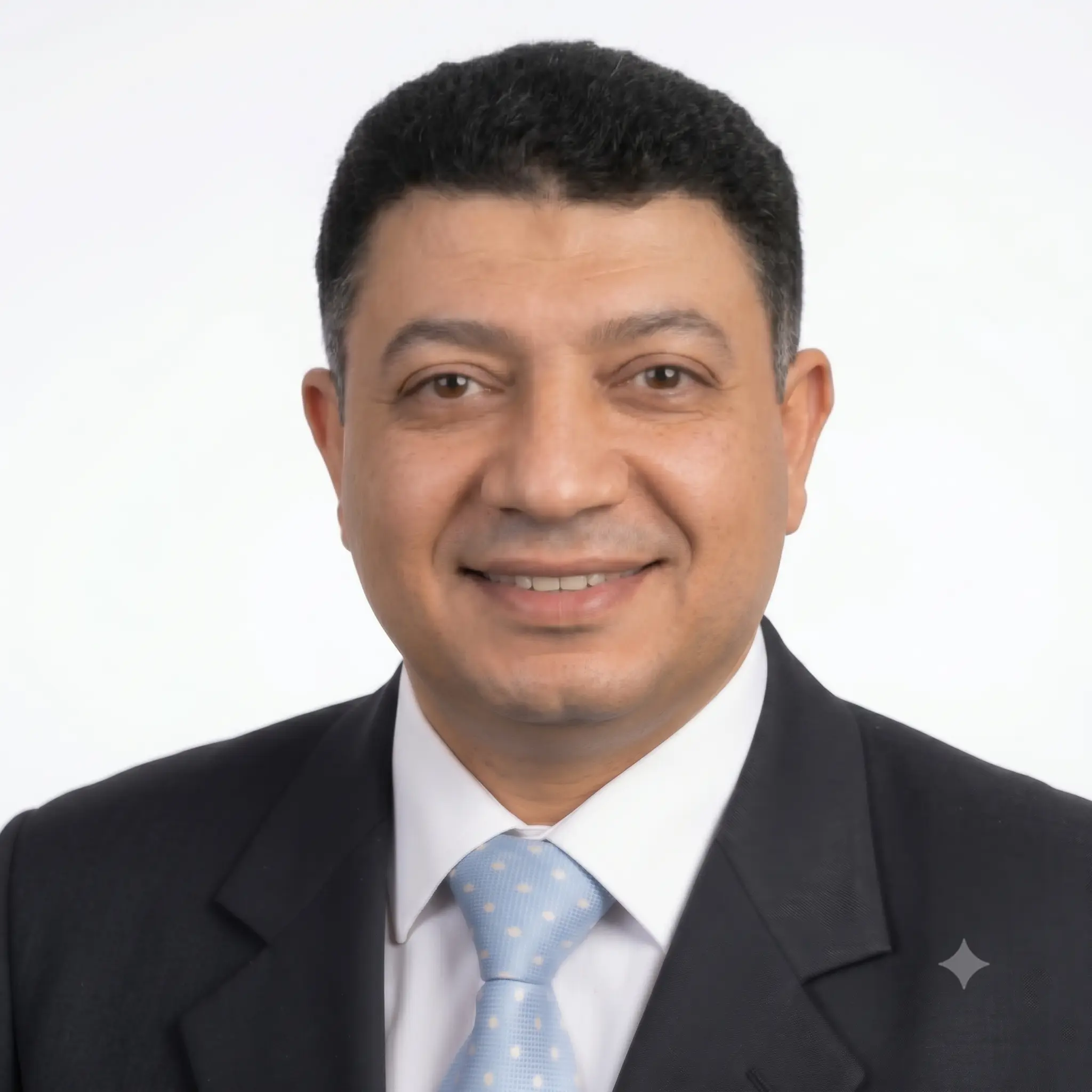
Ustadh Ahmed Mahmoud Abdulaziz is an experienced teacher of Arabic and the Holy Quran for native and non-native speakers. He holds a verified Ijazah in Hafs ‘an Asim and is certified in the foundational Tajweed texts Al-Jazariyyah and Tuhfat Al-Atfal. Drawing on his extensive background in traditional Quranic recitation and international pedagogy, he writes scholar-verified, accessible articles to help students worldwide master Tajweed rules and Arabic linguistics safely and accurately.