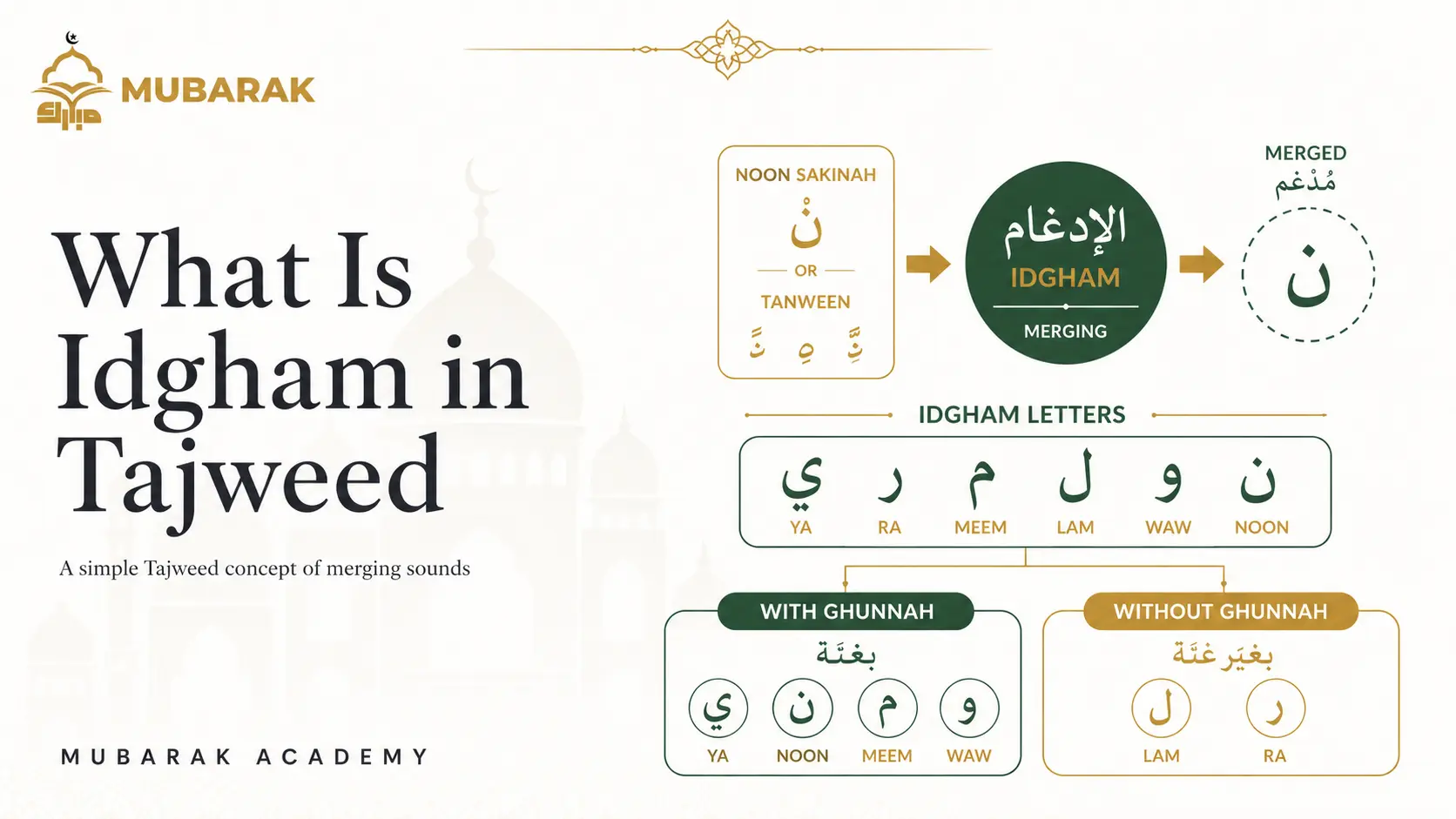
Idgham (الإدغام) is one of the four rules of Noon Sakinah and Tanween. It applies when a Noon Sakinah (نْ) or Tanween (ـًـٍـٌ) is followed by any of the six Idgham letters, merging the Noon into the following letter so only one blended sound is produced. Idgham divides into two types: one with Ghunna and one without, The difference between the two types is not minor. One carries a nasal resonance and one eliminates it entirely, and getting this distinction right is one of the clearest markers of a trained reciter. This guide covers the meaning of Idgham, its six letters, both types with Quranic examples, the four exceptional words where Idgham does not apply, and the most common errors students make.
Table of Contents
ToggleWhat Is Idgham in Tajweed?
Idgham in Tajweed is one of the four rules governing Noon Sakinah (نْ) and Tanween (ـًـٍـٌ). When either is followed by one of the six Idgham letters, the Noon sound is not pronounced. It is inserted into and absorbed by the following letter, so only one merged sound is produced with a Shaddah doubling the following letter.
The word Idgham (إدغام) comes from the Arabic root d-gh-m (د-غ-م), meaning to insert one thing into another, to merge or incorporate. In Tajweed this describes exactly what happens: when a Noon Sakinah or Tanween meets an Idgham letter, the reciter moves directly to the articulation point of the following letter, which is then doubled in sound. This rule was classified by Imam Ibn al-Jazari (رحمه الله), the foremost authority in Quranic recitation science, in Al-Muqaddimah al-Jazariyyah, and his classification of the four rules of Noon Sakinah remains the standard in every Tajweed curriculum worldwide. To understand where Idgham fits within that complete system, see our overview of Tajweed rules with examples.
Idgham Meaning in Arabic
Idgham (إدغام) comes from the Arabic root d-gh-m (د-غ-م). Classical Arabic lexicons define this root as the act of inserting one thing into another until the two become one, the way a sword is inserted into its scabbard or thread is pushed through a needle. In Tajweed, the name describes the rule with complete precision: the Noon does not stop, pause, or hide. It is inserted into the following letter until only one sound remains.
Idgham Meaning in English
In English, Idgham is most accurately translated as merging, assimilation, or blending. Linguists use the term assimilation for the same phenomenon in other languages, where one sound takes on the qualities of a neighbouring sound to create a smoother transition. What makes Idgham distinct from a general assimilation rule is that it is governed by a fixed list of six letters and divides into two types with different conditions. It is not a tendency or a style choice. It is a defined, obligatory rule with no exceptions outside the four special cases covered later in this guide.
The Letters of Idgham in Tajweed
| Letter | Name | Idgham Type | Ghunna? |
|---|---|---|---|
| ي | Yaa | Idgham with Ghunna | ✅ Yes — 2 counts |
| م | Meem | Idgham with Ghunna | ✅ Yes — 2 counts |
| و | Waw | Idgham with Ghunna | ✅ Yes — 2 counts |
| ن | Noon | Idgham with Ghunna | ✅ Yes — 2 counts |
| ل | Lam | Idgham without Ghunna | ❌ No — complete merge |
| ر | Ra | Idgham without Ghunna | ❌ No — complete merge |
2 Types of Idgham in Tajweed
Idgham divides into two types based on whether a Ghunna accompanies the merging. Understanding both types is essential because the mistake of applying Ghunna where it does not belong — or omitting it where it does — constitutes a recitation error (Lahn Khafi).
Type 1: Idgham with Ghunna (إدغام بغنة)
Idgham with Ghunna occurs when a Noon Sakinah or Tanween is followed by one of four letters: ي (Yaa), م (Meem), و (Waw), or ن (Noon) — remembered with the sub-mnemonic يَنْمُو (Yanmu). The Noon merges completely into the following letter, and a Ghunna of two counts is produced through al-Khayshoom (the nasal passage) during the merge.
The key characteristic: the Noon disappears, but the nasal resonance remains and is held for two full counts before completing the following letter. The following letter receives a Shaddah — it is doubled and strengthened as a result of absorbing the Noon.
Practical check: If you can pinch your nose during the merge and feel the Ghunna stop, you are producing it correctly from al-Khayshoom. If there is no vibration, the Ghunna is coming from the throat — an error. |
Type 2: Idgham without Ghunna (إدغام بلا غنة)
Idgham without Ghunna occurs when a Noon Sakinah or Tanween is followed by Lam (ل) or Ra (ر). The Noon merges completely into the following letter — more completely than in Idgham with Ghunna — and no nasal resonance is produced at all. The transition from the Noon position to the Lam or Ra must be clean, instant, and silent.
This is the complete disappearance of the Noon. No echo, no residual nasal tone, no Ghunna of any duration. Students who habitually produce Ghunna in all Idgham positions will carry it incorrectly into Idgham without Ghunna — one of the most common intermediate-level recitation errors.
Understanding the difference between heavy and light sounds also matters here. The Ra (ر) in particular is a heavy letter (Tafkheem) in many positions — see our guide to Tafkheem and Tarqeeq for how letter weight interacts with the merge.
3 Idgham Rules of Tajweed: Conditions and Exceptions
Rule 1: Idgham Only Applies Between Two Separate Words
Idgham never applies within a single word. If a Noon Sakinah and one of the six Idgham letters appear together inside one word, the Noon is pronounced clearly (Izhar), not merged. This is one of the most important structural rules of Idgham and one of the most commonly misunderstood by students.
The reason is phonological: within a single Arabic word, merging the Noon would alter the root structure of the word in a way that could change its meaning. The Tajweed scholars preserved the two-word requirement precisely to protect lexical integrity. This principle is discussed in detail in our article on the rules of Noon Sakinah and Tanween.
Rule 2: The Four Exception Words (إدغام في كلمة واحدة)
There are exactly four words in the entire Quran where a Noon Sakinah is followed by an Idgham letter within the same word, yet — by unanimous scholarly consensus — the Noon is pronounced clearly with Izhar, not merged. These four words are:
| Word | Surah & Ayah | Following Letter | Ruling |
|---|---|---|---|
| صِنْوَانٌ | Al-An’am (6:99) | و (Waw) | Izhar — pronounced clearly, no merge |
| قِنْوَانٌ | Ar-Ra’d (13:4) | و (Waw) | Izhar — pronounced clearly, no merge |
| الدُّنْيَا | Al-Baqarah (2:85) and throughout | ي (Yaa) | Izhar — pronounced clearly, no merge |
| بُنْيَانٌ | As-Saf (61:4) | ي (Yaa) | Izhar — pronounced clearly, no merge |
These four words are memorized as a fixed list in traditional Tajweed education. A student who applies Idgham to any of these four positions is making a clear error (Lahn Jali — a major recitation mistake that must be corrected). Every other case of Noon Sakinah followed by an Idgham letter within one word does not exist in the Quran — only these four.
Rule 3: The Following Letter Receives a Shaddah
When Idgham occurs, the letter that absorbs the Noon receives a Shaddah (ّ) — it is doubled. This doubling is the phonological evidence that the merge has happened. In printed Mushafs, this Shaddah is often visible on the following letter, serving as a recitation marker. In Idgham with Ghunna, the Shaddah is held with a two-count Ghunna before being completed. In Idgham without Ghunna, the Shaddah is produced cleanly and immediately.
10 Examples of Idgham in the Quran
All examples below are from the Hafs an Asim recitation — the most widely read transmission of the Quran worldwide. Verse references are verified against the Tanzil Quran text database.
4 Idgham with Ghunna: Examples with Noon Sakinah
| Example | Surah & Ayah | Trigger | Merge |
|---|---|---|---|
| مِنْ يَعْمَلْ | Az-Zalzalah (99:7) | Noon Sakinah + Yaa | Noon merges into Yaa with Ghunna |
| مِنْ وَاقٍ | Ar-Ra’d (13:34) | Noon Sakinah + Waw | Noon merges into Waw with Ghunna |
| مِنْ مَاءٍ | Al-Anbiya (21:30) | Noon Sakinah + Meem | Noon merges into Meem with Ghunna |
| مِنْ نِعْمَةٍ | Al-Nahl (16:53) | Noon Sakinah + Noon | Noon merges into Noon with Ghunna |
4 Idgham with Ghunna: Examples with Tanween
| Example | Surah & Ayah | Trigger | Merge |
|---|---|---|---|
| يَوْمَئِذٍ يَصْدُرُ | Az-Zalzalah (99:6) | Tanween kasra + Yaa | Tanween merges into Yaa with Ghunna |
| رَحِيمٌ وَدُودٌ | Al-Buruj (85:14) | Tanween damma + Waw | Tanween merges into Waw with Ghunna |
| سَمِيعٌ عَلِيمٌ | Al-Baqarah (2:181) | Tanween damma + Ain | Izhar — Ain is a throat letter, not Idgham |
| غَفُورٌ رَحِيمٌ | Al-Baqarah (2:173) | Tanween damma + Ra | Idgham without Ghunna |
2 Idgham without Ghunna: Examples with Noon Sakinah
| Example | Surah & Ayah | Trigger | Merge |
|---|---|---|---|
| مِنْ رَبِّهِمْ | Al-Baqarah (2:5) | Noon Sakinah + Ra | Complete merge — no Ghunna |
| مِنْ لَدُنْهُ | Al-Kahf (18:2) | Noon Sakinah + Lam | Complete merge — no Ghunna |
2 Idgham without Ghunna: Examples with Tanween
| Example | Surah & Ayah | Trigger | Merge |
|---|---|---|---|
| غَفُورٌ رَحِيمٌ | Al-Baqarah (2:173) | Tanween + Ra | Complete merge — no Ghunna |
| كَعَصْفٍ مَأْكُولٍ | Al-Fil (105:4) | Tanween kasra + Meem | Idgham with Ghunna (Meem is a Ghunna letter) |
Verification tip: All verse references in this article are cross-checked against the Tanzil.net Quran text database — a scholarly resource used by researchers and educators for verse-level verification.
Idgham vs Ikhfa vs Iqlab: Key Differences
| Feature | Idgham with Ghunna | Idgham without Ghunna | Ikhfa | Iqlab |
|---|---|---|---|---|
| Triggering letters | ي م و ن (4 letters) | ل ر (2 letters) | 15 letters | ب (1 letter only) |
| What happens to Noon | Merges + Ghunna 2 counts | Merges completely — silent | Hidden + Ghunna 2 counts | Converts to Meem + Ghunna |
| Applies within one word? | No (4 exceptions only) | No | Yes | Yes |
| Following letter doubled? | Yes — receives Shaddah | Yes — receives Shaddah | No | No |
| Ghunna present? | ✅ Yes | ❌ No | ✅ Yes | ✅ Yes |
How to Identify Idgham in the Quran?
Training yourself to spot Idgham positions before reciting eliminates errors that occur when rules are applied reactively. Use this identification sequence:
- Look for a Noon Sakinah (نْ) or Tanween (ـًـٍـٌ) at the end of a word.
- Check the first letter of the next word. If it is ي م و ن — Idgham with Ghunna applies. If it is ل or ر — Idgham without Ghunna applies.
- Confirm the two words are separate. If the Noon and the following letter are inside the same word, apply Izhar instead (with the exception of the four words listed above).
- In most printed Mushafs, a Shaddah (ّ) appears on the following letter when Idgham applies. This is the visual marker — train yourself to look for it before reading a new passage. For an overview of how Quranic stop and pause signs help navigation, see our guide to Quran stop signs with examples.
5 Common Mistakes in Idgham Recitation:

- Adding Ghunna in Idgham without Ghunna positions: The most frequent error among intermediate students. After drilling Idgham with Ghunna, the habit of producing nasal resonance carries into Lam and Ra positions. When a Noon Sakinah or Tanween is followed by Lam or Ra, the merge must be clean and immediate — zero Ghunna.
- Merging within a single word: Beginners who have memorized the six letters sometimes apply Idgham when they see a Noon followed by يرملون inside one word. Unless it is one of the four exception words, the Noon in a single word is always Izhar — never merged.
- Partial merging — not completing the Shaddah: Some reciters begin the merge but do not fully double the following letter. The Noon must disappear entirely into the following letter, which must then be pronounced with its full doubled weight (Shaddah). A half-merge produces a sound that is neither Idgham nor Izhar — a clear Tajweed error.
- Confusing Idgham with Ghunna and Ikhfa: Both involve a Ghunna of two counts and a Noon that does not appear in the output. The difference: in Idgham, the following letter receives a Shaddah and the Noon fully disappears. In Ikhfa, the Noon is hidden but not merged — there is no Shaddah on the following letter. Hearing this distinction on recordings of expert reciters is the fastest way to internalize it.
- Applying Idgham to a Meem Sakinah: Idgham is a rule for Noon Sakinah and Tanween only. Meem Sakinah has its own separate set of rules. See our guide to the rules of Meem Sakinah for how Meem Sakinah behaves differently.
Practice Verses for Idgham:
Work through these in order. For each verse, read it once slowly — holding the Ghunna consciously on every Idgham with Ghunna position — then recite at normal speed:
- Az-Zalzalah (99:6–8): Three consecutive short verses packed with Noon Sakinah and Tanween positions. Multiple Idgham with Ghunna examples appear within four lines.
- Al-Baqarah (2:173): غَفُورٌ رَحِيمٌ — Idgham without Ghunna (Tanween + Ra). Practice the clean, silent merge.
- Al-Nahl (16:53): مِنْ نِعْمَةٍ — Idgham with Ghunna (Noon Sakinah + Noon). Two Noons merge into one doubled Noon with Ghunna.
- Al-Buruj (85:14): رَحِيمٌ وَدُودٌ — Idgham with Ghunna (Tanween + Waw). Hold the Ghunna before completing the Waw.
- Recite the first page of Surah Al-Baqarah scanning specifically for Idgham positions. Mark them, apply the correct type, then verify with the com recitation audio by Sheikh Mishary Al-Afasy.
Why Idgham Matters in Tajweed?
Idgham is not a technical formality — it is a core feature of how Arabic flows as a spoken language. The merging of consecutive sounds at word boundaries is a natural phonological process in Arabic, and Tajweed codifies this process for Quranic recitation with precision. Reciting without Idgham — pronouncing every Noon Sakinah and Tanween fully regardless of what follows — produces a stilted, unnatural sound that violates the oral tradition the Quran was revealed in.
The Prophet Muhammad ﷺ received the Quran in a specific recitation (tilawah) and transmitted it to his companions in that same recitation. Every rule of Tajweed, including Idgham, is a preservation of that original transmission. This is why Imam Ibn al-Jazari wrote in Al-Muqaddimah al-Jazariyyah: “Applying Tajweed is an obligation — whoever does not apply it is sinful.” For students who want to understand why Tajweed carries this weight, our article on the importance of Tajweed in the Quran covers the scholarly and spiritual foundations.
Frequently Asked Questions
What is Idgham in Tajweed?
Idgham in Tajweed is the rule where a Noon Sakinah or Tanween merges into one of six following letters (ي ر م ل و ن), producing a single doubled sound instead of two separate ones. It has two types: with Ghunna (for ي م و ن) and without Ghunna (for ل ر).
What are the types of Idgham in Tajweed?
There are two types of Idgham in Tajweed. Idgham with Ghunna (إدغام بغنة) applies when Noon Sakinah or Tanween is followed by ي م و ن — the merge is accompanied by a nasal resonance of two counts. Idgham without Ghunna (إدغام بلا غنة) applies when followed by ل or ر — the Noon merges completely with no nasal sound.
What are the letters of Idgham?
The six letters of Idgham are ي ر م ل و ن, collectively memorized using the Arabic mnemonic يَرْمَلُون (Yarmaloon). Four of these letters (ي م و ن) belong to Idgham with Ghunna. Two (ل ر) belong to Idgham without Ghunna.
Does Idgham apply inside one word?
No. Idgham only applies between two separate words. If a Noon Sakinah and an Idgham letter appear within the same word, the Noon is pronounced clearly (Izhar). There are exactly four exception words in the Quran where this situation occurs: صِنْوَانٌ, قِنْوَانٌ, الدُّنْيَا, and بُنْيَانٌ — all four are recited with Izhar despite the apparent Idgham condition.
What is the difference between Idgham with Ghunna and Idgham without Ghunna?
In Idgham with Ghunna, the Noon merges into the following letter and a nasal resonance (Ghunna) of two counts is produced through the nasal passage. In Idgham without Ghunna, the Noon merges completely and silently — no nasal sound remains. The triggering letters determine which type applies: ي م و ن produce Ghunna; ل ر do not.
Is Ghunna mandatory in Idgham with Ghunna?
Yes. Omitting the Ghunna in Idgham with Ghunna positions is a Lahn Khafi (لحن خفي) — a hidden recitation error that does not invalidate the prayer but falls below the standard of correct Tajweed. The Ghunna must last two counts (harakatan) and be produced from al-Khayshoom (the nasal passage).
External References:
- Quran.com — Az-Zalzalah (99:6–8) — Verify Idgham with Ghunna examples and listen to correct recitation audio.
- Quran.com — Al-Baqarah (2:173) — Verify Idgham without Ghunna example غَفُورٌ رَحِيمٌ.
- Tanzil.net — Quran Text Database — Scholarly Quran text resource used to verify all verse references in this article.
- Islamweb.net — Tajweed Fatawa Library — Scholarly source for Lahn classifications and recitation rulings.
Conclusion
Idgham is one of the highest-frequency rules in Quranic recitation. The word مِنْ (min) alone — one of the most common words in the Quran — triggers Idgham every time it is followed by any of the six letters. A student who masters Idgham correctly does not just learn one rule; they correct a phonological pattern that affects hundreds of positions across daily recitation.
The path is straightforward: learn the six letters with their types, internalize the two-word condition, memorize the four exception words, and drill the Ghunna distinction until it is automatic. Slow recitation with conscious attention to each merge, followed by normal-speed recitation, is the reliable method — the same method that Tajweed teachers have used for centuries.
With Idgham mastered, the complete picture of Noon Sakinah rules comes into view. Study Ikhfa in Tajweed next — it is the most complex of the four rules and the one that governs the largest set of letters. Then return to the full Tajweed rules overview to see how all four rules work as a unified system.
Learn to Merge Letters the Way They Were Meant to Sound
Idgham is not just a rule — it is one of the defining characteristics of fluent, beautiful Quranic recitation. The seamless merging of Noon into Yaa, Waw, Meem, and Noon; the clean disappearance without trace in Idgham without Ghunna; the sustained nasal resonance held through Idgham with Ghunna — these are sounds that separate a reciter who has been properly taught from one who has only read about it.
Mubarak Academy provides live, one-on-one Tajweed classes with certified teachers who carry Ijazah through an authenticated Sanad reaching back to the Prophet ﷺ. Every merging rule — both types of Idgham, their letters, their exceptions, and how they interact with the surrounding verse — is taught with direct correction so errors don’t become habits. Classes are open to all levels, from students encountering Idgham for the first time to those refining an already established recitation.
Book a free trial class at Mubarak Academy and practice Idgham positions with a teacher listening to every merge.

Ustadh Ahmed Mahmoud Abdulaziz is an experienced teacher of Arabic and the Holy Quran for native and non-native speakers. He holds a verified Ijazah in Hafs ‘an Asim and is certified in the foundational Tajweed texts Al-Jazariyyah and Tuhfat Al-Atfal. Drawing on his extensive background in traditional Quranic recitation and international pedagogy, he writes scholar-verified, accessible articles to help students worldwide master Tajweed rules and Arabic linguistics safely and accurately.