The Prophet Muhammad (peace be upon him) received the Quran through Angel Jibreel (peace be upon him) in a precise, defined oral form, and he transmitted it to his Companions in exactly the same way. That chain of precise oral transmission, verified across generations, is what Tajweed protects, and it is where the importance of Tajweed in Quran recitation begins. Every rule in Tajweed traces back to a sound the Prophet made, a letter he held, a vowel he prolonged. This is not a supplementary subject. It is the science that keeps the Quran sounding exactly as it was revealed.
In short, Tajweed matters because it preserves the exact pronunciation the Quran was revealed in, guards the meaning of every verse, and is required for valid, God-conscious prayer. Its importance reaches beyond correct pronunciation into prayer validity, spiritual depth, memorisation accuracy, and the preservation of Allah’s (SWT) words across every language and culture where Muslims exist. This article covers the full scope: the definition, the scholarly framework, the proven benefits, the essential rules, and the lifelong value of this science for every Muslim.
What Is Tajweed in Quran Recitation?
Tajweed (تجويد) is the set of phonetic and linguistic rules that govern the correct pronunciation of every letter, word, and verse in the Quran. The word itself means “to make excellent”, from the Arabic root j-w-d (جود), meaning perfection or mastery. In practice, Tajweed defines how each letter is articulated, how vowel sounds are extended or shortened, and how adjacent letters interact during continuous recitation.
These rules were not invented by later scholars. They were codified from the recitation of the Prophet Muhammad (peace be upon him), who received the Quran orally from Angel Jibreel (peace be upon him) and taught it to his Companions with the same precision. The science of Tajweed was later systematically documented by scholars, most notably Imam Ibn Al-Jazari (rahimahullah), whose foundational text Al-Muqaddimah Al-Jazariyyah (14th–15th century CE) remains the standard reference for Tajweed students worldwide.
For a complete grounding in the definition and categories of this science, see: What Is Tajweed in Quran?
What Is the Importance of Tajweed in Quran?
The importance of Tajweed in Quran recitation is that it preserves the exact pronunciation in which the Quran was revealed, safeguards the meaning of every verse, and is required for prayer to be valid. It operates across four dimensions, textual, spiritual, cognitive, and communal, and the eight benefits below represent the core of what Tajweed achieves for every Muslim who studies it seriously.
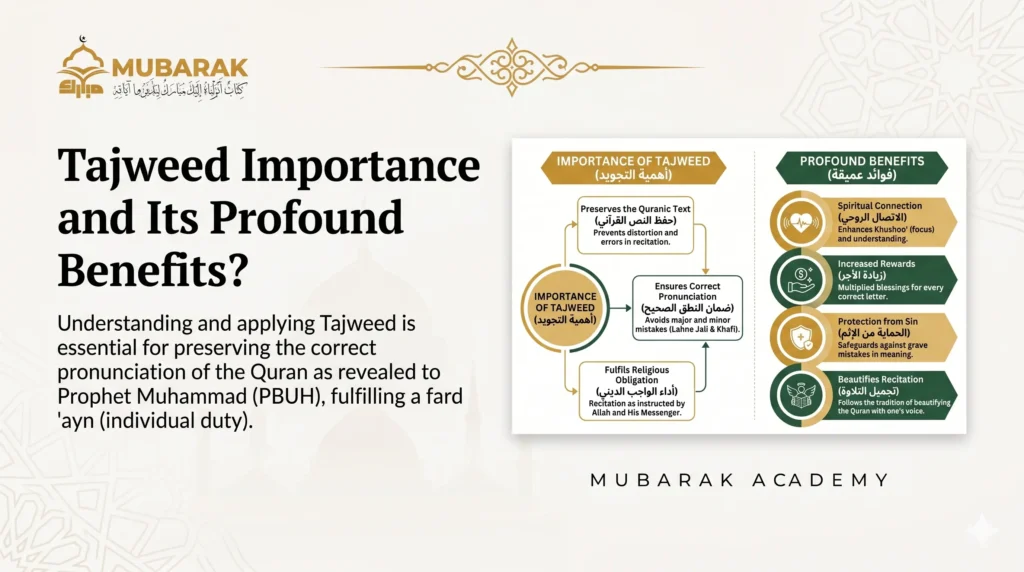
1. Preserves the Original Meaning of Quranic Verses:
Arabic is a language where a single vowel change can alter the meaning of a word entirely, shifting a verb from active to passive, changing a noun’s case, or transforming a statement into a question. The Quran contains words whose meanings would be distorted by even a minor mispronunciation.
Tajweed protects the textual integrity of the Quran at the phonetic level. Allah (SWT) gives the ultimate assurance of preservation in Surah Al-Hijr (15:9):
“Indeed, it is We who sent down the Reminder, and indeed, We will be its guardian.”
“إِنَّا نَحْنُ نَزَّلْنَا ٱلذِّكْرَ وَإِنَّا لَهُۥ لَحَٰفِظُونَ”
Tajweed is the human mechanism through which every generation participates in that preservation, each correctly recited letter a link in an unbroken chain from the time of revelation to the present.
2. Enhances Understanding and Clarity of Recitation:
Precise pronunciation clarifies meaning. When a reciter correctly distinguishes between letters with similar articulation points, such as ح and ه, or ص and س, the words become unambiguous. Listeners who understand Arabic hear the correct text; those learning Arabic develop an accurate phonological model from the start.
The difference between Tajweed and Tafseer is significant here. Tafseer (تفسير) interprets meaning; Tajweed delivers the words accurately so that meaning can be interpreted. One enables the other. For a detailed comparison of both sciences, see: Difference Between Tajweed and Tafseer.
3. Strengthens Focus and Concentration (Khushu’) in Prayer:
Khushu’ (خشوع), the state of deep attentiveness and humility in prayer, is directly supported by Tajweed. When a reciter has internalized the rules, the mechanical effort of pronunciation recedes. Attention moves from how to say the words to what the words mean. The recitation becomes contemplative rather than effortful.
Scholars of Islamic spirituality, including Imam Al-Ghazali (rahimahullah) in Ihya ‘Ulum Al-Din, describe this progression: the student begins with outer correctness and arrives, through practice, at inner presence. Tajweed is the outer architecture that makes inner presence possible.
4. Boosts Confidence During Recitation in Salah and Public Settings:
A Muslim who has studied Tajweed recites with confidence, whether leading a congregation, reciting in Tarawih, or simply performing the obligatory five daily prayers. The absence of doubt about pronunciation eliminates hesitation. The recitation becomes steady, composed, and authoritative.
This confidence has a secondary effect: it encourages more frequent recitation. Muslims who feel uncertain about their pronunciation often reduce their engagement with the Quran. Mastering Tajweed removes that barrier permanently.
5. Maintains Global Uniformity of Quranic Recitation:
One of the most remarkable features of the Quran is that it sounds identical in every corner of the world. A reciter trained in Cairo, Karachi, Jakarta, or Lagos produces the same sounds for the same letters. This uniformity is not accidental, it is the result of a consistent, transmitted system of rules that Tajweed preserves.
In a world where Arabic dialects vary enormously between regions, Tajweed serves as the standard that holds Quranic pronunciation above regional variation. Every student who learns Tajweed becomes a participant in maintaining that global consistency.
6. Improves Memorisation Accuracy for Long-Term Retention:
Tajweed improves Quran memorisation by linking the sound of each word to its precise phonetic rules, creating a multi-layered memory structure. When a student memorises with correct Tajweed, proper letter articulation, vowel lengths, and pronunciation characteristics, the sound itself becomes a memory cue. Errors in memorisation are easier to detect because an incorrect sound violates a known rule, prompting self-correction.
Students of Hifz (Quran memorisation) universally report that accurate Tajweed reduces confusion between similarly sounding verses and improves long-term retention. A mispronounced word stored in memory is harder to correct later than one learned correctly from the start. For this reason, qualified Hifz teachers insist on Tajweed foundations before memorisation begins in earnest.
7. Prevents Common Errors in Makhraj (Articulation Points):
Arabic contains sounds that do not exist in most other languages, the guttural ح, the emphatic ص, the uvular ق, and the pharyngeal ع, among others. Without Tajweed training, speakers of other languages default to the closest sound in their native tongue. This produces systematic mispronunciations that change words and distort meaning.
The science of Makharij Al-Huroof (مخارج الحروف), the articulation points of Arabic letters, maps 28 letters across 17 points of articulation from the chest, throat, tongue, lips, and nasal cavity. Training in Makharij corrects the root cause of mispronunciation rather than addressing individual words in isolation. This systematic approach is what makes Tajweed a complete science rather than a collection of pronunciation tips.
8. Promotes Spiritual and Emotional Connection with Allah:
The Quran was revealed to move hearts. Surah Al-Anfal (8:2) describes the effect of proper recitation: “The believers are only those who, when Allah is mentioned, their hearts tremble.” That trembling is not produced by words read mechanically, it arises from words recited with presence, precision, and understanding.
Tajweed is the foundation of beautiful recitation, and beautiful recitation opens the heart. The melodic qualities of Tajweed, the flowing prolongation of Madd, the resonance of the ghunna, the measured rhythm of Tarteel, engage both the intellect and the soul simultaneously. Scholars and reciters across fourteen centuries have described the Quran as transforming in its effect when recited correctly. Tajweed is how that transformation is accessed.
What Is the Ruling on Learning Tajweed?
Scholars distinguish between two levels of obligation. Reciting the Quran with Tajweed is Fard Ayn, individually obligatory for every Muslim who recites. To produce a recitation with correct letters and basic pronunciation is a minimum requirement, not an advanced accomplishment. The detailed study of Tajweed rules, however, is classified as Fard Kifayah, a communal obligation satisfied when qualified teachers and reciters exist in the Muslim community.
Allah (SWT) commands in Surah Al-Muzzammil (73:4):
“Or add to it, and recite the Quran with measured recitation.”
“أَوْ زِدْ عَلَيْهِ وَرَتِّلِ ٱلْقُرْءَانَ تَرْتِيلًا”
The Arabic word Tarteel (ترتيل) in this verse specifically refers to measured, deliberate, precise recitation, which is the very objective of Tajweed. The verse is not a recommendation; it is a divine instruction. To understand how Tarteel relates to and differs from Tajweed in scholarly usage, see: Difference Between Tajweed and Tarteel.
Why Tajweed Is Important for Kids and Beginners?
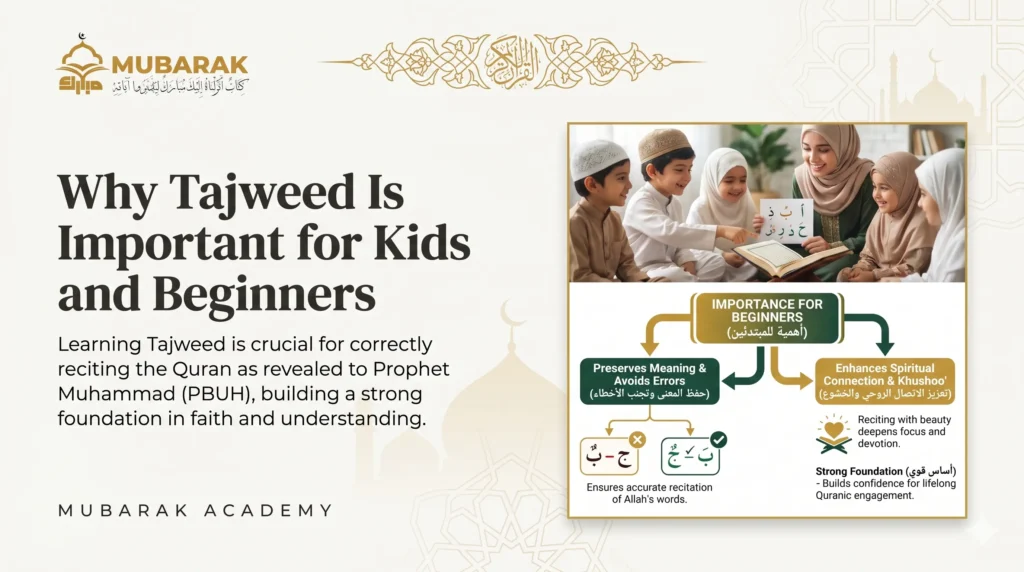
Children who begin Tajweed early establish an accurate phonological foundation before incorrect habits form. The plasticity of a young learner’s auditory and motor systems makes early Tajweed instruction far more efficient than correction in adulthood. Beyond efficiency, early Tajweed builds a lifelong relationship with the Quran grounded in correctness, confidence, and love of recitation.
For beginners of any age, the benefits are equally significant:
- Accuracy from the start, Tajweed trains the ear and tongue simultaneously, preventing the formation of incorrect phonetic habits that are difficult to reverse.
- Valid prayer, Surah Al-Fatiha must be recited in every unit of prayer. Errors in Al-Fatiha that change meaning may invalidate the prayer in the view of several schools of jurisprudence. Learning Tajweed ensures prayer recitation meets the required standard.
- Unlimited rewards, Ibn Mas’ud (may Allah be pleased with him) reported that the Messenger of Allah (peace be upon him) said: “Whoever recites a letter from the Book of Allah will be credited with a good deed, and a good deed gets a tenfold reward. I do not say that Alif-Lam-Mim is one letter, Alif is a letter, Lam is a letter, and Mim is a letter.” [Tirmidhi, Book 42, Hadith 2910]. Every correctly pronounced letter carries that reward. Tajweed ensures each letter is counted.
Common Tajweed Rules Every Muslim Should Know:
The rules of Tajweed number in the dozens, but a core set governs the vast majority of recitation decisions. These are the rules encountered most frequently in daily recitation and Salah.
1. Makharij Al-Huroof, Articulation Points:
Every Arabic letter originates from a specific point in the vocal tract. There are 17 articulation points across five regions: the chest (for the natural sound), the throat, the tongue (which has 10 distinct positions), the lips, and the nasal cavity. Mastering Makharij is the prerequisite for all other Tajweed rules, correct articulation must be established before rules of joining, lengthening, or nasalisation are applied.
2. Noon Sakinah and Tanween Rules:
When the letter Noon (ن) carries a sukoon (a vowelless marker), or when tanween (double vowel markers) appears at the end of a word, one of four rules applies depending on the letter that follows: Idghaam (merging), Iqlab (conversion to meem), Ikhfa (concealment), or Idhar (clear pronunciation). Tanween is governed by the same four rules as Noon Sakinah.
For practical Quran examples and a full breakdown of each rule’s conditions, see: Tajweed Rules with Examples.
3. Madd, Vowel Prolongation:
Madd (مَدّ) refers to the prolongation of one of the three vowel letters, Alif (ا), Waw (و), or Ya (ي), beyond their natural length under specific phonetic conditions. Madd is divided into two principal types:
- Madd Asli (Natural Madd): Two counts of prolongation. Always applied when a vowel letter is followed by no hamza or sukoon.
- Madd Far’i (Secondary Madd): From two to six counts of prolongation. Applied when a vowel letter is followed by a hamza or sukoon.
An example from the Quran, Surah Yunus (10:51):
“أَثُمَّ إِذَا مَا وَقَعَ ءَامَنتُم بِهِۦٓۚ ءَآلۡـَٰٔنَ وَقَدۡ كُنتُم بِهِۦ تَسۡتَعۡجِلُونَ”
The word ءَآلۡـَٰٔنَ in this verse carries Madd Munfasil, a secondary Madd that extends across two words.
Why Tajweed Is a Lifelong Skill for Every Muslim ?
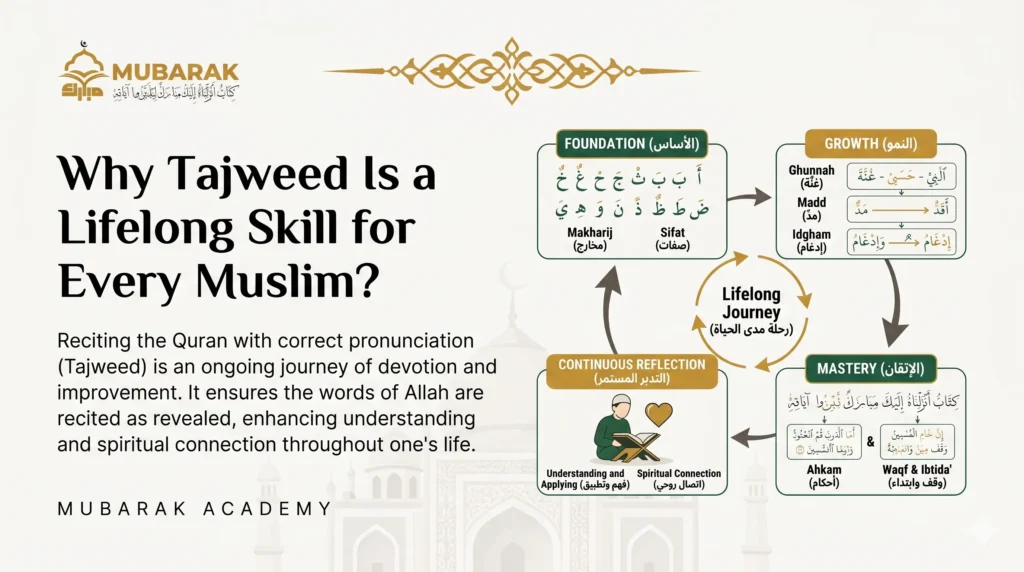
Unlike many subjects studied and then set aside, Tajweed deepens with every recitation. A Muslim who prays five times daily is applying Tajweed hundreds of times each week. The rules are not memorised for an exam, they are rehearsed in the most regular act of worship in a Muslim’s life. This continuous application means Tajweed progressively improves throughout a lifetime without requiring dedicated review sessions.
There is also a transmission dimension. A parent who recites correctly shapes the phonological environment of their children. A teacher with correct Tajweed extends the chain of oral transmission that stretches back to the Prophet Muhammad (peace be upon him). Every person who masters Tajweed becomes, in a meaningful sense, part of the preservation of the Quran that Allah (SWT) promised in Surah Al-Hijr.
Scholars at Al-Azhar University, the world’s oldest continuously operating university and the primary authority on Islamic sciences, have consistently described the study of Tajweed as an ongoing spiritual and scholarly obligation, not a one-time achievement. The International Quran Recitation Award (IQRA), among the most prestigious Quran recitation competitions globally, assesses Tajweed as the primary criterion of excellence precisely because it represents the intersection of technical mastery and spiritual sincerity. For further scholarly context on Tajweed as an ongoing practice, Al-Azhar’s official resources provide authoritative guidance: Al-Azhar’s Tajweed Resources.
For a scientifically grounded perspective on how the phonetic training involved in Tajweed affects neural processing of language and memory, research published by institutions including the National Center for Biotechnology Information (NCBI) explores how repetitive phonological training reinforces long-term memory consolidation, directly supporting the memorisation benefits of Tajweed: NCBI Research on Phonological Training and Memory.
Frequently Asked Questions About the Importance of Tajweed in Quran:
Is learning Tajweed obligatory for every Muslim?
Reciting the Quran with basic phonetic correctness to avoid distorting words is an individual obligation (Fard ‘Ayn) for every Muslim, as emphasized by Imam Ibn Al-Jazari. Conversely, mastering the highly advanced theoretical details, historical terminology, and complex rules of articulation represents a communal obligation (Fard Kifayah) rather than a personal requirement.Can a recitation be valid without Tajweed?
A recitation is valid if the foundational letter sounds are preserved and no meaning-altering mistakes occur. However, deliberately ignoring clear rules, changing letters, or dropping essential elongations is impermissible by scholarly consensus. Reciters must achieve a standard that completely preserves the divine meaning while continuously striving to improve.At what age should a child begin learning Tajweed?
Experienced educators recommend starting formal Tajweed between ages four and seven, immediately after a child masters basic Arabic letter recognition. At this developmental stage, the auditory system naturally absorbs precise phonological patterns, allowing proper pronunciation habits to form effortlessly before adult speech habits become firmly established.What is the first Tajweed rule a beginner should learn?
Makharij Al-Huroof, or the precise articulation points of Arabic letters, is the definitive starting point. Advanced rules governing nasalization, elongation, or phonetic merging cannot be applied properly if the underlying consonants themselves are mispronounced. Perfecting letter origins creates the essential foundation upon which all other rules depend.How long does it take to learn Tajweed?
Understanding foundational theoretical Tajweed rules typically takes three to six months of structured study. However, developing natural fluency so these rules apply automatically during active recitation generally requires one to three years of consistent practice. Full mastery across the entire Quran remains a lifelong journey of continuous refinement.Conclusion
The importance of Tajweed in Quran recitation cannot be confined to a single benefit or a single obligation. It preserves the textual integrity of Allah’s (SWT) words. It enables valid prayer. It deepens spiritual focus, builds lasting confidence, supports accurate memorisation, and connects every reciter to an unbroken chain of oral transmission that began with Angel Jibreel and the Prophet Muhammad (peace be upon him).
Learning Tajweed is not a task to complete, it is a practice to inhabit. Each letter recited correctly is an act of worship, an expression of respect for the Quran, and a contribution to its preservation. The rewards, as the Prophet (peace be upon him) described, are multiplied with every correct letter. The path is clear, the obligation is established, and the rewards are without limit.
Begin with a qualified teacher, apply the rules in every recitation, and understand that Tajweed is not the difficulty, it is the door.
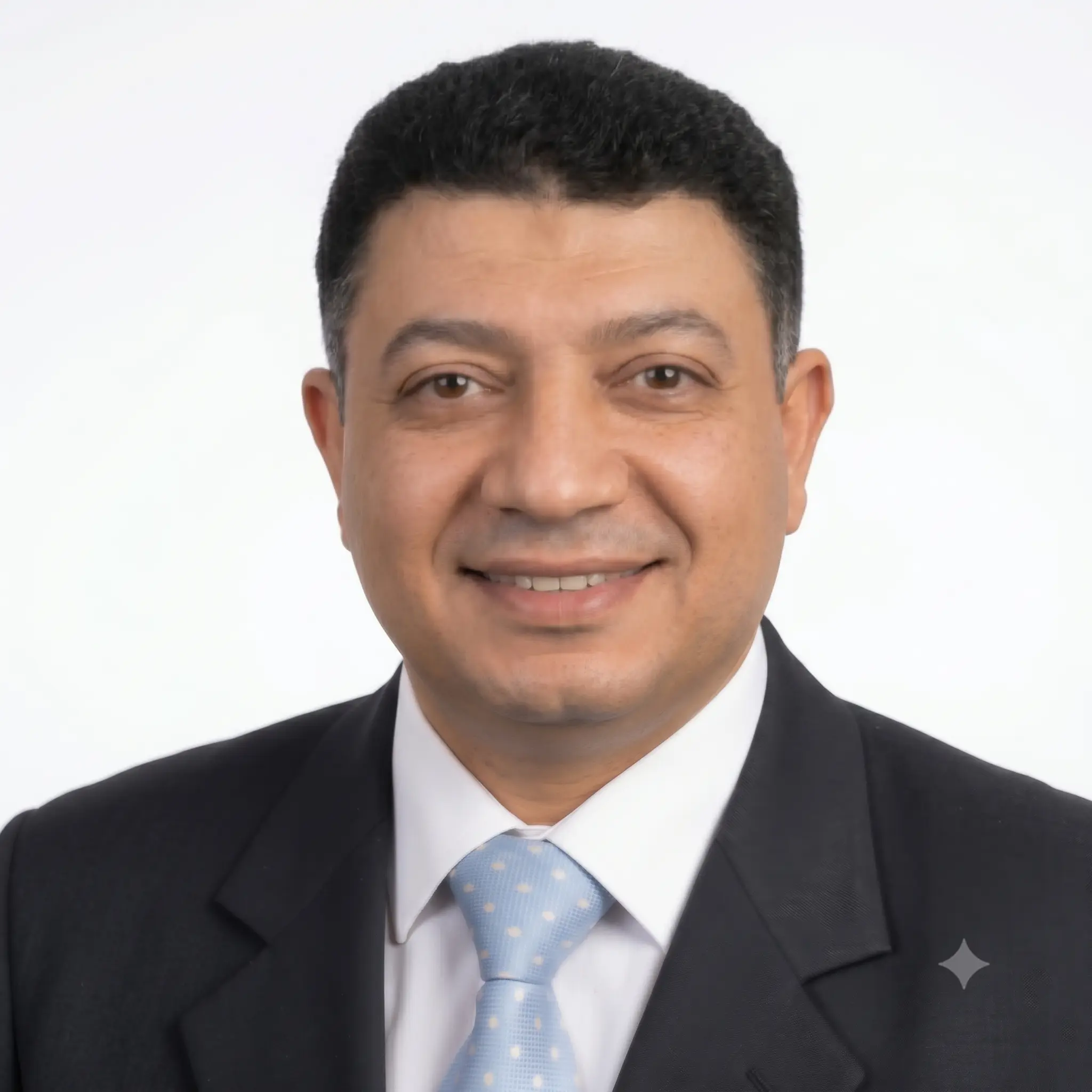
Ustadh Ahmed Mahmoud Abdulaziz is an experienced teacher of Arabic and the Holy Quran for native and non-native speakers. He holds a verified Ijazah in Hafs ‘an Asim and is certified in the foundational Tajweed texts Al-Jazariyyah and Tuhfat Al-Atfal. Drawing on his extensive background in traditional Quranic recitation and international pedagogy, he writes scholar-verified, accessible articles to help students worldwide master Tajweed rules and Arabic linguistics safely and accurately.