
Start Your Study Journey Today
Book a FREE trial class with a certified Quran teacher. No payment, no commitment.
Wanting some islamic studies kindergarten lessons that your little one will enjoy? The very beginning of this love for Allah is when you’re young and short, playful lessons provide that. This guide gives details of the learning that should take place for children aged 3 to 6; how this learning should be made enjoyable for children; how long lessons should be; and how parents can help with their children’s learning at home. At the end you will know exactly which is a gentle and effective start to choose!
What Is islamic studies kindergarten?
Introduction to Islam for children 3-6 years old using a play-based approach for faith, worship and manners.Lessons remain short, hands-on and visual. Childhood meeting Allah the Prophet (saws) and daily Islamic practices in stories, songs and games instead of lectures.
The majority of parents who look for islamic studies kindergarten are looking for one thing; first they want their child to love Islam and then, of course, they want them to learn it accurately. That’s the objective that drives and starts everything below (what to teach).
What Should Children Aged 3 to 6 Learn?
The children from 3 to 6 years should learn about Allah, their daily routines, some short surahs and kind manners in repetitive steps.This age range has minutes as their attention span, not hours.
Each lesson thus strives for one little victory; for example, saying Bismillah before eating or naming Allah as the Creator. A good islamic studies kindergarten plan restates the same concept in a variety of ways until it is remembered. These small wins are in a few key subjects.
Read also: Learn to Read Quran for Kids Step by Step Without Stress or Pressure
Which Core Topics Fit This Age?
The six topics that fit this age are: Tawheed, The Five Pillars of Islam, The Six articles of faith, Stories about the Prophets, Akhlaq & Adab, and Short surahs.
| Topic | What a young child learns | Play-based example |
|---|---|---|
| Tawheed and Allah the Creator | Allah is One and made everything | Nature walk naming His creations |
| Five pillars of Islam | The names and simple meaning of each pillar | Pillar picture cards |
| Six articles of faith | Belief in Allah, angels, books, messengers, the Last Day and destiny | Icon matching game |
| Stories of the prophets | Honesty, patience and trust in Allah | Puppet story time |
| Akhlaq and adab | Greetings, sharing, kindness to parents | Good-manners sticker chart |
| Short surahs and duas | Listening and echo recitation | Call-and-response singing |
Each of the topics in the islamic studies kindergarten is kept simple. A child can say ‘Allah made me and everything around me’ before he has any theology. The next section lists what is realistic for the parents for memorization.
Read also: Online Arabic Classes for Kids at Every Learning Level
Which Short Surahs, Daily Duas and Adhkar Can Young Children Memorize Easily?
Use Al-Fatiha, Al-Ikhlas, Al-Falaq and An-Nas as your first four prayers. Then add duas for eating, sleeping and greeting and simple adhkar like Bismillah and Alhamdulillah. These surahs are short and rhythmic, young children learn them by listening first and reciting afterwards. Teachers teach a line at a time and add the next line only when the first one is easy.
Correct pronunciation is important right from the beginning, and many families therefore opt for a Quran Memorization Course along with it. Movement of the hands and feet is formed by the process of forming a habit, and thus it leads directly to the performance of wudu and salah.
How Do Kids Learn Wudu, Salah Movements and Everyday Sunnah Through Play?
Children are taught wudu, movements of salah and sunnah in a fun and entertaining way:
- Demonstrate each step slowly and label it, e.g. “washing hands, washing face, washing arms”.
- Have child imitate you, then imitate a toy or doll.
- Create picture cards for the child to sequence.
- Make a mini prayer mat at home so it helps you to make prayer special.
- Reward achievements of effort and enthusiasm, not perfection.
Formal prayer begins around the age of seven. The goal of the Islamic studies kindergarten, therefore, is familiarity and joy, rather than pressure. Stories are used for ideas and play works for physical habits.
How Do Stories, Songs, Crafts and Games Make Islamic Lessons Stick for Little Ones?
They make lessons stick; they make it real for a child – something the child can see, hear and do. Follow the following order to use them:
- Story: Read a short prophet story, for example kindness to animals, and ask the child what they think they would do.
- Put key phrase: to a simple song to let it play in the child’s head throughout the day.
- Craft: Create an object related to the lesson (e.g. paper crescent to represent the Islamic months).
- Game: Tackle a short match-up or Simon says game which recycles the new word.
This four-part rhythm is ideal for islamic studies online for kids as in each activity their attention is reset. Once activities are set, the next question is, what length of a lesson should it be?
If you’re considering a complete course later, you can enrol your child in our Online Tajweed Classes for Kids.
How Long Should an Online Islamic Class Be for a 4 or 5 Year Old?
The ideal length of an online class will be around 20-30 minutes for a 4 or 5 year old, then a brief break for movement. Screen gets tiresome for young children. Two or three short sessions a week typically were more effective than one long session, as repetition will help to develop memory.
The good online islamic studies kindergarten class also allows the teacher to shorten a lesson on having a tired day which is difficult in a large class. This can be applied to the situation of islamic studies for 5 year olds already in school learning, hence the scheduling issue.
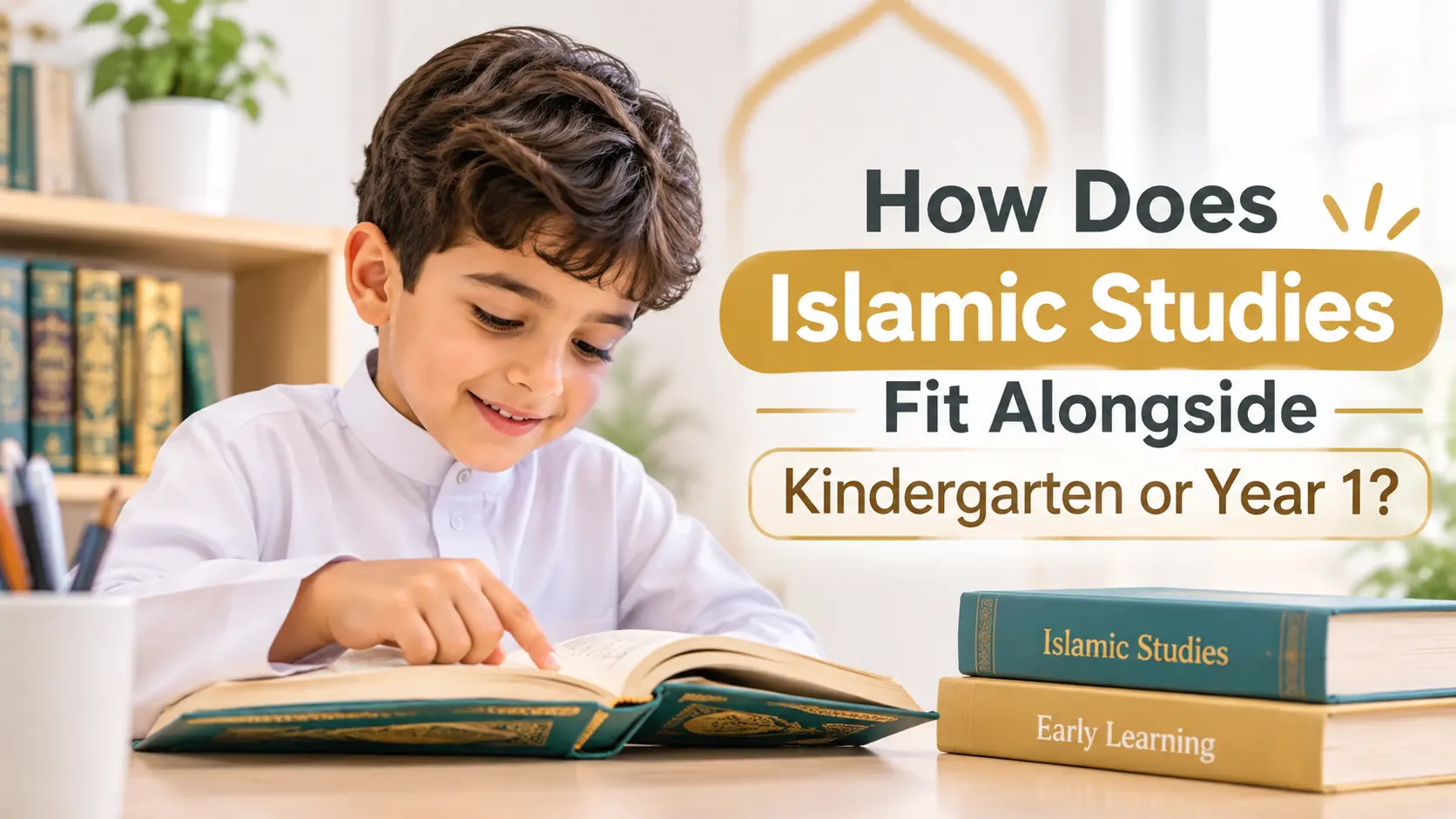
How Does Islamic Studies Fit Alongside Kindergarten or Year 1?
It works when lessons have a fixed, brief time frame. Follow these steps:
- Set a specific time when your child is fed and sleepy, such as early evening or a weekend morning.
- Limit each session to 20-30 minutes.
- Prepare a quiet corner with the device, a mat and a few picture cards.
- Link topics with themes of the school, e.g. sharing, animals, family.
- Include a 5-minute review at home each day.
It’s not the hours that matter, it’s the steady rhythm. After the schedule is determined, the next decision is on the format of the class.
Read also: Hifzul Quran & Islamic Education Centre Guide
Which Works Better One-on-One or Small Group Classes?
For most children 3 to 6 years old, the school teacher’s teaching style is most effective with only one child; the teacher can vary voice speed, correct and attend to one child at a time.
With small groups, confident children can gain social enjoyment, or for those who are shy or very young, the teacher may need to spend their full attention. Online Quran Classes for Kids at Mubarak Academy are individual, age-appropriate and personalized.
How to Choose an islamic studies kindergarten Class Format
- Be aware of your child’s temperament are they slow to warm up or do they require attention?
- If you are offered both formats, book a trial in both formats.
- Observe your child’s response, including if they respond, smile and join in.
- Select the request for your child’s return:
Regardless of the format, parents will always be a vital part of the class.
What Role Should Parents Play During and After Each Lesson?
Parents will sit nearby during the lesson and then do a small review at home the same day. In class: If you are not corrected, remain in class and let your teacher tell you; do not correct in the middle of a recitation. Then, invite your child to “teach” you the new line or story; teaching helps them remember.
Discuss the lesson at the dinner table, make it an integral part of family life not an extra responsibility. Parents can see more about how topics are covered on the Islamic Studies Course. Teachers monitor progress slowly to find out if this home support is effective.
How Do Teachers Track Progress Without Pressuring Young Children?
Teachers monitor for progress by concealing the achievement test as a small, celebrated check point rather than a test. They do the following:
- Make one objective for each lesson, for example, “say ‘Bismillah’ clearly.
- Watch the game, rather than quiz.
- Reward positive behavior with a sticker and a happy “mashaAllah.”
- Notify parents of a brief note on learned concepts and review.
- Revisit monthly and fine-tune with child’s disposition and speed.
This ensures that islamic studies kindergarten provides a positive environment for children to learn in and connect learning with praise. The same confidence is carried outside the house.
How Can Islamic Studies Help Your Child Feel Proud and Confident at a Non-Muslim School?
It helps by giving your child simple words, habits and stories to explain who they are. Try these steps:
- Teach one proud sentence, such as “I am Muslim, and I say Bismillah before I eat.”
- Practice short, friendly answers about food, greetings or celebrations.
- Share prophet stories that show courage and kindness.
- Role-play a classroom moment so your child feels prepared.
- Let your child bring an Eid craft or story to share with classmates.
A child who understands their own habits feels settled instead of different, and islamic studies kindergarten gives them that vocabulary. The same confidence grows during special times of the year.
How Do Ramadan, Eid and Islamic Months Become Joyful Learning Moments at Home?
They become joyful when children take part in small, hands-on traditions. Follow these steps:
- Make a Ramadan countdown calendar and open one kind-deed card each day.
- Learn one new dua each week, such as the dua for breaking the fast.
- Let your child help set dates, plates or decorations for iftar.
- Hang a chart of the Islamic months and name one each week.
- Celebrate Eid with a gift of kindness, like donating a toy or coins to charity.
Young children are not required to fast, so their role is to join the joy. These seasonal moments also prepare them for the next stage.
What Comes After Kindergarten?
After kindergarten, children move on to reading Arabic letters, basic Tajweed and fuller Islamic studies lessons.
Families often compare published programs, such as the iqra kindergarten curriculum or safar islamic studies. Whichever you choose, ask for a clear outline of what your child will learn each term. When your child can recognize letters, the academy’s Tajweed Classes Online are a natural next step.
Book a Free Trial Class at Mubarak Academy to Give Your Child a Loving Start in Islam
Mubarak Academy guides children through every stage of Islamic learning, from foundational Islamic knowledge to understanding Tawheed, Fiqh, Hadith, Tafseer, and the Seerah of Prophet Muhammad (PBUH), through live, one-on-one lessons across all Mubarak Academy courses. With over 100 teachers, experience across 20+ countries, and more than 80,000 teaching hours, the academy offers age-appropriate instruction, gentle correction, and lessons adapted to each child’s learning pace.
Give your child a joyful start in Islamic learning. Book a free trial class at Mubarak Academy today.
Frequently Asked Questions About Islamic Studies Kindergarten
At What Age Should Children Start Islamic Studies?
Children should begin to learn some basic Islamic concepts from about the age of three. Lessons should be on Allah, simple duas, good manners and short stories. Activities should continue to be playful and age and attention span appropriate.
How Often Should a Child Attend Islamic Studies Classes?
Young children should start with 2 or 3 short sessions a week. Sessions may be 20-30 minutes long based on the time attention span, energy level and comfortability in the session allows.
Can Children Learn Islamic Studies Online at Age Three?
Yes. Online Islamic lessons for three year olds can be of benefit if they have pictures and stories, and are repetitive and interactive. One to one teaching would enable the teacher to gradually teach the child simple ideas and keep him engaged with the task.
What Should a Kindergarten Child Learn First in Islam?
Know Allah as the Creator, say Bismillah and Alhamdulillah, learn some duas and practise kindness. Children can slowly delve into the Five Pillars, stories of the Prophets, short Surahs and basic Islamic manners.

Ustadh Ahmed Mahmoud Abdulaziz is an experienced teacher of Arabic and the Holy Quran for native and non-native speakers. He holds a verified Ijazah in Hafs ‘an Asim and is certified in the foundational Tajweed texts Al-Jazariyyah and Tuhfat Al-Atfal. Drawing on his extensive background in traditional Quranic recitation and international pedagogy, he writes scholar-verified, accessible articles to help students worldwide master Tajweed rules and Arabic linguistics safely and accurately.