
Start Your Study Journey Today
Book a FREE trial class with a certified Quran teacher. No payment, no commitment.
How to learn Arabic for kids comes down to a simple order: learn the 28 letters as sounds, add short vowels, then practise for a few minutes every day through games and songs. This guide covers the best age to start, a plan for each age group, the sounds children find hardest, and how to help at home even if you don’t speak Arabic.
What does learning Arabic involve for kids?
Learning Arabic for kids involves 4 stages: the 28 letters and their sounds, short vowels, joining letters, then reading and speaking simple words. Most plans work best with phonics based learning, where every letter is introduced first as a sound, then as a shape, and then inside words.
A few minutes a day works better than one long session a week, and Arabic is no exception. The process also goes more smoothly when you start at the right age.
What is the best age to start?
Ages 3 to 5 are a great time to start, because young children pick up new sounds easily through play and repetition. A good programme to learn Arabic language for children matches the child’s attention span: songs and games for preschoolers, and more reading and writing for older children. Older children are not too late, as the next section shows.
Is it too late for older kids and teens?
No. Older kids and teens can learn faster in some ways, because they already read and write and understand how grammar works.
They can master the Arabic alphabet in a short time and then focus on sentences and vocabulary. Teens do best with a clear goal, such as reading the Quran, joining a Quran memorisation course, or talking to relatives.
The learning path for ages 3 to 5
From ages 3 to 5, focus on letter sounds, songs and simple words through play, not writing. Many families pair these early Arabic sessions with Islamic studies for kindergarten, since both rely on short, playful lessons.
- Say and sing the Arabic alphabet, matching each sound to a picture.
- Add 1 or 2 letters at a time.
- Trace shapes in sand or on a tablet.
- Learn a few everyday words, such as simple family words like mama and baba.
- Keep each session short and happy.
The learning path for ages 6 to 9
From ages 6 to 9, children master all 28 letters, short vowels and connected letters, and start basic reading and writing.
- Learn the 28 letters, their forms and their sounds.
- Add the short vowels (fatha, kasra and dammah).
- Join letters to make words.
- Learn sukoon and shaddah.
- Read and copy simple sentences.
The learning path for ages 10 and up
From age 10, children move quickly through the alphabet and focus on vocabulary, grammar and conversation. In England, some go on to take the Pearson Edexcel GCSE in Arabic, which assesses listening, speaking, reading and writing.
- Review the alphabet and vowels in the first lessons.
- Build vocabulary for everyday situations.
- Understand simple sentence structure.
- Read short texts aloud.
- Speak with the teacher every week.
At any age, some sounds are harder than others.
Which Arabic sounds do English-speaking kids struggle with most?
The letters that are hardest for English-speaking children are ع (ayn), غ (ghayn), ق (qaf), ح (ha), خ (kha), and the heavy letters ص and ط.
These are throat or back-of-the-mouth sounds that English doesn’t use. In online lessons, the teacher models each sound slowly on screen so the child can watch the mouth. Introduce one new sound a week rather than all of them at once, and leave extra time for these letters in any plan for how to learn Arabic for kids. These same sounds later form the core of Tajweed rules for children who go on to recite the Quran.
The next challenge is letters that look almost the same on the page.
How do kids master look-alike letters and connected letter forms?
Children learn them by working on the dots first, then the four letter forms, in this order:
- Group similar letters (for example, the dotted letters ب ت ث) and name each one.
- Start with the isolated form.
- Add the initial, middle and final forms in turn.
- Link 2 letters, then 3 letters.
- Read short joined words.
Once children can join letters, many parents ask whether to start with Quran reading or everyday Arabic.
Should kids start with Quran reading through Noorani Qaida or with Arabic language skills?
Either works. For children who want to read the Quran, Noorani Qaida is a suitable starting point, and many families begin it through online Quran classes for kids. For children who want to speak, language lessons are the better choice.
Noorani Qaida teaches letters, short vowels such as fatha and kasra, and reading rules such as sukoon and shaddah, then madd, in sequence. Language lessons cover vocabulary, grammar and conversation. Both fit a plan for how to learn Arabic for kids, and many families combine the Qaida with online Arabic classes for kids. After the Qaida, children usually move on to tajweed classes for kids.
Read also: Learn to Read Quran for Kids Step by Step Without Stress or Pressure
Which should your child learn first: Modern Standard Arabic or a family dialect?
Learn Modern Standard Arabic first (for reading, writing and the Quran), then add a family dialect for everyday speech.
Modern Standard Arabic is used in books, newspapers and school texts, so it opens the door to reading everywhere. Then add the dialect your family speaks at home. Keep them separate when you plan how to learn Arabic for kids: standard Arabic for lessons, dialect for chats. Whichever you choose, avoid one common shortcut: transliteration.
Why does relying on English transliteration slow children down?
Transliteration slows children down because English letters don’t match Arabic sounds, so children memorise English spellings instead of the Arabic alphabet. They also stop looking at the Arabic text, and real reading doesn’t develop.
The fix is phonics based learning, where each Arabic letter has its correct sound from the very first lesson. Parents can support this at home even if they don’t speak Arabic.
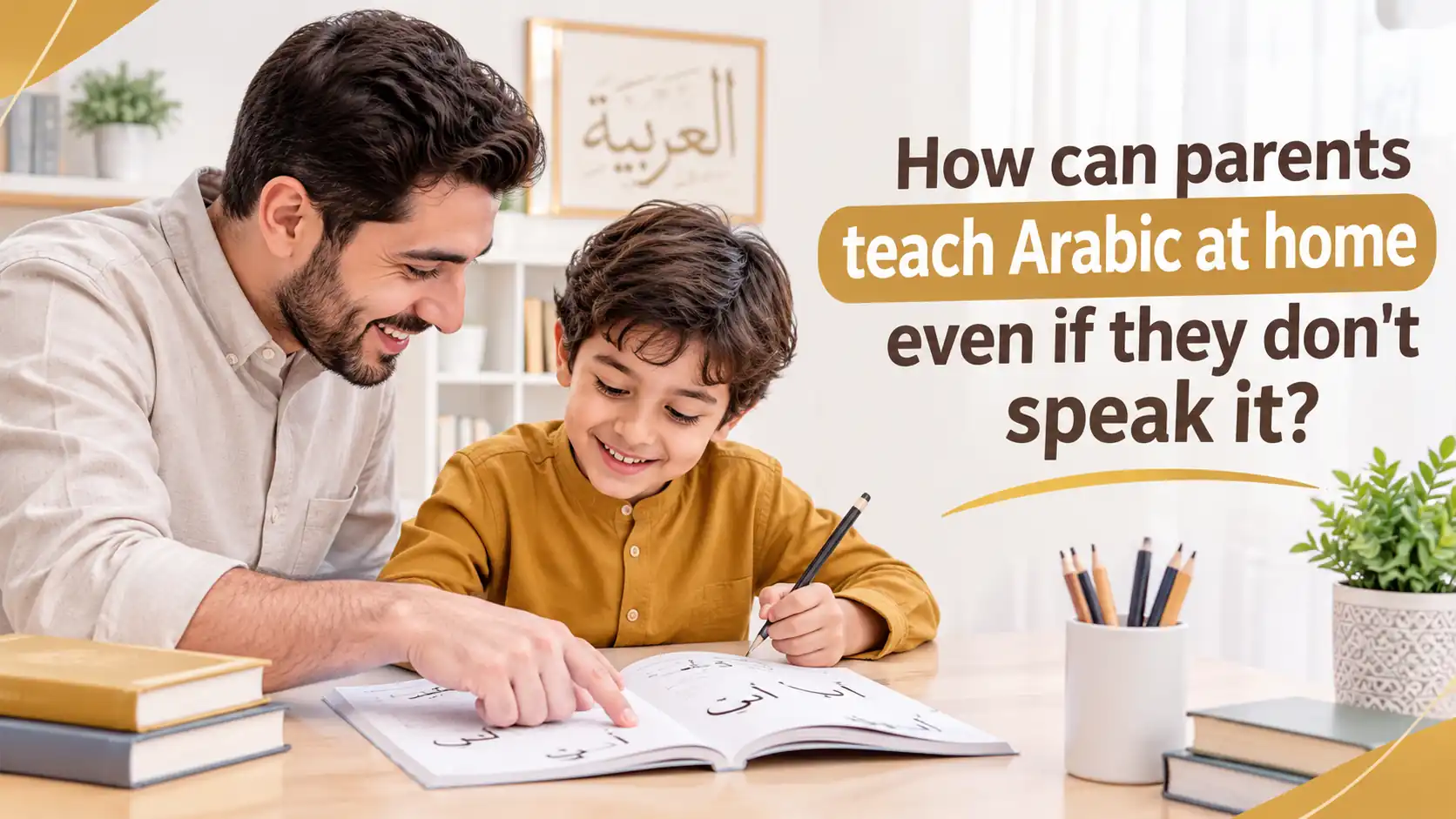
How can parents teach Arabic at home even if they don’t speak it?
Parents can learn Arabic at home alongside their child by following the teacher’s weekly plan of activities. You don’t need to be fluent to help with how to learn Arabic for kids at home; you only need a routine.
Five ways to practise Arabic at home:
- Ask the teacher for the letter or sound of the week.
- Model the same letter, then have your child teach it back to you.
- Stick letter cards around the house.
- Play a 5-minute sound game every day.
- Reward effort, not perfection.
Even with all of this, motivation sometimes starts to fade.
What should you do when your child loses interest or refuses to practise?
Ease off the pressure, shorten practice and make it playful again:
- Cut sessions to a few minutes.
- Switch to songs, games or stories.
- Let your child choose the activity.
- Reward effort with small treats or praise.
- Tell the teacher so lessons can adapt.
Whatever plan you choose for how to learn Arabic for kids, remember that steady, happy practice wins.
Online lessons or weekend classes: which suits UK families?
Online one-to-one lessons suit families who want flexible times and a teacher who adapts to one child, while weekend or mosque classes give children a group and a community. Many UK families combine both, using online lessons for steady progress and weekend classes for friends and Islamic studies.
Read also: Hifzul Quran & Islamic Education Centre Guide
A simple weekly Arabic routine that fits around the school day
A simple routine is 2 live lessons, 3 short practice days and 1 fun review day each week.
| Day | Activity | Suggested time |
|---|---|---|
| Monday | Live lesson | Your child’s lesson length |
| Tuesday | Letter card game | 5 minutes |
| Wednesday | Live lesson | Your child’s lesson length |
| Thursday | Sound song | 5 minutes |
| Friday | Writing practice | 5 minutes |
| Saturday | Fun review: story or game | 10 minutes |
| Sunday | Rest | None |
This routine for how to learn Arabic for kids leaves weekday evenings free for homework.
Book a free Arabic trial class for your child
Want a clear, fun path to Arabic for your child?
Mubarak Academy offers live, one-to-one lessons to learn Arabic language for children, with teachers who adapt each lesson to your child’s age and level. Lessons move from recognising letters and pronunciation to vocabulary and simple conversations, with regular practice and teacher feedback. You can also see all Mubarak Academy courses, including the Islamic studies course.
Book your child’s free trial class today.
Frequently asked questions about how to learn Arabic for kids
Can my child take a GCSE in Arabic?
Yes. In England, the GCSE in Arabic is offered by Pearson Edexcel and assesses listening, speaking, reading and writing. Children who start early with letters and reading usually find the GCSE much easier to prepare for in secondary school.
How long does it take a child to learn Arabic?
It depends on the child’s age, how often they have lessons, and how much they practise each day. With regular lessons, many children learn the alphabet and short vowels within a few months; reading simple sentences takes longer.
How long should an Arabic lesson be for a young child?
Short lessons work best for young children, because their attention span is limited. Ask your child’s teacher to match the lesson length to your child’s age, and keep home practice to about 5 minutes a day.
Can parents help without speaking Arabic?
Yes. Parents can use letter cards, practise sounds for 5 minutes a day and encourage their child. You don’t need to know Arabic well to help.
Ustadh Ahmed Mahmoud Abdulaziz is an experienced teacher of Arabic and the Holy Quran for native and non-native speakers. He holds a verified Ijazah in Hafs ‘an Asim and is certified in the foundational Tajweed texts Al-Jazariyyah and Tuhfat Al-Atfal. Drawing on his extensive background in traditional Quranic recitation and international pedagogy, he writes scholar-verified, accessible articles to help students worldwide master Tajweed rules and Arabic linguistics safely and accurately.