
learn arabic in english step by step, beginning with the alphabet, then simple reading, and progressing to simple sentences and vocabulary, and then to grammar rules. It can be easy for an English learning beginner to get lost trying to learn everything at once. This book divides the process into clear steps: what you should learn first, how long you should expect it to take, whether or not you need to learn transliteration and how you can practise pronunciation and reading to ensure progress that is going to last.
How do I learn Arabic in English step by step?
The best way to learn arabic in english step-by-step: the alphabet and sounds, short words, basic reading, simple sentences, and grammar.
- Learn the 28 letters and sounds of the Arabic language, with the help of the alphabet in English transliteration, as a bridge.
- Read short, common words before sentences.
- Develop foundation of 100-150 common words from real-life contexts
- Begin grammar when reading is comfortable
- Include listening early (because the way the word is said is not always the written word)
- Do not review in long sessions; review in short sessions every day.
Best Way to Learn Quranic Arabic for Beginners Step by Step
What should I learn first in Arabic as a beginner?
The arabic alphabet in english should be mastered first, as all other skills, reading, writing, and pronunciation, rely on it.
Teach isolated letter forms and basic sounds first and then how letters link up in words because letters in Arabic can change their form depending on their position. When recognition becomes automatic, proceed to short vowel marks (harakat) which regulate pronunciation. This is the main way to learn Arabic for beginners in English.
Is Arabic hard for English speakers to learn?
It is because of its new alphabet, right-to-left writing system, and phonemes that are not in the English language that Arabic is one of the harder languages for English speakers to learn. However, despite the reputation, early on in the learning process, Arabic for English speakers is more understandable than it’s given credit for.
Best Way to Learn Arabic Online for Beginners and Adults
How long does it take to learn Arabic step by step?
While it may all depend on the end goal, a general guideline for a steady daily learner would be:
- Alphabet and basic reading: 4-8 weeks
- Simple sentences (2-3): Core vocabulary (100-150): 2-3 months
- Grammar and conversational skills for everyday use: 6-12 months.
- Unvocalised reading: 1-2 years old
- Highly fluent: 2-3 years of continuous study (commonly cited)
Should I learn the Arabic alphabet before grammar?
Yes, learn the Arabic alphabet before grammar because grammar rules are taught by written examples which require reading the letters. Transliteration alone is more likely to form habits which will be difficult to break, as transliteration is not a perfect representation of the Arabic sounds and spelling. When reading is easily accomplished, grammar is much easier to take in.
Arabic Course for English Speaking Students Step by Step Guide
What is the easiest way to learn Arabic for beginners?
Learning Arabic for beginners in English is easier with a structured approach that combines clear explanations, regular practice, and small daily learning habits. Rather than relying only on apps or textbooks, beginners make better progress by following guided lessons, practicing consistently, and applying what they learn in real conversations and reading exercises.
A guided sequence, whether a course, tutor, or structured plan of self-study, is designed to ensure the alphabet, reading, and vocabulary are presented in the correct sequence and pronunciation glitches are not developed as a habit. Use of repetition, such as apps and flashcards, works best when used in addition to, not in place of, larger numbers of repetitions.
Can I learn Arabic by myself in English?
You certainly can learn Arabic without a teacher or without a native speaker, but with structured materials that are in English. Self-study is good for the alphabet, vocabulary and reading because these can be verified from a reference book. The area that self-taught learners lag the most is pronunciation, as some sounds are difficult to self-correct without a teacher.
Arabic Classes for 3 Year Olds That Build Early Language Skills
Do I need transliteration to learn Arabic?
Transliteration will help to get a head start but is not necessary for long-term learning, and there is a risk of slowing the actual learning process if relied upon too long.
Transliteration may be helpful at first for the first week or two, primarily for associating the letters you don’t know with the ones you do. In addition, the use of Arabic script with vowel marks develops actual reading ability as there are several sounds in Arabic that cannot be represented accurately in transliteration.
How do I practice Arabic pronunciation correctly?
Proper arabic pronunciation for beginners isn’t achieved by reading aloud transliteration silently but through listening, repeating verbally, and receiving feedback.
- Listen to native speakers regularly, before you fully understand sentences
- Repeat words verbally right after hearing the word.
- Before you can learn any other skill in the Arabic language, you need to learn the basics of pronouncing sounds that aren’t found in English.
- Make occasional recordings and compare with a native recording.
- Seek input from a tutor with regard to the sounds that are most difficult for you to master (self-correction is only so effective)
Hamzatul Wasl and Hamzatul Qat’: Rules, Differences, and Quran Examples
How do I read Arabic right to left as a beginner?
Most beginners take a couple of weeks to get used to reading from right to left and can become proficient at it quicker than they think with basic letter recognition.
- Do very short words, then sentences (2-3 letters)
- Start with your finger under the text to follow the direction at first
- Repeat the same short passage over and over again; don’t rush it!
- Use large print materials for new readers.
- May be slower initially, but will catch up with practice!
What comes after learning the Arabic alphabet?
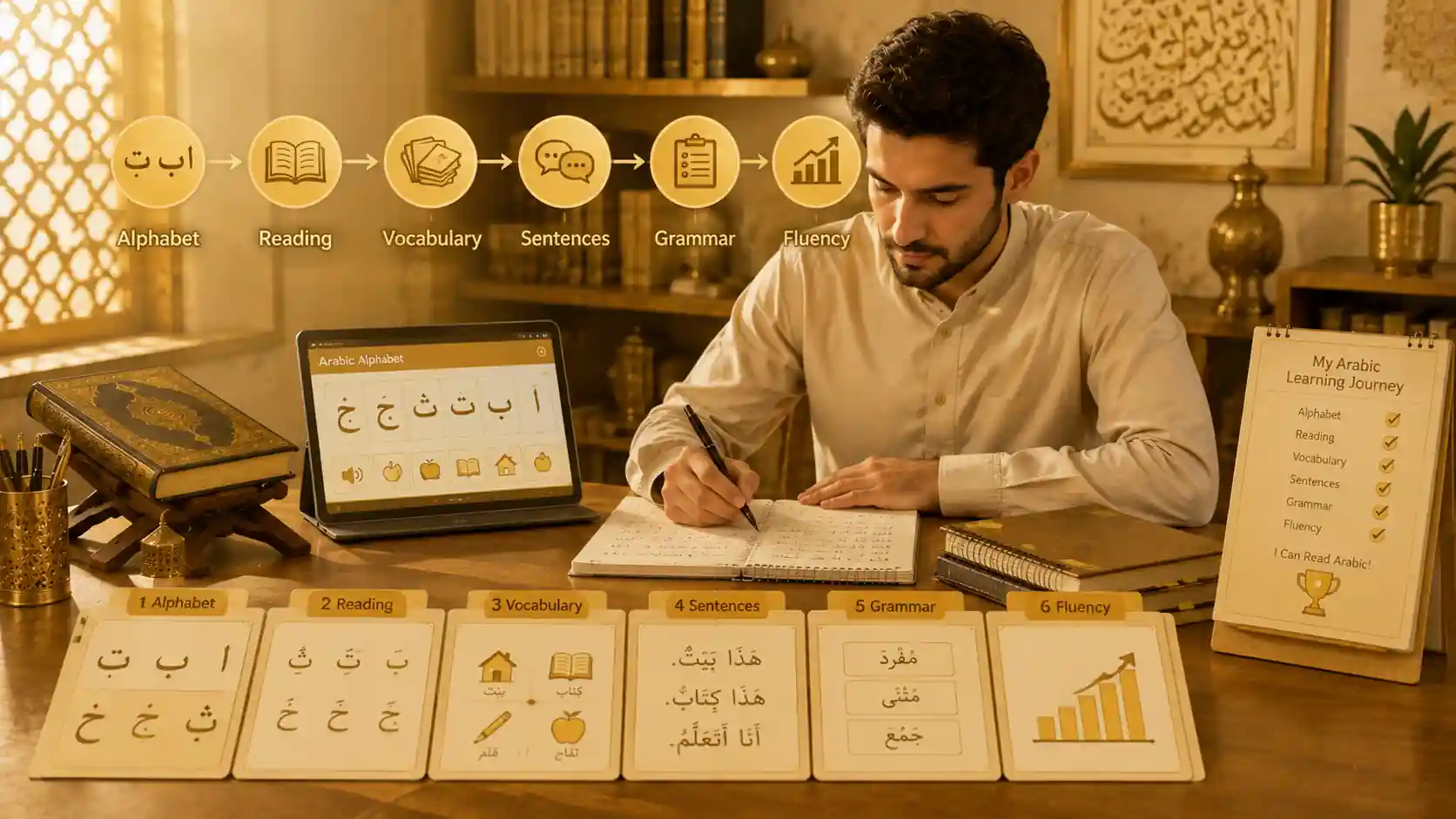
Once you’ve mastered the alphabet, the next phase of basic reading practice is to use short words that are vocalized and then core vocabulary and then simple sentence structure. That’s where learn Arabic in English step by step accelerate: most of the structured courses move from the alphabet to the short reading passages.
that are completely created from the already mastered letters, so that nothing is new and strange. Vocabulary and simple grammar (order of the subject and the verb and basic pronouns) follow, with full grammar rules gradually added in. It is best to learn arabic reading and writing for beginners when reading and vocabulary are taught together.
How Hard Is It to Learn Arabic?
Should I learn MSA or a dialect first?
For most learners with a background in English, the best place to begin is with Modern Standard Arabic (MSA), which is the standard form of written Arabic and is employed in the media and in formal settings; most structured courses are based on MSA.
Dialects (Egyptian, Levantine, Gulf, and others) are more suitable for those who aim for a spoken-communication objective, such as residing in a certain area. As MSA is transferred into any Arabic dialect later in the day, learning MSA first helps you stay on track to learn arabic in english step by step.
How can I memorize Arabic vocabulary faster?
Memorizing new words is all about spaced repetition and using them in context, not memorizing offhand lists of words.
- Use spaced repetition flashcards rather than a list of words.
- Learn words in phrases, not individually as words that are translated.
- Create sets of words for each theme (family words, food words, daily routine words, etc.).
- Look at new words: Review in 24 hours, then after several days.
- Integrate new vocabulary into one’s own short sentences to get it from recognition to recall
Harakat in Arabic Language: The Ultimate Beginner’s Guide to Arabic Vowels
Are online Arabic classes as effective as in-person lessons?
Yes, online Arabic classes can be as effective as classes in person, as long as they also involve live interaction with a teacher and not just pre-recorded lectures. What is important is not the format, but the feedback: a live online teacher corrects pronunciation and adapts pace just like an in-person teacher would, which is most critical when youl earn arabic in english step by step
What should I look for in an Arabic course for English speakers?
Search for a course designed specifically for English speakers that has a well-defined sequence from alphabet to grammar, has a live teacher responding to the students, and has flexible scheduling.
The best course begins at the letter-sounds/transliteration level, rather than assuming knowledge of the script. From a live session perspective, it is more important than recorded sessions, and the ability to select classes and individual or group sessions allows you to work at your own speed.
Best Fusha Arabic Course with Certificate
learn arabic in english step by step with Expert Guidance
Mubarak Academy’s Arabic language course follows the same step-by-step scheme, starting with the alphabet, then reading, vocabulary, and grammar, all taught by licensed and qualified teachers. The academy has delivered over 80,000 hours of instruction to over 1000 students and has helped to deliver instruction in over 20 countries with a team of over 100 teachers.
When you’re ready to get started, Mubarak Academy lets you try it out with a free trial class to meet your teacher and first experience this method. Sign up today and start your Learn Arabic in English Step by Step course with confidence.
Frequently Asked Questions
Is it too late to learn Arabic as an adult beginner?
No. Adults can successfully learn Arabic at any age, and many progress faster than children through the alphabet and grammar stages. Their ability to follow structured study plans, understand language patterns, and practice consistently often helps them achieve steady, long-term progress.
Do I need to understand Arabic to read the Quran correctly?
Not necessarily. Correct Quran recitation depends on accurate pronunciation and applying Tajweed rules rather than understanding the language. However, many students who learn Arabic in English step by step find that understanding Arabic helps them connect more deeply with the meanings of the Quran.
Can I switch from self-study to a tutor later without starting over?
Yes. The vocabulary, alphabet, and grammar you learn through self-study remain valuable when you begin lessons with a tutor. Instead of repeating the basics, a qualified teacher usually focuses on improving pronunciation, building conversation skills, and correcting mistakes more efficiently.
What tools help beginners who type on an English keyboard?
Arabic keyboard layouts, virtual Arabic keyboards, and typing practice tools make it easier for beginners to write in Arabic from the start. These tools help learners become familiar with Arabic letters and spelling while gradually building confidence before memorizing a full keyboard layout.
How many minutes should beginners study Arabic each day?
Most beginners make steady progress by studying Arabic for 20 to 30 minutes a day. Short, consistent practice is more effective than occasional long sessions, helping learners improve vocabulary, reading, grammar, and pronunciation without feeling overwhelmed.

Ustadh Ahmed Mahmoud Abdulaziz is an experienced teacher of Arabic and the Holy Quran for native and non-native speakers. He holds a verified Ijazah in Hafs ‘an Asim and is certified in the foundational Tajweed texts Al-Jazariyyah and Tuhfat Al-Atfal. Drawing on his extensive background in traditional Quranic recitation and international pedagogy, he writes scholar-verified, accessible articles to help students worldwide master Tajweed rules and Arabic linguistics safely and accurately.