

The simplified rules of Tajweed, which are the science that regulates the pronunciation of each Arabic letter, are the first steps in learning to recite the Quran correctly. Many students think that Tajweed is for advanced students, but the basic rules are easy to understand and there are only a few of them. This guide takes you through each important of the rules, using plain English with examples, so that you can start reciting with confidence from your first lesson.
What Are the Simplified Rules of Tajweed?
The simplified rules of Tajweed are divided into five main rules: makharij (places of pronunciation), sifaat (letter qualities), the rules of noon and meem, qalqalah, and madd (elongation). Each area progresses from the previous one and begins with correct pronunciation and then progresses to rhythm and flow. They make up the complete recipe for the perfect-sounding Quran.
Quran Tajweed With English Translation for Easy Reading
What Are the Basic Tajweed Rules for Beginners?
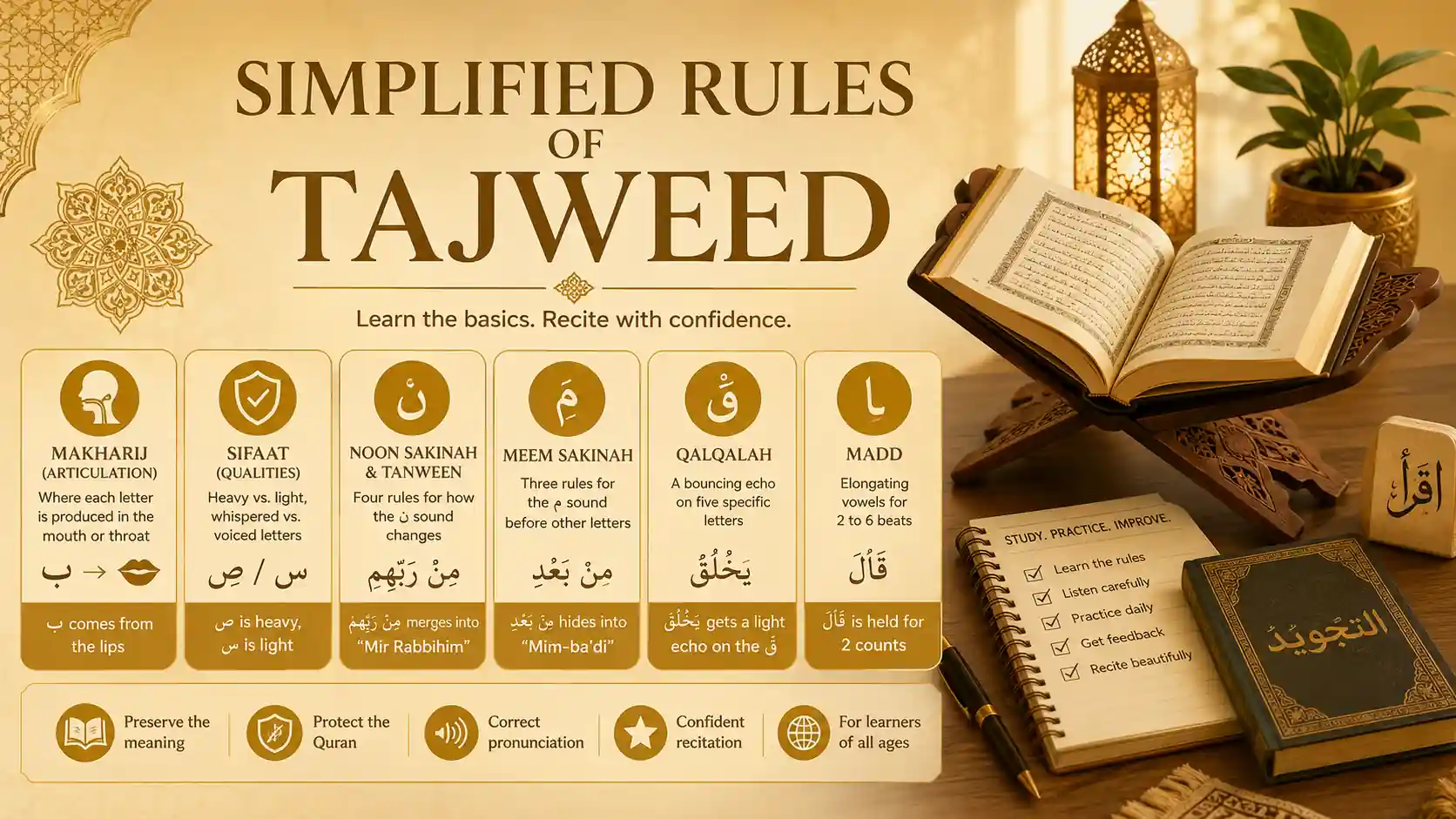
The basic Tajweed rules for beginner level are introduced in five categories, which are summarized here for easy reference in the chart below.
Simplified Rules of Tajweed Chart for Quick Reference
| Rule Category | What It Covers | Quick Example |
|---|---|---|
| Makharij (Articulation) | Where each letter is produced in the mouth or throat | ب comes from the lips, ق from the back of the tongue |
| Sifaat (Qualities) | Heavy vs. light, whispered vs. voiced letters | ص is heavy, س is light |
| Noon Sakinah & Tanween | Four rules for how the ن sound changes | مِنْ رَبِّهِمْ merges into “Mir Rabbihim” |
| Meem Sakinah | Three rules for the م sound before other letters | مِنْ بَعْدِ hides into “Mim-ba’di” |
| Qalqalah | A bouncing echo on five specific letters | يَخْلُقْ gets a light echo on the ق |
| Madd | Elongating vowels for 2 to 6 beats | قَالَ is held for 2 counts |
This chart is a fast way to see how all the simplified rules of Tajweed connect before studying each one in depth below.
Ikhfa Rules of Tajweed Explained with Letters Examples and Tips
What Are the Four Main Rules of Tajweed?
The four fundamental rules of Tajweed are makharij, sifaat, the ahkam (rules regarding noon, meem, and qalqalah), and madd. All errors in recitation fall into these four “buckets” that form the foundation for every list of simplified rules of Tajweed you’ll find online. Knowing them in that order provides an easy and not overpowering way for beginners to move forward.
How Many Tajweed Rules Are There?
This isn’t a fixed number; instead, rules are typically categorized and counted as such. Let’s look at an approximation of how they are added together:
- Noon Sakinah and Tanween: 4 rules
- Meem Sakinah: 3 rules
- Madd: roughly 6 recognized types
- Qalqalah: 5 letters, 1 core rule
- Sifaat: around 17 letter qualities
Combined, most tajweed guides mention 25 to 30 different points in these categories, and so grouping the points is more important than counting them. This is the exact way that the simplified rules of Tajweed are not overwhelming and become manageable.
Easy Tajweed Rules in English for Complete Beginners
Can I Learn Tajweed Without Knowing Arabic?
Yes, one can learn Tajweed without learning Arabic; many students learn the rules and letter sounds phonetically, first learning tajweed rules in english and then later learning Arabic. It is not necessary to be fluent in the Arabic language to master Tajweed
But it is beneficial to learn the alphabet and the basic vowel signs at an early age, as this will make learning easier. In English resources, most tajweed rules employ transliteration to fill this gap for those who don’t speak Arabic.
Is Tajweed Necessary for Reading the Quran?
The answer is yes, because most scholars deem it necessary when reciting the Quran, as it safeguards the meaning and pronunciation. It’s easy to mess up one letter and alter the meaning of a word. The quran recitation rules are in place for a definite purpose: to preserve the quran in the exact form that it was revealed in.
Advanced Tajweed Rules for Accurate and Beautiful Recitation
What Is the Easiest Way to Learn Tajweed?
The most straightforward method of learning Tajweed is to learn the rules sequentially, starting with makharij, then sifaat, then the rules of noon and meem, and finally madd. The beginner of any research who wants to learn Tajweed should begin with this first and then go to the advanced rules of madd. It is better to study tajweed rules with examples.
How Long Does It Take to Learn Tajweed?
Regular practice will allow most beginners to get the hang of the basics in 4-8 weeks, but it may take longer to be mastered. These are the factors which affect timelines:
- The basics of Makharij and sifaat are 4-8 weeks.
- Noon, meem and qalqalah rules: 2-3 months
- Confident and fluent recitation for an entire recitation: 6 months to 1 year
- Ijazah level proficiency: a few years of structured learning
The hours count less; consistency is the most important thing to remember—short, daily sessions will create muscle memory quicker than long, infrequent ones.
the third, Iqlab, treats the noon or tanween as a meem sound; the fourth, Ikhfa, treats the noon or tanween as a sound which is hidden by a light nasal sound. Which of these four rules will apply will be determined by the letter that immediately follows the noon/tanween.
Rules of Raa in Tajweed Explained for Correct Recitation
What Are the Rules of Noon Sakinah and Tanween?
There are 4 rules: Izhar, Idgham, Iqlab, and Ikhfa, all of which occur following the letter after a silent noon or a tanween. In the Hebrew language, “izhar” is the term used to refer to the pronunciation of the vowel “noon” before throat letters.
Idgham is a combination into the following letter. Iqlab makes it a soft meem sound before ب. In the process of hiding it from the Zalman, Ikhfa hums it with a nasal sound in front of the rest of the letters.
What Are the Three Rules of Meem Sakinah?
The three are Ikhfa Shafawi, Idgham Shafawi, and Izhar Shafawi, based on the next letter that follows the silent meem. Ikhfa Shafawi when followed by ب will conceal the sound of the meem. When the second meem is followed by a second م, then Idgham Shafawi is merged. The “mem” is said distinctly before other letters in the alphabet, by the voice of Izhar Shafawi.
Basic Rules of Tajweed for Beginners and Correct Quran Recitation
What Are the Qalqalah Letters?
The Qalqalah letters are ق ط ب ج د, often memorized using the phrase “Qutb Jad.” These letters give a rebounding “echo” sound when they have a sukoon, particularly at the end of the word when stopping the word. The echo should not be exaggerated; this is a common error among people who are still learning the correct pronunciation of tajweed.
How Many Beats Are Used in Madd?
Madd length ranges from 2 to 6 beats depending on the type. Here’s how the counts break down:
- Madd Asli (natural elongation): 2 beats
- Madd Muttasil and Munfasil: 4 to 5 beats
- Madd Lazim: 6 beats
- Madd Arid Lissukoon (at a pause): 2, 4, or 6 beats, reciter’s choice
Counting beats consistently is one of the hardest habits for beginners to build, which is why practicing with a teacher or metronome helps early on.
Iqlab in Tajweed: Definition, Letter, Rules, and Examples from the Quran
What Is the Difference Between Izhar, Idgham, Iqlab, and Ikhfa?
The noon or tanween is treated differently in each of these rules. The first, Izhar, treats the noon or tanween as a clear sound; the second, Idgham, treats the noon or tanween as a sound that is merged with the next sound.
The third, Iqlab, treats the noon or tanween as a meem sound; the fourth, Ikhfa, treats the noon or tanween as a sound that is hidden by a light nasal sound. Which of these four rules will apply will be determined by the letter that immediately follows the noon/tanwin.
Can Children Learn Tajweed Easily?
Yes, children can learn Tajweed more readily than adults can because they learn sounds by repeating and mimicking, rather than analyzing. For younger children, particularly, short, visual, game-based lessons are ideal, accompanied by a patient teacher who models each sound orally. For most academies, formal Tajweed lessons are recommended to begin when a child can read the basic Arabic letters.
Can I Learn Tajweed by Myself at Home?
The theory of tajweed rules can be learned on your own from a book, charts, or a tajweed guide but self-study is not enough to perfect your pronunciation. The simplified rules of Tajweed found on a page are not the same as how to learn tajweed. Makharij and ghunnah mistakes are very difficult to detect unless someone is trained enough to listen to them in real time.
Learn Tajweed the Right Way from Day One
Mubarak Academy Tajweed course is offered by qualified, experienced teachers who teach makharij, sifaat, the rules of noon and meem, madd and waqf. The academy has trained over 1000 students from 20+ countries with over 80,000 hours of live lessons, during which each student’s recitation was corrected while they were in class.
This live correction is the quickest way to go from theory to correct use of the simplified rules of Tajweed. This model is practical, and so the rules of Tajweed are more easily applied in a real situation by a true teacher when the rules are simplified.
Would you like to learn these easy rules of Tajweed with a real teacher, who can hear you recite? Please take your free trial class with Mubarak Academy now and begin correcting your Tajweed from the beginning.
FAQs
Do Tajweed rules change between the different Quran reciters (qira’at)?
There are slight variations in tajweed pronunciation for the accepted qira’āt, but the underlying principles of Tajweed are unchanged. The quran reading rules of noon, meem, madd, and articulation remain unchanged, but some of the recitation details may differ depending on the authenticated transmission being studied.
What tools help me practice Tajweed rules with examples at home?
Practice materials such as color-coded Tajweed mushafs, Tajweed apps, recorded Tajweed albums, and audio comparison tasks are great. It helps consolidate learning between lessons, but it is important to receive feedback from a knowledgeable teacher on a regular basis to detect and correct pronunciation errors.
Is Tajweed only useful for native Arabic speakers?
No. Millions of students who speak languages other than Arabic learn Tajweed every year with phonetic teaching, systematic lessons, and guided practice. Learners can develop good pronunciation with regular recitation and teachers’ feedback without necessarily knowing Arabic.
Is there an age limit for learning Tajweed rules for beginners?
No, Tajweed can be learned by both kids and adults at any age. However, age alone has not been shown to have the same effect as steady practice, patience and instruction by an experienced teacher when it comes to the ability to imitate sounds.
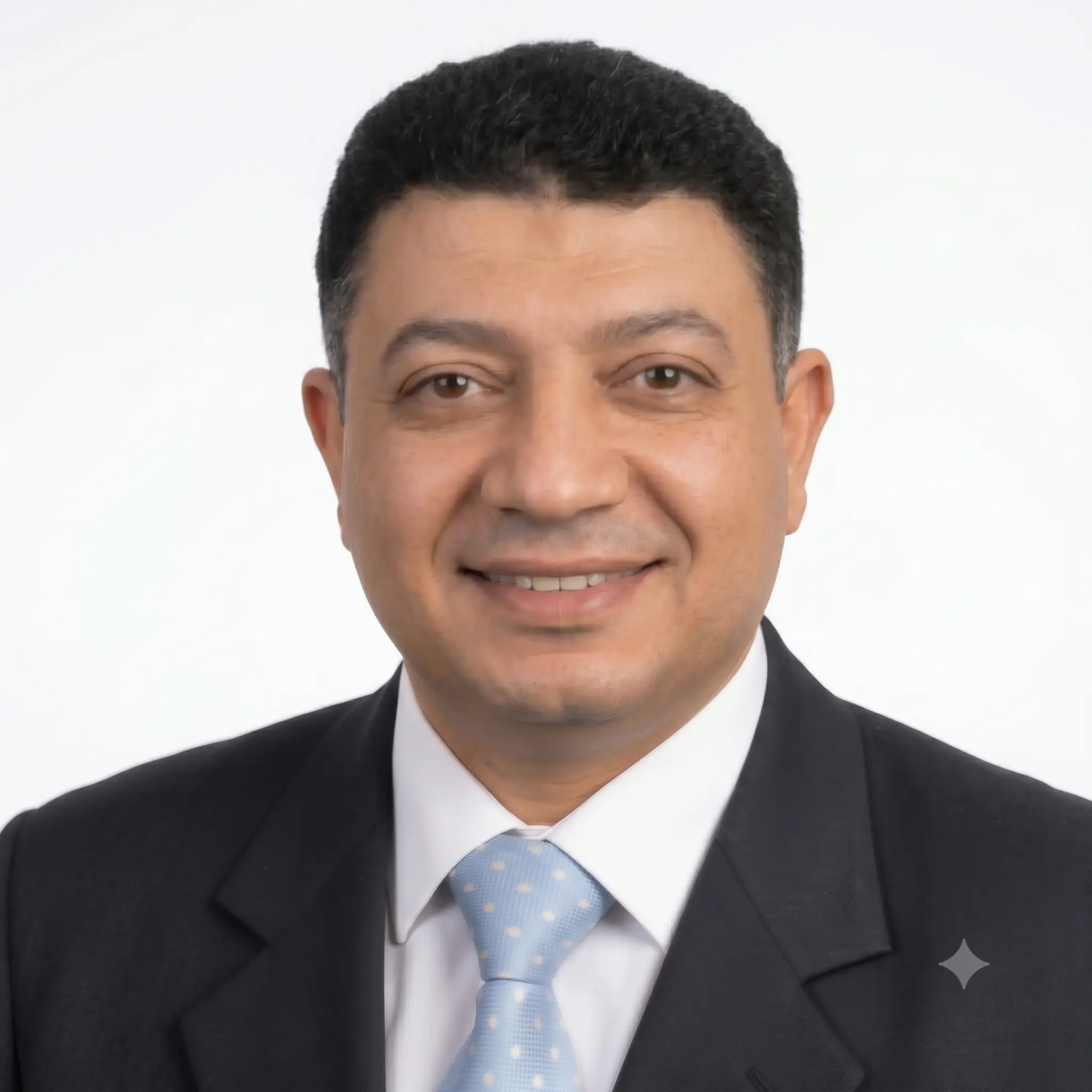
Ustadh Ahmed Mahmoud Abdulaziz is an experienced teacher of Arabic and the Holy Quran for native and non-native speakers. He holds a verified Ijazah in Hafs ‘an Asim and is certified in the foundational Tajweed texts Al-Jazariyyah and Tuhfat Al-Atfal. Drawing on his extensive background in traditional Quranic recitation and international pedagogy, he writes scholar-verified, accessible articles to help students worldwide master Tajweed rules and Arabic linguistics safely and accurately.