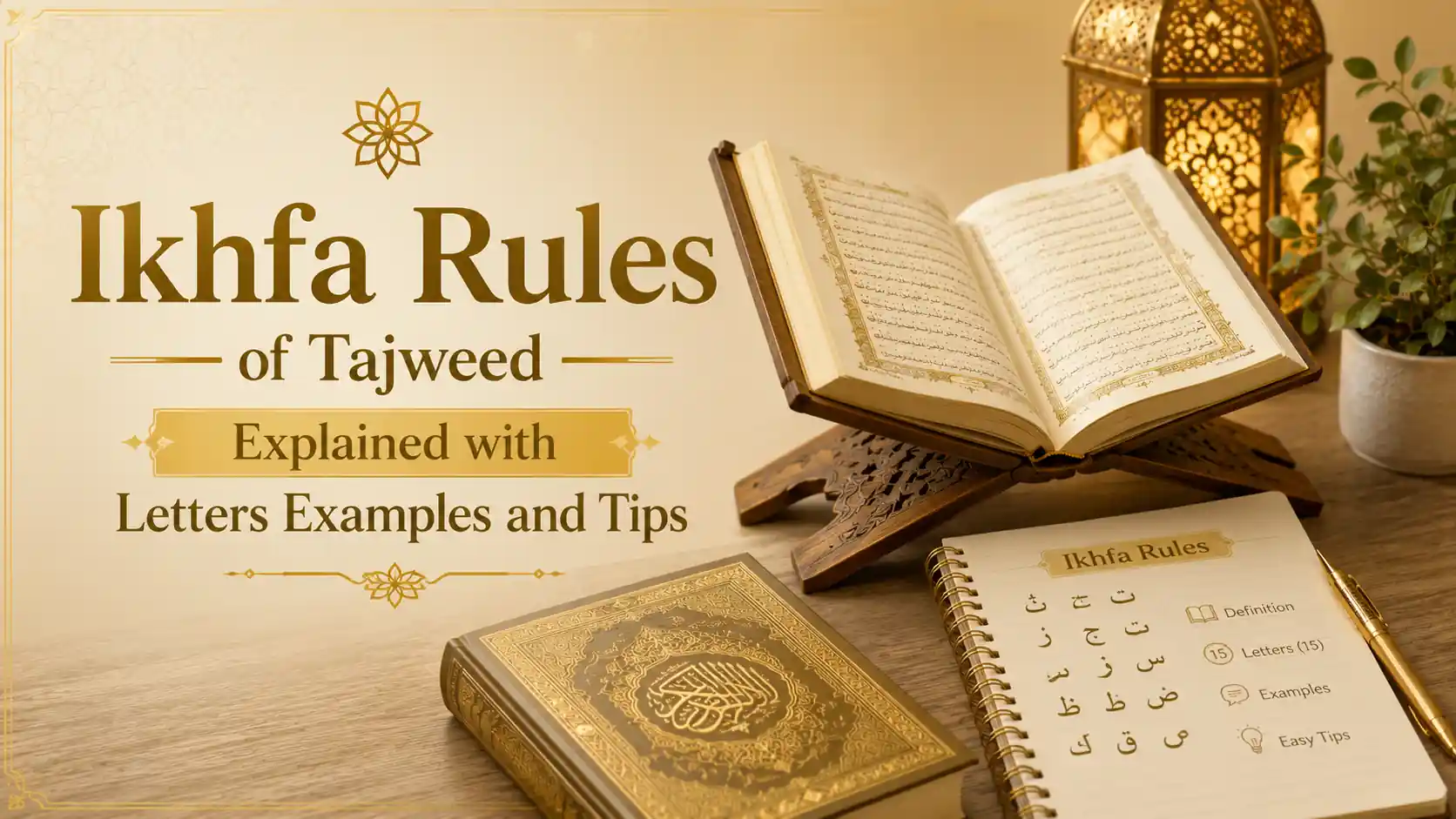
You will hear a noon disappear into a soft hum instead of a clear sound if you’ve ever heard ikhfa rules of tajweed in action. Ikhfa is one of the four rules of noon sakinah and tanween and is the hardest to master, especially for beginners, because this sound is not fully said and not fully hidden. This guide includes all 15 ikhfa letters, the correct pronunciation, the actual recitations from the Quran, and the common errors made by most new reciters.
What Is Ikhfa in Tajweed? (Simple Definition for Beginners):
ikhfa rules of tajweed that partially covers the sound of noon sakinah or tanween, and instead of a clear noon, it is covered with a two-count nasal hum. The word “ikhfa” literally means “concealment.” It is located between the two extremes of “izhar” (noon is fully visible) and “idgham” (noon is fully merged with the next letter).
and falls within the middle range between the two extremes, and one of the most tested Tajweed rules for the students of the quran reading is ikhfa (noon is fully hidden). This partial-hiding effect occurs only before a particular set of 15 letters, and that’s the very place where most people begin memorizing.
Where Does Ikhfa Appear in Quran Recitation?
Ikhfa is always found in the Quran, and it is activated whenever a noon sakinah or tanween is followed by one of its 15 letters, either within a word or across two words. The ikhfa rules of tajweed are based on this single pattern.
These 15 letters represent over 50% of the Arabic alphabet, so statistically, ikhfa is the most common noon sakinah rule, much more common than izhar, idgham, and iqlab. It is this frequency that makes it so easy to memorize the 15 letters early and then saves a lot of time later correcting them.
Easy Tajweed Rules in English for Complete Beginners
What Are the 15 Letters of Ikhfa and How Are They Grouped?
The 15 letters of ikhfa are ت ث ج د ذ ز س ش ص ض ط ظ ف ق ك, and classical scholars group them into three levels based on how close each letter’s makhraj sits to the noon’s own articulation point.
Ikhfa Rules of Tajweed: Letter Groups by Proximity
| Group | Letters | Ghunnah Effect |
|---|---|---|
| Closest to noon | ت ط د | Deepest concealment, shortest perceived ghunnah |
| Middle distance | ث ذ ز س ش ص ض ظ ف ج | Balanced concealment and ghunnah |
| Farthest from noon | ق ك | Lightest concealment, longest perceived ghunnah |
This is the reason for the uniqueness of ikhfa. A noon before ت is almost completely hidden, and a noon before q or ك remains noticeably closer to a clear sound, as in the word كُنتُمْ.
Advanced Tajweed Rules for Accurate and Beautiful Recitation
How Do You Pronounce Ikhfa Correctly?
Here how to pronounce ikhfa, The correct pronunciation of ikhfa begins with the tongue: keep it close to the makhraj of the next letter but don’t touch it, then release a two-count nasal ghunnah rather than a clear noon sound. As with all tajweed, ikhfa relies on the same 17 makharij al-huruf and so will be weakened if articulation is weak elsewhere.
- Make sure the tongue doesn’t touch the roof of the mouth, that makes izhar.
- Do not completely blend into the next letter, this is called idgham
- Keep the ghunnah for 2 counts, not less and not more.
- Make the thickness of the ghunnah equal to the weight of the letter that comes after it
So these ikhfa rules of tajweed english pronunciation tips only work with repetition, and that’s why it’s often the same few words that are said slowly, out loud, hundreds of times in order to master ikhfa.
Rules of Raa in Tajweed Explained for Correct Recitation
How Does Ikhfa Work with Noon Sakinah?
If the noon is a real, written letter that has a sukoon, then the ikhfa is applied at the noon, whether it is inside a word or immediately before the next word starts.
One of the most popular teaching examples is مِنْ ثَمَرَةٍ, where the noon is covered by the consonant ث, which is one of the 15 ikhfa letters. Tanween, which follows it, is almost the same rule, but it has one structural difference to know.
How Does Ikhfa Apply with Tanween?
The application of ikhfa in tanween is the same as in noon sakin, except that the occurrence of tanween is limited to the end of the noun, and therefore it is always a word boundary application of ikhfa, never within a word.
The tanween on عَذَابٌ meets with one of the 15 ikhfa letters (ق) and hides in the same soft nasal sound (قَرِيبٌ). Tanween is written as a diacritic, so it’s a bit harder to spot than a written noon.
Learn Quran Reading With Tajweed For Beginners Step By Step
What Is the Difference Between Heavy and Light Ikhfa Sounds?
The distinction is based on the letter that follows the noon: The five letters of the ikhfa’ require a thick, full ghunnah, and the other 10 require a light, thin ghunnah.
- Heavy ikhfa letters (5): ص ض ط ظ ق (fuller mouth shape)
- Light ikhfa letters (10): thin and forward (ت ث ج د ذ ز س ش ف ك).
- It is one of the most common beginner’s mistakes to use the same light ghunnah before the heavy letter, and it disrupts the natural flow of the recitation.
Basic Rules of Tajweed for Beginners and Correct Quran Recitation
What Are the Best Ikhfa Examples to Practice from the Quran?
The best ikhfa examples to tajweed practice mix a heavy and a light ikhfa letter so you can hear the ghunnah change, using short, commonly cited tajweed examples rather than long verses.
- مِنْ ثَمَرَةٍ, noon sakin before ث, a light ikhfa
- عَذَابٌ قَرِيبٌ, tanween before ق, a heavy ikhfa
- رِيحٍ صَرْصَرٍ, tanween before ص, a heavy ikhfa
- أَنْتُمْ, noon sakin before ت, a light ikhfa from the closest-proximity group
Practicing these four side by side is one of the fastest ways to train your ear to hear the difference between heavy and light ikhfa.
Quran Hifz Classes for Ladies with Female Teachers Online
What Mistakes Do Beginners Make with Ikhfa?
The most common mistakes beginners make are letting the tongue touch the noon’s makhraj out of habit, holding the ghunnah for the wrong duration, and ignoring the letter’s heaviness.
- Touching the tongue firmly to the gum ridge, which accidentally produces izhar instead of ikhfa
- Holding ghunnah too short, which starts to sound like idgham, or too long, which sounds exaggerated
- Using the same light ghunnah before every letter, ignoring the five heavy ikhfa letters
- Practicing silently instead of out loud, which hides your own pronunciation errors from you
learn more about learn tajweed online
How Is Ikhfa Different from Izhar, Idgham, and Iqlab?
Ikhfa is the only one of the four noon sakinah rules that partially hides the sound, while izhar keeps it fully clear, idgham fully merges it, and iqlab converts it into a different letter entirely.
| Rule | Trigger Letters | What Happens to the Noon |
|---|---|---|
| Izhar | 6 throat letters | Pronounced fully clear |
| Idgham | ي ن م و ل ر | Merges into the next letter |
| Iqlab | ب | Converts to a meem sound |
| Ikhfa | 15 remaining letters | Partially hidden nasal hum |
Seeing all four side by side is usually what makes the noon sakinah rules finally feel like one connected system instead of four separate topics to memorize.
Explore more about quran memorization online
What Is the Best Way to Memorize the 15 Ikhfa Letters?
The best way to memorize the 15 ikhfa letters, and one of the fastest shortcuts through the ikhfa rules of tajweed overall, is the classical two-line poem from Tuhfat al-Atfal, where the first letter of each word spells out the full list in order.
- Recite the poem slowly: صِفْ ذَا ثَنَا كَمْ جَادَ شَخْصٌ قَدْ سَمَا, دُمْ طَيِّبًا زِدْ فِي تُقًى ضَعْ ظَالِمَا
- Isolate the first letter of every word to recover the 15 letters in sequence
- Group the letters by proximity (near, middle, far) instead of treating them as one long list
- Test yourself on a random Quranic page, spotting every ikhfa letter after a noon sakin or tanween
Idgham in Tajweed: Types, Rules, Letters, and Examples from the Quran
What Should You Learn After Mastering Ikhfa in Tajweed?
Once you have mastered ikhfa, the next three rules are those of meem sakinah and her own three rules, qalqalah, and the basic madd rules, which are used nearly as frequently as noon sakinah.
Once the 15 letters and the heavy/light distinction are automatic, Ikhfa is not usually the most difficult of the Tajweed rules to remember; it is the one with the most letters. The next step would be meem sakinah, which is the same logic as merging, hiding, and staying clear, except that it starts with a different letter.
Ghunna in Tajweed: Meaning, Rules, Levels, and Quranic Examples
Get Your Ikhfa Corrected Today:
Instructors who have a verified Ijazah in Hafs an Asim and are certified in the classical texts Al-Jazariyyah and Tuhfat al-Atfal, from which the 15-letter memorization poem in this guide was taken, teach ikhfa rules of tajweed and all other noon sakinah rules at Mubarak Academy. Students practice live with a teacher who corrects heavy and light ghunnah in real time, which no app or written guide can do.
Book a free trial class with Mubarak Academy today and learn tajweed online letter by letter from your first class onwards, with your ikhfa checked!
Frequently Asked Questions
Is ikhfa the same in every riwayah?
The basic ikhfa rule of 15 letters is consistent with all the Hafs riwayat and many other narrations, but a few have slightly different durations for ghunnah. The Hafs an Asim version taught here is the one that most online courses teach first for those who are learning English as a second language using resources in English.
Can ikhfa happen with meem sakinah too?
Yes, but it is a separate rule, Ikhfa Shafawi, which is applied to a meem sakinah before the letter ب, and not the 15 letters mentioned in this work. Noon sakinah and meem sakinah are both based on the same logic of concealment, but with different letters.
How long should I practice before ikhfa sounds natural?
It takes 2–4 weeks of brief daily practice for most students to begin sounding ikhfa automatically rather than purposefully. The frequency of reciting the 15 letters within real words is critical to progress, rather than how many times the rule is read silently.
Do I need a teacher to correct my ikhfa, or can I self-check?
Self-checking with a recording will detect obvious errors, such as a strong khaf or a weak noon, but a teacher will detect the subtle errors which most self-taught students make, such as the duration of ghunnah or heavy versus light ghunnah. The quickest method to correct these particular habits is live correction.

Ustadh Ahmed Mahmoud Abdulaziz is an experienced teacher of Arabic and the Holy Quran for native and non-native speakers. He holds a verified Ijazah in Hafs ‘an Asim and is certified in the foundational Tajweed texts Al-Jazariyyah and Tuhfat Al-Atfal. Drawing on his extensive background in traditional Quranic recitation and international pedagogy, he writes scholar-verified, accessible articles to help students worldwide master Tajweed rules and Arabic linguistics safely and accurately.