
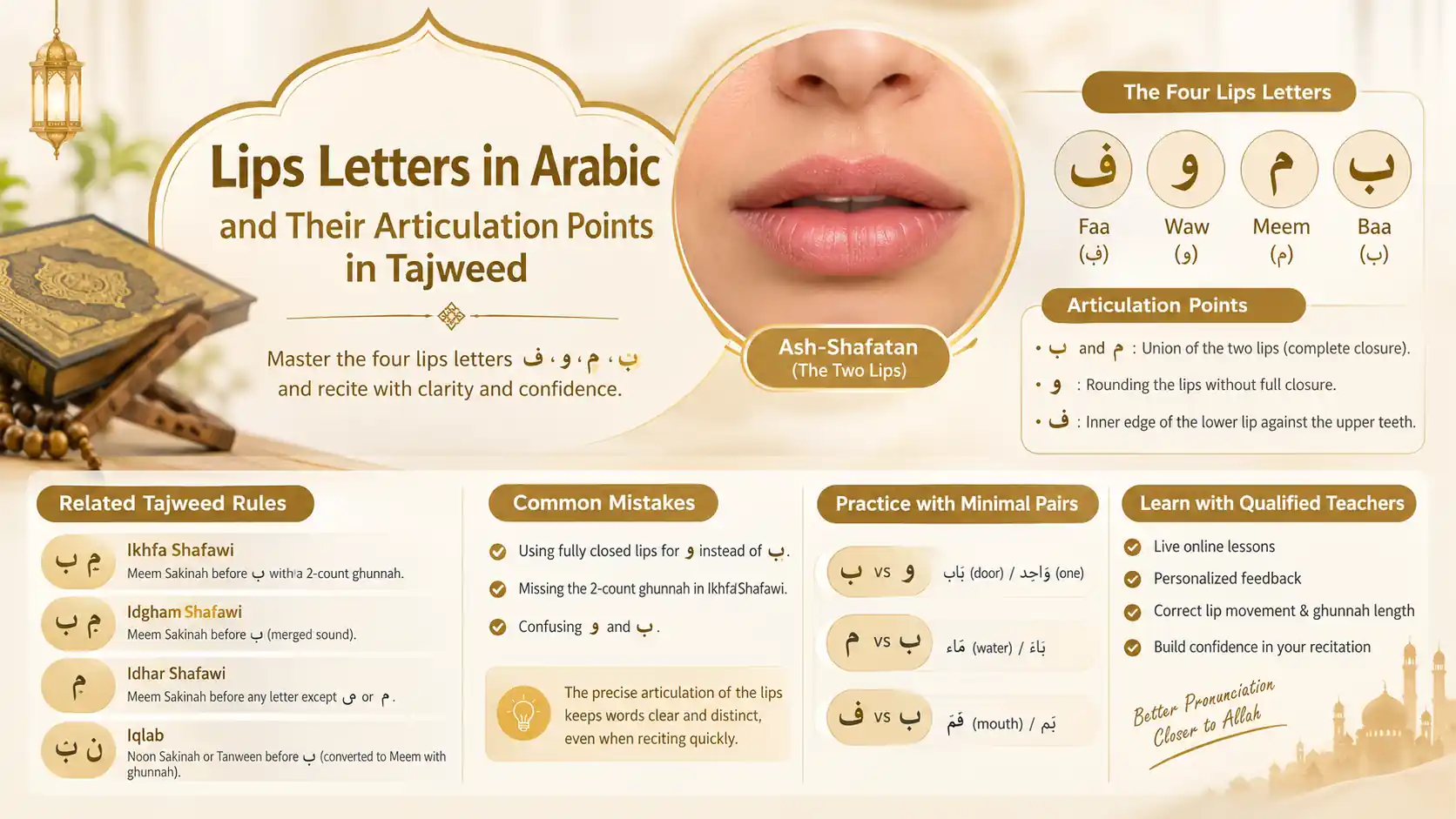
Lips letters in arabic are located in the very front of the Tajweed’s makhraj map, but have more rules than one would expect. The difference between reciting clearly and blending letters by mistake is knowing the makhraj of the lips letters in arabic ب,م,و, and ف. This guide explains the articulation point for each lip letter, rules based on them, along with drills to correct common errors in these rules (Ikhfa Shafawi, Idgham Shafawi, Idhar Shafawi, and Iqlab).
What Are the lips letters in arabic?
When using the lips to make sound, the four sounds are called lips letters in arabic and are very simple to perform in arabic as Ash-Shafatan (waa, beeh, meeh, faah). In english terminology,.
They are one of the five groups of letters in the makhraj of arabic letters in english, along with the letters in the throat, tongue, oral cavity, and nasal cavity. Although they are the smallest group they have a number of tajweed rules associated with Meem Sakinah and Noon Sakinah.
What Is Ash-Shafatan in Tajweed?
Ash-Shafatan literally means “the two lips”, and that is the makhraj that is responsible for the sounds ب، م، و، ف. The two points in this area are the inside of the lower lip against the front of the upper teeth for ف, and the union of the two lips or rounding them for the letters (ب, م, و).
Ash-Shafatan is also one of the five main areas listed on every makhraj chart for the arabic alphabet makhraj next to the throat, tongue, oral cavity, and nasal passage.
Perfect Your Islamic Recitation of Holy Quran With Tajweed
How Do You Pronounce ب (Baa) Correctly from the Lips?
One of the first, most definite lips letters in Arabic is b: both lips must be completely closed then open again with a clear stop, which is no nasal sound unless another rule in tajweed calls for it. Lips should be closed.
but not overly tight so that it sounds natural, not forced. This same closure point occurs for م as well and is the reason why the two arbi horof makhraj are often confused if not practiced.
How Is م (Meem) Pronounced from the Lips?
The lip closure is the same as that of ب, but the sound is emitted from the nose, making a light nasal hum (ghunnah). It is a nasal quality that is one of the conditions of several rules such as Ikhfa Shafawi and Idgham Shafawi. The length of the ghunnah is as important as the lips being closed, and is normally two counts.
Earn Your Tajweed Course Certificate Online and Recite with Confidence
How Do You Pronounce و (Waw) as a Consonant?
The letters of the alphabet in Arabic that involve four lips are tricky in order to round the lips without making them close completely, as in the letter ب and م.The letters of the alphabet in Arabic that involve four lips are tricky:
You should round the lips but don’t fully close the lips like you do with the letters ب and م. Many English speakers actually make the sound of و more like a ب sound by closing their lips too much. The sound of و is a long vowel, which means that the lips do not contribute to the sound.
Explore Online Tajweed Classes
Why Is ف (Faa) Different from the Other Lip Letters?
ف is the only lip letter that doesn’t make direct contact with the lips, and is formed by the inner edge of the lower lip against the tips of the upper front teeth. Despite being classified under Ash-Shafatan, this is more similar to the teeth-based letters than to ب, م, و. Pronounce ف with the whole lip instead of just its inner edge.
Simplified Rules of Tajweed for Easy Quran Recitation
What Tajweed Rules Are Related to the Lip Letters?
lips letters in arabic such as م and ب are very important in the study of tajweed, as several of its major rules rely on them. This is in addition to the three rules of Meem Sakinah, which are Ikhfa Shafawi, Idgham Shafawi, and Idhar Shafawi, and the four rules of Iqlab.
which are the conversion of the Noon Sakinah and Tanween into a Meem before ب. Each rule can be heard with the understanding of tajweed makhraj of arabic letters.
What Is Ikhfa Shafawi — and When Does It Happen?
Ikhfa Shafawi only occurs when Meem Sakinah (مْ) is followed by a b that is pronounced with the lips lightly touching but not fully pressed, and with a 2-count ghunnah. While Ikhfa Haqiqi has 15 trigger letters for Noon Sakinah, Ikhfa Shafawi has only one trigger: ب. This is a very small rule which is not always apparent because it only comes in one particular combination.
Advanced Quran Tajweed Rules for Accurate Quran Recitation
What Is Idhar Shafawi for Meem Sakinah?
If Meem Sakinah is followed by a letter other than ب or م then the sentence is idhar shafawi. In this place, the meem is clearly pronounced and short, and no ghunnah or lip pressure is added to it. When the next letter is either و or ف, extra care is needed.
Explore our Quran hafiz course
How Does Iqlab Affect Noon Sakinah Before ب?
The only trigger letter for this rule is ب and in Iqlab, this meem is pronounced as a light meem. The converted sound is taken with a two-count ghunnah and a soft lip closure because it is now almost a meem. This is because the pronunciation of noon is not very easy in front of the letter ب, so Arabic changes the sound to the lips.
Quran Tajweed With English Translation for Easy Reading
What Common Mistakes Do English Speakers Make with Arabic Lip Letters?
The most common error is to use fully closed lips for the vowel and remove the difference between the two, and that is pronouncing and using و instead of ب. Another mistake that is often made is to miss the ghunnah length in the m in Ikhfa Shafawi, making the nasal length only 1 count instead of 2.
How Do Lip Letters Appear in Quranic Words and Verses?
In the Quran, letter b, m, w, and f are common letters, and lips letters in arabic appear repeatedly throughout the Quran. The precise articulation of the lips is necessary to keep the words clear and distinct even when reciting rapidly,.
such as the word “and” (و)-و) known as the connecting و, as well as the word بِسْمِ, which refers to the name of Allah, and رَحْمَة, which indicates mercy. The wrong pronunciation of lips is not only audible, but it may also affect the delineation of words in a verse.
Ikhfa Rules of Tajweed Explained with Letters Examples and Tips
What Drills and Minimal Pairs Help You Practice Lip Letters?
Minimal pairs — words that differ by only one of the lips letters in arabic — train the ear and mouth together faster than repeating single letters.
- ب vs و: بَاب (door) / وَاحِد (one)
- م vs ب: مَاء (water) / بَاء
- ف vs ب: فَم (mouth) / بَم
Explore Mubarak Academy — Online Courses
How Can You Tell If Your Lip Articulation Is Correct?
Telling whether your lips letters in arabic are correct comes down to a teacher’s live correction, not self-judgment.
- A qualified teacher listens for lip closure, ghunnah length, and و vs ب distinction in real time.
- Recording yourself and comparing to a certified reciter reveals gaps self-listening misses.
- Passing a structured tajweed evaluation confirms accuracy across all four, not just one.
Easy Tajweed Rules in English for Complete Beginners
Learn Arabic Lip Letters With Qualified Quran Teachers
Mastering the arabic lip letters tajweed requires more than memorizing their articulation points. A qualified Quran teacher can listen to your recitation, observe lip movement, correct pronunciation, and explain rules such as Ikhfa Shafawi, Idgham Shafawi, Izhar Shafawi, and Iqlab. At Mubarak Academy, students can learn through live Quran and Tajweed lessons with qualified teachers, structured practice, and direct pronunciation feedback.
Ready to improve your Quran pronunciation? Book a free trial with Mubarak Academy and practice Arabic lip letters with a qualified Tajweed teacher.
Frequently Asked Questions
Do lip letters differ between Arabic dialects and Quranic Arabic?
Yes, pronunciation can vary across Arabic dialects, particularly in everyday speech. However, Quranic recitation follows the established classical Arabic makhraj. Students should therefore learn the articulation points of ب، م، و، and ف according to Tajweed rather than relying only on their spoken dialect.
Is Ikhfa Shafawi the same as Ikhfa Haqiqi?
No, they are different Tajweed rules. Ikhfa Shafawi occurs when Meem Sakinah is followed by ب, while Ikhfa Haqiqi applies to Noon Sakinah or Tanween before fifteen specific letters. Each rule has different articulation and pronunciation requirements that students must practice carefully.
Why does Arabic have a rule for Meem before Baa?
Meem and Baa share a close lip articulation, making their combination especially important in Quranic recitation. When Meem Sakinah comes before Baa, Ikhfa Shafawi applies, requiring a softened pronunciation with two-count ghunnah rather than fully pronouncing the Meem clearly.
Can online lessons teach precise Arabic lip articulation?
Yes, live online Tajweed lessons can effectively teach lip articulation when a qualified teacher observes the student’s mouth position and recitation in real time. Teachers can correct lip closure, Waw pronunciation, ghunnah, and other articulation issues immediately, allowing students to develop accurate pronunciation through guided practice.
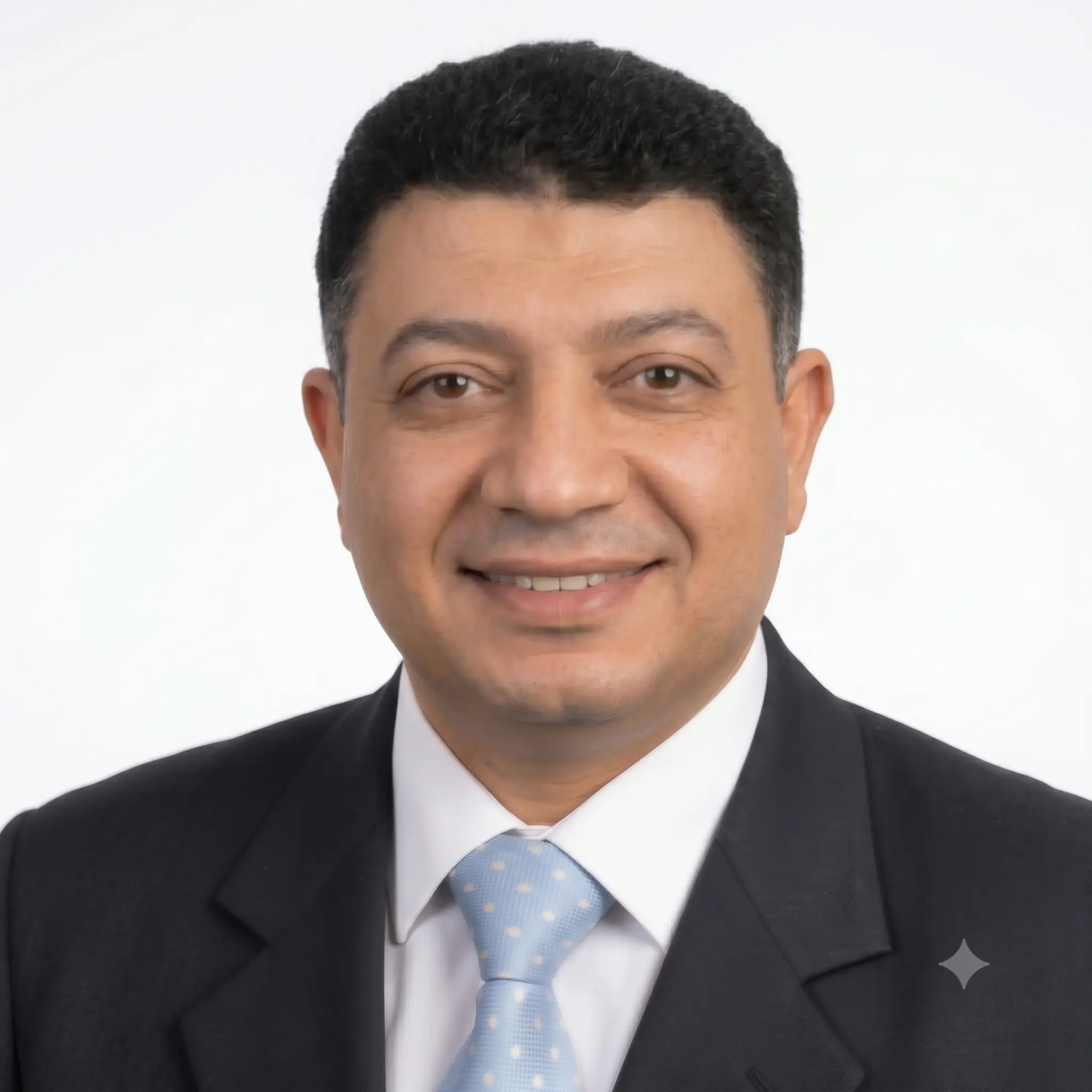
Ustadh Ahmed Mahmoud Abdulaziz is an experienced teacher of Arabic and the Holy Quran for native and non-native speakers. He holds a verified Ijazah in Hafs ‘an Asim and is certified in the foundational Tajweed texts Al-Jazariyyah and Tuhfat Al-Atfal. Drawing on his extensive background in traditional Quranic recitation and international pedagogy, he writes scholar-verified, accessible articles to help students worldwide master Tajweed rules and Arabic linguistics safely and accurately.