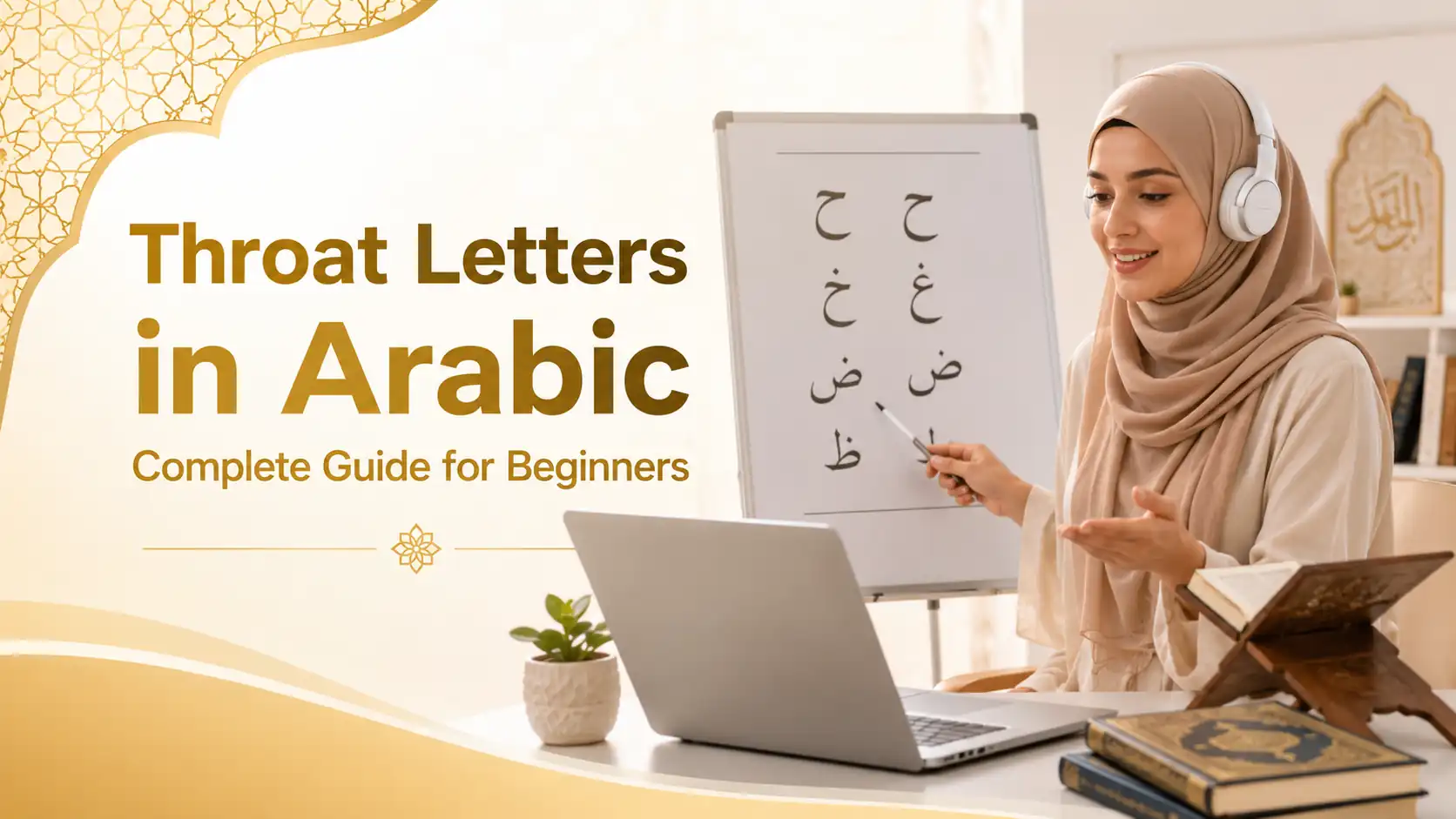
Throat letters in Arabic are the very foundation of proper recitation of the Quran, and many beginners don’t bother with them even though they alter the meanings. These six sounds originate entirely from the throat and are called “huruf al-halq.” We will discuss all the Arabic throat letters, where they are articulated, common errors, and how to practice them so that your online tajweed classes don’t go to waste beyond week one.
What are the throat letters in Arabic?
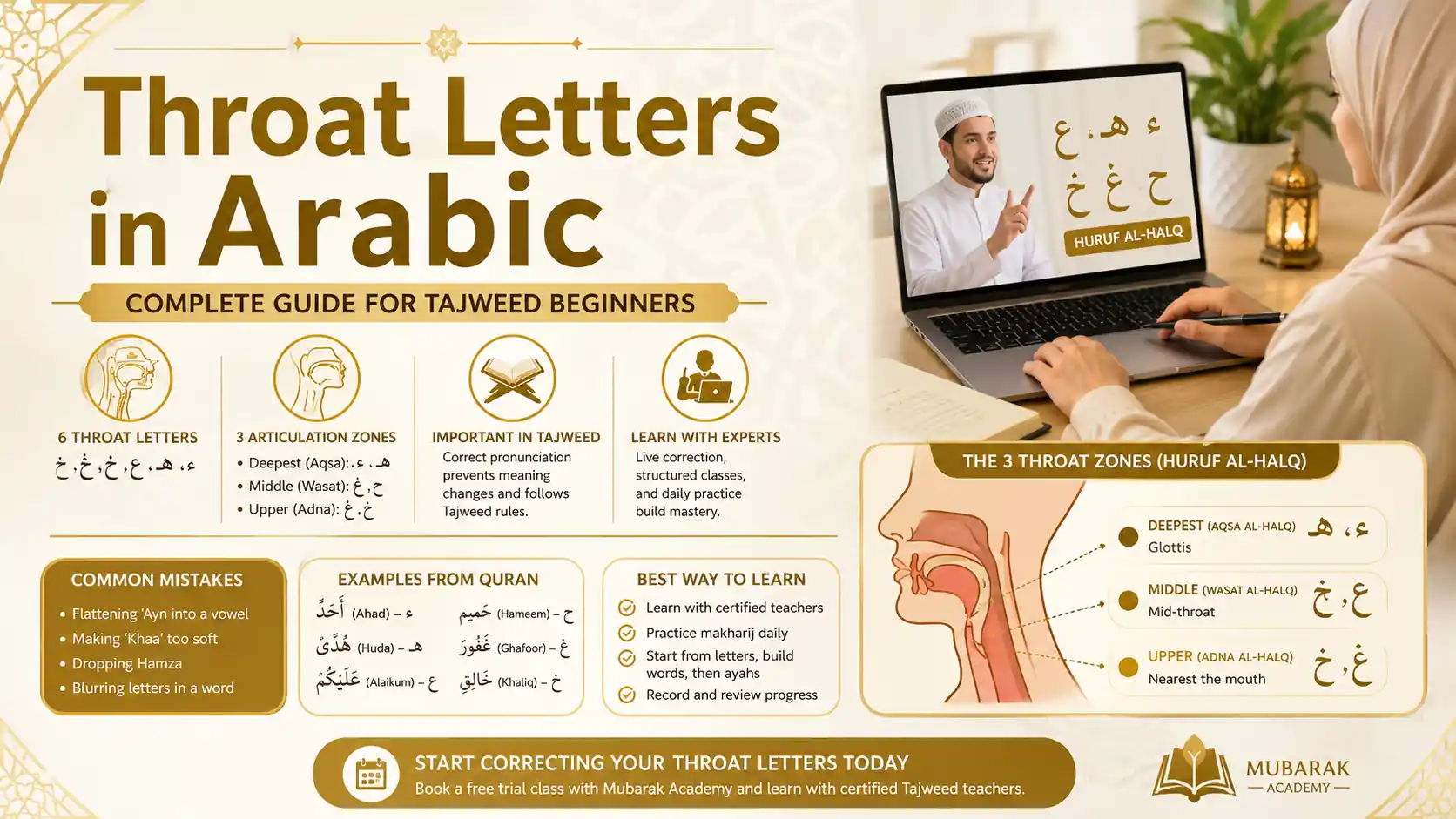
Throat letters in Arabic are 6 consonants that are pronounced from the throat rather than the tongue, lips or nose. They are ء, هـ, ع, ح, غ, and خ. The scholars of Tajweed call this group as huroof al halq which means that each letter comes out from a fixed and measured position on the length of the throat.
How many throat letters are in arabic?
In the Arabic language, there are exactly six letters of the throat. In Arabic, precisely 6 letters of the throat exist. Many students may be surprised that there are a certain number of throat letters in Arabic and that it is so small. The six are equally divided into pairs of letters representing the deepest, middle, and closest parts of the throat.
New Arabic Course for English Speaking Students Guide
Is hamza a throat letter?
Hamza (ء) is indeed a letter of the throat, and it is from the deepest source into which it is placed, the glottis. It shares this lowest level with haa (هـ). A few people mistake alif for hamza because they both have the same form when written, but only hamza has an articulation point all by itself in makharij al huruf.
Here is a simple test: Make a gentle cough, then make the same closure and open it gently on a vowel sound. This is because hamza is created at that closure point, and a soft glide to the next letter is not enough; you must stop firmly and deliberately.
What is the Arabic letter ع called?
The Arabic letter ع is known as ‘ayn and is one of the two letters in the middle of the throat in Tajweed. Ayn has no equivalent sound in English, and that’s why it is one of the most difficult examples of throat letters for non-native speakers to master without the help of a live teacher who can correct the sound of the letter.
Ayn is frequently mispronounced as alif (a) or glottal stop (ʔ), particularly by students who have carried over the English phonics tradition of silent letters. The correct sound requires a slight, but not too great, constriction in the middle of the throat, which is made with the vocal cords closed all the time, as in the voiced sound, unlike the unvoiced sound haa.
Learn Arabic in English Step by Step for Complete Beginners
What is the difference between ح and خ?
In spite of their similar appearance for new learners, both ح and خ share the same set of articulatory configurations and form the middle throat, but they differ in their exact makhraj, with the former being articulated with a light, breathy friction and no involvement of the tongue whereas the latter is articulated with a harsh, rasping sound of the friction against the soft palate and is closer to the mouth.
What are the three throat articulation points?
Huruf al-halq has 3 points of articulation for the throat, which is divided into three sections, each giving rise to 2 letters. The deepest zone (aqsa al-halq) provides for ء androt hwah. The middle zone (wasat al-halq) provides ع and ح. The upper zone (adna al-halq), which is closest to the mouth, produces غ and خ.
| Zone | Arabic name | Letters | Position |
|---|---|---|---|
| Deepest | Aqsa al-Halq | ء, هـ | Glottis |
| Middle | Wasat al-Halq | ع, ح | Mid-throat |
| Upper | Adna al-Halq | غ, خ | Nearest the mouth |
This is a three-zone map that is the quickest way to memorize all 6 throat letters in tajweed without getting confused about the correct placement, and it is the first lesson that is taught in all certified online Arabic courses before any rules are taught.
How do you pronounce throat letters in Arabic?
In Arabic, throat letters are pronounced by isolating exactly where each letter originates and regulating the airflow at that one particular point and not at the throat as a whole. This can be accelerated by a brief routine to makharij practice, which can be structured and practiced in a few minutes a day, rather than doing random repetition.
- Now put your hand over the friction point of each letter to feel it.
- Work in one zone at a time, beginning in the deepest and then progressing toward the surface.
- Say each letter separately, then in a short word, then in a whole ayah.
- Record and check against a professional reciter to identify any drift.
Why are throat letters important in Tajweed?
The importance of throat letters with regards to Tajweed is that if they are mispronounced, the meaning of the word is altered, rather than just the accent. They also prescribe some rules, such as izhar halqi, which means that immediately after noon there must be a clear noon sakinah, and there is no nasalization or blending of any throat letter.
One of the most frequent mistakes made by beginner Tajweed classes online is the avoidance of izhar halqi, which is a common mistake, as it is easy to drop the “noon” sound. A recitation will immediately sound more precise just by getting this one rule right, even before all the throat-letter articulation points are mastered.
Best Way to Learn Quranic Arabic for Beginners Step by Step
What are examples of throat letters in Arabic?
The throat letters examples that are used in the throat are found everywhere throughout the Quran, so the best way to practice is to recite it every day. Ayn would be featured in “Al-Alameen. In “Alhamdulillah” there is the word “Haa.” In the book “Ghafoor,” Ghayn is mentioned. In “Khaliq,” Khaa is featured. Hamza begins almost every surah, and haa (هـ) ends almost every verse in “Allahu.”
- Deepest zone: أَحَد (Ahad, “the One”) and هُدًى (huda, “guidance”).
- Middle zone: “Upon you, be merciful.
- Upper zone: غَفُور (ghafoor, “forgiving”) and خَالِق (khaliq, “creator”).
- Mixed word: أَعُوذُ (a’oothu) is a word that contains three distinct letters of the throat.
Which letters come from the middle of the throat?
The second of the three throat articulation points is made with the letters that are formed in the middle of the throat, namely ع (ayn) and ح (haa). This area is about halfway down the throat, and both letters require a controlled narrow constriction not easily achieved by beginners, which will give the sound a flattening effect.
Arabic Classes for 3 Year Olds That Build Early Language Skills
Which letters come from the deepest throat?
The letters that are produced from the lowest position of the throat are ء (hamza) and هـ (haa al-hams), both of which are produced immediately before any part of the vocal tract is used. This is the point that is located the farthest from the mouth, so students often say it too quietly, and it seems to melt into a word.
Which letters come from the upper throat?
The letters from the upper throat are غ (ghayn) and خ (khaa), which are closest to the mouth of the three throat areas. This close proximity to the oral cavity is why some students make the mistake of moving these two sounds towards regular mouth sounds.
What are common mistakes with throat letters?
Common mistakes with throat letters usually come from collapsing separate zones into one vague “throaty” sound instead of hitting each precise point. Students often flatten ع into a plain alif sound, soften خ until it resembles ه, or rush hamza so it barely registers, distorting meaning for tajweed for beginners.
- Deepest zone: dropping hamza almost silently instead of a clear glottal stop.
- Middle zone: letting “ayn” collapse into a flat, ordinary vowel sound.
- Upper zone: pushing “khaa” too far forward, toward a plain “h” sound.
- Whole-word level: rushing through consecutive throat letters and blurring two makhraj of throat letters into one.
Hamzatul Wasl and Hamzatul Qat’: Rules, Differences, and Quran Examples
How can non natives learn throat letters?
Non-natives can learn throat letters fastest by combining live correction with focused daily drills, since throat sounds are nearly impossible to self-diagnose from a book alone. Progress usually comes from a short, repeatable routine rather than long, occasional study sessions. A practical path looks like this:
- Start with a certified teacher who can hear and correct your exact articulation point in real time.
- Use mirror and hand-on-throat drills before attempting full verses.
- Join structured Tajweed classes online that isolate huruf al-halq before mixing them with other makharij.
- Track weekly progress against a recorded baseline to confirm the sound is actually improving.
How Hard Is It to Learn Arabic?
Are throat letters the same as qalqalah letters?
No, throat letters are not the same as qalqalah letters, even though both groups trip up beginners early on. Throat letters are defined by where they exit the vocal tract, all six inside the throat. Qalqalah letters (ق, ط, ب, ج, د) are defined by a bouncing echo when they carry sukoon, regardless of articulation zone.
The two categories only overlap indirectly: qaf, one of the five qalqalah letters, sits near the throat region but is not classified as huruf al-halq. Keeping these two rule sets separate in your mind prevents a common beginner mix-up between makhraj-based groups and sifah-based (characteristic-based) groups like qalqalah.
Harakat in Arabic Language: The Ultimate Beginner’s Guide to Arabic Vowels
Why Choose Certified Online Arabic Courses from Mubarak Academy?
Choosing certified online Arabic courses from Mubarak Academy means learning with qualified teachers and a structured approach designed for international students. Founded and directed by Ustadh Ahmed Mahmoud Abdulaziz, who holds an Ijazah in Hafs ‘an Asim and certifications in foundational Tajweed texts, the academy maintains high standards for teacher selection and curriculum quality.
Our instructors include graduates of Al-Azhar University and Cairo University, with expertise in Arabic, Quranic Arabic, and teaching non-native speakers. Students receive personalized guidance, flexible individual or group classes, structured learning plans, and ongoing support—helping beginners and advanced learners develop practical Arabic skills with confidence.
Start correcting your throat letters today
Mastering throat letters in Arabic is not something a book alone can fix, since these six sounds live or die on live, real-time correction. Book a trial session with a certified tajweed teacher, get your ayn, haa, and khaa checked letter by letter, and turn guesswork into a Quran recitation you can recite with real confidence.
Our instructors are certified with ijazah in Tajweed and have spent years correcting exactly these six sounds for non-native Arabic speakers, one-on-one. Every lesson applies the classical makharij al huruf framework taught by traditional Qira’at scholars, so corrections are rooted in an established science, not casual guesswork or shortcuts.
Book a free trial class with Mubarak Academy and get personalized, one-on-one correction for every Tajweed articulation point.
FAQs
What are the throat letters in Arabic?
There are six letters of the throat in Arabic: ء, هـ, ع, ح, غ, and خ. They are called huruf al-Halq which are pronounced from three parts of the throat with two letters from each articulation point.
How many throat letters are there in Arabic?
In Arabic, there are six letters for the throat: hamza (ء), haa (هـ), ayn (ع), haa (ح), ghayn (غ), and khaa (خ). According to Tajweed, they are divided into three places of articulation lower, mid, and upper throat.
What are the three throat articulation points?
Aqsa al-Halq is the lowest point of articulation, and Adna al-Halq is the highest point of articulation, while Wasat al-Halq is the middle point of articulation. Aqsa makes ء and هـ, Wasat makes ع and ح, Adna makes غ and خ—six different throat letters.
Why are throat letters important in Tajweed?
Throat letters are significant because mispronunciation may lead to miscommunication and/or unclear understanding of words in the Quran. Their exact makharij, too, assists them to utilize the Tajweed rules accurately, such as the use of the rule of Izhar Halqi, where the student is required to pronounce halqooq in a clear manner after some sounds of the letter noon.
How can non-natives learn throat letters?
Throat letters in Arabic can be learned by non-native learners through regular practice with a qualified teacher of Tajweed who can correct their pronunciation on the spot. Short daily drills, repetition exercises, recording of recitations, and progressive Tajweed lessons online can slowly help to develop Quranic accuracy and improved recitations.

Ustadh Ahmed Mahmoud Abdulaziz is an experienced teacher of Arabic and the Holy Quran for native and non-native speakers. He holds a verified Ijazah in Hafs ‘an Asim and is certified in the foundational Tajweed texts Al-Jazariyyah and Tuhfat Al-Atfal. Drawing on his extensive background in traditional Quranic recitation and international pedagogy, he writes scholar-verified, accessible articles to help students worldwide master Tajweed rules and Arabic linguistics safely and accurately.