If your recitation is still correct but not polished, then the advanced tajweed rules will fill in the gaps. Once these rules are learned, Qaris will use them after learning the rules of noon sakinah, qalqalah, and basic madd: exact madd lengths, idgham exceptions, sakt, and conditional tafkheem. Every advanced rule is explained with examples, every common mistake that advanced learners make, and a study plan to get from correct to truly polished recitation.
What Are Advanced Tajweed Rules?
The rules for tajweed that are used when the basic rules are automatic are known as the rules of the advanced tajweed and include the length of the madd, the exceptions of idgham, sakt, and the conditional heaviness of certain letters. They will develop skills you already have and not teach you new skills.
A reciter should perform at this level:
- Clear makharij and letter characteristics, at natural reading speed
- Several different types of mad, each with a different number required
- A few exceptions to the four general rules for noon sakinah.
- It is important to place ‘sakt, waqf, and ibtida’ in continuous recitation. It is important to place ‘sakt, waqf, and ibtida’ in continuous recitation.
- In the event of two conditions tafkheem and tarqeeq with the help of vowel and context
All of these are based on a rule that you already know but have honed and made automatic (as opposed to thinking about mid-ayah).
Explore more about quran memorization online
How Are Advanced Tajweed Rules Different from the Basics?
The advanced tajweed rules are exceptions that are detailed at the letter level and not covered in detail in basic tajweed. It’s not new topics, but precision.
- The four rules of tajweed for noon sakinah are taught in basic tajweed, while the nuances of meem sakinah and exceptions of shafawi are taught in advanced tajweed.
- In tajweed course online, one will learn one general madd length, and in advanced tajweed, one will learn the exact counts for muttasil, munfasil, laazim, aridh, and lin.
- In basic tajweed, the idgham is classified under one heading, while in advanced tajweed, there are three types of idgham (mutamathil, mutaqarib, and mutajanis), each with its own exceptions.
- In basic tajweed, rare pauses are hardly mentioned, and in advanced tajweed, there are four fixed positions throughout the Quran where the pause is sakt.
Rules of Raa in Tajweed Explained for Correct Recitation
How Do You Know When an Advanced Tajweed Rule Applies?
You’re familiar with an advanced rule that occurs when two sukoon letters come together, when a madd letter is followed by hamza, or when a stop sign is not at the end of an ayah but in the middle.
- When two sukoon letters meet at the beginning of a word, check the iltiqaa’ as-sakinayn:
- If the letter that is maddened is followed in the same word by a maddened letter, then the maddened letter is followed by a hamza
- A madd letter is at the end of a word and a hamza is at the beginning of the next word: apply madd munfasil
- A small seen (س) is placed above a letter in the mushaf to indicate saqṭ
- The mushaf is a stop symbol, and waqf lazim applies, not waqf nafi.
Basic Rules of Tajweed for Beginners and Correct Quran Recitation
What Are the Advanced Madd Rules Every Reciter Must Master?
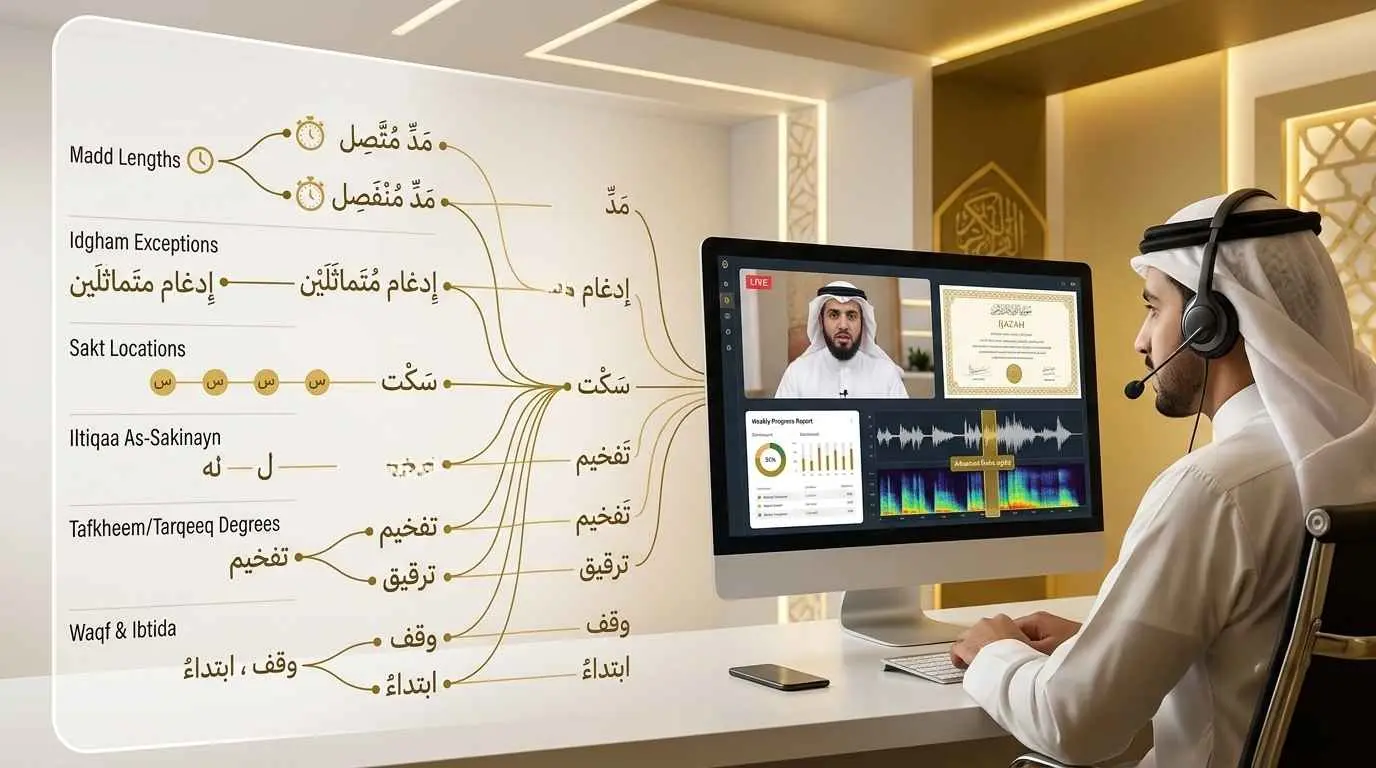
The advanced madd rules which every reciter has to master are Madd Muttasil, Madd Munfasil, Madd Laazim, Madd Aridh lis-Sukoon and Madd Lin, each for a different number of counts.
Advanced Tajweed Rules: Madd Length Reference
| Madd Type | Trigger | Length |
|---|---|---|
| Madd Muttasil | Madd letter and hamza in the same word | 4-5 counts |
| Madd Munfasil | Madd letter ends a word, hamza starts the next | 2-5 counts, by riwayah |
| Madd Laazim | Madd letter before a permanent sukoon or shaddah | 6 counts, always |
| Madd Aridh lis-Sukoon | Madd letter just before a stop | 2, 4, or 6 counts |
| Madd Lin | Waw or ya sakinah preceded by fatha | 2, 4, or 6 counts, only when stopping |
The five are very easy to mix up with each other, and most teachers have students learn them one at a time before adding them all together in whole surahs, but this is one of the quickest ways to lose marks in an ijazah exam.
Revelation Recording and Memorisation of the Holy Quran
What Are the Types of Advanced Idgham and Their Exceptions?
Advanced idgham is broken down into three categories: idgham with ghunnah, idgham without ghunnah, and three additional types for letters that touch outside of the noon sakinah rules altogether.
- Idgham with ghunnah: noon sakinah or tanween merges with ي ن م و with a nasal sound that is made over two counts.
- Idgham without ghunnah: noon sakinah or tanween meets ل or ر, merged with no nasal sound at all
- Idgham mutamathilain: two identical letters come together, and the first merges completely into the second.
- Idgham mutaqaribain: two letters having close makharij meet, like lam meeting ra
- Exception: Izhar Mutlaq: If two waw or ya letters appear side by side in the same word, they are not joined together and are pronounced distinctly.
Explore more about Tafkheem and Tarqeeq in Tajweed
What Is Iltiqaa as-Sakinayn and How Do Reciters Resolve It?
Iltiqaa as-Sakinayn is the meeting of two letters with the same madd, which classical Arabic phonetics does not allow but is solved by dropping or shortening a letter with the madd.
- In continuous recitation, any word ending with a long madd letter and the next word beginning with sukoon will have the madd letter dropped.
- Hamzatul wasl is followed by a madd letter, in which case the madd is shortened or dropped so that the two sukoons do not join.
- The most common is the madd letter that meets with hamzatul wasl at the beginning of the following word.
This is the only way to avoid having a fast recitation sound clipped or mumbled between words.
Explore more about Comprehensive Quran Hifz Classes for Ladies
What Is Sakt in Quran Recitation?
Sakt is a short pause (2 counts) without breathing between two words that would otherwise be misread if there were no pause between them.
Sakt is mandatory at four fixed locations in the narration of Hafs an Asim: after the word “عِوَجًا” in Surah Al-Kahf, after the word “مَرْقَدِنَا” in Surah Ya-Sin, after the word “مَنْ” in Surah Al-Qiyamah, and after the word “بَلْ” in Surah Al-Mutaffifin. Sakt, on the other hand, has no breath and no change to the mad length, which is why it is easy to miss without a teacher’s correction.
How Does Tafkheem and Tarqeeq Work at an Advanced Level?
In the advanced level, tafkheem and tarqeeq no longer rely on the letter but on the vowels and the letter just preceding them.
- The letters always considered heavy are seven letters, namely, خ, ص, ض, ط, ظ, غ, andغ ق, no matter whether the vowel that is attached to them is long or short.
- The lam is heavy when it occurs between letters after fatha or damma but light when it occurs between letters after kasra.
- Ra is heavy with fatha or damma, and light with kasra
- When the vowel of the letter before Ra with sukoon, it is decided by Ra with sukoon.
- The heaviness of heaviness has different degrees, the strongest one being “fatha” and the weakest one being “kasra.”
Explore more about Idgham in Tajweed: Types, Rules, Letters, and Examples from the Quran
How Do Waqf and Ibtida Affect Pronunciation?
Waqf changes the ending of words by removing tanween and adding or dropping short vowels, and ibtida determines the exact point of a recitation to begin without disturbing the meaning.
- Waqf lazim: A full stop that is required in the mushaf at the end of tanween and short vowels.
- Waqf jaiz: an optional stop, made based on breath and meaning
- After each stop, Ibtida must start somewhere that maintains the grammatical structure of the sentence.
- If it is restarted in the middle of a phrase, then it may change the meaning, so the advanced reciters learn waqf for each surah they memorize.
Explore more about Online Islamic Homeschooling
What Mistakes Do Advanced Learners Make in Tajweed?
The most frequently made mistake by the advanced learners is that they start to use rules of reading too quickly and too inconsistently, particularly in the case of madd counts and ghunnah length.
- When reciting the madd laazim is shortened and recited quickly, the counts are reduced to less than six.
- Not remembering anything of sakt whatsoever and incorporating it into normal pause
- The use of idgham without ghunnah when ghunnah is needed.The application of idgham instead of ghunnah when ghunnah is needed.
- An error that occurs when a vowel is not used to match the “ra” and is guessed instead of being checked according to the vowel rule each time.
- Learning without the ability of a teacher to hear these subtle differences as they happen.
Explore more about Quran Stop Signs (Waqf): Symbols, Rules, and Examples
What Is the Best Study Plan for Mastering Advanced Tajweed?
The best means of study is to deal with one rule family at a time, starting with madd, then idgham, then sakt and waqf, then tafkheem, and then having the teacher correct each one as it goes.
- Weeks 1-2: learn all five types of madd from a teacher who will correct the counts on the spot
- Weeks 3-4: drill idgham with and without ghunnah, then the three-letter meeting exceptions.
- Week 5: make four SAKT locations familiar and practice them in their real context.
- Week 6: study waqf and ibtida rules in whole surah, rather than individual ayat
- Ongoing: Review makharij and tafkheem within the context of the real Quran recitation, not isolated drills.
This is a written guide, like all others, which is a good place to start, but a live course with a qualified teacher, online, is what will make the map a habit.
Start Refining Your Recitation Today:
In Mubarak Academy you get advanced tajweed rules from ijazah-certified teachers in live, 1-on-1 Zoom sessions and receive weekly progress reports to track which rules you are mastering. Over 100+ teachers from 80,000+ hours of live teaching have helped over 1,000 students across 20+ countries perfect their recitations.
Book a free trial class with Mubarak Academy today and get a personalized tajweed assessment before you commit to a plan.
Frequently Asked Questions
Do I need to memorize all madd counts before starting advanced tajweed rules?
No, it’s not enough to write out the counts; they don’t necessarily get recited. Begin to apply MADD rules with a teacher correcting you as you go, ayah by ayah—so that the numbers are imprinted in the muscles rather than recalled as abstract numbers that you have to think about.
Can I learn advanced tajweed rules without a live teacher?
Not reliably. The rules are explained in writing, but the difference between tafkheem strength, ghunnah strength, and sakt timing cannot be explained in writing. A tajweed course online with a live teacher allows you to be corrected on the spot when you make a mistake.
How long does it take to master advanced tajweed rules?
Most dedicated students need three to six months of consistent quran recitation practice with a teacher to apply every advanced rule correctly and automatically, though full mastery, the kind examined for ijazah, often takes a year or more of steady, corrected practice.
Is Sakt the same in every Qiraat?
No. The four “sakt” sites presented here are based on the Hafs an Asim narration, which is the most common nowadays. These words are narrated differently by other narrators and riwayat, with either the idgham or a full stop, so ask your teacher about the type of riwayat they follow.
Ustadh Ahmed Mahmoud Abdulaziz is an experienced teacher of Arabic and the Holy Quran for native and non-native speakers. He holds a verified Ijazah in Hafs ‘an Asim and is certified in the foundational Tajweed texts Al-Jazariyyah and Tuhfat Al-Atfal. Drawing on his extensive background in traditional Quranic recitation and international pedagogy, he writes scholar-verified, accessible articles to help students worldwide master Tajweed rules and Arabic linguistics safely and accurately.