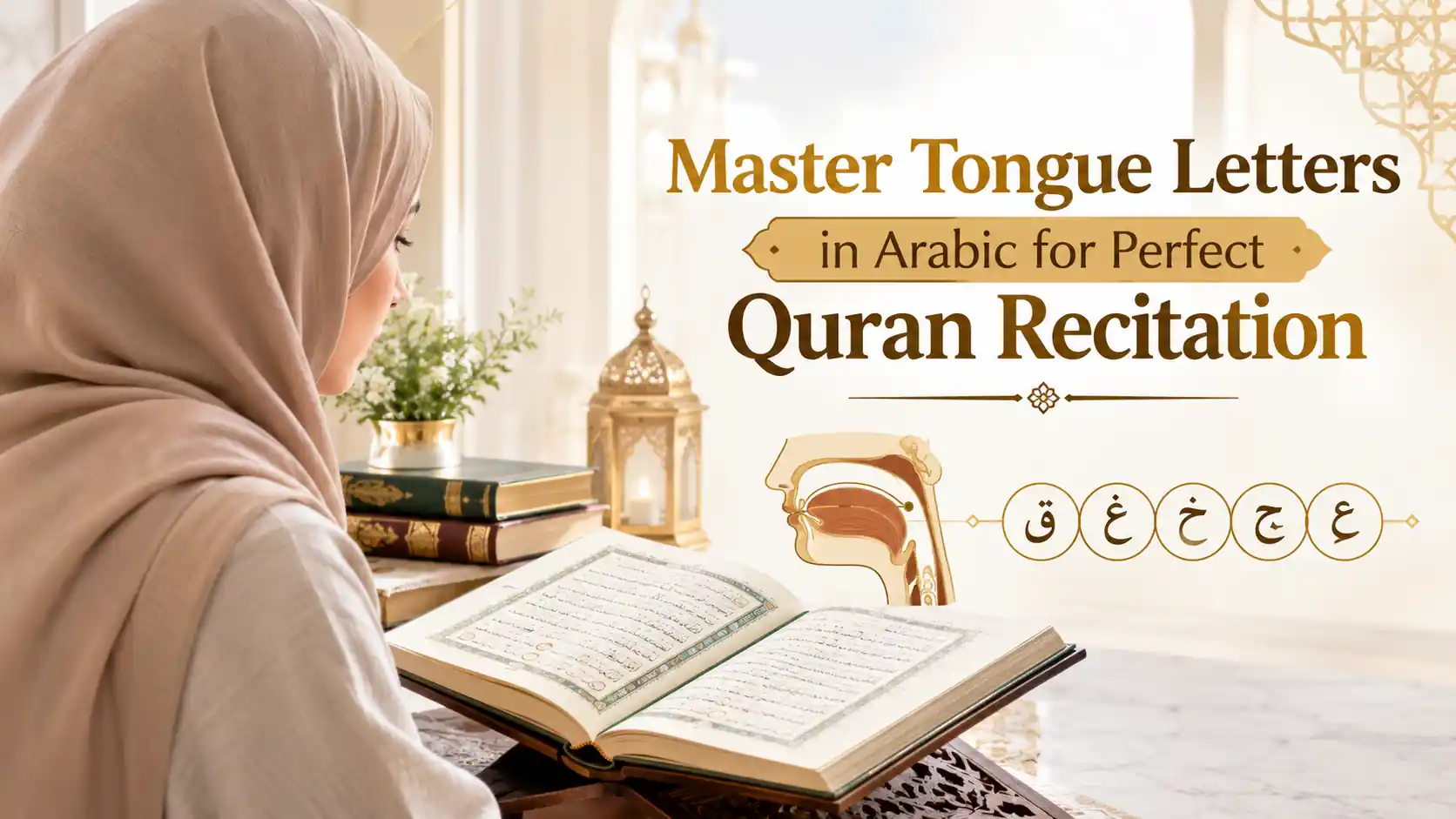
The greatest number of articulation points in tajweed are tongue letters in arabic, and correct pronunciation of the arabic letters, the correct recitations of the quran, and the correct pronunciation of the quran are based on the mastering of these letters. Many students know the shape of the letters of their own language, but they aren’t taught exactly where each sound is produced in the mouth, resulting in their whole lives of small mispronunciations.
What Are the 14 Arabic Tongue Letters?
tongue letters in arabic are the sounds made by the tongue in contact with, or narrowing against, various parts of the mouth, and they comprise the largest number of Arabic points of articulation. However, there are various ways of categorizing them in the Tajweed sourcebooks.
with some referring to about 14 main letter sounds of the tongue, and others to a more comprehensive 18, when each contact point is split up. The throat, lips and nasal cavity, in either case, generate fewer Arabic letters than does the tongue.
How Does the Tongue Produce Arabic Sounds?
The production of the tongue letters in arabic begins with two simple movements of the tongue.
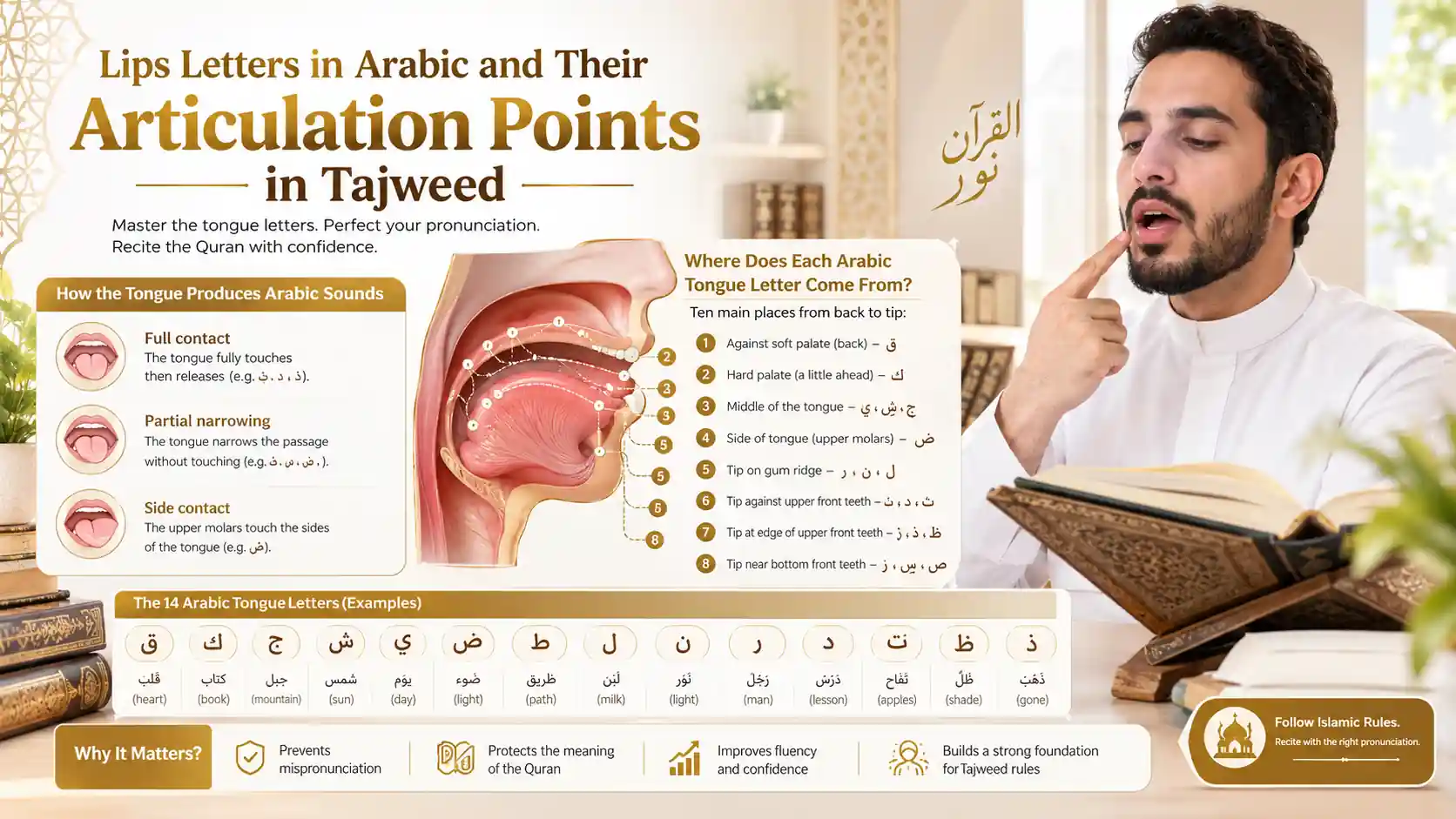
- Full contact: entire contact of the tongue to another sound is completed and then released (as in the sounds ت، د، ط).
- Partial narrowing: Tongue narrows the passage but does not touch it, friction (as in ص، س، ز).
- Side contact: teeth of upper molars touching the sides of the tongue, used only in ض.
Lips Letters in Arabic and Their Articulation Points in Tajweed
Where Does Each Arabic Tongue Letter Come From?
Arabic letters for tongue are made at approximately ten places from the back to the tip of the tongue.
- Against soft palate near the back of the tongue: ق
- A little ahead of that, on the hard palate: ك
- Middle of the tongue: ج، ش، ي
- Next to the upper molars on the side of the tongue: ض
- Tip of the tongue on the gum ridge: ل، ن، ر
- Tip of the tongue, against the base of the upper front teeth: ط، د، ت
- Tip of the tongue at the edge of upper front teeth: ظ، ذ، ث
- Tip of the tongue, near the bottom front teeth: ص، س، ز
Ikhfa Rules of Tajweed Explained with Letters Examples and Tips
What Is the Difference Between Tongue, Throat, and Lip Letters?
tongue letters in arabic are formed with the tongue at a point in the mouth; throat letters are formed by the tongue (very little) at a point in the throat; lip letters are formed by the lips meeting or narrowing at a point in the lips.
Throat letters such as ء and ع are far back, lip letters such as ب and م are those with the lips closing and tongue letters are by far the largest and the most detailed set of points. It’s easy for novices to confuse these categories, which is one reason they get confused with similar-sounding letters.
Perfect Your Islamic Recitation of Holy Quran With Tajweed
How Do You Pronounce Each Arabic Tongue Letter Correctly?
correct pronunciation of arabic letters of the tongue group is more about matching the exact point of contact, than anything else about the general shape of the letter.
- Do not touch an adjacent area on the tongue, but rather its tip, side or middle.
- Regulate air flow: some letters block the flow, others impede it.
- Consistently practise all letters with each vowel.
- Live correction from teacher self-correction may overlook minor differences.
Advanced Quran Tajweed Rules for Accurate Quran Recitation
What Are the Most Common Mistakes in Pronouncing Tongue Letters?
The most frequent error is the combination of similar letters of the tongue such as the letters of the double letter [ص] and [س] or the double letter [ظ] and [ذ] because they have the same contact point but not the same shape.
A common mistake is using the wrong part of the tongue for instance, using the tip for ض when it is supposed to be used against the molars. In Quran recitations, these small differences not only alter the sound of the recitations but can also alter the meaning of the words.
Earn Your Tajweed Course Certificate Online and Recite with Confidence
What Words Can You Practice to Master Arabic Tongue Letters?
When working with tongue letters in arabic is trained quicker than repetitions of letters as in words it appears.
- ق / ك: قَلْبٌ (heart) / كِتَابٌ (book)
- ض / ط: ضَوْءٌ (light) / طَرِيقٌ (path)
- ص / س: صَبْرٌ (patience) / سَمَاءٌ (sky)
- ظ / ذ: ظِلٌّ (shade) / ذَهَبَ (he went)
Explore Online Tajweed Classes
How Can You Practice Arabic Tongue Letters at Home?
Hrer how to improve arabic pronunciation:
- Record a short list of words and play it back with a reciter to check for accuracy.
- Practice with a mirror to ensure correct tongue and mouth placement.
- Repeat each letter of the tongue, using a different vowel for each one, then move to the next.
- Check with teacher weekly to prevent errors from becoming habits.
Simplified Rules of Tajweed for Easy Quran Recitation
How Do You Know If Your Arabic Pronunciation Is Correct?
Outside correction, and not self-judgment, is the only way to improve the pronunciation of Arabis reliably.
- A qualified teacher hears the sound live and marks the point where it went out of tune.
- When you hear yourself read it’s not the same as when you hear a certified reader read it; and when you compare your voice with a certified reader’s, you will notice the differences.
- The structured tajweed evaluation guarantees accuracy not just with a few letters but with all letters of the tongue.
Easy Tajweed Rules in English for Complete Beginners
What Tools and Resources Can Help You Learn Tongue Letters?
It is always the best to have a live teacher, because only a person can see the placement errors as they happen. In addition, a structured tajweed course for beginners, mouth-position diagrams and audio of certified reciters all promote proper habits. Mispronunciation is not corrected in apps or videos without a teacher’s live correction.
Can You Learn Arabic Tongue Letters Online Without a Teacher?
The shapes and sounding of the rough sounds can be learnt, but it is highly difficult, if at all possible, without a teacher making correction in real time. Self study too, can have potential of reinforcing small errors as the difference in tones between the letters of the tongue is subtle and can not be heard easily.
Explore Mubarak Academy — Online Courses
How Long Does It Take to Master Arabic Tongue Letters?
You can’t build accurate muscle memory in a few days, most students will need to practice this over several weeks.
- Simple recognition and approximate pronunciation: 2-4 weeks of daily work.
- Correct pronunciation, comfortable: 2-3 months with live correction.
- Recitation speed: 6 months or more (determined by practice level).
Explore our Quran hafiz course
How Do Tongue Letters Improve Quran Recitation?
Mastering tongue letters in arabic directly improves recitation accuracy, since a large share of Quranic vocabulary depends on these exact sounds.
- Prevents accidental changes in meaning caused by similar-sounding letters.
- Improves fluency, since correct articulation removes hesitation while reciting.
- Builds a stronger foundation for tajweed rules that assume correct pronunciation already exists.
Quran Tajweed With English Translation for Easy Reading
What Should You Learn After Mastering the Tongue Letters?
After tongue letters, most students move on to throat and lip letters to complete the full set of articulation points. From there, the natural next step is applying tajweed rules like elongation (madd), nasalization (ghunnah), and stopping rules (waqf) across full verses. Mastering tongue letters in arabic is the foundation everything else in tajweed builds on.
What Real Correction Looks Like
What actually fixes tongue-letter mispronunciation is live, session-by-session correction not an app that only tells you if a word sounds close enough. Mubarak Academy’s teachers hold formal ijazah certification in tajweed and articulation, have taught more than 1,000 students across over 20 countries, and have logged upward of 80,000 hours of live correction.
figures published on the academy’s own site. Every student begins with a pronunciation assessment that identifies exactly which tongue letters need work before any lesson plan is built. That kind of individualized correction is what separates real progress with tongue letters in arabic from guessing alone.
If you want to stop guessing whether your pronunciation is right, book a free trial class with a certified tajweed teacher and get live feedback from your very first session. It costs nothing, takes about 30 minutes, and gives you a clear, honest picture of where your tongue letters in arabic currently stand.
Frequently Asked Questions
Are tongue letters the same in every Arabic dialect?
No, the pronunciation of the letters of the tongue varies from one Arabic dialect to another, particularly in colloquial language. In the case of Quranic recitation, however, there are points and rules to be followed for articulation. It is important for students who are learning the pronunciation of Quranic Arabic to pay attention to the pronunciation of Classical Arabic.
Do children learn tongue letters differently than adults?
Articulation points are the same for children and adults, although they might be taught differently. Children may need repetition, demonstration with visual aids and interactive activities, whereas adults might prefer detailed explanations. They can learn to say the words correctly with practice and from the teacher.
Can wrong tongue letter pronunciation actually change a Quran verse’s meaning?
Yes, some of the letters of the Arabic language can be mispronounced and affect the meaning of a word. Pronunciation of similar sounds like ظ/ذ, ص/س is exact. Correct makhraj can help avoid mistakes in pronunciation and help in the correct recitation and understanding of the Qur’an.
Is it normal to still make mistakes after months of practice?
Yes, it’s normal that some pronunciation errors will occur from time to time, particularly when you are unfamiliar with the Arabic articulation points. Creating accurate tongue placement will take practice and feedback. A qualified teacher of Tajweed should be able to gradually correct any errors which are persistent and will ensure that any incorrect pronunciation is not a habit.
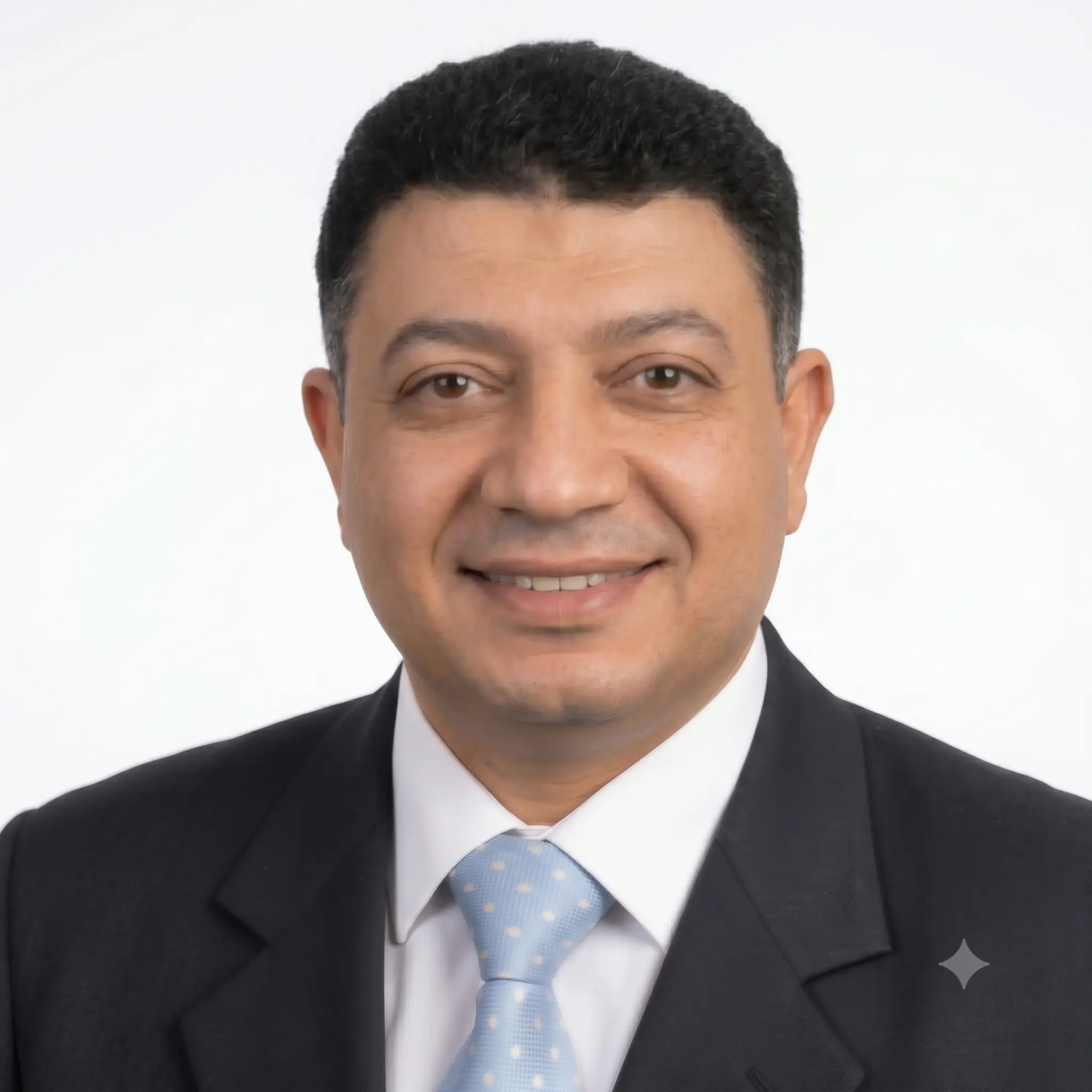
Ustadh Ahmed Mahmoud Abdulaziz is an experienced teacher of Arabic and the Holy Quran for native and non-native speakers. He holds a verified Ijazah in Hafs ‘an Asim and is certified in the foundational Tajweed texts Al-Jazariyyah and Tuhfat Al-Atfal. Drawing on his extensive background in traditional Quranic recitation and international pedagogy, he writes scholar-verified, accessible articles to help students worldwide master Tajweed rules and Arabic linguistics safely and accurately.